Personal Agents: Why Do They All Stall Before Payment?
 11/09 2026
 482
Produced by | Zhixie Island
There's a running joke about AI: as long as you learn slowly enough, you can avoid learning altogether. By the time you finally master the previous AI product, the next one is already obsolete.
Over the past four years, AI products have come and gone in wave after wave: chatbots, AI companions, coding agents. With each wave, some proclaimed "this time is different," yet with each wave, a batch of products was shut down, merged, or scaled back.
According to incomplete statistics, in 2025 alone, at least 392 AI tools worldwide ceased service, and at least 25 AI applications in China were suspended, taken offline, or left without updates for extended periods.
The AI story began in the spring of 2023, when the chat box first made ordinary people feel that "this thing actually has something to do with me." You ask, it answers; it helps you write poems, write code, and draft weekly reports. At the time, ChatGPT's monthly active users surpassed 100 million, making it the fastest-growing consumer application in history.
But soon, the barrier to building a chat product dropped so low that wrapping a model API and slapping on a UI was enough.
In 2024, the spotlight shifted to new protagonists: writing, drawing, search, and portrait generation. Each function became a standalone app, enjoyed its moment in the sun, and was then built for free into the big companies' own applications. Users had no reason to install an extra piece of software for a single-point feature.
Companion products were also lively during those one or two years. Some people were willing to exchange billions of messages with them, but the more they chatted, the thicker the computing power bill became. Character.AI, once valued at over $1 billion, ultimately collapsed under losses of $8 million per month.
The AI industry gradually came to a vague realization: whether users are willing to use something and whether an application can generate revenue through it seem to be two entirely separate matters.
The turning point came in 2025. Coding agents could compile code and launch projects, and began delivering results that actually worked. Finally, some people were willing to pay subscription fees for them. By mid-2026, Cursor's annualized revenue had once exceeded $4 billion—but that revenue came from enterprises and developers, not from an answer for consumer AI.

Image source: Doubao Mobile Assistant
Consumer AI also wants to find a formula that works. A group of agents tried to handle tasks for users across apps. ByteDance teamed up with ZTE to launch the Doubao phone, but what it ultimately got was a list of more than 155 applications—including WeChat and Alipay—explicitly refusing to be operated by AI.
Since the software path has narrowed, a group of companies turned to making earbuds, glasses, and AI agent phones, hoping to collect context directly from the physical world and bypass app authorization barriers.
And so the industry arrived at today's term: Personal Agent.
In September 2026, Meta's Muse reached over 10 million downloads in the United States within 40 days of launch. In history, only 11 apps have reached this threshold. Domestically, big companies and startups alike are racing to enter. This is the closest thing to a consumer entrance in four years.
From the chat box of 2023 to the Personal Agent of 2026, it's not hard to see that the AI industry has repeatedly run into the same wall: every time, AI has proven that it can create value, but the people creating that value have yet to achieve major results.
The AI industry has entered a cycle: the further AI advances, the more it must embed itself in others' service chains, and the harder it becomes to complete settlement independently.
So, is this round of Personal Agent the exit from this cycle, or the starting point of the next migration?
I. Those Abandoned AI Products
If you were to list the abandoned AI products, it would be very long: Translator Jun, Luban, Tongyi Tingwu, Huoshan Writing, Xiaowukong, MarsCode, Xinghui, Coze Enterprise Edition, Tencent Yuanqi, QClaw, Kimi Claw, the self-built agent entrances of Doubao and Qianwen, Character.AI, Inflection Pi...
Some of these AI products were renamed, some stopped updating and remained in maintenance mode, some lost their independent identity and were merged into other business lines, and some simply ceased service and went offline.
Although AI exploration looks messy, if classified by business model—that is, by what they sell—they can be roughly divided into six selling methods: wrapper layer, single-point tool, companion product, cross-app operation, open-source framework, and dedicated hardware.
At every step, some people fell on the road to delivery, but the ways they fell were different.
Specifically, the first batch to be eliminated was the wrappers around other companies' models. These products had no models of their own and relied on calling big companies' APIs, plus clever interaction and growth tactics, to acquire users.
For example, Translator Jun went offline and its capabilities migrated into Yuanbao; Huoshan Writing shut down its site and redirected to Doubao; Tongyi Tingwu canceled its independent app identity and was merged into Qianwen; Doubao and Qianwen successively took down their self-built agent entrances.
Every time the underlying model upgrades, the value of the wrapper layer shrinks by one round until it reaches zero. Because they sell others' capabilities, they are the layer in the entire AI application stack that has been proven first to have no moat.
Close behind were single-point tools. Products for writing, search, and portraits sold a specific function. They once had good traffic, but the function itself had no barrier. After big companies built the function for free into super apps, independent products lost their reason to exist.
For example, Luban ceased service, the Xinghui team was merged into Doubao, Xiaowukong stopped updating and was taken down, and MarsCode was renamed the TRAE plugin. The most recent example is the exit of Coze Enterprise Edition. In 2025, it held a 19.3% share of China's public cloud market for agent development platforms, ranking first, but the function of building agents is being directly absorbed by the natural language capabilities of general assistants. Users no longer need to learn to build a workflow; they just state their needs.
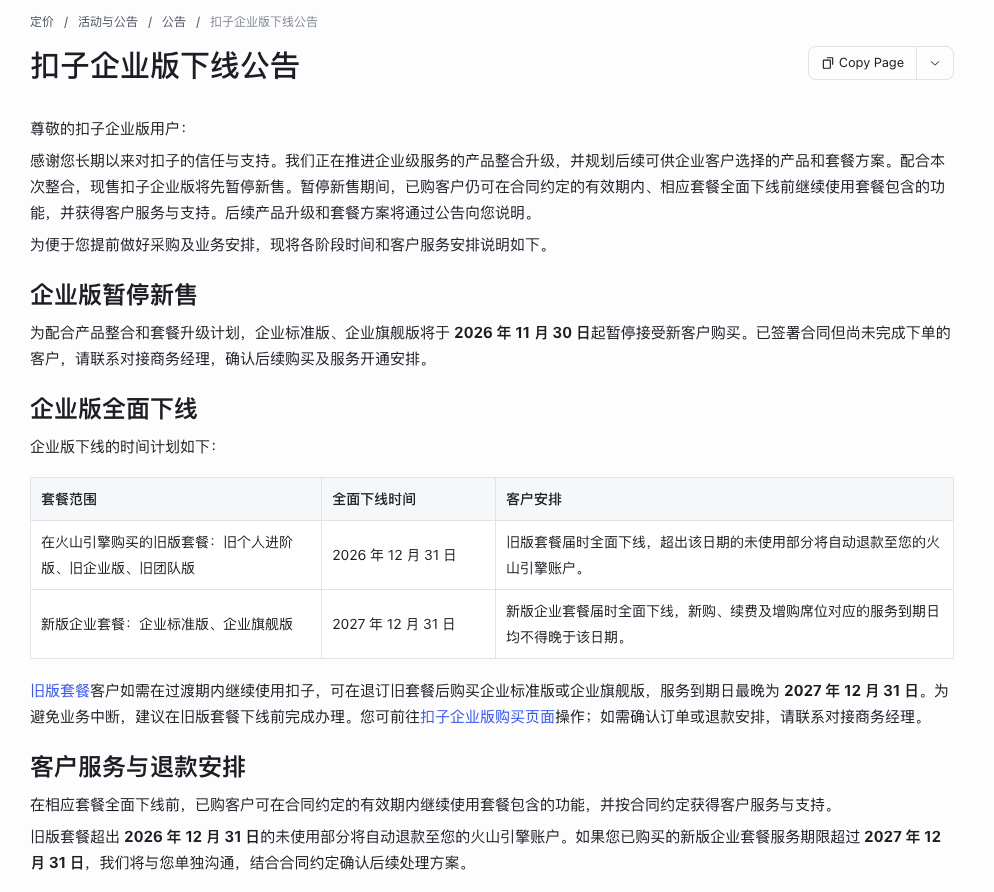
Image source: Coze
The way single-point tools exited was that their functions became a default option in someone else's product.
Companion products are another way of exiting, and the only one of the six with a sense of regret, because users clearly stayed. These products have relatively high user stickiness, but emotional value is hard to price, and users are not willing to pay for chatting over the long term.
Because computing power costs rise linearly with usage, high interaction brings high inference costs, and subscription prices cannot cover the marginal computing power of a long conversation. High stickiness instead becomes a constantly bleeding bill.
The batch that tried to operate across applications ran into the high walls of platforms. Their value proposition was to handle things for users across different apps, but this touched the interests of the platforms. They could only work technically, not commercially.
Open-source resident agents sell frameworks. These products let many people experience for the first time what it feels like to "raise an Agent"—that is, the previously popular shrimp-raising craze—but it requires users to deploy it themselves, install skills themselves, and maintain it themselves, and its stability is relatively poor.
OpenClaw proved that there are users who need resident Agents, but it failed to make money. Later, SpaceXAI turned the resident Agent into the out-of-the-box Grok Bot, made money, packaged it into paid plans, and turned it into a business.
After commercial companies put the same capabilities into products and turned them into services, as the popularity of open-source frameworks faded, the functions were incorporated, but the framework itself failed to become an independent business.
The above five belong to the software layer. There is also a batch of products building dedicated hardware for AI, trying to create a physical carrier for Agents.
For example, the brooch-style wearable AI device Humane AI Pin was positioned to replace phones. After delivery in April 2024, it suffered a large number of returns due to poor reliability and insufficient practicality. It later sold most of its assets to HP, stopped selling the device, and shut down server functions.
After all, phones are already convenient enough, and these hardware experiences failed to deliver the promises in their marketing, so they did not become a new default entrance.
These six types of products have different selling methods and different ways of exiting, but when placed side by side, you will find that none of the things they sold belonged to themselves.
Those selling model capabilities: the capabilities are in the hands of model companies; those selling a single function: the function can be copied for free; those selling emotional stickiness: stickiness cannot be monetized; those selling wall-bypassing operations: the wall is in the hands of platforms; those selling open-source frameworks: anyone can copy the framework; those selling dedicated hardware: phones have already covered it.
And those abandoned by big companies or eliminated in internal competition also cannot escape this logic: if a product's value can be copied at zero cost or internalized for free, then it has no need to exist independently in this market.
Therefore, the industry's turn to Personal Agent is essentially an attempt to change the monetization method once again—no longer relying on selling capabilities, but instead selling context and decision rights that grow on users.
II. Why Personal Agent?
Compared with all previous products, what Personal Agent sells has undergone a qualitative change for the first time: it lets AI products own something exclusive.
Any company can call the same model and copy the same interface, but the memory, authorization, and historical behavior a user accumulates in one product cannot be moved to another.
Whoever holds it exclusively owns it. This is an asset attribute that none of the previous six selling methods had.
At the same time, the more a user stores in an AI, the higher the cost of switching. This is retention that neither subscription fees nor advertising can buy.
This is exactly why all players in this round have unanimously changed their slogans from stronger models to memory, context, proactivity, and hosting.
But the truly valuable part of context is its endpoint. If AI remembers your preferences, budget, schedule, and other private information, it can participate in decisions before you have even figured out what you want. And whoever owns the decision rights over where things happen also controls the dominant position in the direction of transactions.
For example, what a family buys and uses is often not decided by whoever pays, but by the person who best understands the whole family's preferences and budget.
Therefore, this round of Personal Agent may not even need to charge users. What it charges is every consumption behind the user, including traffic referral, commissions, and revenue sharing by transaction—returning to what the internet sector is best at.
Selling products to users has become selling users' decisions to service providers. That is the truly new thing in this round of Personal Agent's shift.
For Personal Agent to make the logic work, in theory a company needs to hold three things at the same time: the user's context, the execution capability to get things done, and the trust that makes users willing to hand over their accounts and money.
But these happen to be divided among three groups of people, and each group is missing one corner.
Super apps hold context and trust. Accounts, payments, and risk control systems built over more than a decade are in their hands, and users are already used to handing sensitive operations to them.
But their context is trapped inside their own walls: Ant Lingguang can see Alipay bills but cannot see WeChat chat records; Xiaowei can operate WeChat mini-programs but cannot connect to other companies' food delivery. If execution cannot cross the wall, context is only half complete.
Model companies hold the foundation of execution capability. OpenAI's Dots can connect to more than 4,000 applications, and Anthropic's Duet has more than 6,000 connectors, but they do not have consumer accounts, do not have a payment system, and do not have a scenario in which users feel comfortable handing over their credit cards.
No matter how comprehensively tools are connected, most of what they connect to is work software. The door to life services cannot be entered.
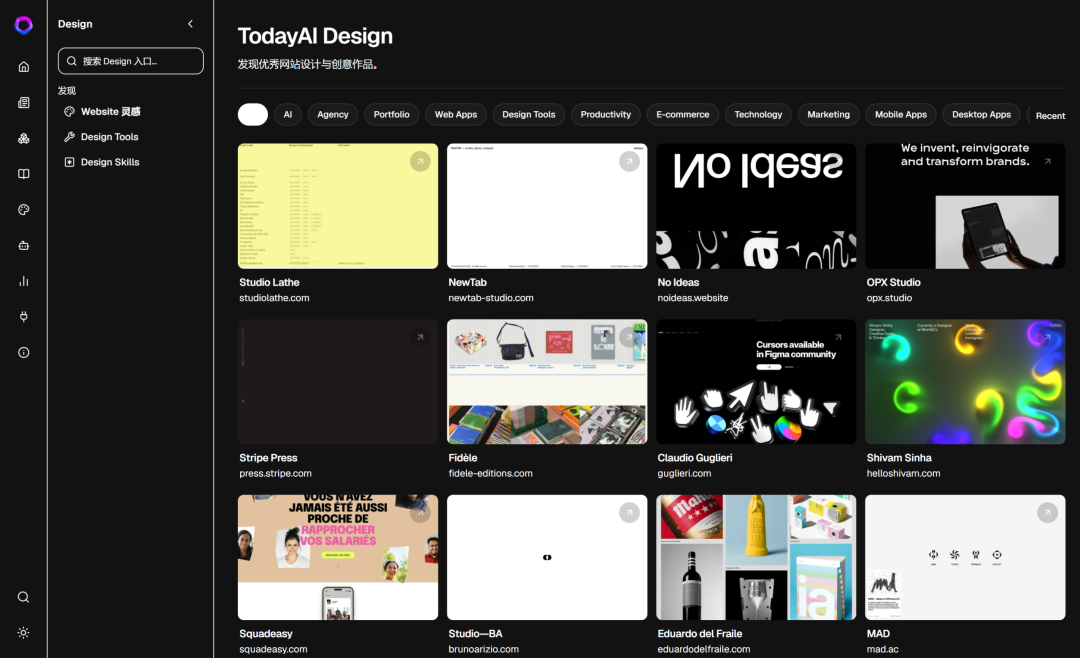
Image source: Today AI
Independent startups hold the product. Today AI's proactivity and interaction have been recognized by a group of users. Instinct retained people who linked their cards simply through SMS and phone calls, but neither has an account system or a settlement channel. Context has to be fed bit by bit by users, and execution must wait for permission from other platforms. Of the three things, only how to make the product good is their own.
On-device hardware tries to bypass authorization and collect context itself. The advantage is that hardware such as phones, glasses, and earbuds is very close to users, and recording, vision, and system permissions do not need app permission.
But hardware manufacturers also do not have transaction capabilities, and the devices themselves have not yet become the default entrance. The context collected ultimately still has to return to some platform to be monetized.
By contrast, it becomes clear why Muse could succeed in the United States.
The US internet is decentralized. Users' information and transactions are scattered across email, dozens of independent websites, and apps, while platforms remain relatively open.
What Muse therefore needs to solve is the integration problem: using a cloud browser and connectors to stitch these fragments back together and spare users the manual running around from one website to another.
This is a genuine need that exists in the open internet, and it is also why Muse could succeed. Open web pages and email provide context, the cloud browser provides execution, Stripe and one-time virtual cards provide settlement, and Meta's social network provides distribution and trust. All four pieces are present and none can be done without.
In the domestic market, these four puzzle pieces are held separately by four companies that guard against one another, and none of them can obtain all four at once.
Since the puzzle cannot be completed, who is missing the fewest pieces? And among those closest to complete, is the piece they are missing actually the same one?
III. How Far Is It from Delivery?
Let us first look at how far several domestic big companies have brought the Personal Agent.
Alibaba moved earliest. In October 2026, Qianwen Go opened for trial within the Qianwen App. What it can handle is already real work. For example, with user authorization it can pursue flight delay claims on the user's behalf. In one recorded case, customer service first offered compensation vouchers. It refused them and kept negotiating around "wanting cash," ultimately recovering 70 yuan for the user.
But its capability radius is bounded by Alibaba's own ecosystem. Once it steps outside Taobao and Alipay, the same execution may not be delivered.
Tencent's Xiaowei is in a different state. It grows inside WeChat. It was established in 2025 and began gray-scale testing in June this year. Transfers, posting to Moments, and calling mini-programs to order food delivery are indeed things it can do quite a lot of.
However, according to media reports, employees involved in the project gave their own assessment: "It is not yet a true Personal Agent." It cannot communicate with external servers, and once it leaves WeChat it cannot execute tasks—cross-ecosystem things like monitoring ticket prices and making bookings are still out of reach.
ByteDance was the first to make noise but the last to act. The project codenamed Spell was launched back in April this year, and Xiaodou has been in testing for quite some time, yet the launch date has been repeatedly postponed.
A player that has invested most aggressively on the consumer side has pressed pause on the Personal Agent direction—this fact alone explains the difficulty of an independent cross-app route better than any analysis.
By comparison, Ant's Lingguang is currently the closest to delivering.
Lingguang 2.0 positions itself as a personal AI assistant that can get things done, built on the same technical foundation as Muse, relying on an independent cloud host plus cross-session memory to let tasks continue running after the user exits the conversation.
One week after launch, the figures it disclosed were: over one million affairs managed, over three million tasks executed, and users surpassing twenty million—among the domestic players, it is one of the few able to show operating data.
At the same time, Alipay connects a billion users and eighty million merchants; the payment, risk control, and authorization systems accumulated over more than twenty years, plus a full set of trusted infrastructure for agents—these are the ready-made answers to why users dare entrust it with their accounts and money.
Its built-in payment capability has already proven volume: AI Pay has cumulatively processed 300 million agent payments, covering about 95% of general agent frameworks. The settlement piece others lack, Ant Lingguang already has in hand.

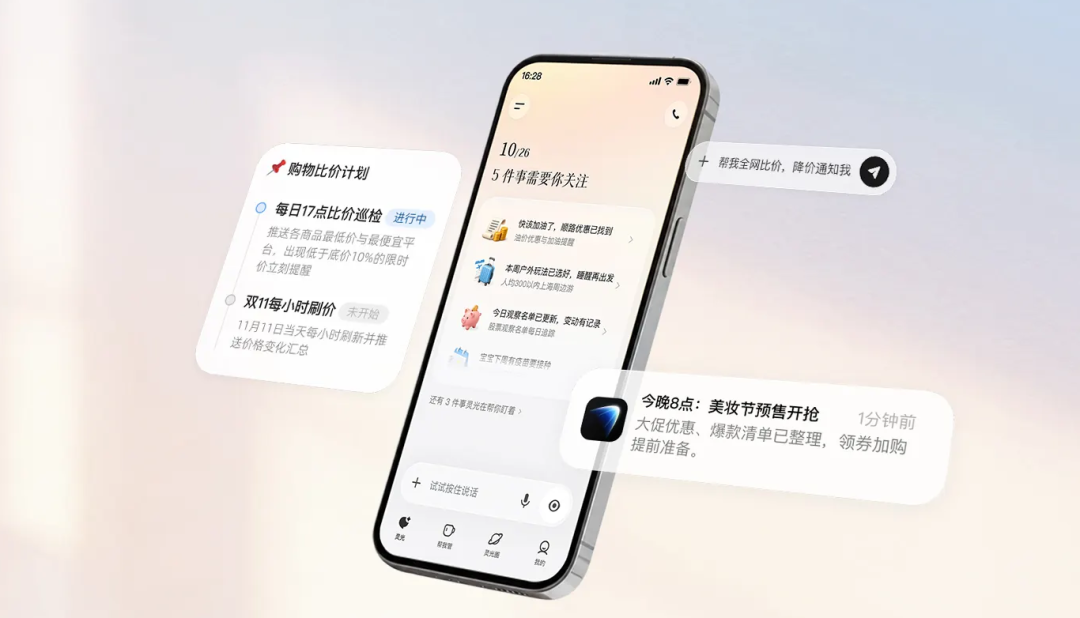
Image source: Lingguang APP
But being closest to delivering is not the same as having delivered. Zhixie Island's hands-on testing found that Lingguang can analyze bills, monitor prices, and push a movie seat selection all the way to the link stage, but it cannot directly complete Alipay payments or Taobao purchases—for example, bookings for hotels, restaurants, and performances end at the level of providing information, and data from ETC and charging apps cannot be pulled either, requiring users to provide order screenshots themselves.
Lingguang makes selecting and choosing very smooth, but the final payment step is always handed back to the user.
This is not a capability problem of any single company. Looking at Qianwen Go, Xiaowei, Xiaodou, and Lingguang side by side, the four companies' shortcomings lie less in how many things they can do and more in how far they can go—each one's capability scope is boxed in by ecosystem authorization and the transaction closed loop.
This boundary does not belong to any single company; it belongs to the structure of China's internet itself.
Looking inward along this boundary reveals the biggest contradiction of the Personal Agent: it sells saving money, but what it wants to earn is transaction fees.
The Personal Agent's first selling point is helping you save money. Price comparison, refunds, canceling subscriptions, reminders about forgotten auto-renewals, finding direct booking channels cheaper than platform prices—these constitute its main reason for customer acquisition. Muse even launched a dedicated money-saving challenge overseas, encouraging users to share the amounts they saved.
Saving money, viewed from the other side, is the evaporation of platform profits.
A user asked Muse to book accommodation; it bypassed the platform and found a direct booking channel, ending up about sixty percent cheaper than the platform price. Amazon's reason for banning Muse was actually simple: in advertising business alone, Amazon earns over sixty-eight billion dollars a year. If an agent were allowed to skip browsing and compare prices across the web to place orders on users' behalf, this business model centered on ad bidding would take a direct hit.
More awkward still, the Personal Agent's own future revenue is precisely bet on transactions. CICC estimates that under a base scenario, by 2030, China's Personal Agent subscription revenue, transaction commission revenue, and advertising revenue potential will reach 83.8 billion yuan, 391.8 billion yuan, and 38.6 billion yuan respectively, with transaction commissions accounting for about 76.2%.
In addition, CICC's report also mentions that subscription fees for some packages may struggle to cover hardware costs, and greater revenue potential needs to rely on commissions and advertising.
Commissions depend on facilitating transactions, while saving money requires bypassing transactions—so is it transaction volume or killing transaction prices? These two settings fight each other on the same business line.
At present, there is no sign of this paradox being resolved. What the industry is actually doing is splitting it apart: to users, it continues telling the money-saving story; to merchants and platforms, it sells the ability to find people for you and facilitate transactions for you.
But ultimately, whoever controls the infrastructure for how machines spend money can collect a toll on every transaction AI handles, whether that transaction saves money or spends it. Alipay's AI Pay, Token Pay, AI Wallet, and overseas Stripe's one-time virtual cards are all paving this road.
Returning to the question left in part two: what the several closest-to-complete players lack is the same piece—the position where AI personally walks to the final step of a transaction.
All four stop before payment. The problem is not insufficient capability, but that once AI pays on the user's behalf, the contradiction of both helping users save money and earning from transactions can no longer be avoided anywhere.
How long this position stays empty determines how far China's Personal Agent is from delivering.
IV. Conclusion
The contradictions on the books will ultimately land on specific people, and once they land on people, the picture may differ from the industry's mainstream narrative.
A popular saying in the industry is that AI will give ordinary people capabilities that previously only big companies had. This statement itself is not wrong, but it only tells half the story.
The same tool, in different hands, heads in two opposite directions. At offline events held by Tencent and Baidu, among those queuing up to install "Lobster" were developers, students, and retired elderly people.
For the former, this tool takes over repetitive labor, and the time saved can be used for more important things; for the latter, it may just be something installed without knowing what it can be used for.
More noteworthy is the other half of the statement: those who don't know how to use it are often unknowingly "used" by AI tools.
An experiment at Wharton showed that when AI gives a wrong answer, eighty percent of people still adopt it—people lack the willingness and ability to detect and correct it.
The stronger the tool, the more it divides people into two categories: one knows how to outsource life and let AI save time for them; the other doesn't even know what to hand over to it, and instead is unknowingly led by it to place orders and follow the answers it gives.
Using tools, or being used by tools—this deserves particular vigilance in the AI era. Between knowing how to use and not knowing how to use, a new divide is forming, and it will ultimately leave its mark on people.
Cover image source: "Mountains May Depart"
Header image source: Lingguang APP
Disclaimer: The content of this article is for reference only and does not constitute investment advice. Investors operating based on this do so at their own risk.
Copyright Zhixie Island. Unauthorized reproduction is prohibited.
-
![]()
Let the Data Speak: China Is Winning the Automotive Electrification Race While the US Market Remains an Island
-
![]()
Electric Vehicles Are Selling Like Hotcakes—Yet Profits Are Halved, Leaving European and American Automakers Bewildered
-
![]()
Is It Reasonable for the CIIE to Be Dominated by "Chinese Cars"?
-
![]()
Tencent's Yao Shunyu Says AI Moats Lie Mostly at the Product Layer, Not the Model Layer
-
Storage Storm Looms, Niche Phone Brands 'Doomed'
-
Has Apple Been "Bitten Back" by Its Supply Chain?
-
Huawei HarmonyOS PCs Hold Just 0.4% of the Global Market, Yet Already Capture 10% of China's Xinchuang Sector?
-
![]()
Breaking: BYD Yangwang Shatters 500 km/h Barrier—Has China's Supercar Era Arrived?