Breaking: BYD Yangwang Shatters 500 km/h Barrier—Has China's Supercar Era Arrived?
 11/09 2026
 360
Written by | Guanchesjun
For the first time ever, a production car's top speed has surpassed 500 km/h.
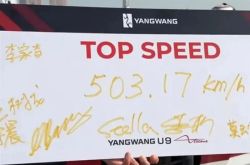
On November 1, the BYD Yangwang U9 Xtreme hit 503.17 km/h on a closed section of the Sheikh Khalifa bin Zayed International Highway (E11) in Abu Dhabi's Al Dhafra region. The driver was German racer Marc Basseng.
On November 6, the FIA officially ratified the result. This surpasses the 496.22 km/h achieved in Papenburg, Germany, in September 2025, raising the record once again.
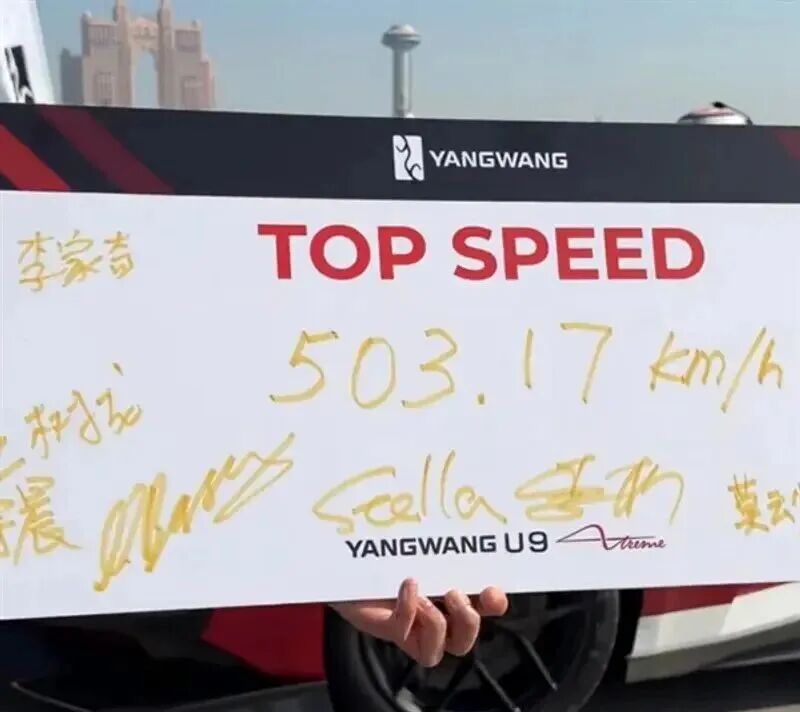
What does 503.17 km/h actually mean? Guanchesjun ran the numbers: the car covers roughly 139.77 meters per second—meaning 100 meters takes just 0.72 seconds.
Though the speed is only about 1.4% higher than before, the power required to overcome air resistance must increase by roughly 4.2%. At this speed range, the power needed to overcome aerodynamic drag grows approximately with the cube of velocity.
And that's just an idealized estimate. The truly daunting factors include tires, thermal management, and body stability.
So the 3,019 Ps combined output is merely the most eye-catching headline figure. Behind the U9X lies the combined support of four motors revving up to 30,000 rpm, a full-domain 1200V platform, a 30C track-grade Blade battery, along with the e4 Platform, DiSus-X, and custom semi-slick tires.
Voltage, discharge rate, motor speed, aerodynamics, and chassis control—any weak link could turn "500+" into a crash scene.
In Guanchesjun's experience, electric vehicles were often mocked in the past as "only good at 0-100 sprints," with weak top-end acceleration and thermal degradation as unavoidable doubts.
The value of the U9X lies precisely in using one extreme condition to push sustained high-power battery output, high-speed electric drive, and vehicle-level thermal management to a new level of validation.
From this perspective, the upper limit of electric systems is far higher than many are willing to admit.
Another detail worth mentioning: why choose Abu Dhabi? According to public reports, the test involved the local investment office, culture and tourism department, and traffic management authorities, which provided road closures and operational support.
This is a win-win outcome. For Abu Dhabi, it's a global showcase of its industrial and investment image; for Yangwang, it demonstrates R&D, testing, and coordination capabilities with overseas governments.
When Chinese automakers go global, the past benchmark was how many cars they sold; now they're beginning to compete over who can organize top global resources.
Finally, let's discuss the most easily overlooked point: 503.17 km/h is a one-way result.
What the FIA confirms is recognition of this speed achievement; Guinness awarded two one-way records, also explicitly worded as "fastest one-way speed for a production car" and "fastest one-way speed for a purely electric production car." This is not the same standard as taking the average of two-way runs.
The significance of two-way testing is to offset external influences such as wind direction and road gradient as much as possible. The roughly 455.3 km/h two-way average record of the SSC Tuatara remains another reference point.
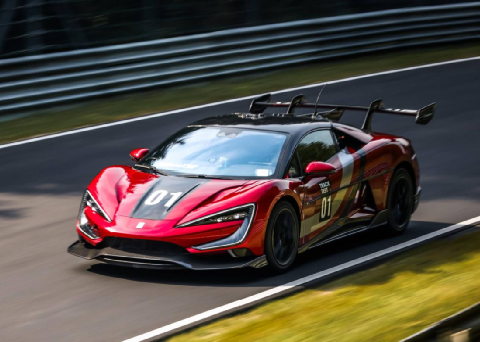
Another point is production. The U9X tested this time is limited to 30 units worldwide, and the official side has disclosed progress on customer customization and production scheduling. However, the degree of consistency between the record car and the final delivered vehicles—in details such as tires and software calibration—still deserves clearer disclosure.
Of course, being limited-edition does not invalidate the technological breakthrough, but it does determine that for now it is more like a technological lighthouse than a product victory that can be replicated at scale.
500 km/h cannot prove that a family car is safer, nor will it automatically translate into a luxury brand premium. Between extreme records and ordinary consumers lie durability, cost, quality control, after-sales service, and regulations.
In summary, Guanchesjun believes that this run by the U9X deserves hearty applause, but it is not yet cause to declare a "comprehensive victory."
It proves that Chinese companies already have the ability to set and solve questions in the toughest exam room of global performance cars; it has not yet proved that the engineering credibility, brand credibility, and global service system of Chinese supercars have comprehensively reached the top.
Next time, if it can continue to answer with two-way average results, delivered-car consistency, and long-term reliability, then 500 km/h will not just be the peak of marketing noise, but will become a new starting point for China's automotive engineering capability!
Charts and figures in this article without indicated sources are all from public disclosures through various channels, and are hereby noted and acknowledged! The views in this article are for reference only and do not constitute investment advice.
Original title: Breaking: BYD Yangwang Shatters 500 km/h Barrier—Has China's Supercar Era Arrived?
-
![]()
Let the Data Speak: China Is Winning the Automotive Electrification Race While the US Market Remains an Island
-
![]()
Electric Vehicles Are Selling Like Hotcakes—Yet Profits Are Halved, Leaving European and American Automakers Bewildered
-
![]()
Is It Reasonable for the CIIE to Be Dominated by "Chinese Cars"?
-
![]()
Tencent's Yao Shunyu Says AI Moats Lie Mostly at the Product Layer, Not the Model Layer
-
Storage Storm Looms, Niche Phone Brands 'Doomed'
-
Has Apple Been "Bitten Back" by Its Supply Chain?
-
Huawei HarmonyOS PCs Hold Just 0.4% of the Global Market, Yet Already Capture 10% of China's Xinchuang Sector?
-
![]()
Breaking: BYD Yangwang Shatters 500 km/h Barrier—Has China's Supercar Era Arrived?