Even Environmental Groups Can't Do Without AI—But Is All That Electricity Worth It?
 11/10 2026
 536
Even the environmental organizations most concerned about AI's environmental costs have started using AI themselves.
As of November 7, all 15 international environmental, conservation, and development organizations interviewed by Reuters had used AI—without exception. Greenpeace International questions the need for large-scale data center construction, yet some of the software it uses daily has already integrated AI tools.
On November 9, the 31st UN Climate Change Conference (COP31) opened in Antalya, Turkey. The host country is promoting the "Antalya AI Commitment" to address the environmental pressure brought by expanding computing power. When AI can already help humanity protect nature, is the electricity consumption behind it really worth it?
01 The Computing Costs That Are Hard to Price
In 1960, 26-year-old Jane Goodall arrived in Gombe, Tanzania, and began observing wild chimpanzees. Over the next half century, generations of researchers kept recording their observations, leaving behind a vast volume of handwritten notes. Today, the Jane Goodall Institute she founded is using AI to organize this scientific legacy.
Many of the notes mix the local Kiha language with scientific shorthand. Manual identification and data entry alone were originally expected to take 13 to 15 years. The institute partnered with Amazon Cloud Technologies to develop an AI tool that identifies, translates, and organizes these handwritten records, expected to cut the digitization work to about two years. Field observation materials spanning decades will also become easier for researchers to search and analyze.
In Kenya, the wildlife conservation organization Save the Elephants also once devoted enormous manpower to organizing massive numbers of photos. In 2017, a large protected area in Kenya conducted an aerial survey, taking about 200,000 images—and nine staff members spent nine months reviewing them all. Today, a trained AI model can process materials on a similar scale in just a few hours.
The organization's head, Frank Pope, told Reuters that AI-assisted analysis also revealed that past manual surveys had undercounted elephants by about one-third, with undercount rates for zebras and giraffes approaching half. Animal population statistics inform patrol arrangements and help secure conservation funding; only with more accurate survey results can conservation work rest on a more reliable foundation.
In the Houhe National Nature Reserve in Wufeng, Hubei Province, staff also once struggled with organizing images. A single trip into the mountains brought back more than 160 infrared camera memory cards, and off-the-shelf software struggled to accurately identify local species. The reserve therefore spent two years developing its own AI recognition system.
Today, the system has processed over 4TB of images in total, recognizing more than 30 species including musk deer and Asiatic black bears, with overall accuracy exceeding 90%. According to Hubei Daily, materials that previously required two or three people a full year to analyze can now be completed in about seven days.

The significance of these applications goes far beyond saving labor. Field observation records accumulated by the Jane Goodall Institute over decades can be used more quickly for subsequent research; more accurate population data from protected areas can also provide a basis for patrol arrangements and ecological protection. The benefits of research and ecological conservation often take years to materialize—and are shared by more people.
Environmental organizations have proven AI's value in nature conservation. But a few success stories cannot justify every newly added computing project. As data centers continue to expand, energy and environmental costs must also be fully accounted for.
02 Costs Beyond the Electricity Bill
The International Energy Agency predicted in April this year that global data center electricity consumption will rise from 485 TWh in 2025 to 950 TWh in 2030—nearly doubling—accounting for about 3% of global electricity consumption at that time. AI is becoming a major force driving this growth, with electricity consumption by AI-oriented data centers expected to triple within five years.
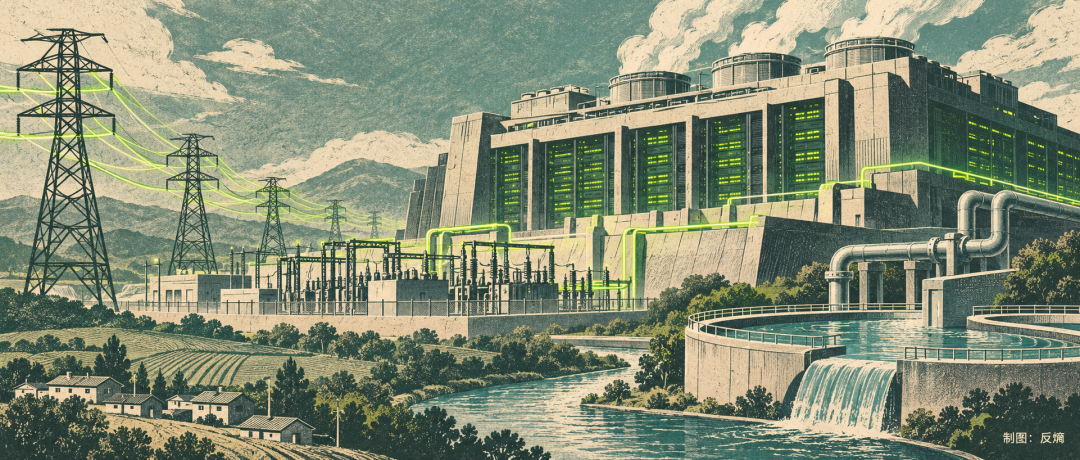
Data center electricity demand is often concentrated in specific regions, and local power grids feel the pressure first. Substations and transmission lines often take years from planning to operation, making it difficult to immediately accommodate the concentrated load increase from large computing projects. The International Energy Agency predicts that by 2027, the peak power of an advanced rack could be equivalent to that of 65 households.
Expanding power grids requires investment. If the related costs are recovered through public electricity prices, existing residents and businesses will also share the cost of new projects. Data center cooling systems may also increase water stress in water-scarce areas. Tech companies purchasing green electricity can reduce their corresponding carbon emissions, but cannot replace local grid construction and water resource management.
Economics calls this kind of social burden—borne by others and not fully included in corporate expenses—an external cost. Large tech companies pay high costs for chips, servers, and electricity, and should also bear the public infrastructure costs caused by their own expansion. Investment decisions for commercial projects cannot be premised on other users passively sharing the burden.
COP31 is now trying to promote related governance. Host country Turkey and the International Telecommunication Union are jointly promoting the "Antalya AI Commitment," calling for improved AI energy efficiency, expanded use of clean energy, and stronger disclosure of environmental impacts. The two sides plan to hold a high-level AI roundtable on November 16 to encourage governments and businesses to make voluntary commitments.
However, this initiative currently lacks mandatory constraints. On October 27, the World Resources Institute pointed out that the document lacks an effective accountability mechanism and does not provide sufficient guarantees for the participation rights of communities affected by data center construction, nor for water and air quality protection. The institute advocates mandatory disclosure of tech companies' actual electricity and water consumption, and requires companies to bear the grid upgrade costs required for new data centers themselves, rather than passing these costs on to local residents.
Large tech companies have already invested heavily in AI infrastructure, but environmental responsibility cannot rely on voluntary commitments long-term. The benefits brought by computing expansion accrue to companies, so there should be clear bearers of the increased public costs.
03 Why Saving Electricity Consumes More Electricity
In 1865, British economist Jevons observed in The Coal Question that after the coal efficiency of steam engines improved, Britain's coal consumption continued to grow. Cheap power entered more and more production processes, and new demand could offset the savings brought by efficiency gains. This phenomenon was later called the Jevons Paradox.
More than a century later, AI's energy efficiency improvements are also stimulating new computing demand.
Chip upgrades, model compression, and inference optimization continuously reduce unit computing costs, and the scope of enterprise AI use expands accordingly. The International Energy Agency points out that tasks such as video generation, complex reasoning, and agent-based operations may consume hundreds or even thousands of times more energy per request than simple text generation.
Today, AI can polish emails—and can also, driven by agents, continuously retrieve materials, write programs, and run repeated tests. The latter often requires multiple rounds of model calls. After usage costs decline, companies tend to hand more work to AI; tasks become increasingly complex and calls increasingly frequent, which may ultimately offset the electricity saved by technological progress.
Some environmental organizations have begun controlling computing demand. The World Resources Institute limits energy-intensive image and video generation and uses caching to avoid repeated queries. The Nature Conservancy installs AI camera devices on commercial fishing boats to analyze catch images on-site and reduce the transmission of raw video to remote data centers.
Improved chip energy efficiency does not automatically reduce the electricity consumption of the entire industry. For model service providers and application companies, controlling repeated calls and optimizing computing tasks should also become part of daily operations. Otherwise, the energy saved by technological progress is likely to be consumed by continuously expanding inefficient demand.
04 China's Choice in Computing Expansion
The electricity scale of China's computing facilities is already considerable. In July this year, the National Development and Reform Commission cited statistics from relevant institutions: in 2025, the country's electricity consumption of computing infrastructure in use was about 196 billion kWh, accounting for 1.9% of total social electricity consumption, up 18.1% year on year. As large model applications accelerate, new electricity demand will continue to affect data center layout.
China has a massive power system, with wind and photovoltaic installed capacity continuously increasing. The "East Data, West Computing" initiative promotes the layout of some computing tasks in the west, creating conditions for using local clean energy. But photovoltaic generation peaks do not necessarily align with computing loads, and wind output also changes with weather. For real-time businesses, network latency also limits data center site selection. Favorable power conditions do not guarantee stable customers and sufficient usage for machine rooms.

The evaluation method for computing facilities is also changing. In September, the Ministry of Industry and Information Technology and four other departments released the 2026 national green computing facility evaluation index system, requiring attention to energy efficiency per unit of computing power and output benefits per unit of energy consumption, and increasing the weight of indicators such as carbon efficiency, water resource utilization, and rack utilization rate.
The commonly used PUE in the industry mainly measures losses in auxiliary systems such as machine room cooling and power supply and distribution. Even if PUE performs well, servers may sit idle due to lack of business. Equipment still depreciates, machine rooms still need maintenance, and computing projects without sustained orders struggle to achieve reasonable returns. Rack utilization rate also cannot replace real computing load, let alone prove how much benefit applications bring.
At a stage of rapid increase in computing supply, China should pay more attention to the utilization efficiency of existing equipment. Model service providers need to improve effective load, enterprises purchasing AI need to verify the cost and results of specific tasks, and local investment in computing facilities must have reliable market demand support. Expansion projects can bring short-term investment, but will not automatically form a competitive AI industry.
When rack numbers and chip scale become the main indicators for demonstrating achievements, the risks of low utilization and high depreciation are easily obscured. For computing centers without stable business and idle for long periods, continued expansion will only amplify resource waste. China still needs advanced computing power, but every new investment should be tested by real demand and usage efficiency.
-
![]()
The First Country Built by AI—How Is It Doing Now?
-
![]()
Robot Vacuum Cleaners: Drawing the "Kill Line"
-
![]()
Mobile Phones Aren't Selling, and Tablets Are Suffering Too—What Exactly Is Going On?
-
![]()
Car Buyers Are Getting Older and Older—So Why Are Cars Still Marketed as Youth-Oriented?
-
![]()
Domestic Profits Are Plummeting: BYD, Chery and Geely Race to Expand Overseas | A Deep Dive into the CPCA's October Auto Market Review
-
After Propelling Geely Galaxy, the Million-Unit Xingyuan Phenomenon Comes at a Cost
-
![]()
Even Environmental Groups Can't Do Without AI—But Is All That Electricity Worth It?
-
![]()
Lei Jun's "Boast" Comes True: Xiaomi Pengcheng Secures October's "Double Championship"! Harmony Intelligent Mobility Drops Out of Top Three