Car Buyers Are Getting Older and Older—So Why Are Cars Still Marketed as Youth-Oriented?
 11/10 2026
 472
Introduction
Make no mistake—the automobile market belongs to older folks.
"Some use knowledge as electricity; some use passion as light." "Youth is an attitude: no internal friction, no bowing down." "The young don't need to rush; happiness is in every step of the journey."
This string of slogans was used by several domestic automakers around Youth Day this year—Exeed, Geely China Star, and BYD among them—in seasonal marketing campaigns. Their core idea was to tug at young people's heartstrings, collectively shifting away from "striving and inspirational" themes toward resonance around "relaxation" and self-identity.
Less than a month later, before Children's Day, other brands began jumping on the bandwagon. Chery, for example, teamed up with Sohu to hold a QQ3 event at Chengdu Xichen Tianjie. The slogans at the time included lines like "Who isn't still a baby?" "Refuse to be crushed by work," and "A cure for all the mental friction of contemporary young people."
Two weeks later, in mid-June, with the World Cup approaching, the spotlight shifted to Geely Galaxy, Xiaomi, Deepal, GAC Aion, and others, and the topic naturally turned to the World Cup. There were campaigns like "Dami joins Xiaomi," "Score a goal, win a car," Xiaohongshu's World Cup chief partnership, Arsenal's Rice as a experience officer, and Portugal giving away one year's use of a car for every goal scored.
Don't think that all these "menu items" of finding common ground and connecting emotionally with young people only happen in May and June. Look back to the start of the year, and look forward to July, August, September, and October—it's full-year, no-blind-spot coverage.
In my view, a major characteristic of China's automotive market in 2026 is that major automotive groups and brands actually anticipated the situation early on and fully recognized reality from the very beginning. They anticipated it because marketing campaigns targeting young car owners like those above are far more numerous than just these few examples—in fact, they ran almost continuously from the start of the year through after National Day. Anyway, whether useful or not, the campaigns still had to be run—every extra car sold counts.
And they fully recognized reality from the start because, at the beginning of this year, the automotive market made a big move—lowering down payments, even to zero, and offering ultra-long loan terms.
Not long after the start of this year, a bunch of brands, as if they had coordinated, extended car loan terms to seven years. Tesla, for example, offered terms like a down payment of 79,900 yuan for the Model 3 with monthly payments of 1,918 yuan, and monthly payments of 2,263 yuan for the Model Y—converted into a daily payment of 74 yuan in its promotions. Li Auto also launched a plan starting with a down payment of 32,500 yuan combined with a long repayment cycle. Dongfeng Nissan's Teana was even more straightforward: zero down payment, eight-year term, 55 yuan per day. Even BYD's Ocean Network at the time advertised an extreme low of 29 yuan per day.

Image | These days, who cares about what "-ization" or not—selling a few more cars is what really matters.
Once these ultra-low down payment, ultra-long repayment models appeared, they quickly became popular, and soon almost all brands followed suit. Of course, using financial tools to break monthly payments into tiny fragments is a sign that the domestic auto market's price war has been pushed to its limit. But there is another implied meaning that is unmistakable—automakers and dealers are very clear about the payment capacity of various social groups, and such measures target young people who have only worked for a few years and have little savings.
Although the industry still talks about young people and "youth-oriented" strategies, and seasonal marketing measures are all in place, some research reports this year still boast that post-95s firmly hold the largest car-buying group, that the share of post-00s tripled in three years, and so on. Online arguments about "old-folks flavor" are also raging. Yet financial measures are far more honest than rhetoric. Pushing monthly payments down to just over a thousand yuan and stretching loans to eight or nine years already reveals the essence of the matter—
Traditional automakers and new forces alike, whether they truly believe it or pretend to, have together promoted the "youth-oriented" trend in automobiles for nearly a decade, and it has now thoroughly come to an end. And for current automakers, young domestic car owners are essentially a matter of "even a mosquito leg is meat."
01 2026 Year-End: A Judgment on the Main Force of Chinese Car Buyers
Let's start with the conclusion: from the data, the age of China's new-car buyer group is increasing year by year. The "youth-oriented" wave that automakers began imagining a decade ago has not arrived, and based on current trends, it never will.
Here are some specific data points. First, let's clarify one thing: to determine who bought the car, you have to look at who signed the contract, not who the primary driver is. And from the age trend of car purchase contract signers, the age of buyers has actually been rising over the past decade.
CNR reported in 2024 that from 2014 to 2023, the average car purchase age rose from 32 to 40. Especially between 2019 and 2024, the average age of buyers rose from 35, increasing by one year each year, all the way to 40. And China Automotive News reported in April this year that by 2025, the average age of first-time car buyers is 42, a sudden increase of 2 years from 2024.
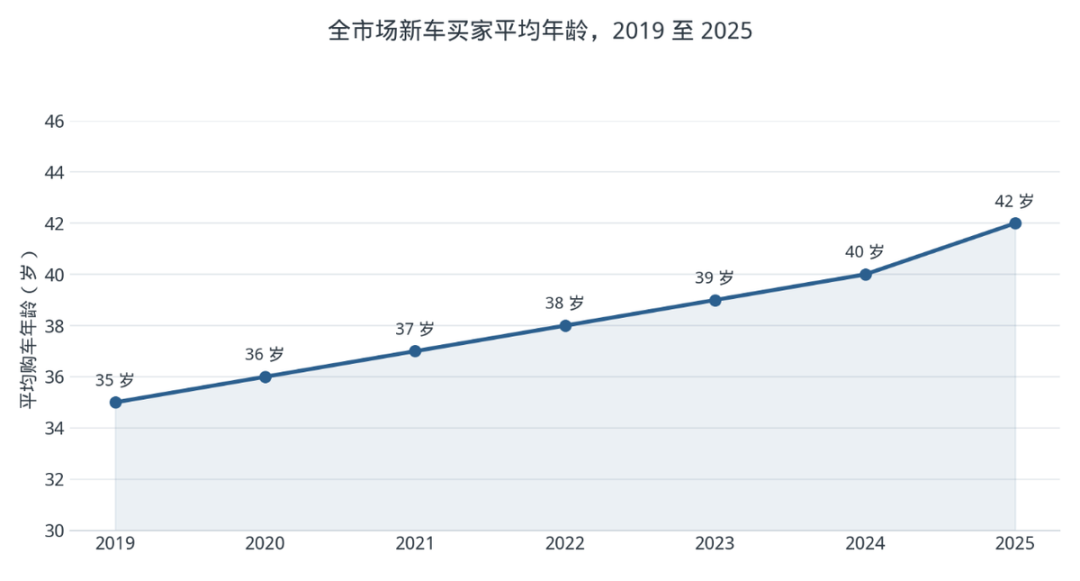
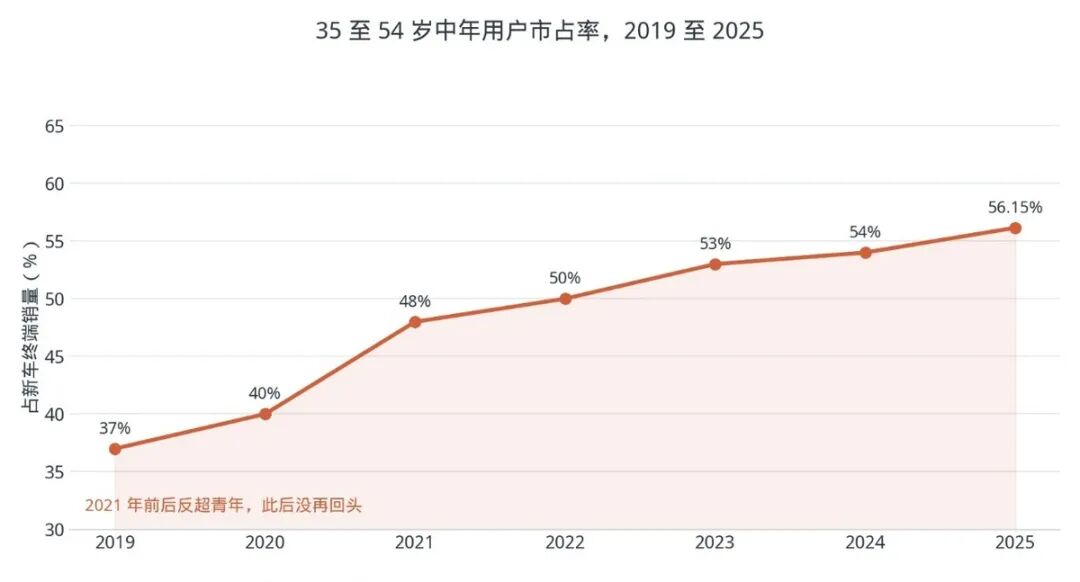
As the average age rises, the age structure is also changing. In an annual report breaking down ages by terminal transactions, the market share of middle-aged users aged 35 to 54 was only 37% in 2019, rose to 48% in 2021, climbed to 53% in 2023, and reached 56.15% in 2025. The middle-aged group overtook youth around 2021.
In terms of total purchases, the under-35 youth group fell from 10.63 million vehicles in 2020, accounting for around 50%, to 7.07 million vehicles in 2025, accounting for only about 30%. As for the 25-29 age group, it dropped from 3.96 million vehicles in 2020 to 1.8 million, essentially halved. Some institutions have concluded that the declining marriage rate in recent years is the main cause of this phenomenon, because the segment where marriage-related car purchases were most concentrated has suffered the most severe collapse in the statistics.
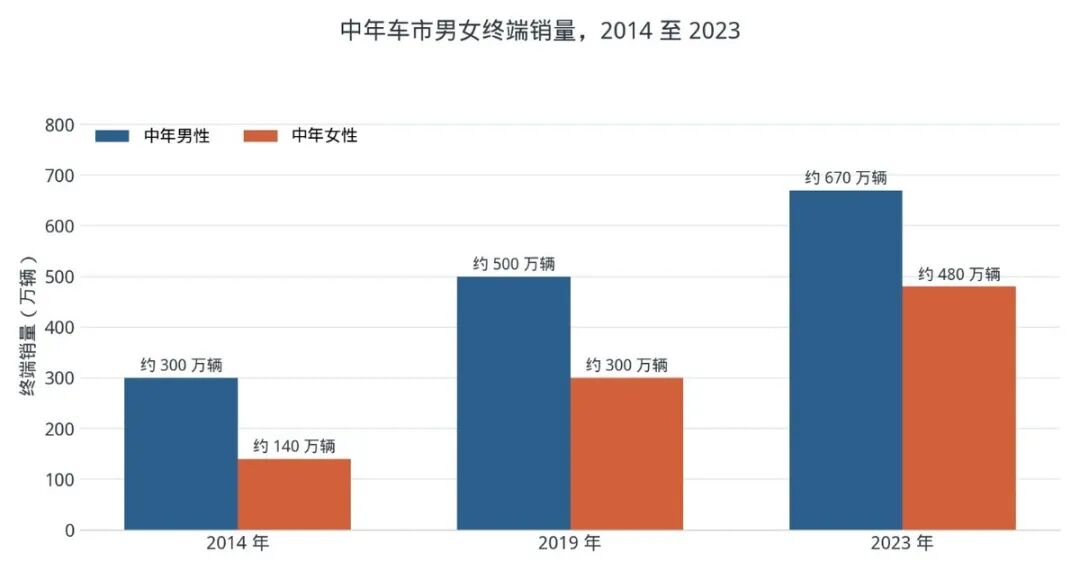
Let's also look at the gender ratio. In 2023, the male-to-female ratio in the middle-aged car market was about 60:40, with middle-aged men's terminal sales nearing 7 million vehicles and middle-aged women approaching 5 million. Looking back, in 2014 these two figures were 3 million and 1.4 million respectively—both sides have grown, with men's absolute volume always larger.
The change occurred at the younger end. A car buyer trend study reported by CNR in February 2025 stated plainly that starting in 2022, the share of users under 30 rapidly decreased, and in 2023 the 31-40 age bracket also fell sharply, with men under 40 declining even more noticeably. Meanwhile, the replacement ratio from the Passenger Car Association quickly rose from about 40% in 2019-2022 to 45% in 2023, and the share of users over 41 rose accordingly.
Can we draw a conclusion from this—that men haven't actually exited the car market, but young men who have just entered society have temporarily chosen not to buy cars?
The 2026 statistics only cover the first nine months so far, so only partial organization is possible.
A People's Daily Online and China Youth Network article in November discussing the age differences between Chinese and European car owners said in one place that new energy consumers aged 31-40 account for 73.18% this year, with post-00s exceeding 10% for the first time, and in another place cited a German newspaper saying that Chinese new energy car owners average 34 years old, while EU ones average 56. Comparing the two, we can only say that our car market has just entered the middle-aged phase and is still much better than Europe, especially Germany.
To summarize why the overall trend is upward, we need to look at several things together.
The age is rising. First, there are fewer people. In the early 1990s, over 24 million people were born each year; by the late 1990s, only over 18 million. Throughout the 2000s, it was around 16 million every year. When it comes to buying cars, fewer people are entering the market.
Similarly, the timing of first-time car purchases is being pushed back. Replacement subsidies have made families that already own cars the main source of incremental growth. Parents pay the down payment and children pay the monthly installments, or old cars are passed down—all of this counts in sales, but the payer has changed generation.
Finally, I want to emphasize one point: the actual data on young people buying cars is even worse than current statistics suggest, because the portion bought for ride-hailing must be excluded. Production tools and private vehicles are fundamentally different things, and ignoring the difference artificially inflates the number of young buyers.
02 The So-Called "Youth-Oriented" Approach Is Itself a False Proposition
Why has it become harder and harder over the past decade for young people in their twenties to buy their first car? Actually, the question itself has a big problem—there was never a "harder and harder" issue; it has simply never been easy.
In February this year, the media concentrated on reporting a wave of seven-year low-interest car loans, and one case, I think, is very illustrative.
Auto mechanic Xiao Fang earns less than 5,000 yuan a month. Seeing that his colleagues all had cars, he bought a used car with a 20% down payment, monthly payments of 1,700 yuan, an annual interest rate of 7.67%, and total interest over seven years of over 10,000 yuan. He said he signed the contract and ordered the car on impulse.
But getting the car is never just about the bare car price. There are taxes, insurance, and basic accessories like floor mats and car covers. The excitement lasted only about a month before Xiao Fang discovered problems. On his daily commute, if he happened to hit traffic, driving was even slower than riding an electric bike, and it cost more in fuel. On rest days, he had a limited social circle and liked to stay home playing mobile games, so he didn't really need the car. If he forced himself to drive out for fun, the round-trip fuel cost plus parking seemed completely not worth it. And even when he didn't use the car, the monthly payment still had to be paid, leaving him with almost no spare money each month. To save money, Xiao Fang even skipped breakfast...
After two months of suffering, Xiao Fang, whose quality of life had plummeted, realized: others buy cars with savings, and I'm buying one with debt—am I stupid? After painful reflection, he sold the car, cleared the loan, and got back half of his down payment.
In a report by a well-known Shanghai media outlet, I saw another example. A Yang, who had only been working for a year, also got the idea because a colleague bought a car. Fortunately, his family was relatively well-off, and his parents, feeling sorry for their son, paid the down payment for him, with the rest on installments.
But the problem is that A Yang doesn't work in his hometown—he chose to stay in Shanghai after graduation, which means he has to rent. So although A Yang's salary is decent for a workplace newcomer, after deducting car loan and rent from his monthly pay, every penny still has to be carefully budgeted.
Many times, to save the 10-yuan-per-hour parking fee, A Yang didn't park in paid spots but on unmarked roadside areas. So during meals, he had to constantly watch for police text messages telling him to move the car, and as soon as he saw one, he would rush out of the restaurant to move it.
If the above cases are not enough to illustrate the point, let me talk about my own experience buying my first car.
That was over a decade ago, when I was just over 30 and domestic cars were beginning to become widespread. At the time, I was somewhat overly ambitious, so I chose the flagship version of a well-known joint-venture A-segment family sedan. With various taxes and registration fees, the on-road price was about 200,000 yuan.
The down payment basically emptied the little savings I had accumulated over several years, and I also took advantage of a bank and brand promotion for a 24-installment interest-subsidized loan, with monthly payments of just under 4,200 yuan. Counting monthly fuel costs, parking at work and home, occasional parking elsewhere, and the monthly share of regular maintenance, the car added nearly 6,000 yuan in expenses per month.
At that time, my take-home pay was only about 10,000 yuan. Fortunately, I didn't have to make a living in another city, so I saved on rent and could still have over 4,000 yuan left for daily expenses. Those two years were truly a struggle to make ends meet, and later when I won a Shanghai license plate quota, my parents ultimately had to pay for it.
What is the essence of young people buying cars? We cannot rule out the very few exceptionally gifted people who enter high-income brackets right after entering society, or various second- and third-generation individuals. Or those who caught era bonuses such as relocation compensation during periods of rapid economic development. But most people without wealthy families have relied over the past decade or so on their parents' generation—the post-50s and post-60s—using decades of accumulation to build a family foundation for their post-80s and post-90s children.
Now, as time has moved to the era when post-00s are beginning to consider buying cars, social and economic development has entered a slowdown cycle. Isn't the problem naturally here?
Last month, on the 15th, a minor controversy broke out in the auto world. XPeng's MONA L05 was in the middle of its presale event, with He Xiaopeng joining remotely from Paris and the spotlight handed to the company's young team. A post-00s product manager named Etta took the stage to talk about styling, interior, and so on.
It was supposed to be a routine product walkthrough, but who would have guessed that she would open with "How could old folks possibly understand what young people want?"—and then go on to label wood grain and chrome trim as "old-folks aesthetics" to be rejected outright. The remarks spread online fast and sparked controversy.
There's no point debating whether those remarks were right or wrong—after all, Etta apologized in person on October 22, and there's no need to keep flogging a dead horse half a month later. What I find most fascinating about this episode, though, is the core user positioning of the XPeng brand itself.
XPeng is seen as a brand for young people for good reason: more than half of MONA M03 buyers are under 30, and when the L03 was delivered, He Xiaopeng also said that orders from under-30s accounted for half. But the company doesn't only sell two models.
Further up the range, there are larger cars like the GX and X9 costing over 300,000 yuan, and most people who walk into stores for those are buying after starting families. Further down, for cars in the 100,000-plus yuan range like the MONA, the contract may bear a young person's name, but the down payment often isn't self-funded. A Yang's parents paid; my Shanghai license plate was also paid for by my parents. That's what it means when the payer has changed generation.
The line on stage—"How could old folks understand"—sounded like it was only about aesthetics, but when it comes to money, it gets a bit awkward. And the generation being called "old folks" is precisely the one swiping cards to pay down payments for young people buying 100,000-plus yuan cars.
Alright, let's not bring up the "old-folks flavor" matter anymore and get back to the main topic. In the end, the endless relaxation-themed marketing and the various long-term car loan schemes are all attempts by automakers to capture the incremental growth from young people in a car market that continues to age. Even the youth-oriented approach itself is more like a marketing narrative that has lasted for years rather than a real consumer trend.
At this point at the end of 2026, the main force of car buyers has shifted to middle-aged groups with savings and trade-in needs. Population structure, income pressure, and vehicle ownership costs are jointly suppressing young people's willingness to make their first purchase. Even for cars registered under young people's names, the funding behind them is still underpinned by elders.
What OEMs need to see clearly is the reality that the dividends of the auto market are no longer with young people, and it is difficult to change the fundamentals of consumption with emotional slogans alone.
Responsible editor: Shi Jie Editor: He Zengrong

THE END
-
![]()
The First Country Built by AI—How Is It Doing Now?
-
![]()
Robot Vacuum Cleaners: Drawing the "Kill Line"
-
![]()
Mobile Phones Aren't Selling, and Tablets Are Suffering Too—What Exactly Is Going On?
-
![]()
Car Buyers Are Getting Older and Older—So Why Are Cars Still Marketed as Youth-Oriented?
-
![]()
Domestic Profits Are Plummeting: BYD, Chery and Geely Race to Expand Overseas | A Deep Dive into the CPCA's October Auto Market Review
-
After Propelling Geely Galaxy, the Million-Unit Xingyuan Phenomenon Comes at a Cost
-
![]()
Even Environmental Groups Can't Do Without AI—But Is All That Electricity Worth It?
-
![]()
Lei Jun's "Boast" Comes True: Xiaomi Pengcheng Secures October's "Double Championship"! Harmony Intelligent Mobility Drops Out of Top Three