Domestic Profits Are Plummeting: BYD, Chery and Geely Race to Expand Overseas | A Deep Dive into the CPCA's October Auto Market Review
 11/10 2026
 412
Written by | Guanchesjun
New energy vehicles now account for two-thirds of the retail market, yet they have still not been able to lift the growth rate of the overall auto market.
On November 9, the Passenger Car Association (CPCA) released its October analysis of the national passenger car market. Retail sales of passenger cars nationwide stood at 1.643 million units, down 27.1% year-on-year. The new energy retail penetration rate reached 67.5%, a record high.
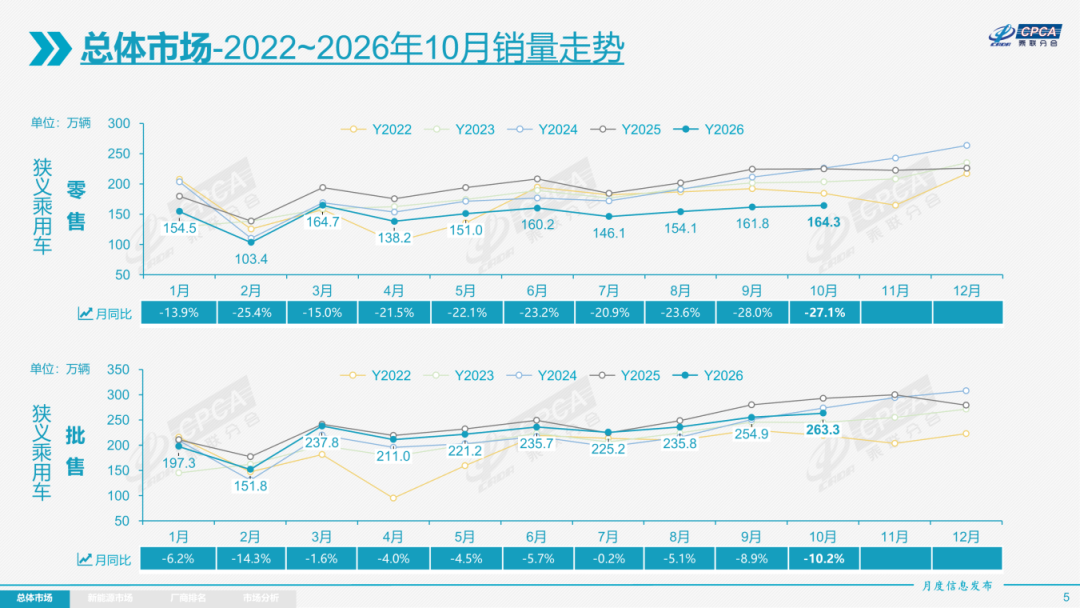
After reviewing the analysis, Guanchesjun found that the October auto market underwent simultaneous shifts across three major dimensions: demand, exports and profits.
01
Let's start with demand. In October, fuel vehicle sales nearly halved, and new energy vehicles did not grow either.
Retail sales of conventional fuel vehicles came in at 530,000 units, down 45% year-on-year. Within that, pure fuel vehicles fell 51%, while ordinary hybrids grew 28%.
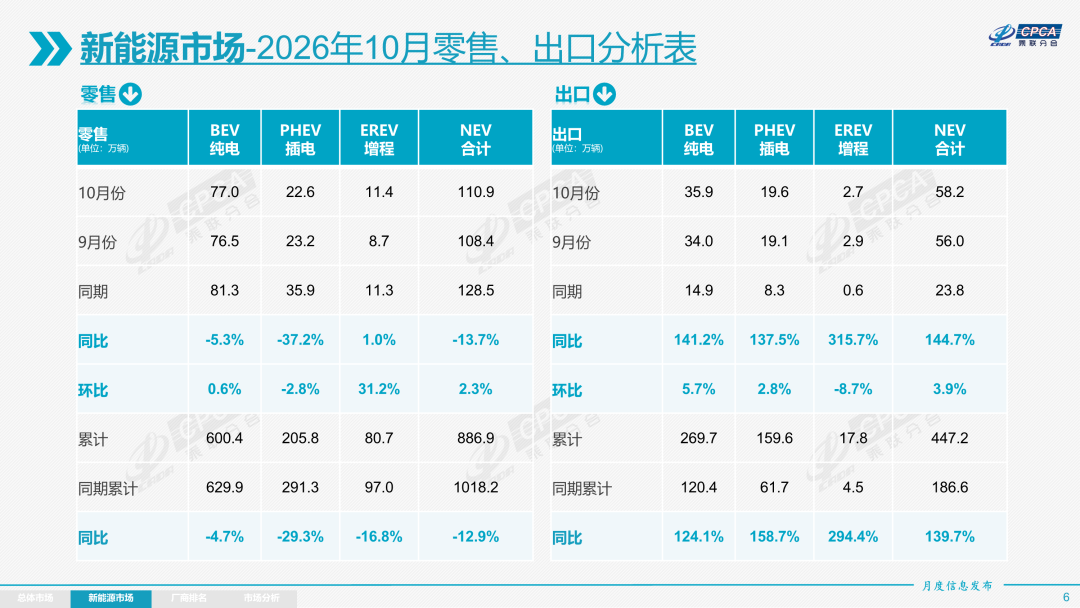
Retail sales of new energy passenger vehicles were 1.109 million units, down 13.7% year-on-year but up 2.3% month-on-month. From January to October, cumulative retail sales reached 8.869 million units, down 12.9% year-on-year.
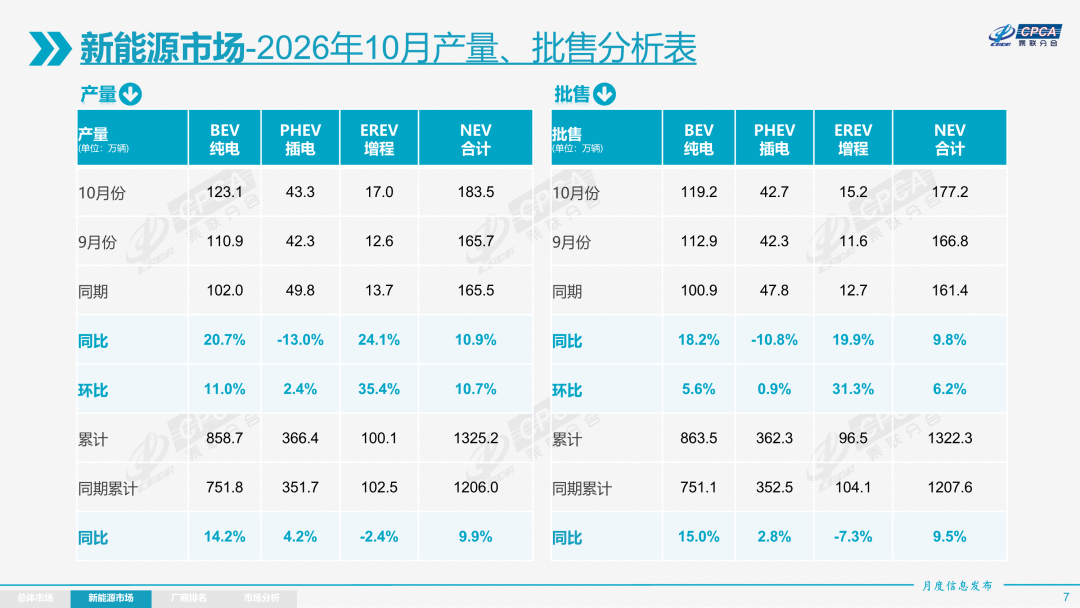
The supply side told the opposite story. In October, production of new energy passenger vehicles reached 1.835 million units, up 10.9% year-on-year, while wholesale sales were 1.772 million units, up 9.8% year-on-year.
This indirectly suggests that a growing share of new energy products is not reaching domestic end-consumer retail. Exports have become an important destination, a point Guanchesjun will examine in detail later.
For domestic brands, October retail sales were 1.21 million units, down 22% year-on-year, yet their market share climbed to 73.8%.
Retail sales of mainstream joint venture brands were 320,000 units, down 38% year-on-year.
Luxury car retail sales were 110,000 units, down 39% year-on-year and down 34% month-on-month.
The retail shares of German, Japanese and American brands stood at 12.6%, 10.2% and 2.7%, respectively, down 1.1, 2.1 and 1.1 percentage points year-on-year.
02
Next, exports. As Guanchesjun noted earlier, October passenger car wholesale growth outpaced retail by 16.9 percentage points, and the gap came mainly from exports.
CPCA data shows that October passenger car exports totaled 928,000 units, up 68.5% year-on-year and up 1.0% month-on-month, accounting for 35% of manufacturers' sales. In the same period of 2025, that share was only 19%.
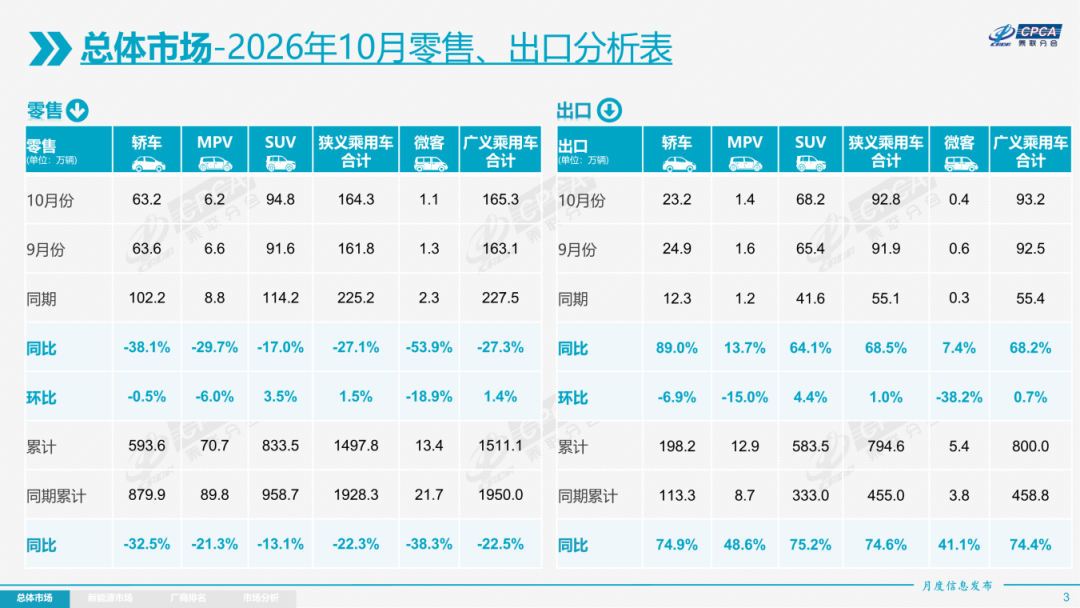
Within that total, exports of new energy passenger vehicles were 582,000 units, up 144.7% year-on-year, accounting for 62.8% of all passenger car exports — an increase of 20 percentage points year-on-year.
Exports of conventional fuel vehicles were 346,000 units, up 11% year-on-year.
Exports of domestic brands reached 810,000 units, up 77% year-on-year, while exports of joint venture and luxury brands totaled 118,000 units, up 28% year-on-year.
At the automaker level, BYD exported 165,194 new energy vehicles, Chery exported 83,843 and Geely exported 80,119.
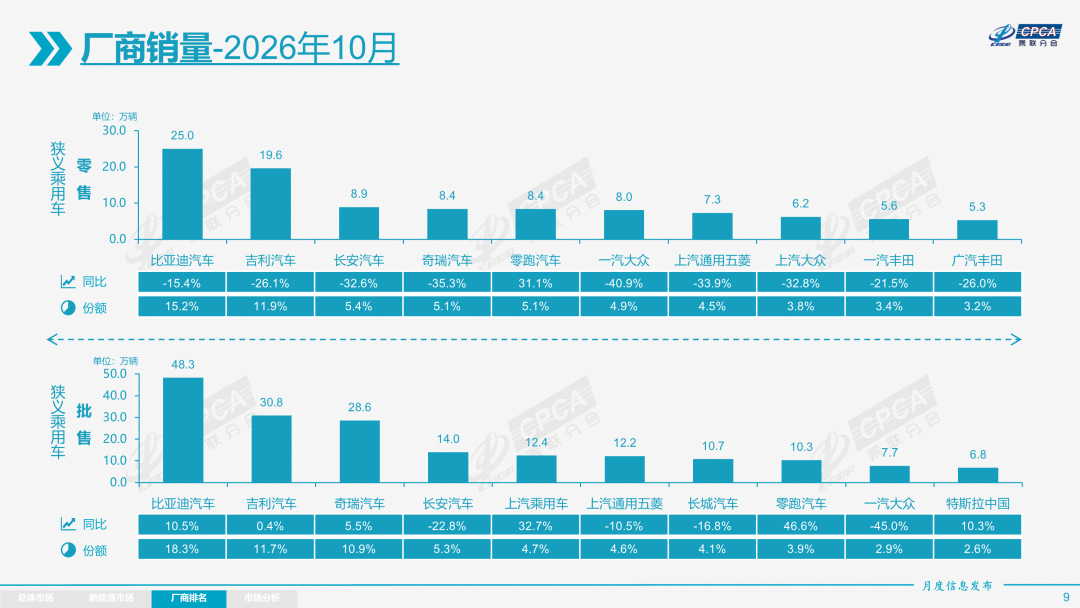
In addition, Guanchesjun found that the export mix raises another question. A00- and A0-class pure electric vehicles accounted for 56.4% of pure electric exports, compared with 42.1% in the same period last year.
This means overseas growth is coming more from low- and mid-priced mainstream models. It helps domestic brands leverage their scale and cost advantages, but it also means export growth is closely tied to price competition and overseas purchasing power.
03
Finally, profits deserve a mention.
As noted, the October new energy retail penetration rate was 67.5%, up 10.5 percentage points year-on-year and up 0.5 percentage points month-on-month. The wholesale penetration rate was 67.3%, up 12 percentage points year-on-year.
Both figures hit record highs.
But Guanchesjun noted that, according to figures previously released by CPCA Secretary-General Cui Dongshu and also reported by Securities Times, the automotive industry's profit from January to September was 267.5 billion yuan, down 23% year-on-year, with a sales profit margin of just 3.3%.
During the period, revenue grew 2.6% and costs grew 3.8%, yet profits fell by nearly a quarter.
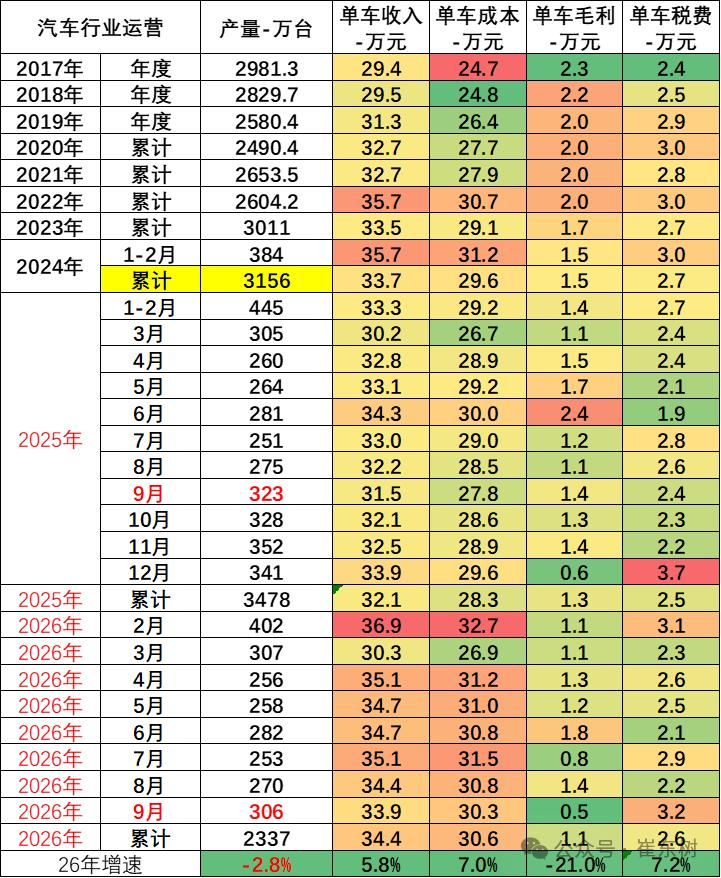
Looking at September alone: industry revenue was 1,037.4 billion yuan, up 0.6% year-on-year; costs were 925.7 billion yuan, up 2.5% year-on-year; profit was 14.2 billion yuan, down 68% year-on-year, and the sales profit margin dropped to 1.4%. October is likely to look much the same.
Clearly, penetration rate does not necessarily translate into profit margin.
2026 will also be a seismic year for the new energy vehicle industry. Starting January 1, the new energy purchase tax will shift from full exemption to half collection, with the maximum tax reduction per vehicle capped at 15,000 yuan, and trade-in subsidies will decline at the same time. These removed policy levers all represent costs for automakers. BYD, for example, according to calculations by Soochow Securities, had an overseas per-vehicle profit of about 15,000 to 20,000 yuan in the third quarter, while domestically it was only about 2,000 yuan. This is still the largest domestic new energy automaker, and its domestic per-vehicle profitability is already razor-thin.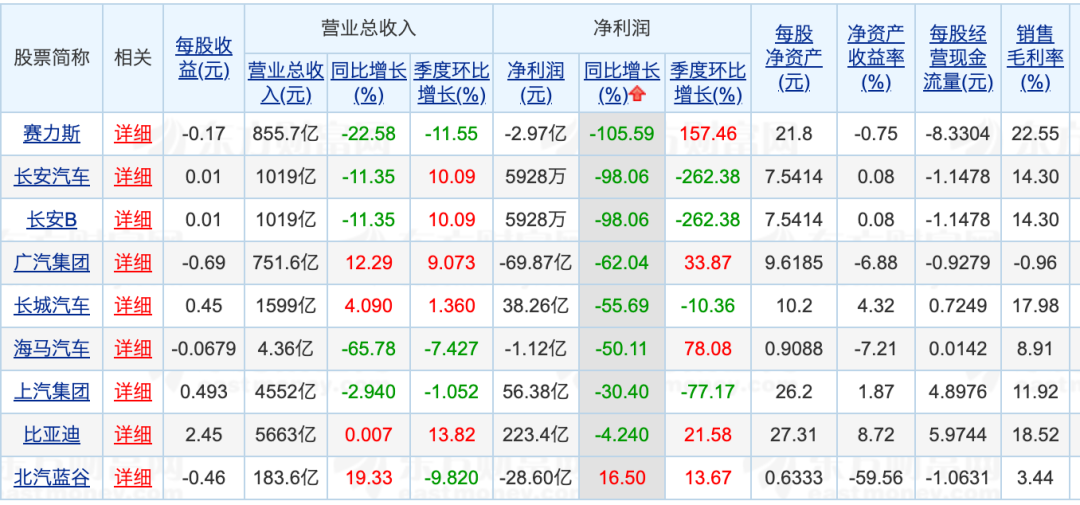
And the process of penetration rate peaking is also the process in which the marginal returns of major automakers' strategy of trading market share for profits accelerate toward zero. What comes next is the real test for automakers. Whoever can protect profits may be qualified to stay at the table longer.
Charts in this article without indicated sources are all from public disclosures through various channels, and are hereby explained and acknowledged! The views in this article are for reference only and do not constitute investment advice.
-
![]()
The First Country Built by AI—How Is It Doing Now?
-
![]()
Robot Vacuum Cleaners: Drawing the "Kill Line"
-
![]()
Mobile Phones Aren't Selling, and Tablets Are Suffering Too—What Exactly Is Going On?
-
![]()
Car Buyers Are Getting Older and Older—So Why Are Cars Still Marketed as Youth-Oriented?
-
![]()
Domestic Profits Are Plummeting: BYD, Chery and Geely Race to Expand Overseas | A Deep Dive into the CPCA's October Auto Market Review
-
After Propelling Geely Galaxy, the Million-Unit Xingyuan Phenomenon Comes at a Cost
-
![]()
Even Environmental Groups Can't Do Without AI—But Is All That Electricity Worth It?
-
![]()
Lei Jun's "Boast" Comes True: Xiaomi Pengcheng Secures October's "Double Championship"! Harmony Intelligent Mobility Drops Out of Top Three