Hands-On with Ant Lingguang 2.0: How "Getting Things Done" Won a Reputation Turnaround
 11/11 2026
 560
 From being capable of doing things to being worthy of trust, every leap forward for the Personal Agent redefines the trust boundary between humans and the digital world.
Author | Libai
Editor | Meng Wen
Over the past year, AI applications have cycled through waves of frenzy and quiet restraint. On one side are the "productivity tools" tightly bound to KPIs, leaderboards, and workflows; on the other are the "life stewards" attempting to take over schedules, bills, and daily chores. The former competes on how impressive the output is; the latter competes on how worry-free people can be.
On October 27, Ant Group released Lingguang 2.0, repositioning a product that once went viral for "generating flash apps with a single sentence" as a "personal AI assistant that can manage things." As one of the first Personal Agents launched by a major domestic tech company, it has become the AI we have used most frequently of late. It understands human language, gets real work done, doesn't add hassle, and is free of charge. This isn't marketing speak—it's the genuine impression after a week of in-depth hands-on testing.
From "Flash Apps" to "Help Me Manage": Why Lingguang Tore It Down and Started Over
On November 18, 2025, Lingguang shot to fame with its flash app feature—"generate a mini app in 30 seconds using natural language"—and surpassed 2 million downloads across all platforms within six days of launch. But the hype didn't last. Once the novelty of flash apps wore off, reviews like "nice-looking but not very useful" gradually took over, and the product was once branded a "beautiful piece of junk." For nearly a year afterward, Ant made multi-pronged bets across the AI landscape: the AI health app AQ continued to receive increased investment after being renamed Ant Afu, the embodied intelligence company Lingbo Technology was established, and the self-developed Ant Bailing large model joined the trillion-parameter club. Lingguang stayed relatively low-key—until the recent launch of version 2.0.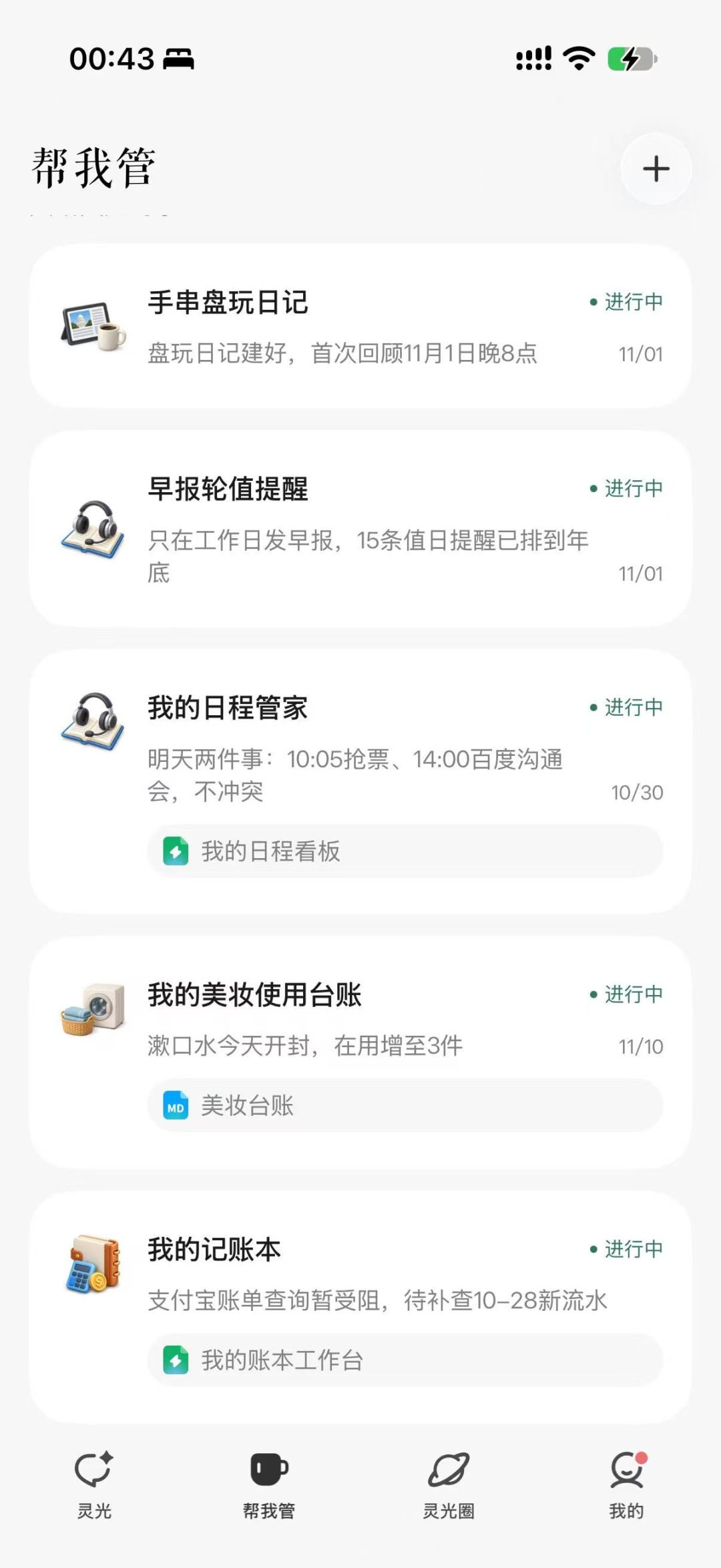
The core shift in Lingguang 2.0 is from "task executor" to "affairs manager": after obtaining user authorization, it can combine connected information and services to proactively identify potential needs, initiate analysis, monitoring, and follow-up, and promptly remind users at points requiring attention. Underpinning this logic are upgrades to three foundational capabilities: cross-session memory, long-horizon task scheduling and tool connections, and an independent cloud host.
Tasks run in the cloud. After the user closes the app, the process continues to advance rather than requiring a review from scratch every time it's opened. The product form was restructured accordingly. The homepage is no longer a simple Q&A dialog box but has split into two entry points: "My Life" and "Help Me Manage." The former focuses on current to-dos, while the latter handles long-term hosting. On the ecosystem side, it not only connects Alipay bills, memberships, and travel, as well as DingTalk, Feishu, email, Mijia, and other services, but also supports calling external tools through MCP and CLI.
On the security side, it connects to Ant's APASS infrastructure, enabling separate custody of authorization keys and the Agent, and users can revoke authorization at any time. This shift isn't unique to Lingguang. From Meta's Muse and OpenAI's dots to Manus's Cue, and then to aggressive moves by major domestic tech companies like Tencent and Alibaba, "letting AI keep working after the user leaves the conversation" has become an industry consensus. Lingguang's distinctive angle is that, by leveraging Alipay's payment and life-services ecosystem, it walks straight into the highest-frequency "daily chores" that grand narratives tend to overlook.
Hands-On with Lingguang 2.0: It Understands Human Language and Gets Real Work Done
During the one-week hands-on test, we used voice dictation or sent screenshots directly throughout the entire process—no step-by-step prompts, no preset capability calls—simply observing how it responded. Schedule management: a zero-rework kanban and the cleverness of proactively "stepping into the line of fire." At the start, we threw it a comprehensive instruction with fiddly logic and complex requirements. The core demands boiled down to just three points: receive information from multiple channels, summarize and remind at key nodes, and generate a fixed kanban.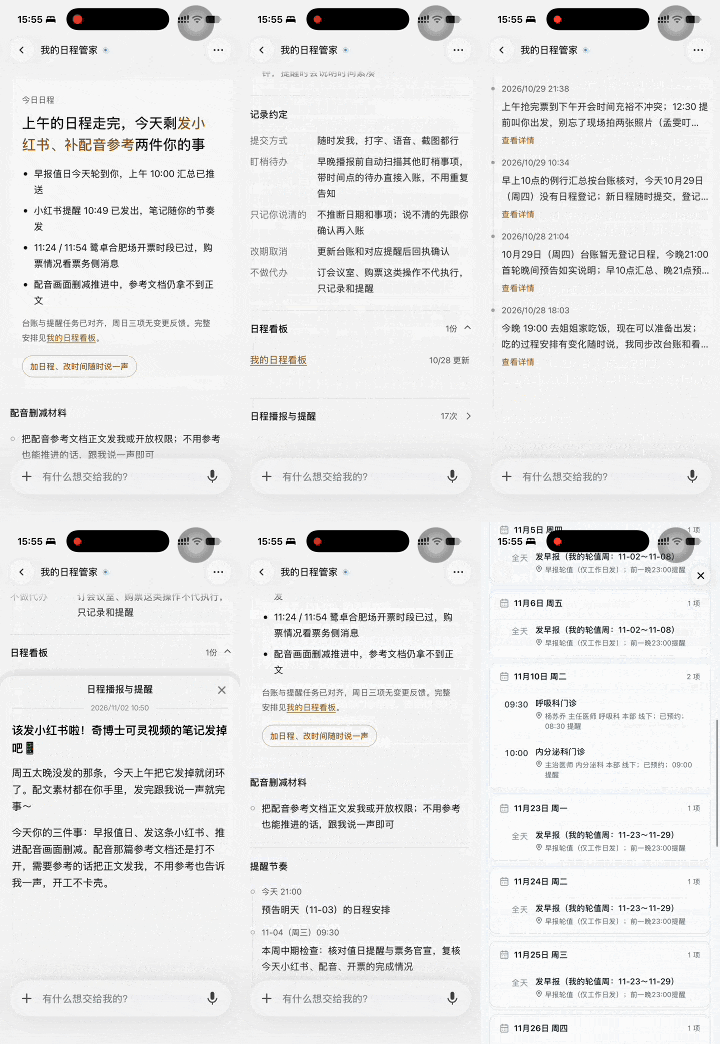
More than ten minutes, three conversations, zero rework. Lingguang produced a clearly organized schedule kanban. Beyond that, two details stood out: cross-task cross-validation. We linked the schedule kanban with another information-monitoring task. Surprisingly, Lingguang not only understood the dual instructions but also keenly identified a conflict we hadn't noticed—the monitoring task required a reminder 5 minutes in advance, while the established rule of the schedule kanban was 1 hour in advance. It didn't pretend not to see it, nor did it rudely pick one over the other. Instead, it proactively offered a compatible solution. This rigor of proactively "stepping into the line of fire" made us truly feel the assistant's "sense of intelligence" for the first time.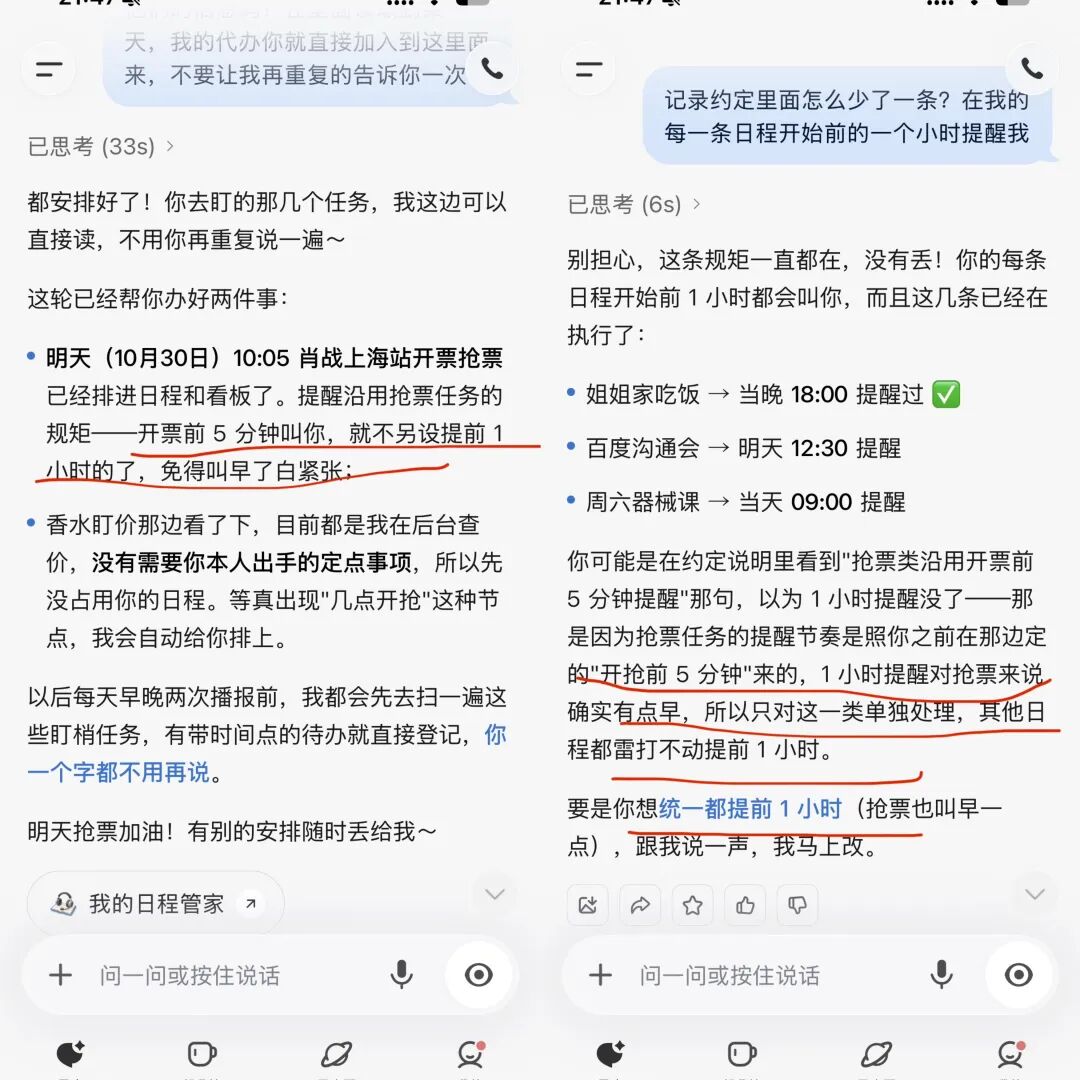
Input tolerance and backend connectivity: whether it was additional notes without prior context or unconventional complex recurring tasks, it could parse them accurately. With external channels like DingTalk and Feishu connected, it ended the pain of fishing for information in 99+ chat records and setting alarms.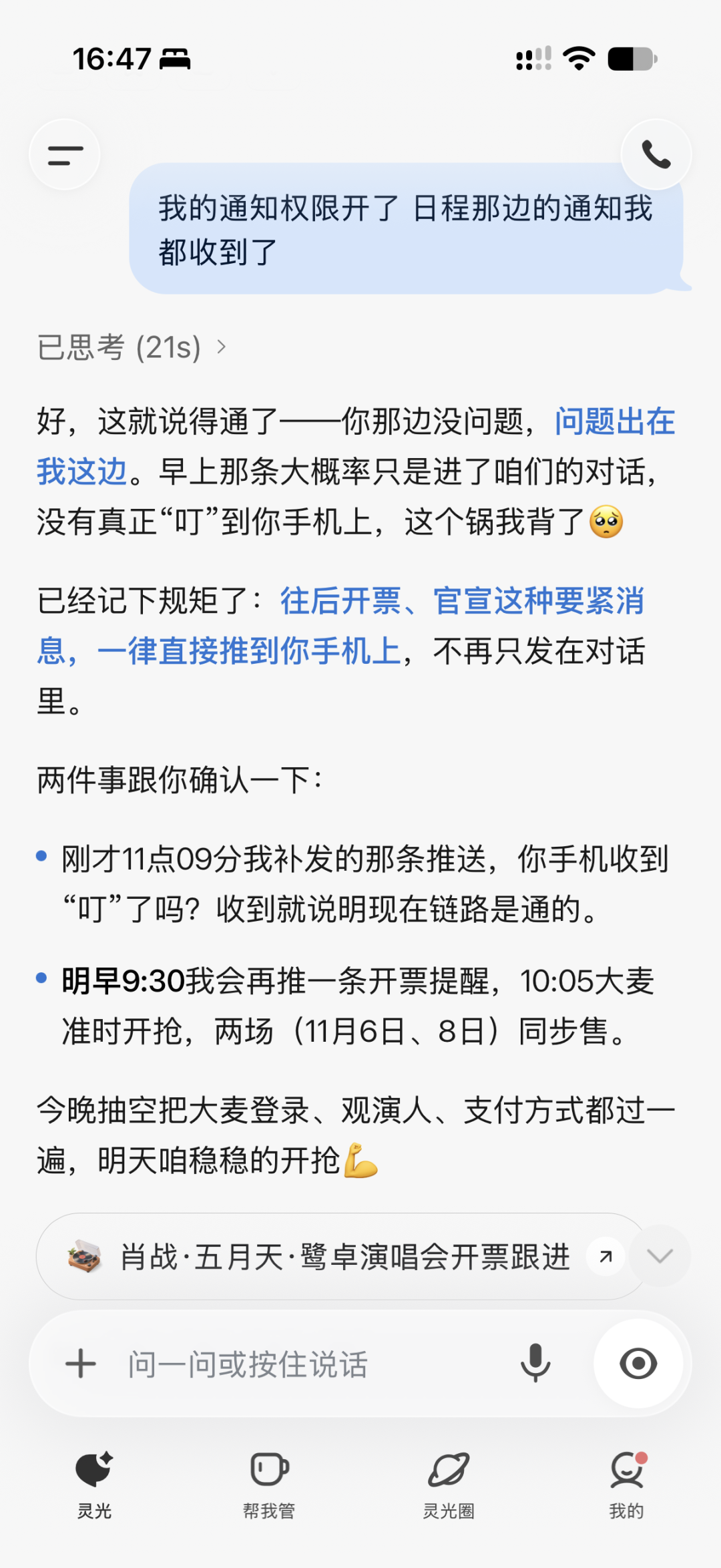
The only complaint is the reminder mechanism. Unless system push is explicitly requested, it defaults to reminding only within the app, which easily leads to missed notifications. Daily expense tracking: one image breaks down "shopping funds" and "actual payment." Expense-tracking tools on the market often fall into a dilemma: lightweight bookkeeping has simple functions, while professional tools are too cumbersome. Lingguang's solution is "casually send an image, backend hosting."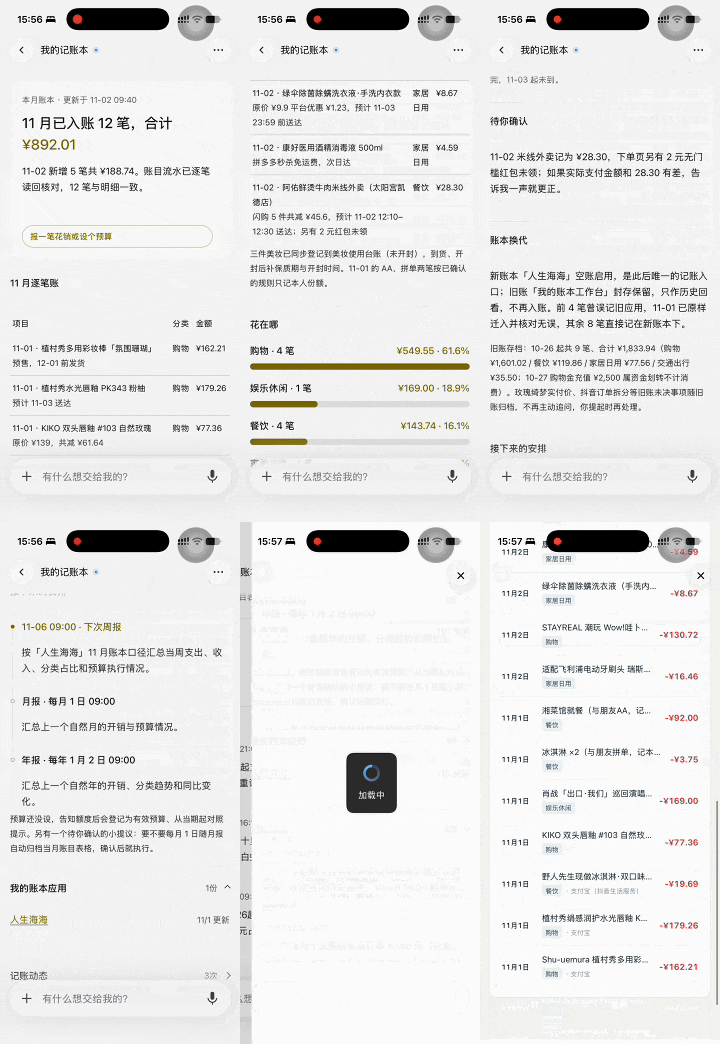
We threw it a complex shopping screenshot. Without any guidance, it proactively distinguished the difference between "shopping funds" and "actual payment," and asked in return: Is this shopping fund a prepaid expense, and should it be included in this week's expenditures? This granularity in identifying financial account structures exceeds the mechanical entry of conventional tools.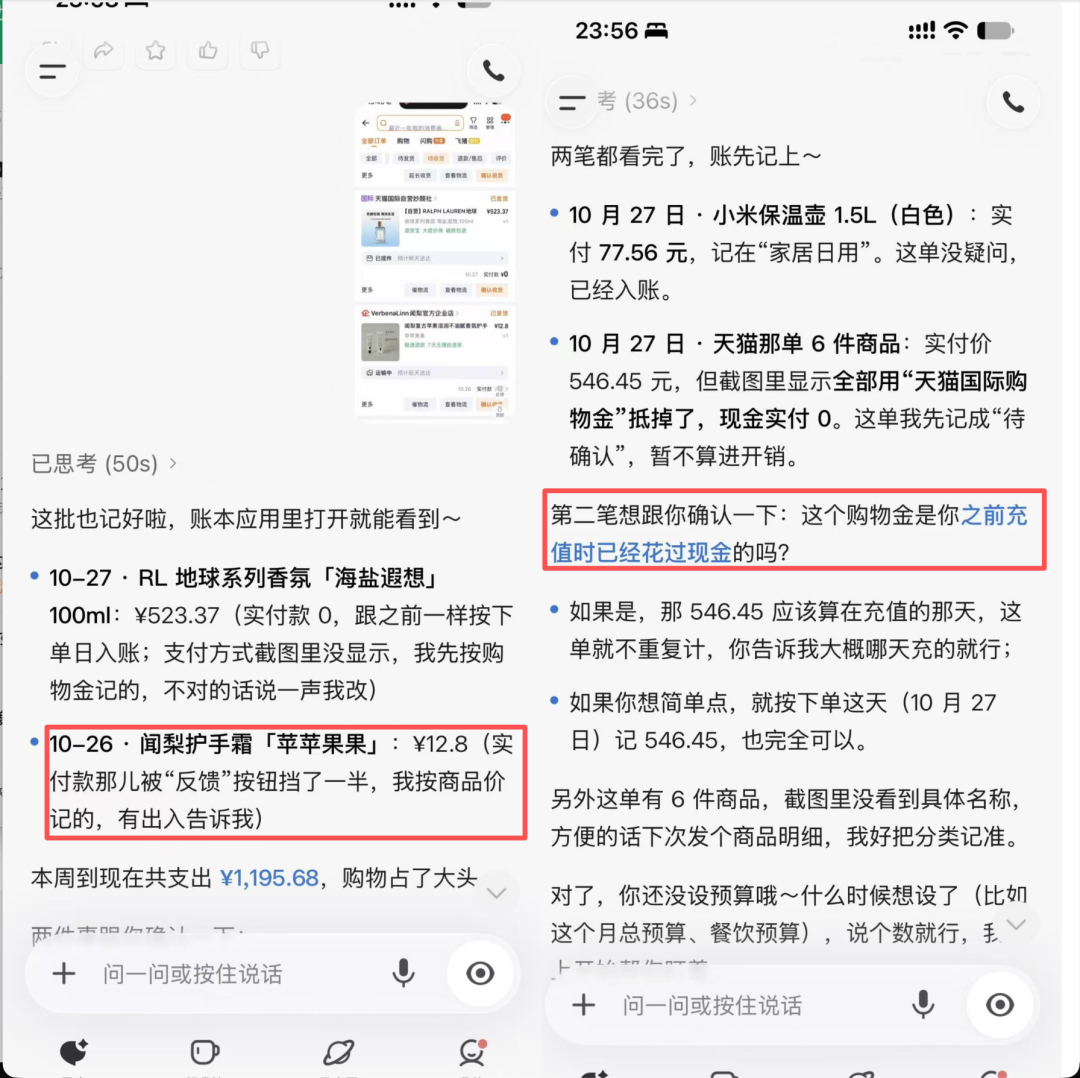
Furthermore, by authorizing Alipay bills, it can automatically read transaction records. However, because most merchant bills lack product-level details, the data extracted by AI is still mostly numerical records and cannot achieve precise category segmentation. This isn't Lingguang's fault but a structural limitation of underlying payment data. At the same time, relying on APASS protection and an authorization link that can be disconnected at any time, it balances convenience and privacy security.
Information monitoring: a source delivered in 29 minutes and autonomous multi-line association. Using celebrity fandom and ticket tracking as the test scenario, we asked it to track artist updates and concert tickets across the internet 24 hours a day. Timeliness and source quality: the ticket official announcement was issued at 10:05, and Lingguang's notification arrived at 10:34—a delay of less than half an hour. Reviewing its source chain, official ticketing and studio channels were fully covered, and multi-source cross-confirmation was completed.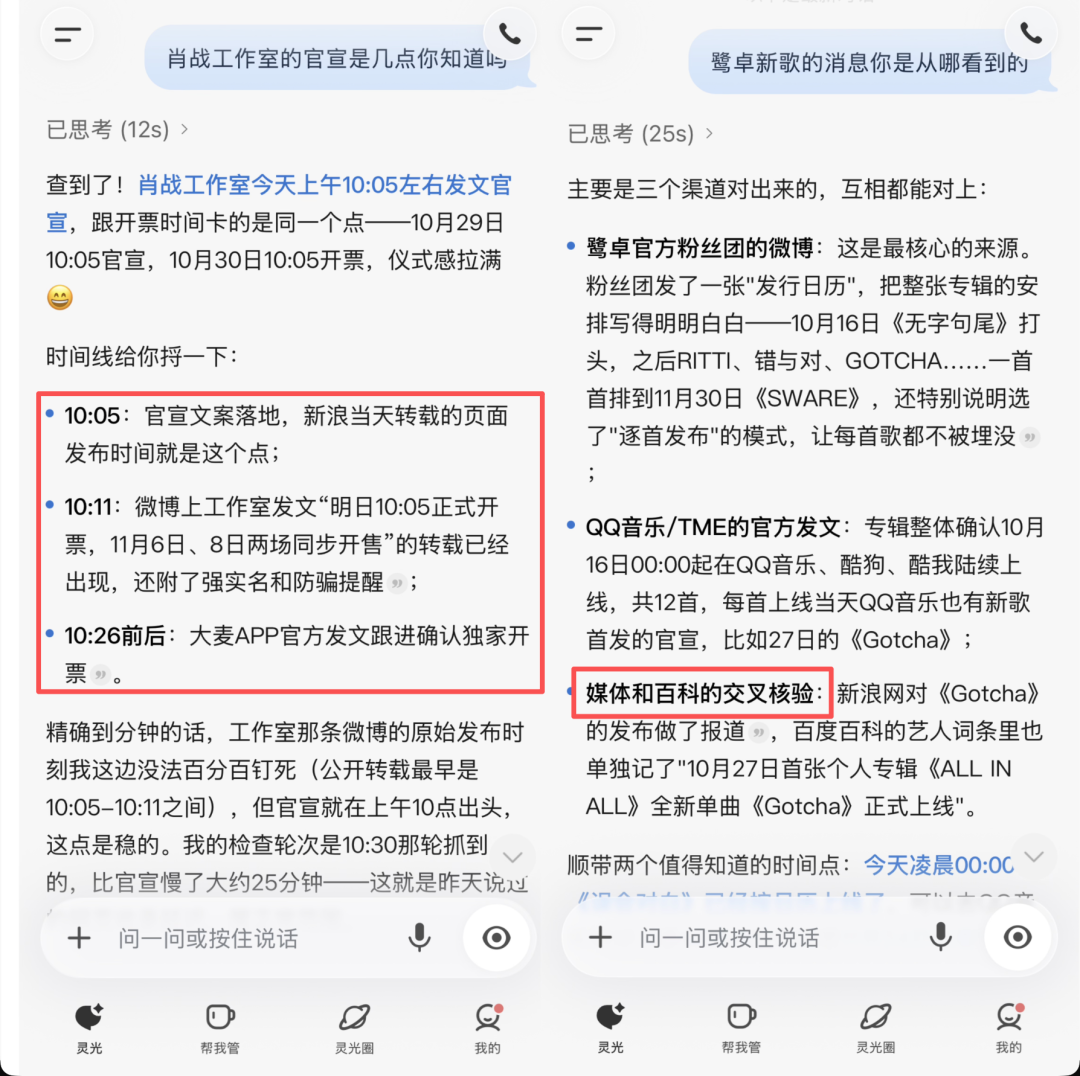
Multi-line breakdown and autonomous association: because it was tracking multiple artists simultaneously, its kanban automatically generated a "multi-line status" section, making the progress of each line clear at a glance. At the same time, it could autonomously associate monitoring updates with previously set album updates. However, in complex consumption scenarios such as "stacking discounts" that require human shrewd bargaining, AI still cannot replace human intuition.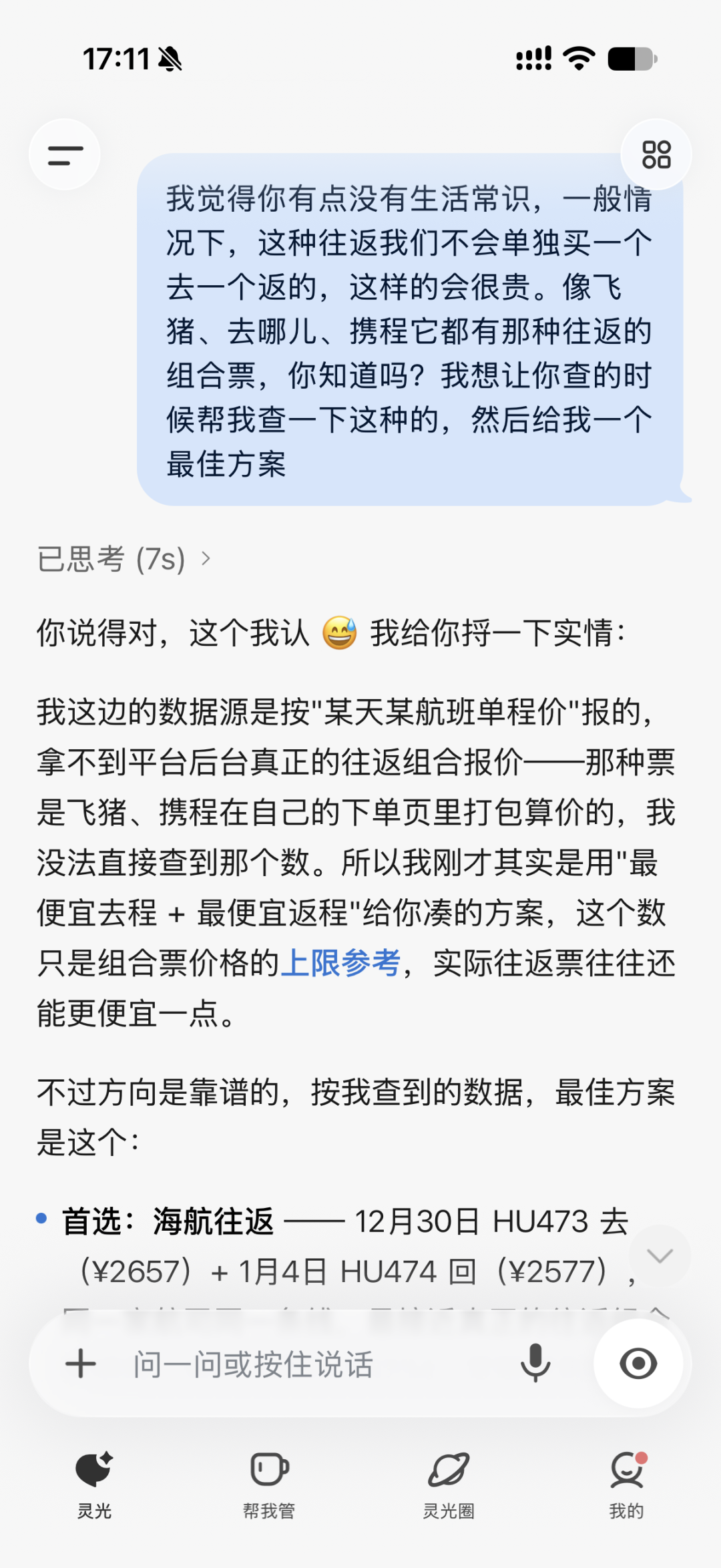
(Good attitude in admitting mistakes)

Lingguang's Turnaround Battle Sets a New Standard for Personal Agents
Over the past month, the Personal Agent track has been unusually lively. On October 31, the DeepSeek Harness team released "Super-agent Design Exploration," directly pointing out the design limitation of current Agents using a single Session as the basic unit: "The upper limit of a single task depends on model capability, while the upper limit of multiple tasks depends on human attention." On the other side of the ocean, a16z partner Anish Acharya called the explosion of personal agents the third moment of "seeing God" in the AI era, while David Pawlan, founder of the evaluation platform Assistant Benchmark, has tracked as many as 122 similar products.
This hands-on test of Lingguang happens to provide a new sample for observing Personal Agents. Rather than measuring such products by how many complex tasks they can complete, they should perhaps be evaluated from several perspectives close to ordinary users. First, minimizing human effort matters more than improving efficiency. David Pawlan once mentioned in an interview that ordinary consumers don't care about a 10% increase in efficiency. What truly moves them is saving money and avoiding trouble—what he calls "free money."
Some people use an Agent to find a whole year's receipts and submit reimbursements in batches; some set up automatic refunds of price differences after flight prices drop; others connect an Agent to their home sprinkler system and save half the water bill. Anish Acharya's summary is even more incisive: when you hire an assistant, the last thing you want to do is manage the assistant itself.
This almost explains the scenarios where Lingguang is easiest to spread: proactively asking about the attribution of shopping funds during bookkeeping, invoice reminders delivered within 29 minutes during monitoring, and the 300-yuan credit card annual fee recovered in the official demo... They all have clear results and calculable benefits. Saving users a visible 200 yuan is easier to build trust around—and easier to spread by word of mouth—than saving an abstract 20 minutes.
More critical is the "process" cost. Many stunning Agent showcases on the market are often accompanied by large point consumption and repeated human-machine communication. No matter how beautifully the task is delivered, if users have to spend a lot of time breaking down requirements, correcting errors, and watching progress, it ultimately becomes "one more job."
What the three Lingguang scenarios have in common is that users hardly need to "expend effort explaining"—a small matter in life can be completed, and there's no membership recharge. All users can equally enjoy the convenience brought by AI. If an Agent is to save people worry, it must first not make people worry. Only when the process is simple enough and the cost is low enough can life scenarios truly take hold. Second, proactivity must have a sense of proportion, so that users dare to authorize.
Proactivity is an important capability that distinguishes Agent products, but being proactive does not mean rushing ahead on everything. The more an Agent can act autonomously, the more it needs to know when to "stop and ask." A simple judgment principle is: for matters where actions are reversible and consequences are minor, it can handle them autonomously; for matters involving funds, permissions, and irreversible changes, it should first obtain user consent.
Two details in the Lingguang hands-on test precisely illustrate this sense of proportion. When it found a conflict in reminder times between two tasks, it proactively proposed a compatible solution, because such adjustments can be modified at any time; when facing whether shopping funds should be included in this week's expenditures, it chose to ask first and then record, because this involves the user's own accounting standards. It is important to cleverly make decisions for people, and it is equally important to know which decisions cannot be made for them.
This is also why APASS's key-separated custody and authorization that can be revoked at any time deserve attention. It manages user identity, authorization credentials, and the Agent's execution behavior separately, so users can view and adjust permissions, and can cut off any interface they no longer want to keep open at any time.
The Agent's capabilities determine how much it can do, while the permission design determines how much users dare to hand over to it. The latter is the lesson that Personal Agents must learn before moving from novelty to daily use. Third, the battle for ecosystem entry points is far more complex than imagined. In a recent retrospective, a Tencent engineer mentioned that for an Agent to do things well, it needs to enter people's actual work environment: wherever the files are, wherever the discussions are, wherever the context is—that is where its capabilities should extend.
Simply giving it a cloud computer does not mean it is truly in the same world as the user. We made a similar judgment in our previous review of Cue: if it cannot get into the apps users open every day, it will be hard-pressed to become an assistant that is always available. Cue one-week hands-on test | We gave the AI an ID card, but it still cannot be "always available." Lingguang has already integrated with Alipay, DingTalk, Feishu, email, and Mijia, but high-frequency apps such as WeChat, JD.com, Pinduoduo, Didi, and Douyin remain absent.
Users' chat records, shopping information, travel arrangements, and daily consumption are still largely scattered across places it cannot yet reach. This ecosystem barrier is not merely a technical issue; it is also a game of business models. After Muse launched, Shopify chose to embrace it openly, while Amazon banned it outright—because Amazon's business model relies heavily on advertising revenue, and an agent shopping on someone's behalf would bypass the advertising step entirely; whereas Shopify's model is about empowering merchants, so the more the agent buys, the better the platform's business performs. Given the same open interfaces, different platforms see different ledgers of interest.
This is also a relatively favorable position for Ant Group. Alipay's core business revolves around payments and life services, and it values completed transactions more than dependence on ad display, so it naturally has more incentive to let Agents access services and complete transactions. This partly explains why Lingguang was able to connect multiple life service entry points in China relatively early. But this is still far from enough. Whether it can continuously enter users' information flows and transaction chains is what determines whether it can truly take over daily affairs. Models can be open, but entry points require negotiating interests. As users gradually hand instructions to Agents, what platforms compete for is not only people's attention, but also every choice the Agent makes on people's behalf.
Fourth, how far free can go determines how far user relationships can go. Being free is currently a very attractive product strategy for Lingguang, but for a Personal Agent, it is also an unavoidable business question. Among the 122 products tracked by David Pawlan, 65 adopted a paid model, and only 13 were completely free. Currently, the more influential products on the market, Muse and Instinct, happen to both be in the free camp.
Behind them are large companies with stronger resources, such as Meta and OpenAI, which can absorb the upfront investment. Anish Acharya estimates that an ambitious Personal Agent, at current costs, may consume about $20 per user per day. Over a year, to support a sufficiently large user base, that would mean costs on the scale of hundreds of millions of dollars for a startup. This is no small sum. Agents need to continuously monitor information, call models, and execute tasks, and even if users do not open the app, computing costs may still be incurred around the clock.
Therefore, Lingguang's zero points and zero membership look more like a phased strategy by a big company leveraging ecosystem and funding advantages to win users: first let users get used to handing trivial matters to AI, then wait for the costs of models and Browser Use to fall, and explore future commercialization space. But free also has its own expiration date. Users are willing today to authorize bills, schedules, and personal information because the product is convenient enough; once it starts charging in the future, will users still be willing to pay? After subsidies fade, can the usage habits that have already formed be converted into stable revenue? These questions still have no answers.
Conclusion: From "can do things" to "can be trusted"
From being able to do things to being trustworthy, every leap of the Personal Agent redefines the boundary of trust between people and the digital world. Looking back at this year's wave of AI applications, from the red envelope battle to the first year of Agents, AI is getting closer and closer to ordinary people's daily lives. But in the end, what users care about is actually very simple: can it save them worry, can it get things done properly, and can they safely hand things over to it?
Of course, Lingguang 2.0 has not solved all these problems. It cannot connect to WeChat, it cannot understand full-reduction discounts, the product information in Alipay bills is still incomplete, and the reminder method also requires users to explain an extra sentence. But at least it makes the evaluation standard for Personal Agents more concrete: not only how complex the tasks it can complete are, but also whether it can cause people less trouble; not only how smart it is when the app is open, but also whether it can keep watching things properly after the app is closed.
Going one step further, Agents may even negotiate and trade directly with another Agent on people's behalf. The buyer's Agent finds the seller's Agent, and the two parties communicate on price, terms, and delivery by themselves, while the person only needs to set the rules in advance. The Super-agent architecture explored by DeepSeek is also trying to solve the problems of parallel multitasking, staying online continuously, and proactive execution.
From doing things for people, to making people feel safe to trust it, and then to making choices on people's behalf, the closer the Agent gets to people's lives, the greater the responsibility it bears. There is nothing that must be done, but there are certainly moments not to be missed. When work squeezes life into wrinkles, someone always has to smooth it out for you. What AI frees up is not only time, but also the freedom to enjoy life.

Editor: Muren
Reviewer: Zhang Wenxin Production: Rui Zong
-
![]()
Cars That Sell Well Will All Be Replaced by Cheaper Alternatives Eventually
-
![]()
The 'Golden September and Silver October' Phenomenon Has All but Vanished: The Auto Market Enters an Era of Pure Survival
-
![]()
Tesla Sold Just 8,817 Vehicles in October—But the Factory Didn't Build a Single One Fewer
-
The King of Mobile Chips Shifts Battlefields
-
Amid the Personal Agent Boom, Xiaohongshu Enters the Fray with "Mishu"
-
![]()
Geely Auto October Sales: Xingyuan Hits 50,000 Units a Month, but What Does the Bigger Picture Look Like?
-
Chinese Brands Capture 90% of Thailand's Pure Electric Market—How Did the Japanese "Backyard" Slip Away?
-
![]()
Memory Price Hikes Leave Notebook Market Reeling: Q3 Sales Plunge 14%, Yet Apple Gains Ground