Cars That Sell Well Will All Be Replaced by Cheaper Alternatives Eventually
 11/11 2026
 346
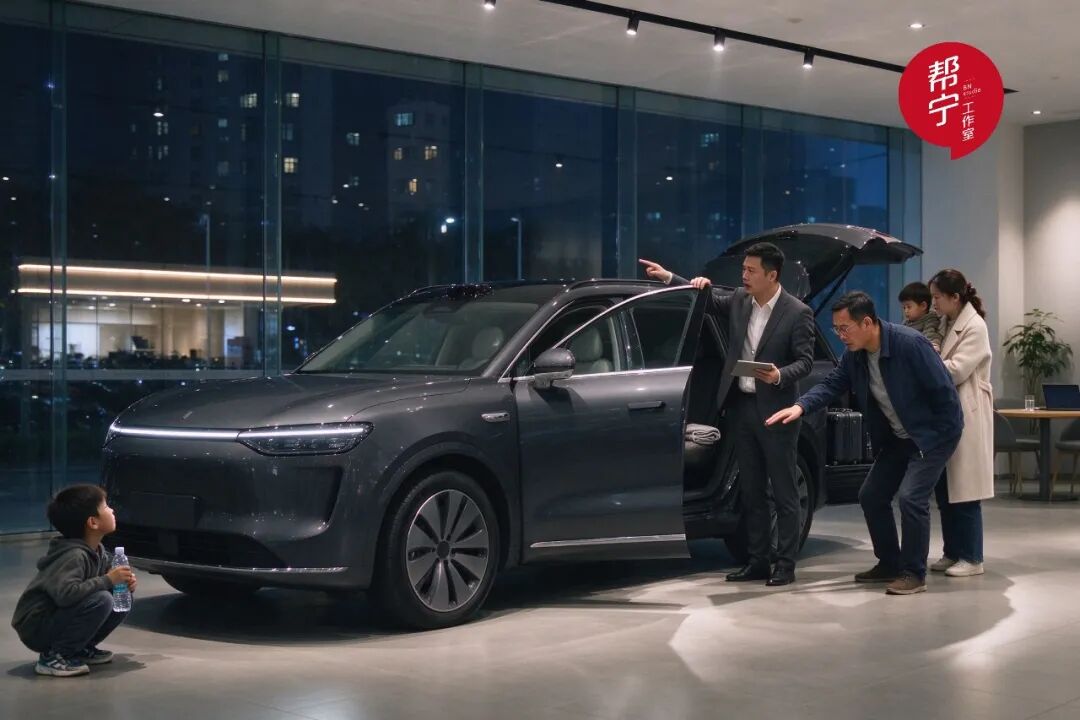
"From the 'half-price Highlander' to the 'half-price AITO and Xiaomi,' no model stays the benchmark forever."
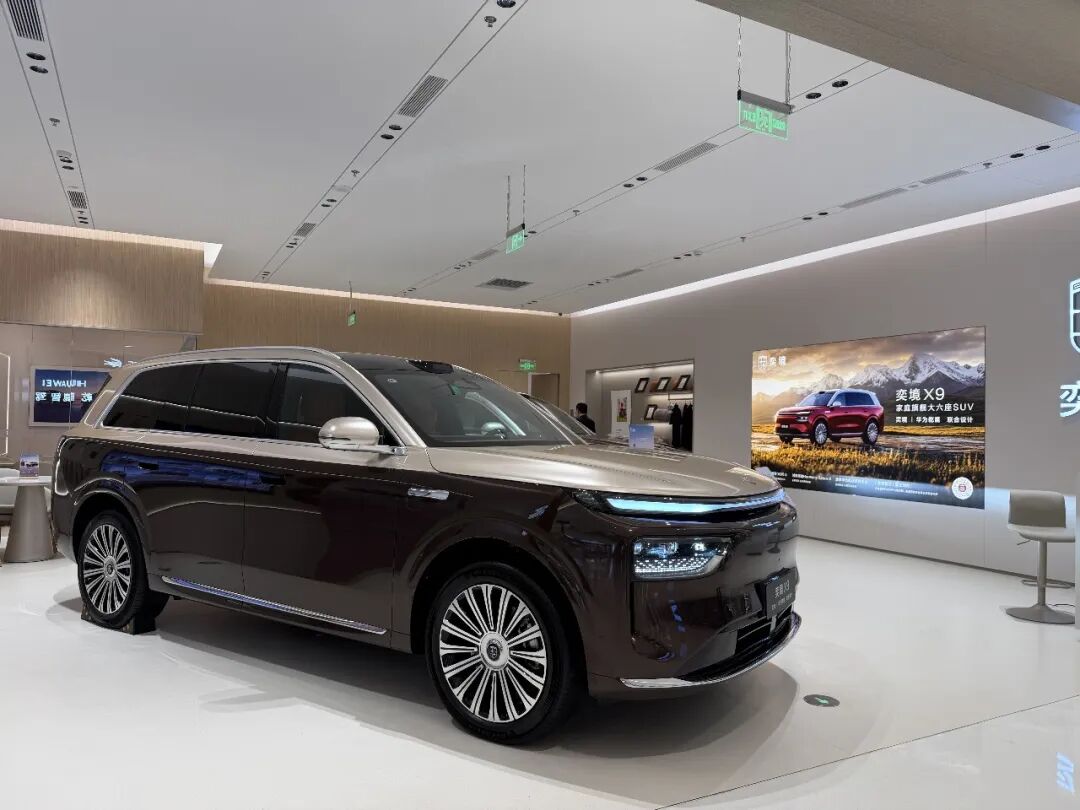
"It (the Yijing X9) is the 'half-price AITO M9.' The voice assistant is even called Xiaoyi, it uses the same intelligent driving assistance system, and many features come standard that are optional or unavailable on the M9—dual-chamber air suspension, for instance."
On November 5, a store manager at a Yijing dealership in Beijing's Chaoyang District told Bangning Studio that the Yijing X9 starts nearly 200,000 yuan below the AITO M9—almost half the price.
In China's auto market, "half-price" and "affordable alternative" have become perhaps the easiest advertising slogans of recent years. The market has seen the "half-price Highlander," "half-price GL8," "half-price Li Auto," "half-price AITO M9," "Porsche alternative," "half-price Xiaomi"... The pitch is instantly clear: for half the money, you can buy the model widely considered the better value.
The expressions "half-price XX" and "XX alternative" are hard to trace to any single origin, but they surface most often on the front lines of auto retail. In June 2020, for example, when the Geely Haoyue launched at a starting price of 103,600 yuan, some dealership sales consultants billed it as the "half-price Highlander."
In December of the same year, the Tank 300 launched at a starting price of 175,800 yuan, and the market coined the phrase "half the price of a Wrangler." At the time, "half-price" meant roughly enough space, enough off-road capability, and just about enough prestige.
These days, the "half-price" label is already dated. Automakers prefer to talk about "leapfrogging"—surpassing models a class above in certain respects. The Leapmotor C16, for example, "brings the Li Auto L8's six seats, color TV, and big sofa into the 150,000 yuan range"; the Geely Galaxy M9 "brings the AITO M9's dual-chamber air suspension below 200,000 yuan for 173,800 yuan."
A new benchmarking chain has formed. In the ultra-luxury market above 1 million yuan, there are "Porsche alternatives," "half-price Maybachs," and "Hangzhou Bay Cullinans"; among the rivals of the Highlander, GL8, Alphard, Prado, and Wrangler, each has a model positioned as a "half-price" alternative; the Camry and Accord now face the Qin L and Seal 07, built to replace them.
The chain runs upward toward brand and downward toward price. Each time the price drops a tier, the premium of the tier above thins by a layer. Judging from October sales this year, the thinnest layer collapsed first—Li Auto fell to 29,000 vehicles, and Porsche China declined 33.2% in the first three quarters...
The auto industry has entered an era of great contention, and some value standards are being re-evaluated.
▍01 Coordinates shifting downward
Looking at the auto market's development over the past six years, the "half-price" benchmarks have gone through several rounds of replacement.
The first round of benchmarks was hot-selling joint venture models.
When the Geely Haoyue launched in mid-2020, for example, many media outlets called it the "half-price Highlander." At the time, the Highlander started at 239,800 yuan.
In 2022, the Beijing BJ60 went on sale starting at 239,800 yuan, and netizens dubbed it the "half-price Prado."
The Trumpchi M8 and Roewe iMAX8 were also once called "half-price GL8s."
These benchmarked joint venture bestsellers mostly have a long sales history, and their prices include a brand tax. Domestic models flying the banner of "half-price XX" erase that brand tax by piling on size, configuration, and off-road capability—at roughly half the price.
The second round, from 2022 to 2024, saw the benchmarks shift from joint venture bestsellers to million-yuan luxury cars.
In June 2022, the Li Auto L9 launched at 459,800 yuan. Li Xiang, founder and CEO of Li Auto, said at the launch event: "Even compared with the Cullinan, we are not afraid at all." He also called it "the best family SUV under 5 million yuan."
A month later, the AITO M7 launched. Yu Chengdong, Huawei's executive director and chairman of the Terminal BG, said at the launch event that the AITO M7 "completely surpasses million-yuan luxury cars such as the Toyota Alphard and Lexus LM."
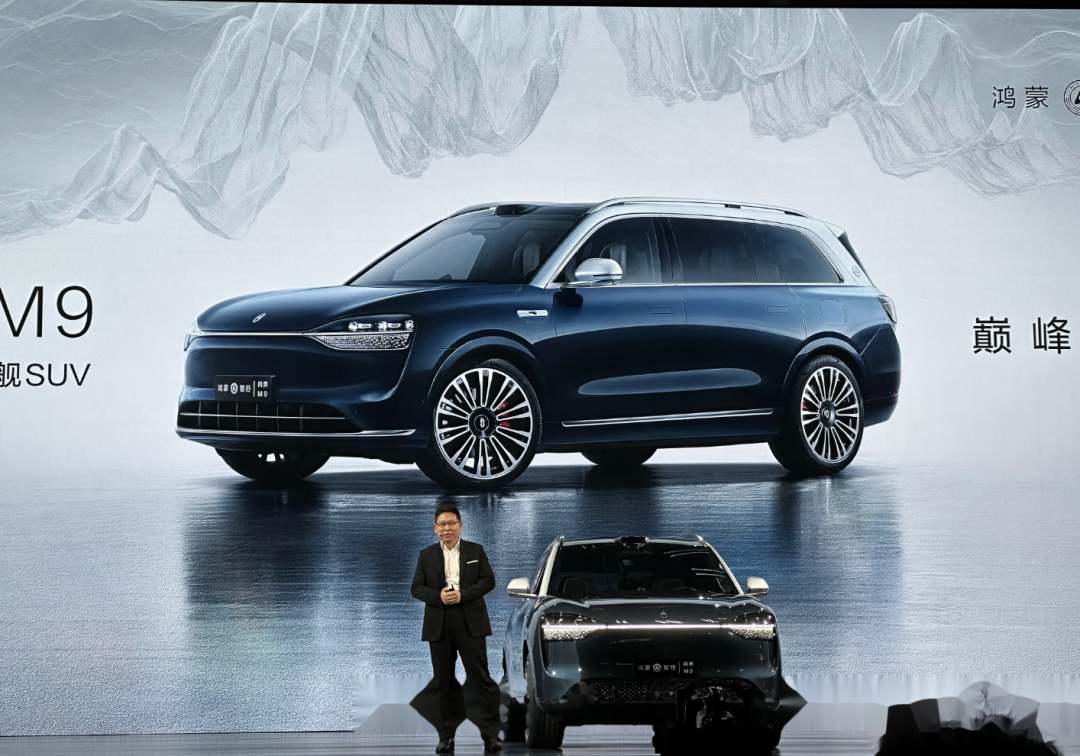
In December 2023, when the AITO M9 launched, his phrasing changed to "the best SUV under 10 million yuan."
In March 2024, when the Xiaomi SU7 launched, Lei Jun, founder of Xiaomi Group, said bluntly at the launch event that the product "must fight Porsche Taycan to the death in performance." The former's price is only a quarter of the latter's entry-level version.
The third round, from 2024 to now, has seen the benchmarks shift to hit models from Chinese brands.
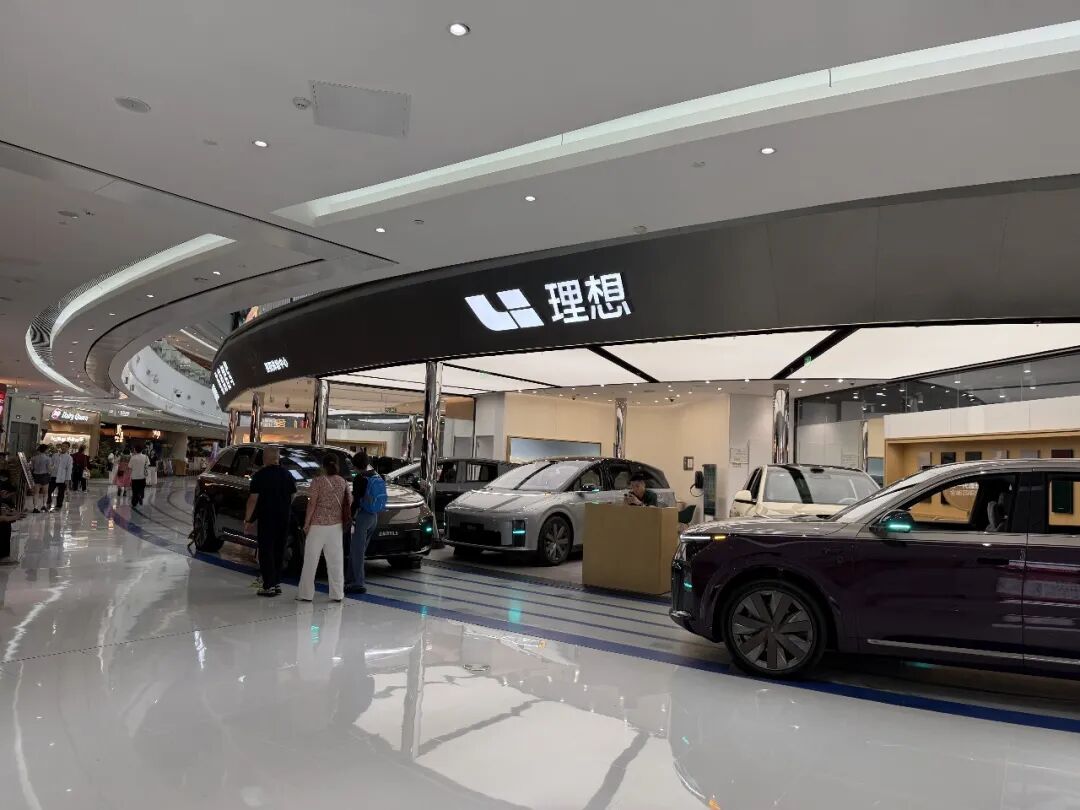
The Li Auto L9 launched in June 2022 and encountered a wave of benchmarkers within two years—the Leapmotor C16 entered with the label of "half-price Li Auto."
The AITO M9 launched in December 2023. By September 2025, the Galaxy M9 stood opposite it at 173,800 yuan and was called the "half-price AITO M9." To this day, many new cars still come to market under the banner of "half-price M9."
The Xiaomi SU7 launched in March 2024, and in 2026 new cars such as the Shangjie Z7, Fengyun A9, Galaxy TT, and MG07 surrounded it. Zhang Xiaoliang, founder of SoCar Product Strategy Consulting, said the SU7 is an affordable alternative to the supercar dream, and the MG07 in turn became an affordable alternative to the SU7. Official information shows that the MG07's limited-time price starts at 105,900 yuan, less than half of the Xiaomi SU7.
This generation of "half-price" battles is not fighting import taxes and brand taxes, but the little technology and brand premium that domestic brands have just accumulated—even if it has not yet had time to become a status symbol.
Lining up the price tags of these six years side by side, you will see that those applying the labels and those being labeled are basically not in the same price band. Challengers are concentrated in the 100,000-280,000 yuan range, while the targets range from 200,000 yuan to 6 million yuan. The price bands are disconnected by two or even three tiers, and the "half-price players" are mostly seizing entry-level users from the tier above.
Why has it come to this? The answer is not on the price list.
"The affordable-alternative wave is the result of overlapping changes in consumer attitudes, mature industrial technology, and price wars. Among them, the shift in consumers' car-buying standards is the underlying reason; price wars and technology wars are the drivers that accelerate its spread," Zhang Hong, a member of the Expert Committee of the China Automobile Dealers Association, told Bangning Studio. The affordable-alternative wave means that car consumption is shifting from proof of identity to a life solution.
Against this background, consumers still value quality, service, and experience, but they no longer assume by default that a high price necessarily equals high value. They are more willing to pay for technology and services that truly improve the experience of use, while refusing to repeatedly pay for brand halos.
Zhang Hong believes that for automakers, "half-price XX" may bring short-term sales but makes it difficult to build a brand over the long term. What truly remains are companies that do cost control, product quality, service systems, and technology iteration well together. Otherwise, affordable alternatives will ultimately become consumptive competition with similar parameters and lower prices.
The 2026 Consumer Sentiment Insight Report shows that more than 95% of consumers review comments, check ingredient lists, and search for affordable alternatives before placing an order, while only about 4.3% place orders directly. When faced with products with similar functions but prices several times those of similar products, about 42.1% of people first look for affordable alternatives, and only 23.9% agree that "you get what you pay for."
"The price war is only an amplifier. What truly makes affordable alternatives stand is that the product itself is already close enough. But some low-priced cars differ too much in experience, and consumers will only regard them as cheap options," Zhang Hong said. In the first half of 2026, sales of new energy passenger vehicles above 400,000 yuan increased 46% year on year.
On one side, price bands are shifting downward; on the other, the high-end car market is still growing. Although "half-price" and "affordable alternative" are prevalent, the market is not simply moving downward—it is just re-queuing.
Of course, there are exceptions. The Shangjie Z7 has an entry price of 219,800 yuan, only 100 yuan cheaper than the new-generation Xiaomi SU7 it benchmarks. The two cars fight close-quarters in the same price band, and the words "half-price" fail here, replaced by another approach—same price, but more features.
In this regard, Zhang Xiaoliang said that although both talk about "affordable alternatives," the product logic splits into two paths: one is the sinking of advanced value, redoing the space, cabin, and comfort features already proven effective in high-priced cars with a lower cost structure. The Leapmotor C10 and C16 take this route.
The other is called complete functional substitution, not copying high-priced cars but redefining what a car should have around commuting, school runs, and short trips. The BYD Seagull takes this route, selling nearly 480,000 vehicles in 2024 and about 530,000 in 2025.
"The former competes over the cost of realizing overestimated high-end capabilities; the latter competes over the underestimated completeness of daily use. Both paths can succeed, but if mixed, you end up relying on neither," Zhang Xiaoliang said.
▍02 Loss of share
Most of the targets end up poorly, with market share mostly eaten away and product lines shrinking, especially fuel vehicles.
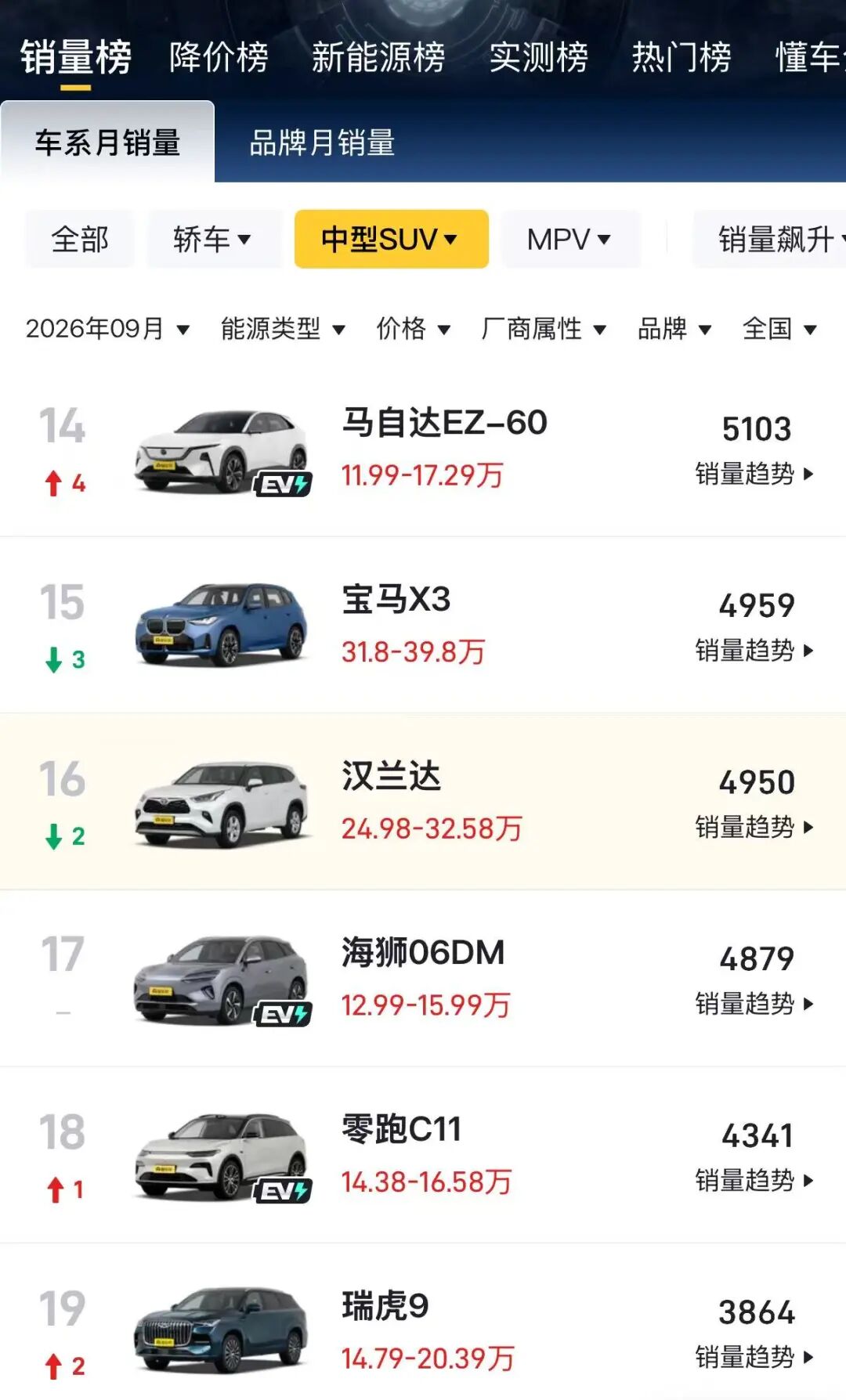
According to data from the Dongchedi App, the Highlander's retail sales fell to 4,950 vehicles in September 2026, with sales of less than 50,000 in the first three quarters; the GL8 fuel version fell to 2,442 vehicles in September.
Porsche China sold 21,500 vehicles in the first three quarters, down 33.2% year on year; BBA (Mercedes-Benz, BMW, Audi) all fell by more than 20% in the third quarter, and none sold more than 10,000 vehicles in September.
The difference in outcomes lies in whether what is being attacked is capability or identity.
For example, the Highlander's reliability and durability are a set of replicable parameters. The Li Auto L7, AITO M7, and Tang DM-i put space, energy consumption, and configuration at the same price, making it easy for consumers to change their minds.
But Porsche's crest, Maybach's double-M standing emblem, and the Alphard's circle symbol cannot be replicated by other automakers. The S9 can call itself "more luxurious than a Maybach," but people who buy a Maybach will not switch to the S9 just because it is 1 million yuan cheaper.
Zhang Xiaoliang calls this change "value anchor migration." He breaks user-side value into four categories—identity, capability, experience, and trust—and then separately calculates economic constraints such as price, cost of use, and residual value.
In his view, a capability being important to users does not mean it necessarily affects purchase decisions; affecting purchase does not mean users are willing to pay more for it; being willing to pay more does not mean there are not enough other products on the market that can provide it. The answers to these four questions are often different.
This means that a value anchor must go through five stages: discovery, establishment, diffusion, popularization, and re-evaluation. The diffusion period is the comfort zone for affordable alternatives; users may feel the product is valuable, but the supply chain will drive costs down. By the re-evaluation period, the product capability remains, but the premium disappears.
Zhang Hong said that in the later stage of affordable alternative products, several dangerous signals will appear at the same time—core technology is copied, the experience gap narrows, consumers start doing the math, the price difference becomes glaring, the brand halo weakens, and products become homogeneous. If these conditions are all present, high-end brands enter the danger zone.
He calls such brands "hardware-luxury types"—selling expensive through configuration, materials, and brand stories, but without forming barriers in software, ecosystem, service, and long-term reliability.
Conversely, brands that are hard to replace always have a few things others cannot copy, such as proprietary technology, a complete service system, a stable reputation, and an experience users are willing to pay for over the long term.
Value types explain "what will be copied," and brand types explain "who will be copied first." Stack the two rulers together and the conclusion emerges—luxury built by piling on configuration is caught up with after one price cut; luxury built by systems cannot be caught up with even after a price cut.
Now look at the side applying the labels; their fates fall into three types.
The first is the successful ones.
Xiaomi turned "half-price" into a business, delivering 411,100 vehicles in 2025, up 200.4% year on year, with the SU7 alone reaching 246,000 vehicles and taking the sales crown among sedans above 200,000 yuan. The Zeekr 9X starts at 455,900 yuan, with orders exceeding 10,000 in 13 minutes after sales began; when the five-seat version launched in July 2026, the German top luxury modification brand Mansory ordered 200 vehicles the next day.
The Zunjie S800 delivered more than 7,000 vehicles in its first half year on the market, surpassing the combined sales of the "78S (BMW 7 Series, Audi A8L, Mercedes-Benz S-Class)" for two consecutive months.
The second group consists of those that have already failed. From August to October 2023, monthly deliveries of the HiPhi Y remained below 2,000 vehicles, and HiPhi subsequently fell into a funding crisis. The Neta L attempted to offer generous space, extended-range power, and a relatively complete family SUV experience at a lower price, but failed to translate that into delivery scale.
"These two cases cannot simply be attributed to the failure of affordable alternative products, but they also remind us that similar configurations and lower prices do not guarantee that users will buy; even if the right product opportunity is identified, it does not mean the company is necessarily capable of turning that opportunity into commercial success," Zhang Xiaoliang said.
The third group consists of those still under observation. For example, since batch deliveries began on October 18, the Yijing X9 sold 3,612 vehicles in two weeks, with mid- and high-end trims accounting for more than 95% and an average transaction price exceeding 340,000 yuan—a promising start. But Yijing is a new brand, and its store count, after-sales network, and used-car residual value have yet to undergo a complete test, so its momentum remains to be seen.
Behind these three fates, Zhang Hong believes there are four barriers: identifying the right value proposition, making the cost calculation work, building trust, and supporting a product matrix. For example, Leapmotor first drove down costs through full-domain in-house development and platformization, with the proportion of core components developed and manufactured in-house exceeding 65% and the vehicle architecture generalization rate reaching 88%; the money saved comes from technology and management.
"The order of these four barriers cannot be reversed. If the cost calculation does not work, trust cannot be built; if the matrix cannot be supported, a single hit model can only sustain you for a while. The chain will also bite back," Zhang Hong said.
It is worth mentioning that AITO is rather special: it is both a labeler and a labeled target. At the end of 2023, it used the M9 to benchmark the Maybach and Cullinan; in 2026, the Yijing X9, Galaxy M9, and Huajing S all entered the six-seat family market where AITO excels, with prices under 300,000 yuan, courting the same prospective users.
Capability value can be replaced, but identity value is hard to replace. "Half-price" can capture market share, but it is hard to capture the brand.
As for how far alternative products can go, Zhang Xiaoliang believes the key lies in whether they can inherit the core experience of the products they are replacing. If they can, then a half-price downgrade can truly be called a replacement; if they cannot, it is merely a cheaper option. Following this premise, as long as the core experience can still be inherited and delivered at a lower cost, alternatives will not stop.
"In the next one to two years, the most likely targets for the next round of alternatives are the mid-to-high-end family market priced at 200,000 to 350,000 yuan, as well as fuel vehicles and oil-to-electric products from traditional joint ventures and luxury brands," Zhang Hong said.
Moreover, the endpoint of the half-price label is that it will itself be labeled with an even cheaper half-price. The market has no permanent benchmark, only the next "half-price XX" and "XX alternative." Who will this label be attached to next time?
(The cover image was created with AI)
-
![]()
Cars That Sell Well Will All Be Replaced by Cheaper Alternatives Eventually
-
![]()
The 'Golden September and Silver October' Phenomenon Has All but Vanished: The Auto Market Enters an Era of Pure Survival
-
![]()
Tesla Sold Just 8,817 Vehicles in October—But the Factory Didn't Build a Single One Fewer
-
The King of Mobile Chips Shifts Battlefields
-
Amid the Personal Agent Boom, Xiaohongshu Enters the Fray with "Mishu"
-
![]()
Geely Auto October Sales: Xingyuan Hits 50,000 Units a Month, but What Does the Bigger Picture Look Like?
-
Chinese Brands Capture 90% of Thailand's Pure Electric Market—How Did the Japanese "Backyard" Slip Away?
-
![]()
Memory Price Hikes Leave Notebook Market Reeling: Q3 Sales Plunge 14%, Yet Apple Gains Ground