Tesla Sold Just 8,817 Vehicles in October—But the Factory Didn't Build a Single One Fewer
 11/11 2026
 495
Produced by Zhineng Technology
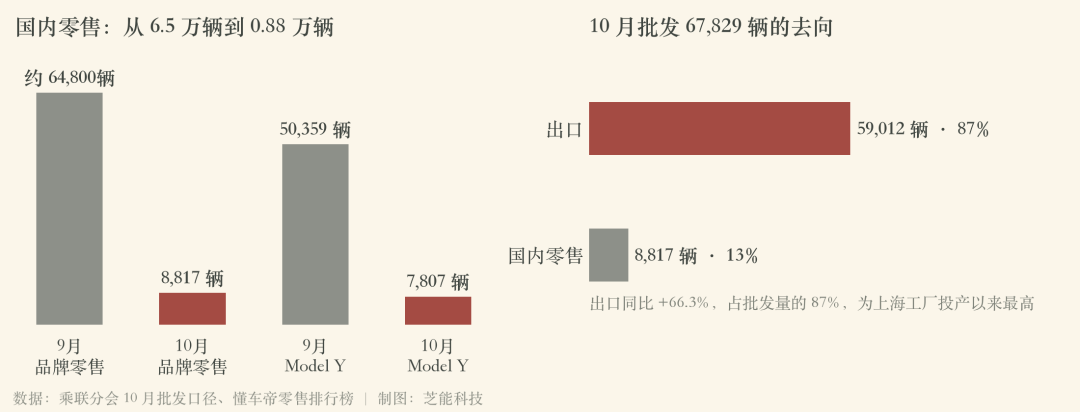
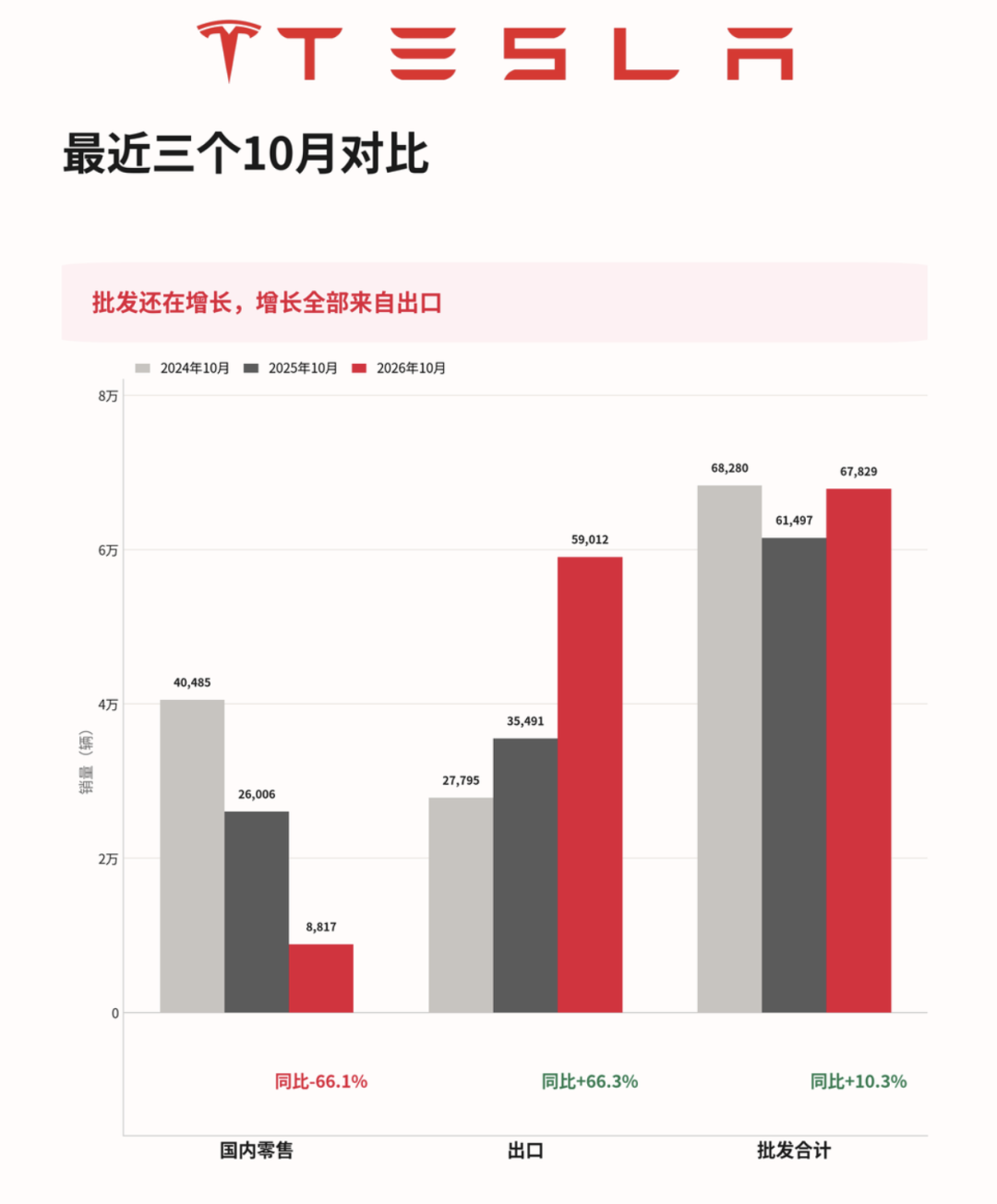
On November 10, Dongchedi's retail rankings revealed that Tesla China's domestic retail sales in October came in at 8,817 units, down 66.1% year-on-year—the lowest monthly figure since July 2022 and the fifth consecutive month of year-on-year decline.
Model Y monthly retail sales stood at 7,807 units, more than 42,000 fewer than September's 50,359, dropping from 1st to 66th place; Model 3 was left with just 1,010 units.
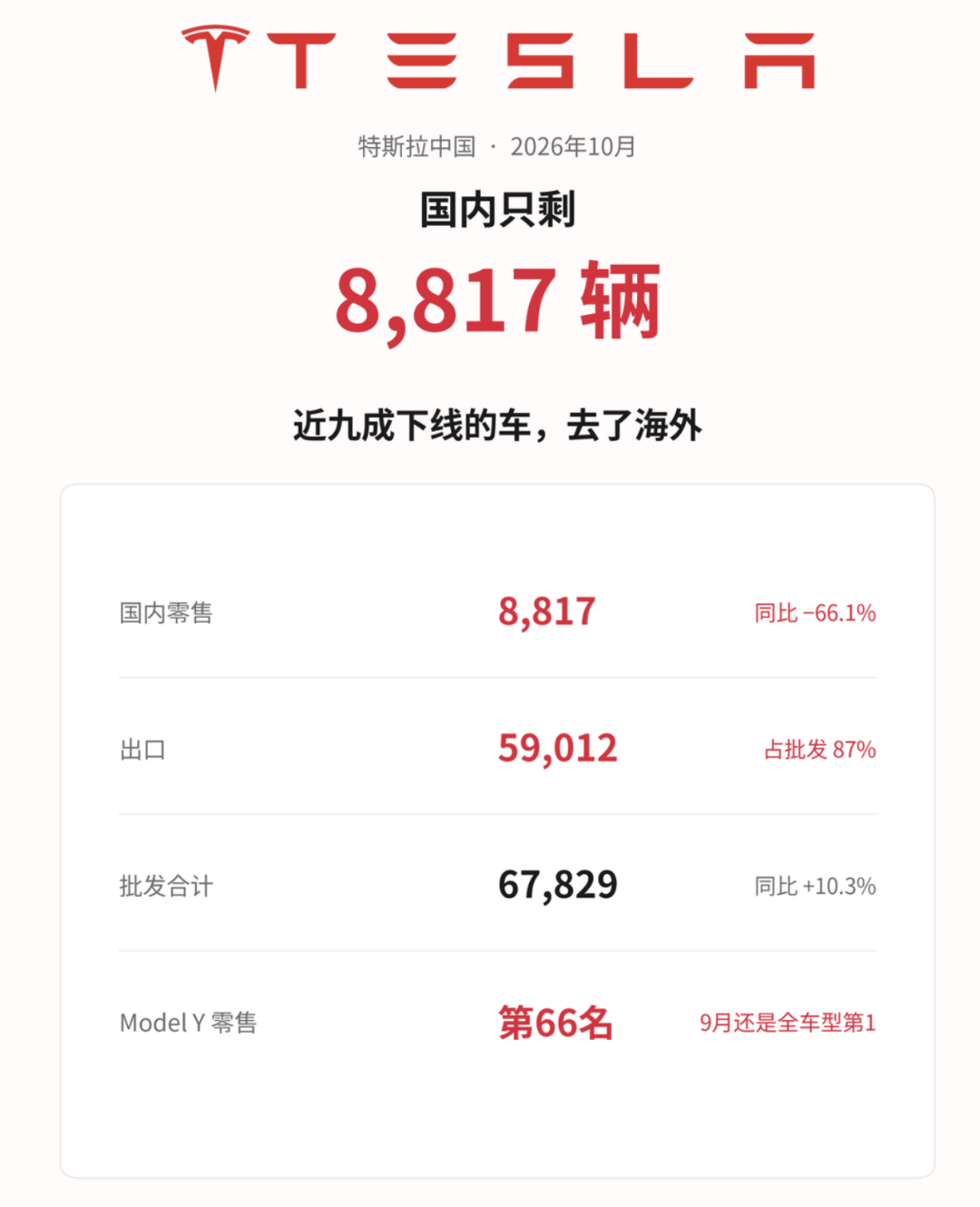
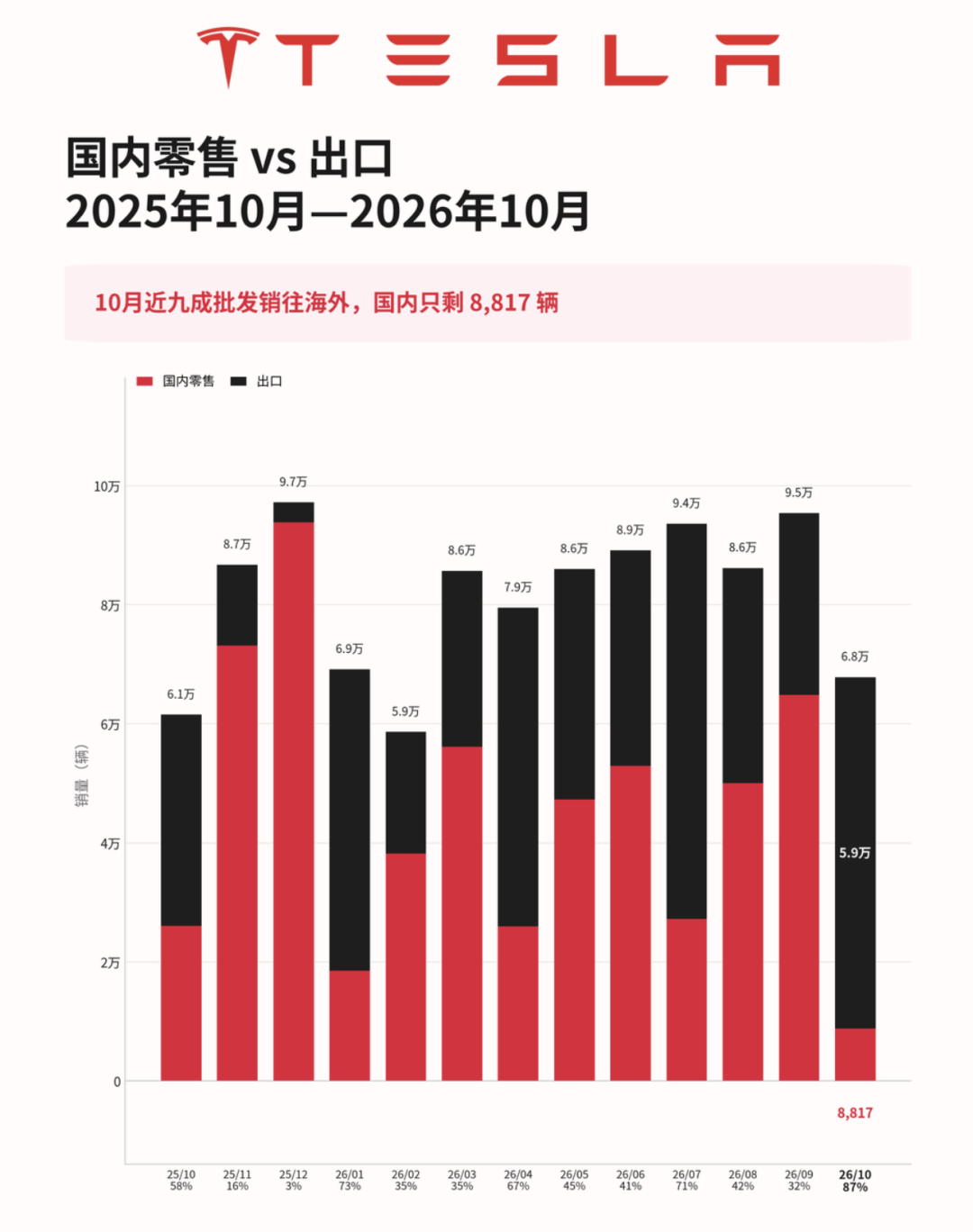
Tesla's Shanghai factory wholesale volume in October reached 67,829 units, up 10.3% year-on-year—the 12th consecutive month of year-on-year growth. Of that, exports totaled 59,012 units, up 66.3% year-on-year, accounting for 87% of wholesale volume—a new high for export share since the Shanghai factory began production.
Of the vehicles rolling off the line in Shanghai in October, nearly 90% were shipped overseas, leaving only a tiny fraction for domestic retail.
Tesla's rhythm has always been to prioritize exports in the first month of each quarter and concentrate domestic deliveries at quarter-end. In the first three quarters of this year, every month with the lowest domestic sales fell in the first month of a quarter.
September was a quarter-end month, and combined with the delivery momentum of the Model Y L, the domestic base was raised to around 65,000 units—so October naturally fell sharply by comparison.
A salesperson at a Beijing store explained: "Capacity at the beginning of the quarter all goes to overseas markets, so domestic deliveries are low." The store currently has no cars in stock: the Model Y base version has a delivery window of 1–3 weeks, and other versions 3–5 weeks.
Where capacity goes and what demand looks like—neither is about Tesla being unable to sell cars.
Five consecutive months of year-on-year decline.
The quarterly rhythm can drag a single month to the bottom and pull it back to a high at quarter-end, but looking quarter by quarter, the trend is downward.
In the first nine months of this year, Tesla's cumulative retail sales in China totaled 381,100 units.
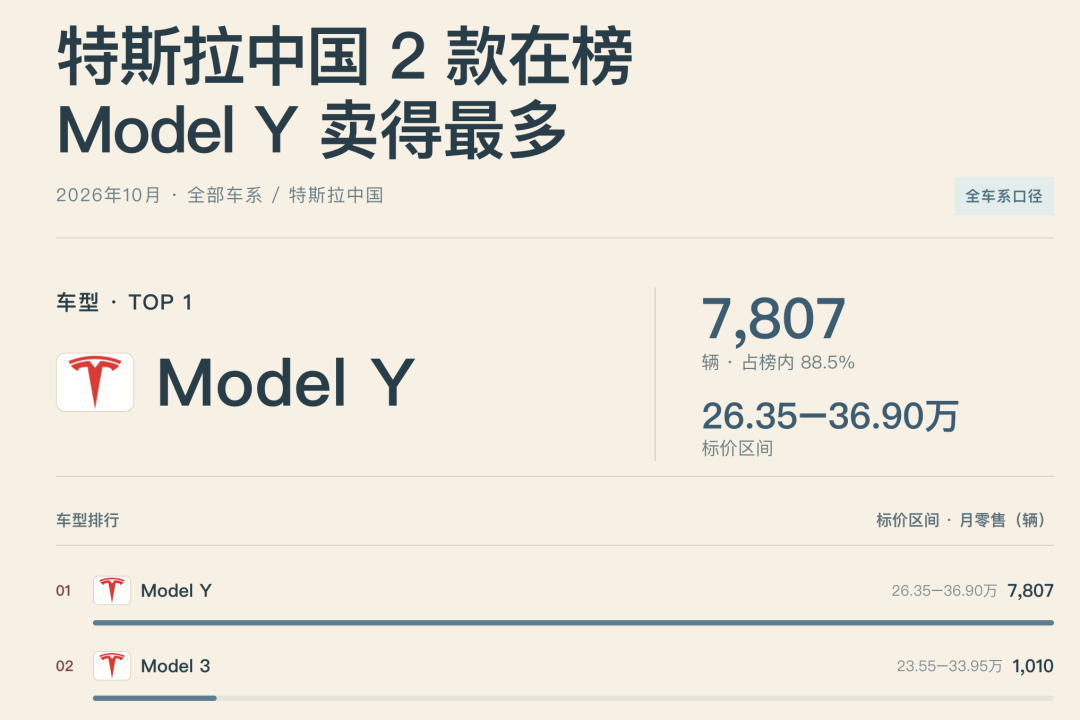
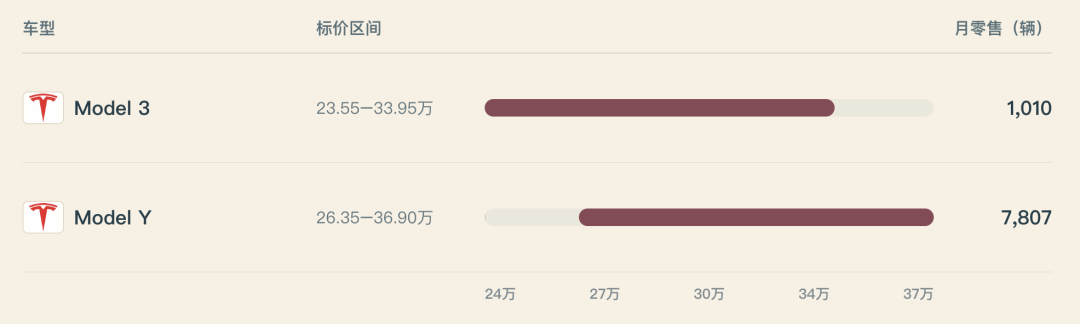
The Model Y alone carries the brand's entire sales volume, so any capacity allocation gets magnified into a "crash"; and the reason this magnification holds is that the other half is already bleeding—the Model 3 sold only 1,010 units in October.
A sedan launched in 2019 is no longer a must-pick in the pure electric sedan market above 200,000 yuan.
The top pure electric SUV in October was the Xiaomi YU7, with retail sales of 33,662 units, surpassing the Model Y.
In the same month, Leapmotor delivered 106,127 units, XPeng 50,237 units, Xiaomi over 50,000 units, NIO 34,246 units, HarmonyOS Intelligent Mobility 33,537 units, and Li Auto 29,025 units.
The 200,000–300,000 yuan price band that Tesla once defined is now crowded with domestic cars featuring longer wheelbases, faster charging, and more frequent intelligent driving iterations.
The Model Y is still selling on its brand and efficiency, but its benchmark dividend is narrowing.
Tesla Q3:
◎ Global production 464,391 units, deliveries 486,532 units, with deliveries exceeding 480,000 units for two consecutive quarters;
◎ Revenue $28.046 billion, basically flat year-on-year;
◎ Gross margin rebounded to 19.6%, automotive business gross margin excluding carbon credits 18.1%.
◎ But operating margin was only 2.6%, down 56% year-on-year; GAAP net income $787 million, down 43% year-on-year.
Musk said undelivered orders are the highest in nearly four years.
-
![]()
Cars That Sell Well Will All Be Replaced by Cheaper Alternatives Eventually
-
![]()
The 'Golden September and Silver October' Phenomenon Has All but Vanished: The Auto Market Enters an Era of Pure Survival
-
![]()
Tesla Sold Just 8,817 Vehicles in October—But the Factory Didn't Build a Single One Fewer
-
The King of Mobile Chips Shifts Battlefields
-
Amid the Personal Agent Boom, Xiaohongshu Enters the Fray with "Mishu"
-
![]()
Geely Auto October Sales: Xingyuan Hits 50,000 Units a Month, but What Does the Bigger Picture Look Like?
-
Chinese Brands Capture 90% of Thailand's Pure Electric Market—How Did the Japanese "Backyard" Slip Away?
-
![]()
Memory Price Hikes Leave Notebook Market Reeling: Q3 Sales Plunge 14%, Yet Apple Gains Ground