The 'Golden September and Silver October' Phenomenon Has All but Vanished: The Auto Market Enters an Era of Pure Survival
 11/11 2026
 539

Text / Yang Xuejian Source / Node Auto
'For the first time in so many years, the Golden September and Silver October phenomenon has all but vanished—and going forward, this may well become the norm.' Gui Shengyue, vice chairman and executive director of Geely Automobile Holdings Limited, put it bluntly at the company's (0175.HK) third-quarter earnings call.
Data source: China Passenger Car Association
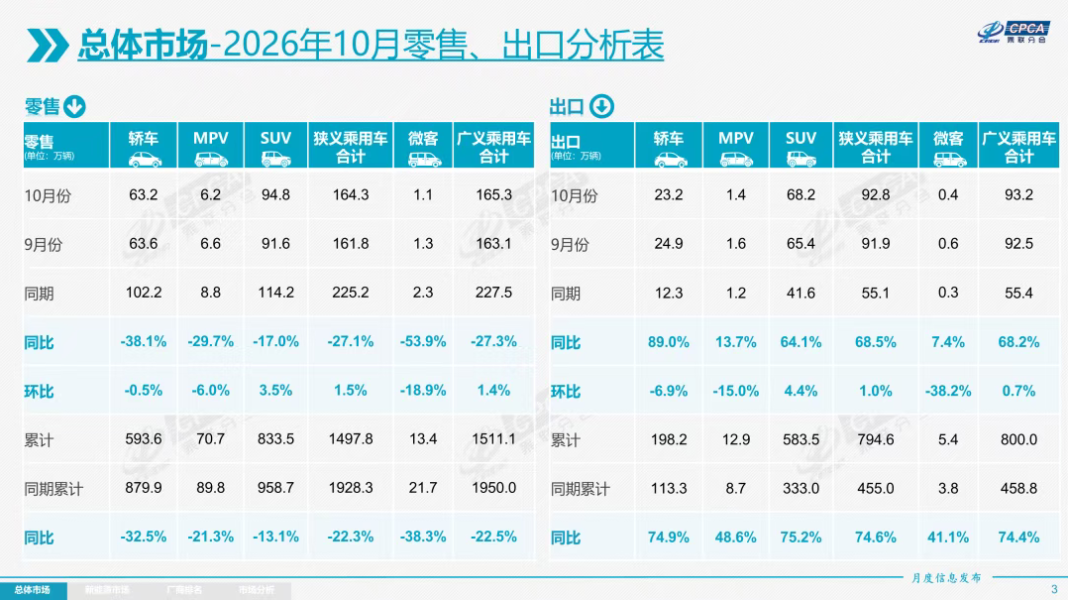
In September 2026, China's passenger car retail sales came in at 1.618 million units, down 28% year on year; in October, retail sales reached 1.643 million units, down 27.1% year on year. From January to October, cumulative passenger car retail sales totaled 14.978 million units, down 22.3% year on year. (Note: Data source is the China Passenger Car Association; sales figures are based on narrow passenger car statistics.) For the second consecutive month, the domestic market failed to deliver the traditional Golden September and Silver October peak-season performance, and the October decline outpaced the cumulative decline for the first ten months—seemingly throwing a bucket of cold water on the auto market well ahead of the fourth quarter.
On November 9, at the National Passenger Car Market Analysis and Seminar, Cui Dongshu, secretary-general of the China Passenger Car Association, weighed in on the September and October 2026 passenger car market: 'The traditional concentrated explosion of Golden September and Silver October will most likely become normalized and weakened. The core reason is that the auto market has entered an era of stock replacement: the pool of first-time buyers is shrinking, purchasing power is low, and high-end groups have stronger consumption.'
On one side are automakers who feel the temperature most directly; on the other are research institutions coordinating macro data. When their conclusions converge, it shows that the concept of the Golden September and Silver October peak season—which held strong for more than a decade—has truly become a thing of the past.
In Node Auto's view, however, today's Chinese automakers are no longer confined to domestic soil. Even if Golden September and Silver October no longer exist, overseas markets have become a battleground every player must contest. After years of talking up going global, in the autumn of 2026, overseas markets have become a new world for Chinese automobiles.

China's Auto Market Is Uneven
Following the sales data, Node Auto found that the sense of anxiety that filled the auto market in past years seems to be fading, replaced by an increasingly clear state of differentiation: differentiation in sales by vehicle category, by energy type, by market structure, and accelerating differentiation among automaker camps.
The most obvious differentiation is the retail gap between sedans and SUVs. In October, sedans fell 38% year on year, MPVs fell 30%, and SUVs fell 17%—the decline in sedans was nearly double that of SUVs. Traditional sedans, especially A-class fuel vehicles, once formed an important sales base for the auto market. Now, as the mass base for sedans loosens, SUVs are accounting for a heavier share. SUV products are popular, and this too shows differentiation, with more incremental volume coming from new energy SUVs.
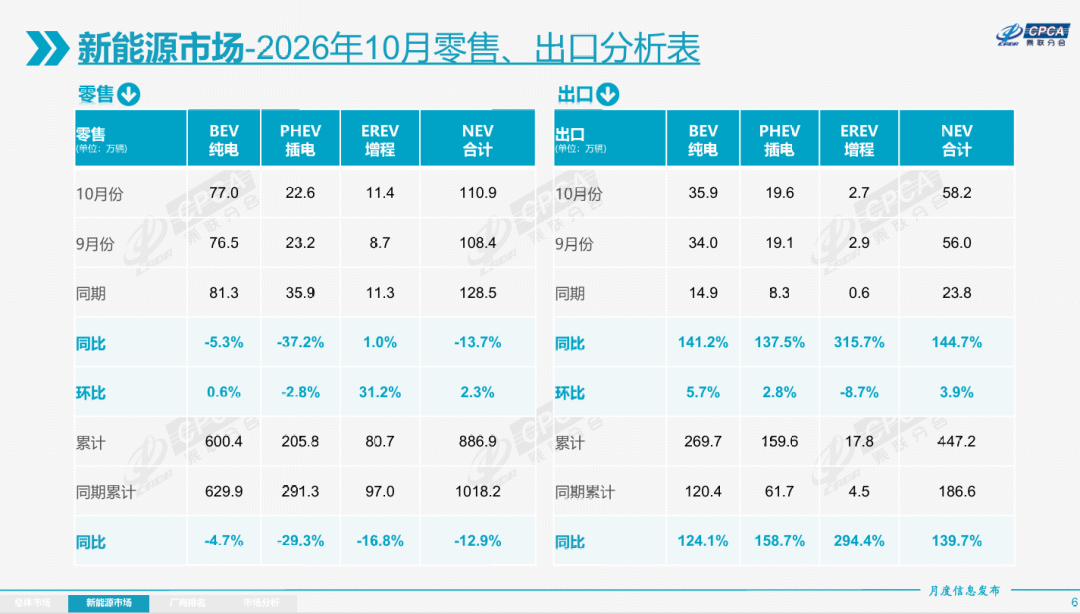
Turning to the new energy vehicle market: in October, domestic retail sales of new energy passenger cars were 1.109 million units, down 13.7% year on year, but the retail penetration rate of new energy passenger cars simultaneously reached a record 67.5%. The China Passenger Car Association pointed out that the rise in the penetration rate was mainly because fuel vehicles were shrinking faster, with retail sales of conventional fuel passenger cars down 45% year on year. The differentiation between new energy vehicles and fuel vehicles has also accelerated over these two months. Combined with rising oil prices, more consumers are choosing to embrace new energy vehicles.
'Against the backdrop of pressure on the overall auto market in October 2026 and a year-on-year decline in retail sales, the strong performance of exports has become a key variable supporting automakers' sales,' Cui Dongshu said. He further analyzed: 'The export structure shows an obvious characteristic of mainstream mid- and low-priced models, which directly helped mainstream independent brands perform more prominently in performance differentiation.'
In October, passenger car exports were 928,000 units, up 68.5% year on year, accounting for 35% of manufacturers' sales—higher than 19% in the same period last year. Among them, new energy passenger car exports were 582,000 units, up 144.7% year on year, accounting for 62.8% of total exports, an increase of about 20 percentage points from the same period last year. Cui Dongshu pointed out that, unlike the domestic market trend in which large vehicles attract more attention, the main export force skews toward mid- and low-priced models.
Node Auto believes that as domestic automobile consumer demand enters the stage of stock competition, overseas sales expansion has become an important direction for the auto market. This also means that automakers with the ability to operate in both domestic and overseas markets will hold more initiative.
Statistics from the China Passenger Car Association show that the top three in new energy exports in October were BYD with 165,000 units, Chery with 84,000 units, and Geely with 80,000 units. Focusing on new force brands, it is also clear that brands that have already laid out overseas operations clearly hold more initiative.
Differentiation Within the New Force Brand Camp Intensifies
The uneven hot and cold is also particularly obvious on automakers' posters during this Golden September and Silver October. Leapmotor, XPeng, and Xiaomi were still able to release sales reports with relative ease; while NIO, HIMA, and Zeekr, with monthly sales of 30,000 vehicles, know their own warmth and coldness in the current situation; 'model student' Li Auto falling below 30,000 vehicles in October surprised many people.
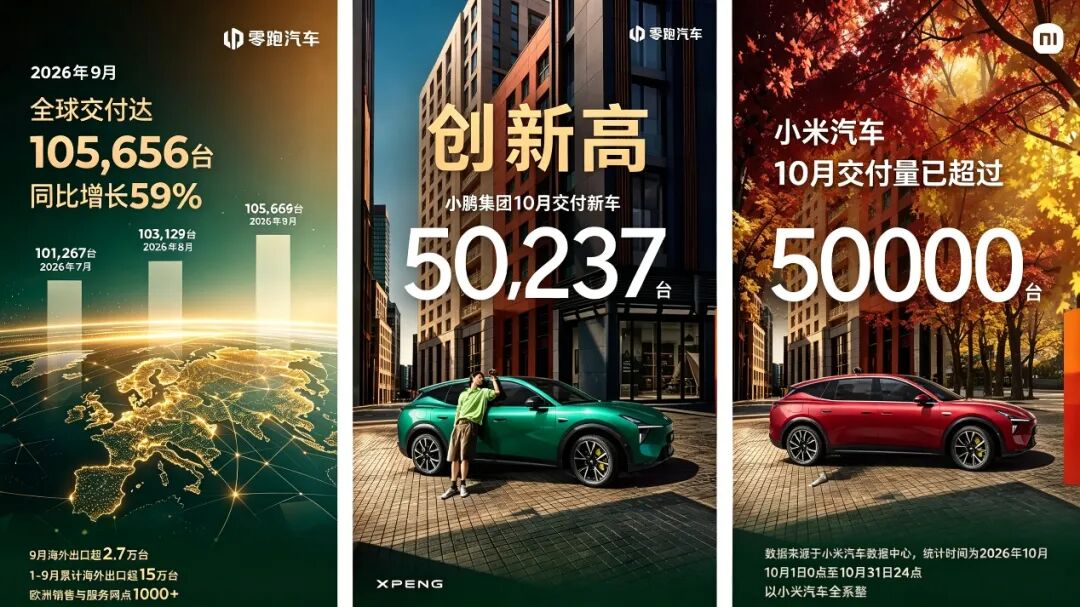
The camp of new force brands has become relatively clear. The first tier, dominated by Leapmotor, XPeng, and Xiaomi, shows a common characteristic: they have shifted toward system efficiency and overseas markets and no longer rely on the explosion of a single model.
Among them, Leapmotor delivered 105,000 vehicles in October, up 51% year on year, standing above the 100,000 mark for four consecutive months. Node Auto believes that the significance of Leapmotor's consecutive 100,000+ deliveries is not just good-looking numbers. Its cooperation with Stellantis overseas has brought Leapmotor a dual qualitative change in scale and brand, further diluting R&D, procurement, and manufacturing costs. In the mainstream price band with the fiercest price competition, Leapmotor can be said to have achieved a 'big result.'
Xiaomi Auto delivered more than 50,000 vehicles in October, another step up from 'more than 40,000 vehicles' in September. The Pengcheng series, launched and beginning deliveries in September, expanded Xiaomi Auto's product matrix from pure electric to extended range, and terminal numbers also grew. No one would question Xiaomi Auto's marketing ability. What needs to be focused on next is only whether the production capacity and service network of the new series can keep up with the order rhythm, as well as Xiaomi's new moves in the pure electric sequence.
XPeng delivered 50,237 vehicles in October, up 22% month on month and 20% year on year—a new monthly high; the bigger surprise came from overseas markets, where its overseas deliveries were 13,326 units, also setting a record. For XPeng, it has already taken the lead among 'NIO, XPeng, and Li Auto' in crossing the threshold of 'walking on two legs: domestic and overseas.' The good news is that the MONA L05, launched at the end of October with a limited-time benefit price starting at 139,800 yuan, will open up new mainstream price band space for XPeng after deliveries begin in November and will also bring better-looking sales numbers.
Behind 'Leapmotor, XPeng, and Xiaomi,' 30,000 vehicles has become a delicate threshold. Standing on it may not be easy, and falling off it would be terrible.
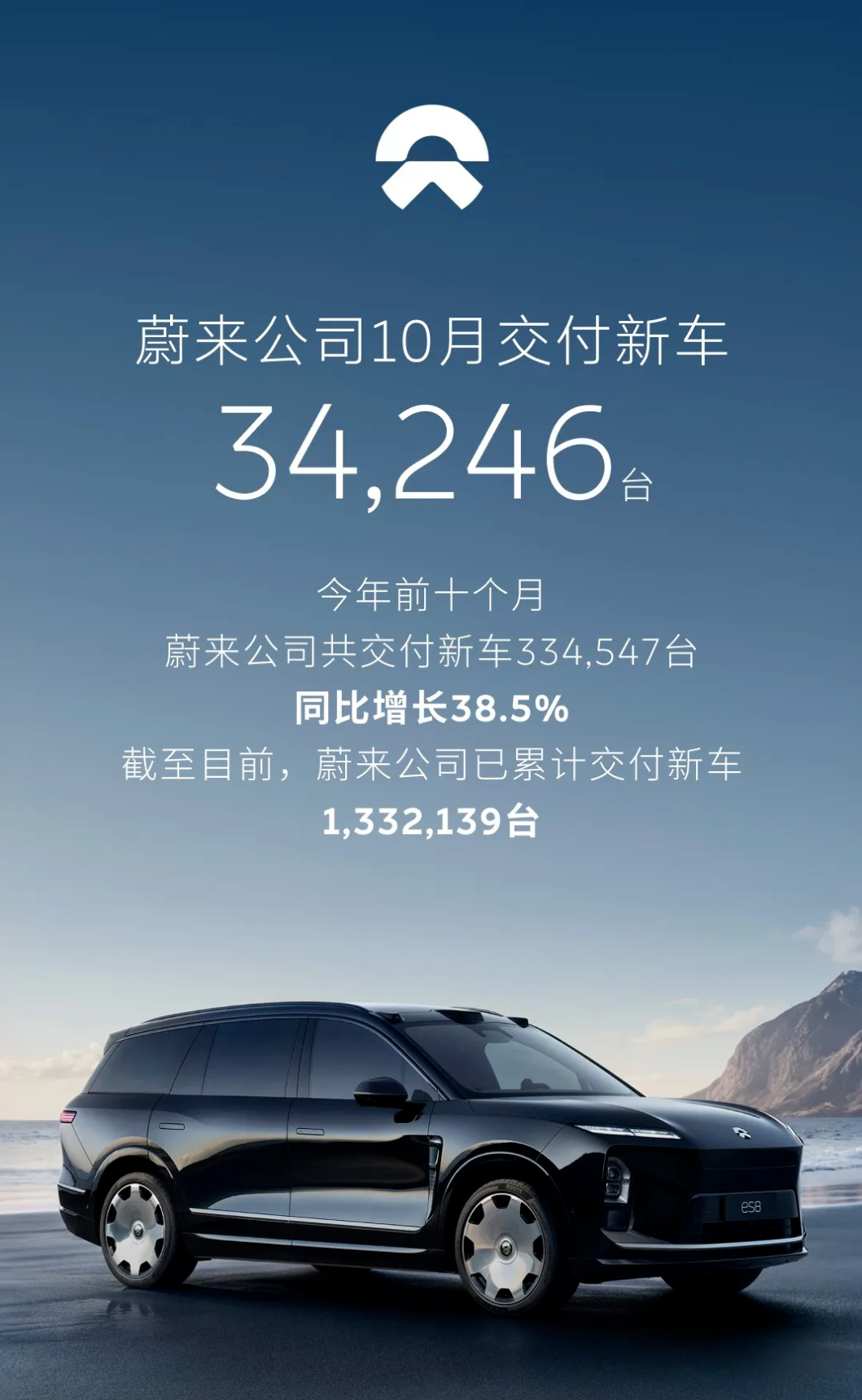
NIO delivered 34,246 vehicles in October, including 18,125 under the NIO brand, 8,383 under Onvo, and 7,738 under Firefly. Cumulative deliveries in the first ten months were 334,547 units, up 38.5% year on year. NIO's three brands have broadened user coverage, but the month-on-month decline in October is also reminding Li Bin that the popularity of NIO's flagship SUV needs new models to continue it. Whether the long-range version of Firefly and the addition of battery-swapping models can form stable incremental volume still needs further observation. Recently, issues such as the panoramic roof delamination outbreak on the Firefly product have also plunged this refined small car into quality control controversy. And Onvo, as a volume brand, with monthly deliveries of less than 10,000 units, can hardly be called passing. Perhaps this is exactly the root of why NIO, with monthly sales of 30,000 vehicles, still cannot hide its anxiety.
HIMA, which has been troubled for the past two months, delivered 33,537 vehicles in October, a month-on-month decline. What is more noteworthy than sales is the off-field turmoil surrounding HIMA. First, there was a change in the cooperation model with AITO, with Seres taking back core speaking rights for AITO, while Huawei Terminal will lead the other 'four boundaries' throughout the process. Just as this turmoil subsided, immediately after the National Day holiday, the Zunjie V800 brake pedal bracket incident plunged HIMA into an even bigger public opinion storm, and the truth still awaits the official investigation conclusion. But what is certain is that AITO remains an indispensable sales pillar for HIMA at present. It is just that after the turmoil, how the four boundaries plus AITO will develop next will become a focus of sustained industry attention.
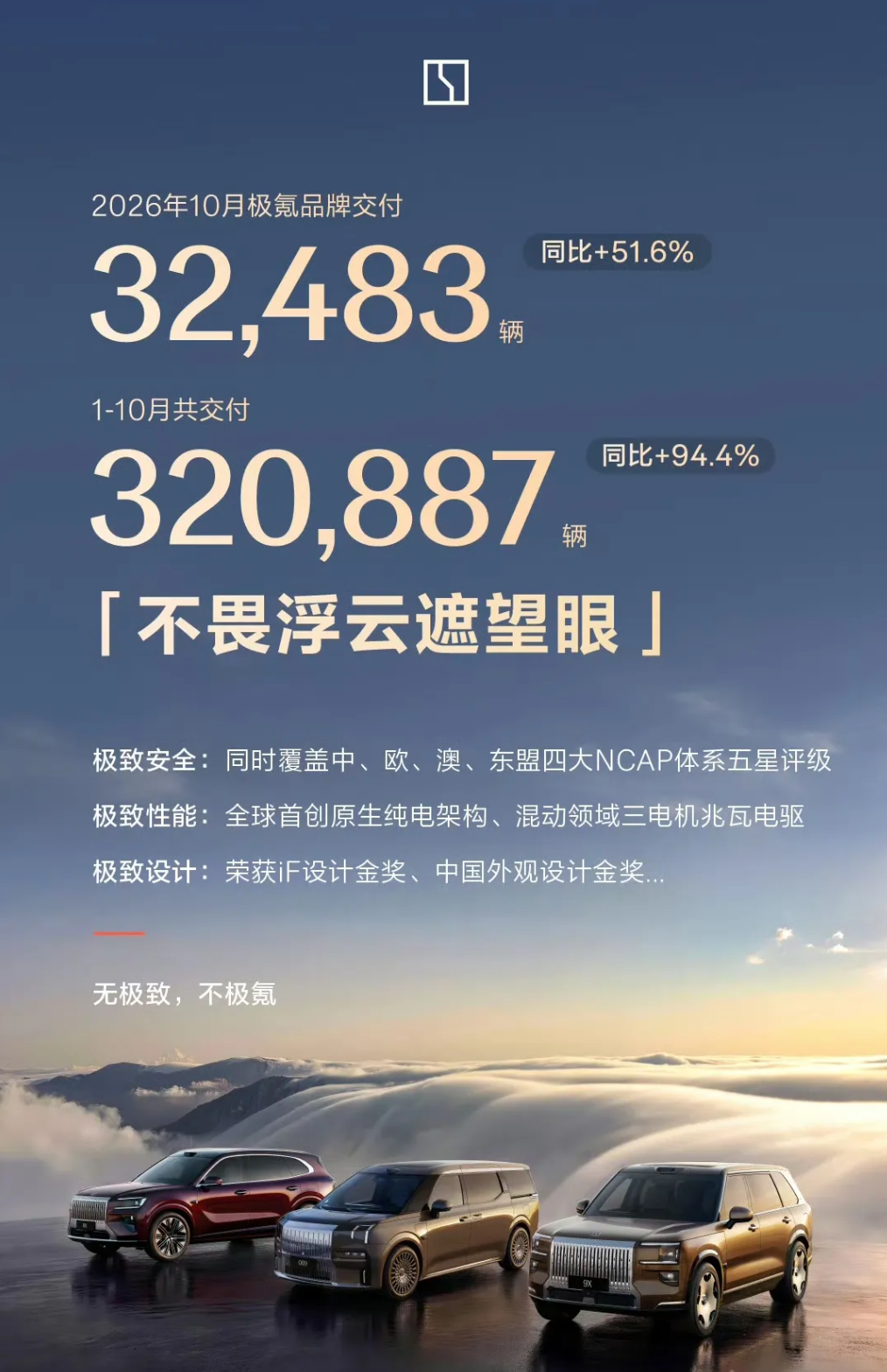
Zeekr delivered 32,483 vehicles in October, up 51.6% year on year, with cumulative deliveries of 320,887 units in the first ten months, a year-on-year increase of 94.4%, already hitting its annual target of 300,000 vehicles ahead of schedule. After a series of adjustments to organizational structure and product lineup, Zeekr has returned to a track of rapid growth. In the view of Node Auto, the market recognition of its high-end products is its most solid asset. As long as it maintains a stable product delivery rhythm, relying on Geely's layout in overseas markets, Zeekr is expected to return to the first tier.
Of course, there were also surprises. 'Model student' Li Auto seemed to underperform this time. After delivering 31,817 vehicles in September, its October deliveries fell to 29,025 vehicles, falling below 30,000 for the first time. This is obviously not the level Li Auto should be at, but on November 1, Li Auto still generously released its sales poster and seemed not to be affected by 'not doing well on the test.'
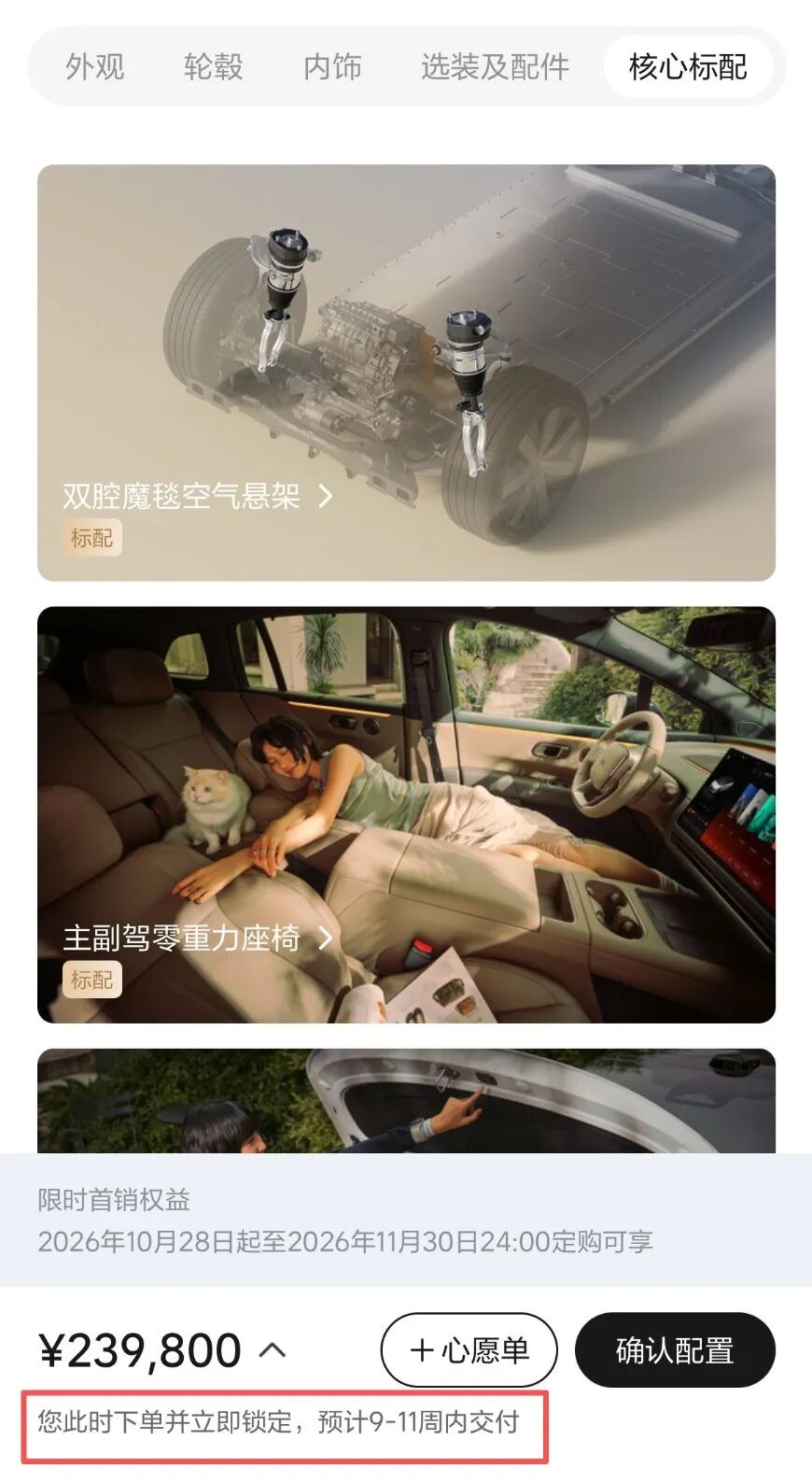
(Orders placed on November 10 for the new Li Auto i6 are already scheduled for delivery within 9-11 weeks)
Li Auto's calmness actually has a foundation. First, entering the second half of 2026, Li Auto clearly accelerated the speed and frequency of product updates. In recent months, it successively completed product updates for Li L9, L8, and L6, and based on a new pure electric platform launched Li i9, the new-generation MEGA Home version, and the new i6. The extended-range and pure electric product lines have simultaneously entered a concentrated renewal period. Second, the new Li i6 has already received a flood of orders and will enter a high-intensity delivery period in the next two months. Although Li Auto officially disclosed only that 'orders in 72 hours greatly exceeded the same period last year,' according to rough estimates by third parties based on delivery cycles in the Li Auto App and monthly production capacity, total orders for the new Li i6 are at about 50,000 to 55,000 units. On November 10, Node Auto tried to place an order for the new i6 in the Li Auto App, and the estimated delivery cycle shown was 9-11 weeks. Calculating from this time, the latest delivery window for some orders may be scheduled as late as early 2027.
Final Thoughts
As the year comes to an end, the biggest suspense in the auto market is the completion rate of annual targets. In a trend where even Golden September and Silver October have become a thing of the past, there may not be many brands that can achieve big results this year.
As mentioned above in Node Auto, judging by cumulative deliveries in October, Zeekr is currently the only brand that has clearly completed its annual target: 320,887 vehicles delivered in the first ten months, already exceeding its annual target of 300,000 vehicles.
Leapmotor has achieved over 100,000 deliveries for consecutive months and has set a target of 1 million vehicles for 2026. Cumulative deliveries in the first ten months totaled approximately 772,700 vehicles, leaving about 227,300 vehicles to reach the goal. Spread over two months, that requires an average of roughly 114,000 vehicles per month. So far, Leapmotor's performance this year has already been impressive enough. If it ultimately achieves the 1 million vehicle sales target, that would be an unprecedented feat in the history of China's new energy vehicle industry.
For most other automakers and brands, completing their annual targets in the remaining two months will prove quite difficult.
At this moment, the outline of the 2026 auto market may have essentially taken shape, but looking five years ahead, it is still hard to predict what kind of landscape China's auto market will evolve into. Perhaps those players who are slowly being edged out of the game will look back five years from now and suddenly realize that the Golden September and Silver October that vanished in 2026 was precisely that life-and-death dividing line?
-
![]()
Cars That Sell Well Will All Be Replaced by Cheaper Alternatives Eventually
-
![]()
The 'Golden September and Silver October' Phenomenon Has All but Vanished: The Auto Market Enters an Era of Pure Survival
-
![]()
Tesla Sold Just 8,817 Vehicles in October—But the Factory Didn't Build a Single One Fewer
-
The King of Mobile Chips Shifts Battlefields
-
Amid the Personal Agent Boom, Xiaohongshu Enters the Fray with "Mishu"
-
![]()
Geely Auto October Sales: Xingyuan Hits 50,000 Units a Month, but What Does the Bigger Picture Look Like?
-
Chinese Brands Capture 90% of Thailand's Pure Electric Market—How Did the Japanese "Backyard" Slip Away?
-
![]()
Memory Price Hikes Leave Notebook Market Reeling: Q3 Sales Plunge 14%, Yet Apple Gains Ground