Geely Auto October Sales: Xingyuan Hits 50,000 Units a Month, but What Does the Bigger Picture Look Like?
 11/11 2026
 548
Produced by Zhineng Technology
Geely Auto reported total October sales and exports of 310,183 units, of which 107,153 were exports. Current data shows Geely's terminal retail sales stood at 196,255 units, with the largest sales segment falling in the 100,000–150,000 yuan range.
The Galaxy lineup leans on the Xingyuan to drive customer traffic at lower price points, the fuel vehicle series uses the Xingyue L and Boyue L to retain mature users, and Lynk & Co and Zeekr separately push prices above 200,000 yuan.
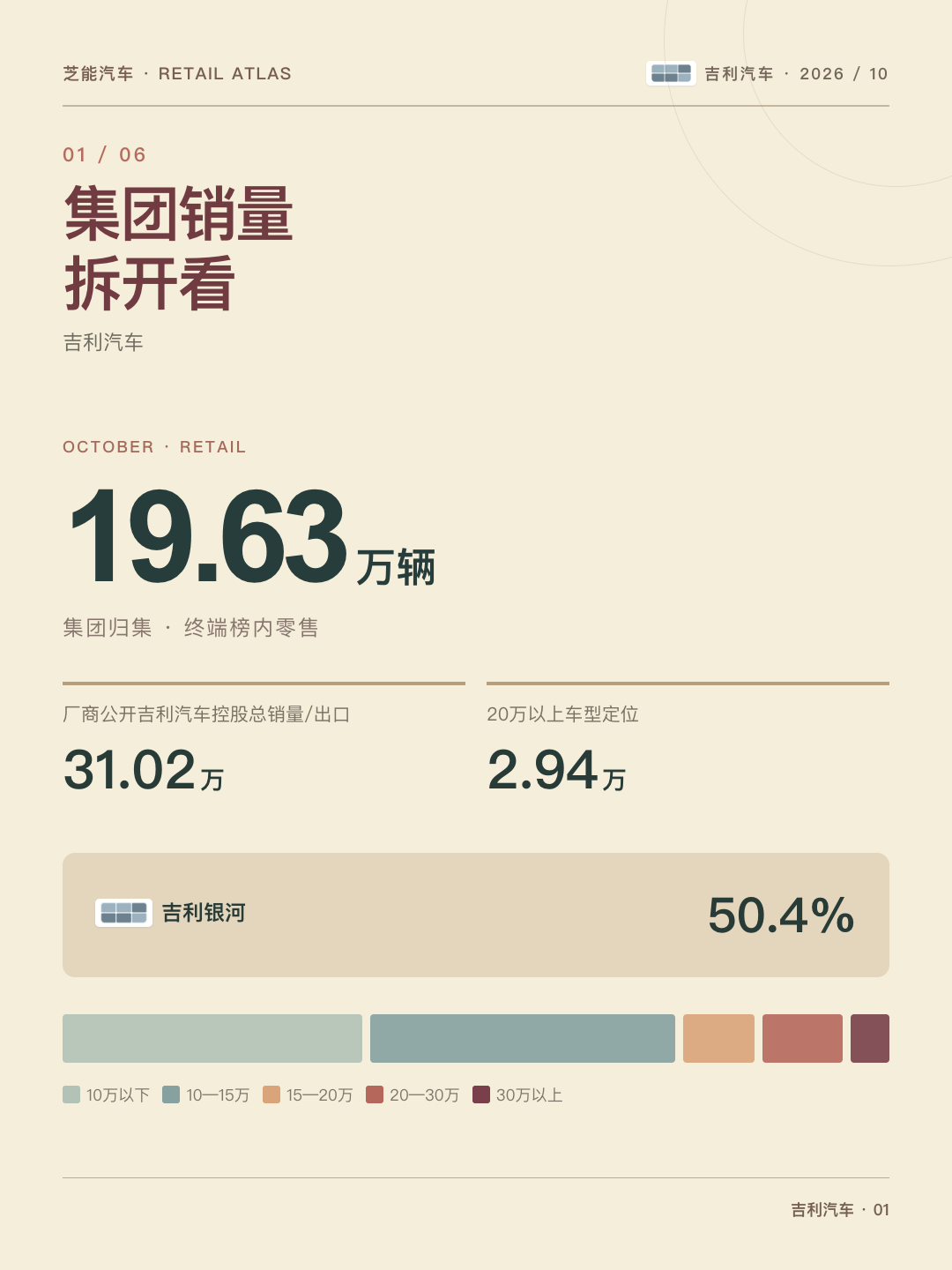
The announced 310,200 units include wholesale and exports, while the 196,255 units reflect terminal retail sales only.
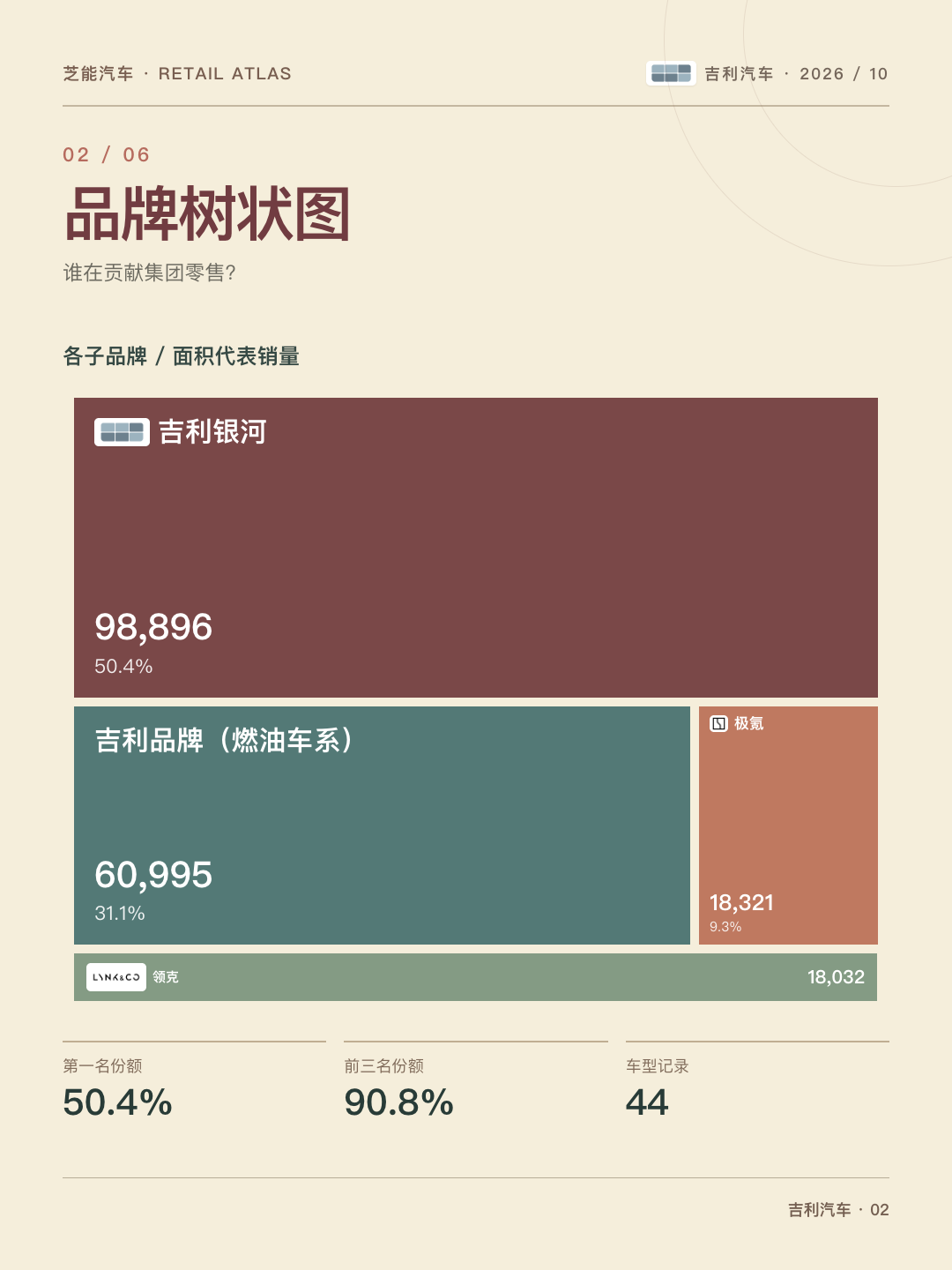
◎ Geely Galaxy: 98,896 units, accounting for 50.4%
◎ Geely brand (fuel vehicle series): 60,995 units, accounting for 31.1%
◎ Zeekr: 18,321 units, accounting for 9.3%
◎ Lynk & Co: 18,032 units, accounting for 9.2%
Galaxy's expansion is built in the most price-sensitive zone. The Xingyuan uses a small pure electric vehicle to capture customer traffic for Geely at low price points. Product updates and price adjustments around 100,000 yuan will immediately be amplified in total volume.
The traditional Geely brand still has the Xingyue L, Boyue L, Binyue, and Xingrui. Cars and SUVs cover mature users, carry the fuel vehicle stock, and provide a foundation for dealer channels.
Lynk & Co has recognizable design, and the 150,000–250,000 yuan segment has already been squeezed by Galaxy moving up and Zeekr moving down. As the price gap narrows, Lynk & Co must rely on clearer model advantages to retain customers. Station wagons and hybrid sport positioning are two lines for expansion outward.
The top two brands together account for 81.5%, and the Geely brand (fuel vehicle series) has 37,901 fewer units than Galaxy.
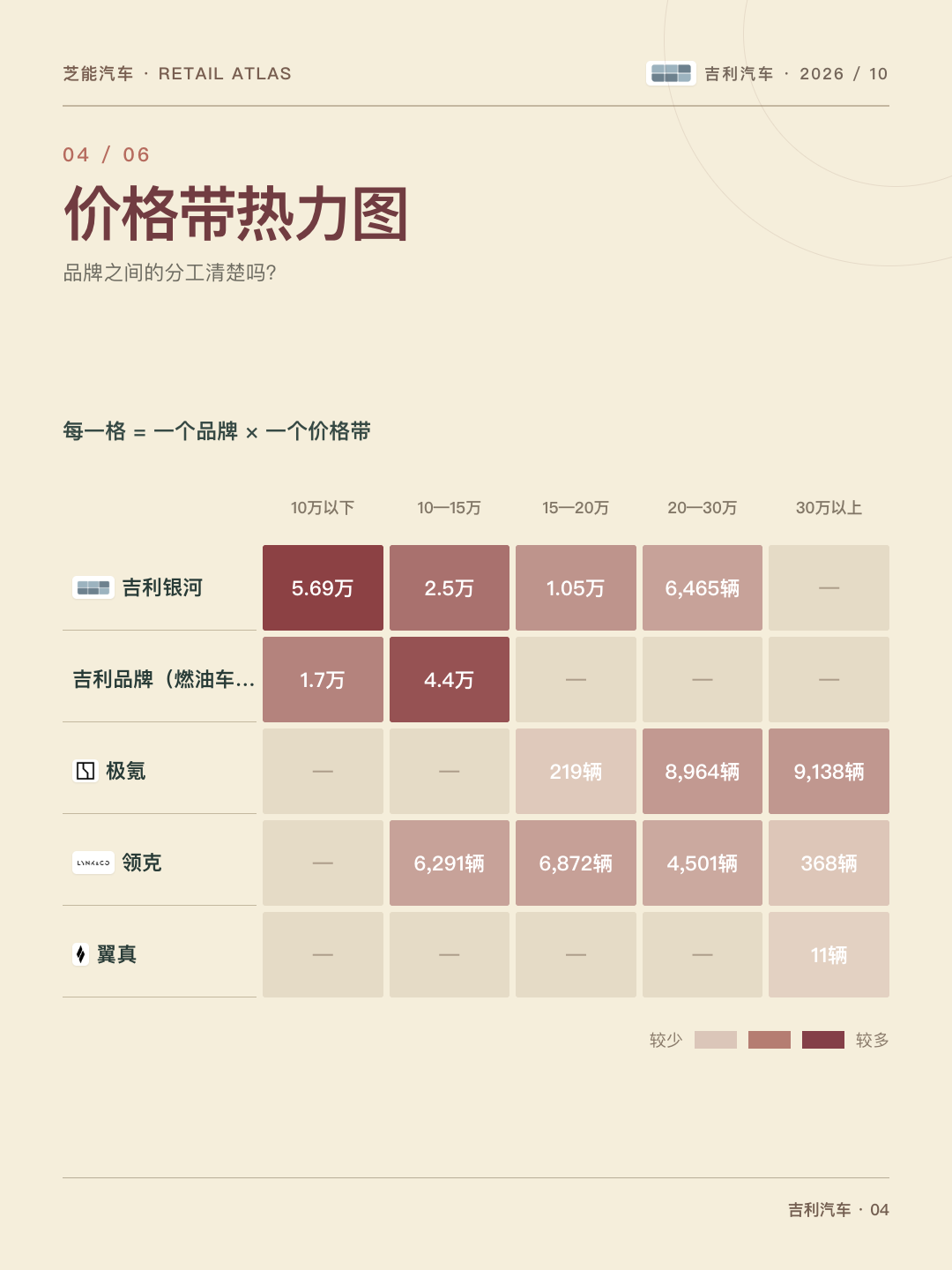
Lynk & Co and Zeekr have not yet reached their own scale. High-end products need more price entry points to gain volume. Among the 5 brands, Livan has only 11 units, and only 3 brands are truly volume drivers.
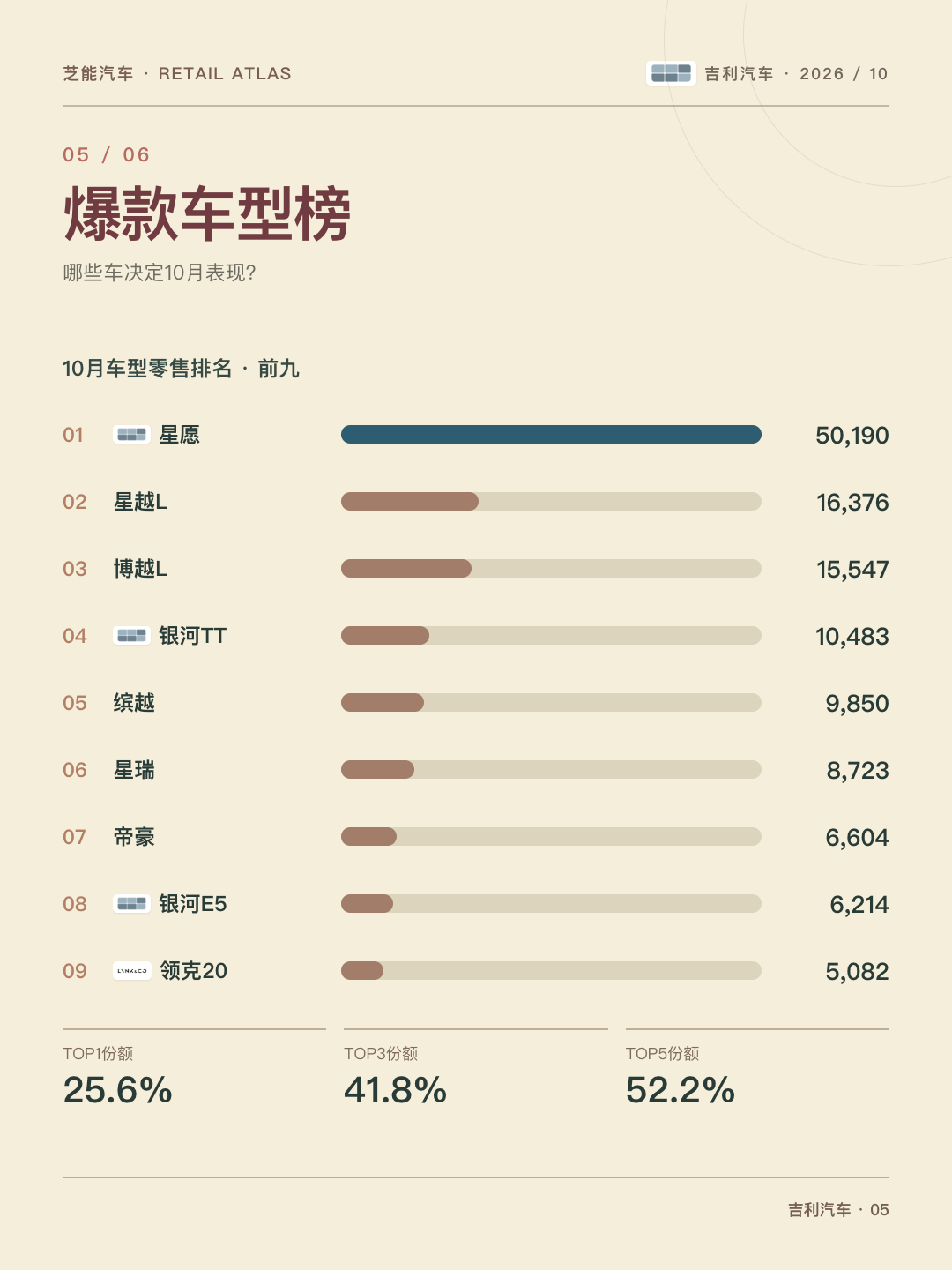
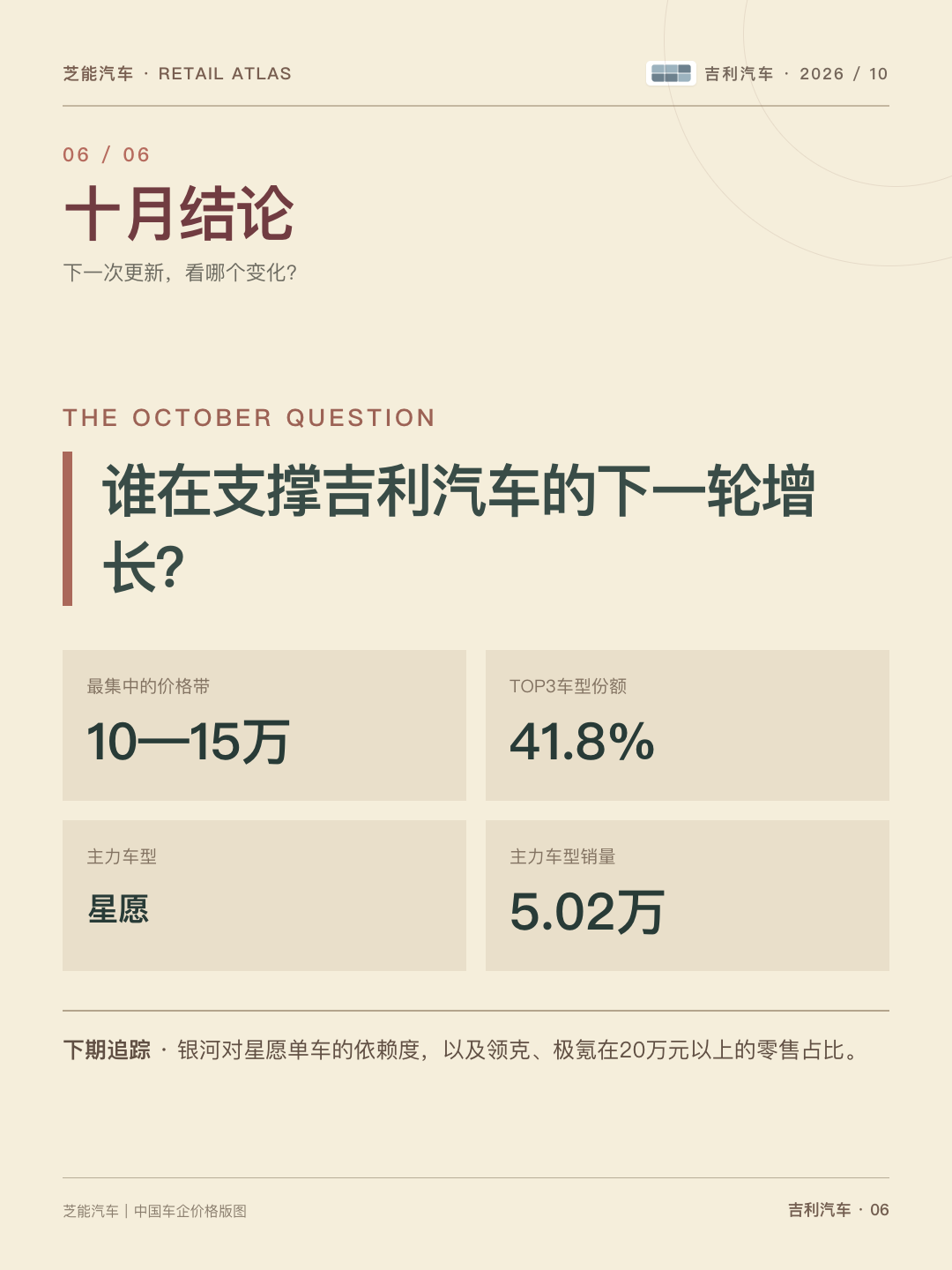
The top three models — Xingyuan, Xingyue L, and Boyue L — totaled 82,113 units, accounting for 41.8%.
◎ Xingyuan alone accounts for 25.6%, with 50,190 units at 61,800–91,800 yuan,
◎ Xingyue L: 16,376 units at 121,700–161,700 yuan,
◎ Boyue L: 15,547 units at 92,900–129,900 yuan,
◎ Galaxy TT: 10,483 units at 129,900–185,900 yuan,
◎ Binyue: 9,850 units at 58,800–85,800 yuan,
◎ Xingrui: 8,723 units at 88,700–139,700 yuan,
◎ Emgrand: 6,604 units at 52,900–88,900 yuan,
◎ Galaxy E5: 6,214 units at 87,800–169,800 yuan.
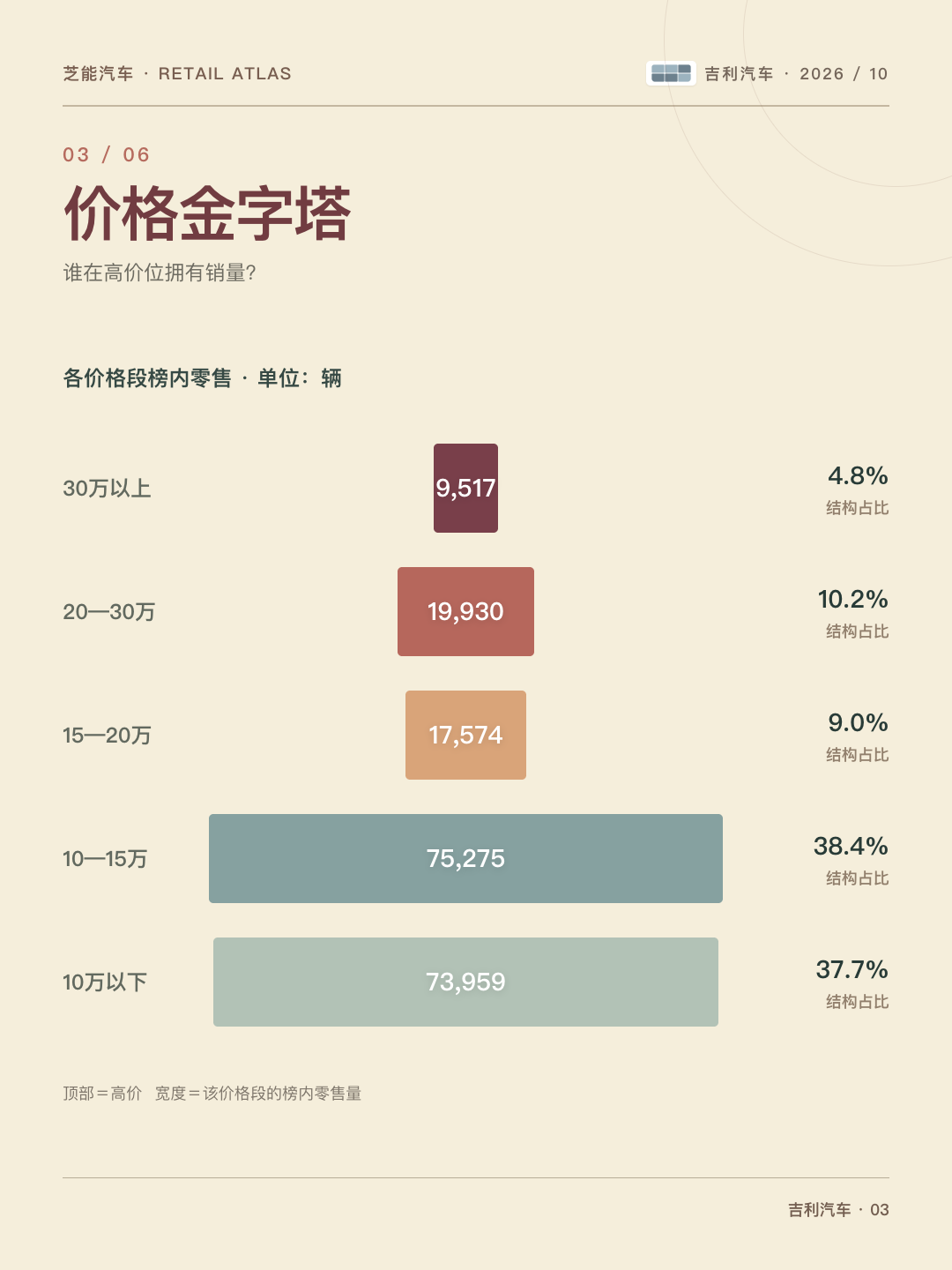
Models positioned above 200,000 yuan totaled 29,447 units, accounting for 15.0%. The Xingyuan is priced at 61,800–91,800 yuan, and the Xingyue L at 121,700–161,700 yuan.
◎ Below 100,000 yuan: 73,959 units, accounting for 37.7%
◎ 100,000–150,000 yuan: 75,275 units, accounting for 38.4%
◎ 150,000–200,000 yuan: 17,574 units, accounting for 9.0%
◎ 200,000–300,000 yuan: 19,930 units, accounting for 10.2%
◎ Above 300,000 yuan: 9,517 units, accounting for 4.8%
Zeekr follows a pure electric route with higher budgets, and its SUVs and cars face both traditional luxury cars and new energy competitors.
It needs enough effective models to spread development and channel costs. Monthly retail sales above 200,000 yuan directly reflect how far it has moved upmarket.
Geely Galaxy's peak is below 100,000 yuan, while the fuel vehicle series peaks at 100,000–150,000 yuan. Geely has 7 vehicle series crossing the 200,000 yuan line, totaling 13,659 units.
Summary
For sales by brand, we will discuss Geely Galaxy and Zeekr in more detail.
-
![]()
Cars That Sell Well Will All Be Replaced by Cheaper Alternatives Eventually
-
![]()
The 'Golden September and Silver October' Phenomenon Has All but Vanished: The Auto Market Enters an Era of Pure Survival
-
![]()
Tesla Sold Just 8,817 Vehicles in October—But the Factory Didn't Build a Single One Fewer
-
The King of Mobile Chips Shifts Battlefields
-
Amid the Personal Agent Boom, Xiaohongshu Enters the Fray with "Mishu"
-
![]()
Geely Auto October Sales: Xingyuan Hits 50,000 Units a Month, but What Does the Bigger Picture Look Like?
-
Chinese Brands Capture 90% of Thailand's Pure Electric Market—How Did the Japanese "Backyard" Slip Away?
-
![]()
Memory Price Hikes Leave Notebook Market Reeling: Q3 Sales Plunge 14%, Yet Apple Gains Ground