Ten Questions on Intelligent Organizations: If the Decision-Makers Don't Change, It's Still the Same Old Factory
 11/13 2026
 366
At Baidu World 2026, Robin Li likened AI to the new electricity and intelligent organizations to the "new factory buildings" of the AI era. He offered a sharp diagnosis: more and more tokens are being burned, yet revenue and profit aren't rising—because only the motor has been replaced, without redesigning the factory. He then prescribed a remedy—the "three principles of organizational evolution": break down job boundaries, precipitate tacit knowledge, and design closed-loop processes.
Follow these three principles and dig a little deeper, and you'll find a gap that runs through the entire argument: who exactly is being redesigned, and who is left behind in the old factory building? 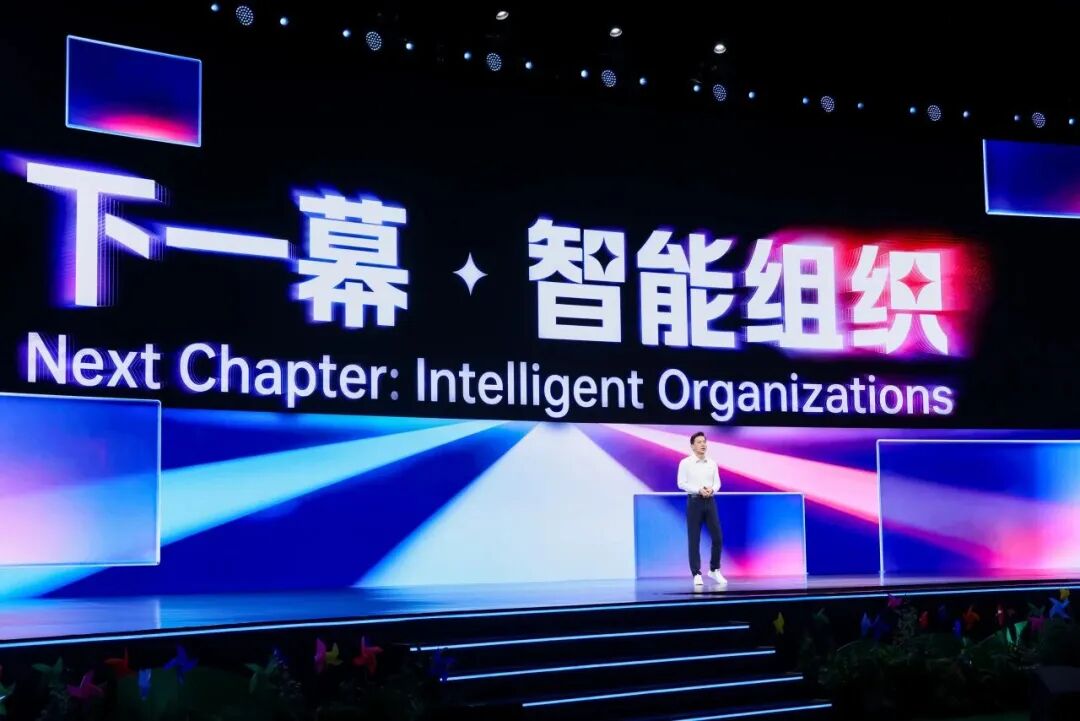
Question One: Do the three principles measure an organization's "intelligence," or simply how fast it executes?
The validation data Baidu provided is remarkably specific: daily active agents rose from 5,000 to 37,000; effective tasks grew from 84,000 per week to over 1 million; Workspace reached 4,300; and more than 20,000 organizational Skills were accumulated. These numbers measure how fast tasks run and how densely agents are deployed. But if an organization completes 1 million tasks a day, and those tasks themselves point in a direction that needs no verification, then 1 million is just 1 million efficient executions. The first principle says "the organization is a network of tasks"—but who decides where this network should be laid out? The three principles don't answer that.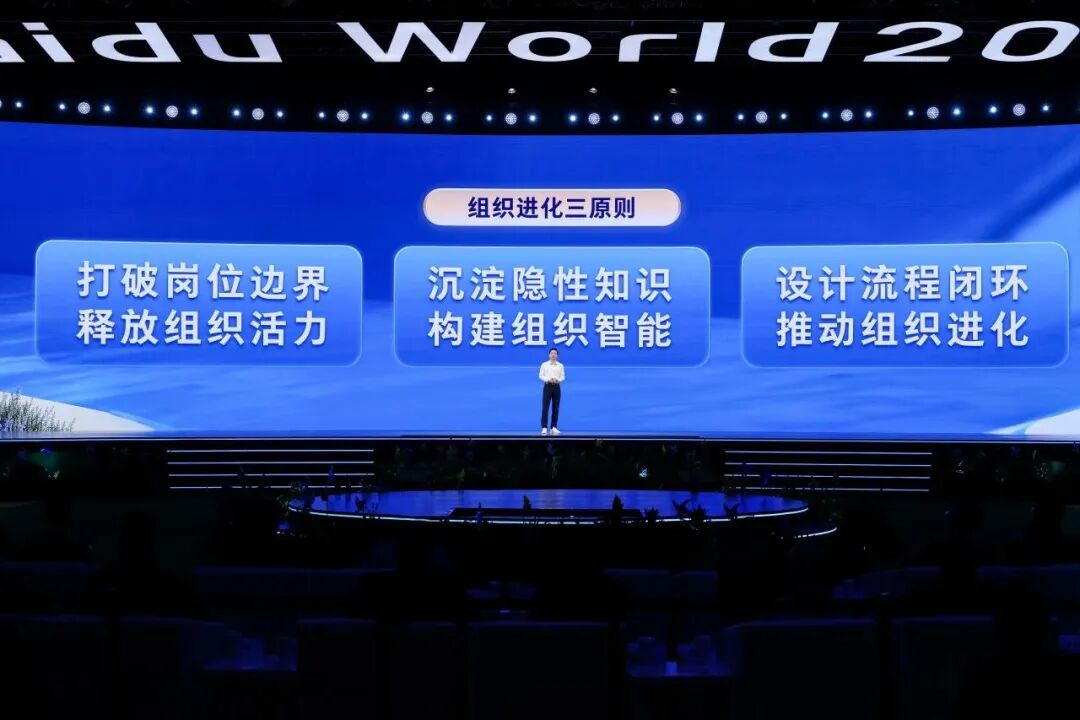
Question Two: Why is the starting point of the process closed loop set at "after the task is issued"?
"Measurable + Looping = continuous evolution" is the expression closest to "intelligence" in the entire framework: the enterprise becomes an automated system composed of countless Loops, constantly learning and iterating. But look closer—what Looping encompasses is the execution loop after tasks are issued. Where tasks come from, why goals are set this way, why resources are allocated this way—these actions that occur before the closed loop fall neither within the scope of "measurable" nor on the track of Looping. A closed loop that only covers the execution end and bypasses the decision-making end is not the organization's closed loop; it is the closed loop of the execution workshop. And the upper limit of organizational intelligence is precisely determined by that unmeasured link outside the loop.
Question Three: "Tacit knowledge" precipitates how to do things—but has "whether it should be done" been precipitated?
The second principle is stated movingly: make the experience in employees' minds explicit, precipitate it onto the platform, and turn it into organizational intelligence that everyone can invoke—"this is the deepest moat of an enterprise." But the most critical tacit knowledge in an organization has never been the operational experience of "how to do it"; it is the judgment logic of "whether it should be done" under conditions of incomplete information and irreversible consequences. If that logic exists only in the intuition of decision-makers, needs no articulation, no precipitation, and no verification, then what gets precipitated is merely the experience of the execution layer, while what is exempted is the intuition of the decision-making layer. An intelligent organization that learns only from grassroots experience learns efficiency, not direction.
Question Four: When positions converge into Builder and Seller, who has been converged away?
Robin Li said positions won't disappear but will converge into two categories: Builders who create new things, and Sellers who build interpersonal connections. It's a very clean dichotomy. But the people who define tasks, allocate resources, and bear the consequences of ultimate trade-offs are neither Builders nor Sellers—they are the layer that decides what Builders should build and whom Sellers should connect. When the organization is described as "a task network of human-Agent collaboration," this network reserves no place for "the person who issues tasks." Positions can be converged into two categories, but decision-making power has not been converged into this network.
Question Five: "AI cannot replace the CEO on business trips"—what can't be replaced is connection, or the exemption from decision-making?
At the same conference, Robin Li and Yang Yuanqing had a dialogue. Yang Yuanqing said "AI still cannot replace the CEO on business trips," and Robin Li agreed, believing that emotional connection between people remains important. The statement itself is not wrong. But placed within the narrative of "intelligent organizations," it inadvertently exposes a deeper structure: the CEO is exempted from the scope of "what can be restructured." AI cannot replace business trips because trust needs to be built by people; but strategic trade-offs, resource tilting, risk preferences—these judgments that equally require people to bear consequences—are they also, on the grounds that they "cannot be replaced," by default left outside algorithms and closed loops? Business trips shouldn't be replaced, but that doesn't mean the decision-making process shouldn't be verified.
Question Six: Is the cause of tokens not raising profits really just "not designing the factory building"?
Robin Li's diagnosis: enterprises only equipped individual employees with AI tools without redesigning the organization and processes, so tokens were spent but profits didn't rise. This diagnosis is half right. The other half is: if the redesigned "factory building" only restructures the execution assembly line, while what the line produces, how much it produces, and to whom it sells are still determined by a set of top-level assumptions unverified by data, then a smoother factory building will only make the organization faster at producing things that may not be needed. There are two possibilities for tokens not raising profits: one is that execution isn't fast enough; the other is that the direction was wrong from the start. The three principles only cure the first.
Question Seven: The pitfalls Baidu itself stepped into—do they expose execution problems or decision-making problems?
In his speech, Robin Li reviewed two pitfalls Baidu encountered in its AI transformation: in the early days, engineers were keen on using open-source models for SFT, and the results fell behind after model upgrades; later, various business units rushed into agents, resources were dispersed, success rates declined, and the problem was finally solved by holding monthly meetings to narrow project scope. The common thread is clear: the problem lay in the judgment of "what to do" and "what not to do," and the solution was centralizing authority, focusing, and unified allocation. This precisely shows that before the chaos at the execution end was amplified by AI, the trade-offs at the decision-making end were the real gate of organizational efficiency. The three principles break the execution end into a task network, but that action of "holding monthly meetings to narrow projects" remains a decision-making behavior that occurs outside the closed loop and is not verified by Looping.
Question Eight: Is the premise of the three major opportunities "asset-light" or "decision-light"?
Intelligent organizations will bring three major opportunities: asset-light operations, building new moats, and creating and discovering new markets. "One person or very few people with a group of Agents completing various tasks—human resources are no longer the bottleneck of expansion"—this picture is very enticing. But among the "very few people," who is making the judgments that Agents cannot make? If the essence of asset-light operations is that human power at the execution end is replaced by intelligent agents, while the decision-making burden of defining direction, allocating resources, and bearing risks has not become correspondingly "lighter," then the organization has merely swapped heavy assets from human power to tokens, and the weight of decision-making remains unchanged on the original point. The premise of asset-light is that decision-making itself also becomes deducible, verifiable, and iterable—otherwise only execution is light, and what remains heavy is always the final call.
Question Nine: If "organizational intelligence" only requires employees to adapt to AI, what exactly is it evolving?
Every anchor point of the three principles requires employees and middle managers to change: from position-holders to task nodes, to hand over experience and precipitate it into Skills, to adapt to the iteration rhythm of Looping. But no principle requires decision-makers to change their way of making decisions. A system that claims to "continuously learn and evolve," yet whose highest decision-making node needs no learning, no correction by data feedback, and no participation in Looping—this is not evolution; this is one-way adaptation. If the organization's intelligence only occurs at the execution end, its upper limit is locked within the cognitive boundary of the one person who alone needs no adaptation.
Question Ten: If decision-makers remain outside the assembly line, where exactly is the new factory building new?
Robin Li is absolutely right: replacing the motor is only the starting point; redesigning the factory building is the watershed. But on the redesigned blueprint, task networks, agent collaboration, and process closed loops are drawn everywhere—except there is no drawing of how the person who issues the first instruction is constrained by this system.
Humans and AI networking around tasks is a useful collaboration paradigm; but when it is elevated to "the next-generation organizational form," it must answer a question it has so far avoided: the intelligence of an organization begins at the decision-making end, not the execution end. If the decision-making end does not join the network, the new factory building is merely a faster assembly line connected beneath the old command tower—the tower is still the same tower, the command logic is still the old logic; only the workers are fewer and the tools are faster. The so-called intelligent organization remains an efficiency improvement that transforms only the downstream and leaves the upstream untouched.
-
![]()
Five Charts Show China's Auto Exports Soaring | Total Volume, Automakers
-
![]()
Half of the Second-Tier Luxury Brands Are Already Preparing to Exit the Field, Yet Lincoln Wants to Bet on the EX8
-
![]()
BMW: No Room for Error
-
![]()
October SUV Sales Roundup: Yuan UP Takes the Crown as Three Fuel Vehicles Secure Top Ten Spots
-
![]()
New Energy Rides the Wave, While "Old Energy" Drifts
-
![]()
Ten Questions on Intelligent Organizations: If the Decision-Makers Don't Change, It's Still the Same Old Factory
-
Kaojiang Embraces AI: A Deep Empowerment Journey Begins
-
When Will Interstellar Glory Hit the Bullseye with a Single Shot?