Why Does Correcting One Aberration Often Make Another Worse?
 11/16 2026
 401

Abstract: The seven aberrations are not isolated faults, but a set of variables that pull against one another and trade off with one another. Spherical aberration and coma follow the aperture; astigmatism, field curvature, and distortion follow the field of view; chromatic aberration is brought about by wavelength differences.
Fixing one type of aberration easily affects other metrics. The core of optical design is not to completely eliminate aberrations, but to find a suitable balance point.
In optical design, one often encounters something very counterintuitive: after finally suppressing spherical aberration, coma then emerges; after taking great effort to flatten field curvature, distortion becomes larger again.
This does not mean that design capability is inadequate; the root cause lies in the coupling and mutual constraint that inherently exist among the various aberrations. The seven aberrations are not seven unrelated problems, but a set of variables that constrain one another.
Frankly speaking, understanding this mutually pulling relationship is far more useful than rote memorization of the definitions of the seven aberration terms.
First look at the full picture: the seven aberrations, understood in three groups
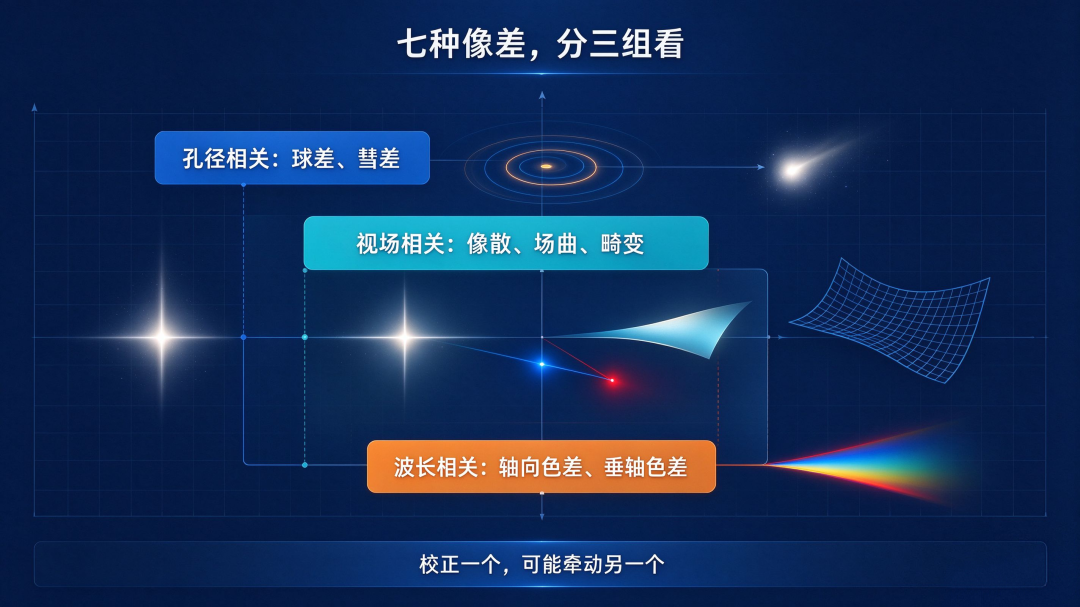
We can classify the seven primary aberrations into three major categories according to their source of influence. Bound to aperture: spherical aberration and coma.
Spherical aberration occurs at the on-axis light point; rays at different aperture positions have different convergence points. Coma is a problem of off-axis light points: different annular zones of the lens have different magnifying capability for obliquely incident rays, ultimately producing a comet-like trailing spot.
Bound to field of view: astigmatism, field curvature, and distortion. Astigmatism is when the focal points in the meridional and sagittal directions cannot coincide. The detailed principle was discussed in The Essence of Astigmatism: Why Do the Meridional Focus and Sagittal Focus "Each Go Their Own Way"?
it was expanded there; field curvature means that the best imaging surface is curved, not flat; distortion means that the magnification differs at different field positions, so straight lines appear bent in the image. For the conversion basis of distortion, refer to TV Distortion and Optical Distortion: How Exactly Are They Converted?.
Bound to wavelength: axial chromatic aberration and lateral chromatic aberration (magnification chromatic aberration). Axial chromatic aberration is when the focal points of different colors of light are staggered back and forth along the optical axis;
lateral chromatic aberration (also called magnification chromatic aberration) is when the image heights corresponding to different wavelengths are different. The larger the field of view, the more obvious the shift, and colored fringing appears at the edges of the image.
Classifying according to this framework, when you encounter imaging problems later, you can quickly determine in which direction to investigate.
Spherical aberration and coma: a pair of problems brought by aperture, one governing on-axis and one governing off-axis
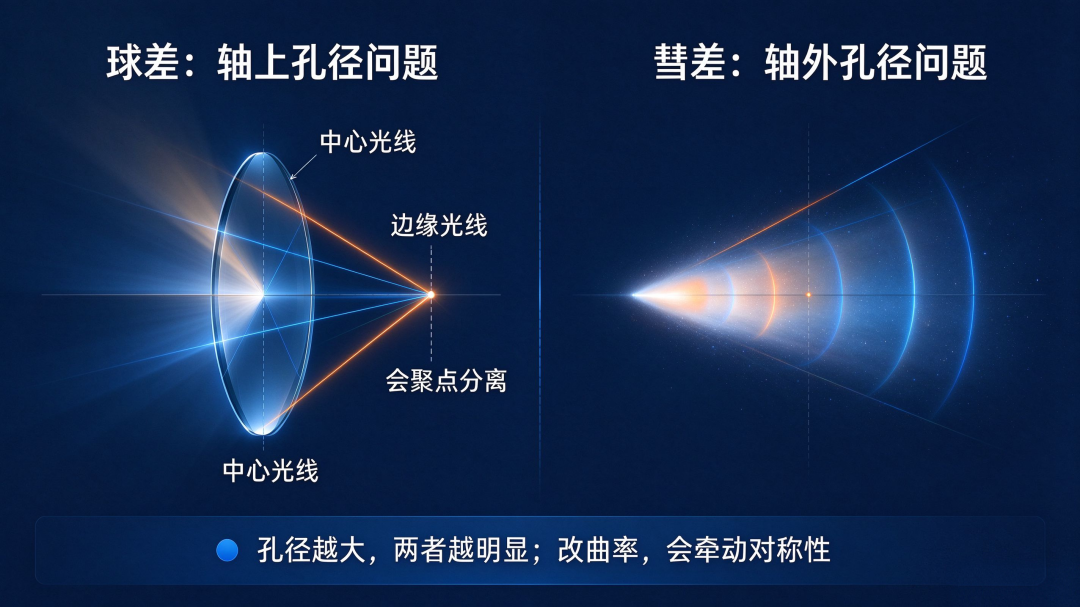
Spherical aberration targets the on-axis light point. When parallel light enters a spherical lens, paraxial rays near the center and rays near the edge have different refraction angles, so their convergence positions naturally separate.
An ideal point light source ultimately becomes a blurred diffuse spot. Commonly used correction methods: use aspheric lenses, pair positive and negative lenses, and use multiple lenses to share the refraction burden. Coma targets light points deviated from the center.
Different radius zones of the lens have different magnifying effects on obliquely incoming rays. After imaging, a point light source becomes a comet-shaped spot that is pointed at one end and wide at the other.
The most classic correction approach is a symmetrical lens group: the coma produced by the front half of the lenses is canceled by the structurally symmetrical rear half.
Both worsen as the aperture increases, but one acts on the central axis and the other acts off-axis. When adjusting lens curvature to correct spherical aberration, it is easy to destroy the original symmetrical relationship of the lens group, and coma then deteriorates.
This is the first layer of coupling.
Astigmatism, field curvature, and distortion: three types of defects derived from field of view; fixing one affects the other two
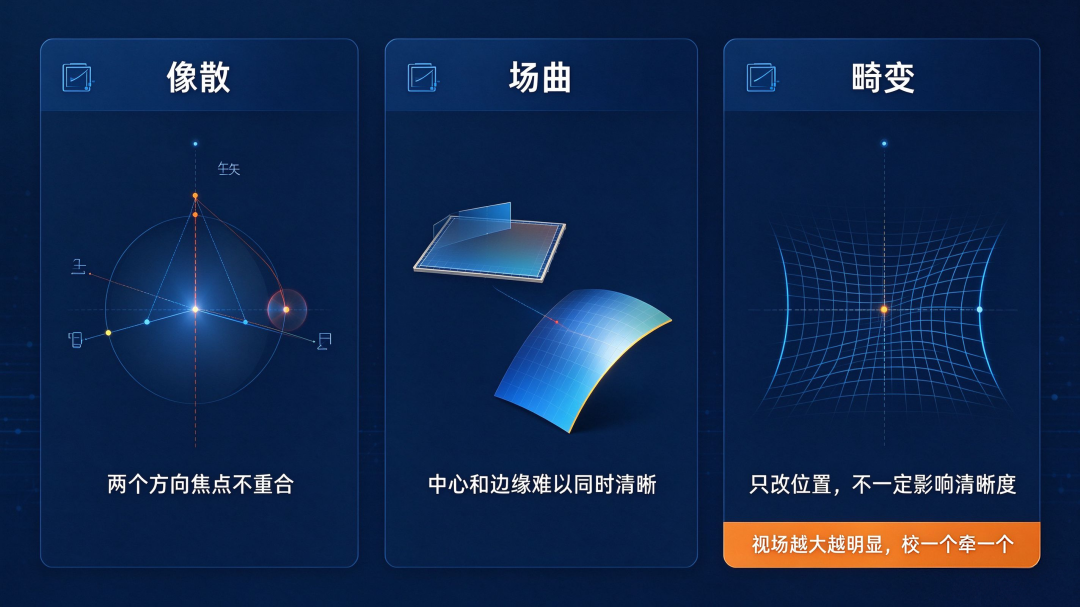
Astigmatism: in the two orthogonal directions, meridional and sagittal, the lens has different bending capability, so the two focal points cannot coincide. The larger the field of view, the more obvious the phenomenon.
It can be optimized by relying on symmetrical structures, adjusting the stop position, and freeform surfaces.
Field curvature: when a planar object is imaged through a spherical lens, the surface with the best imaging quality is actually curved, namely the Petzval surface.
A flat sensor is flat and cannot simultaneously make both the center and the edge of the image clear. Optical design generally uses a combination of positive and negative lenses to cancel field curvature: positive lenses bring positive field curvature, and negative lenses bring negative field curvature.
Distortion: the magnification differs at different field positions, so straight lines become curved after imaging. If the edge magnification is smaller than the center, it is barrel distortion; the reverse is pincushion distortion.
Distortion does not make the image blurry; it only changes the image contour. It can be compensated by symmetrical lens groups or by pre-distortion in post-processing software. All three worsen as the field of view expands, and their correction methods constrain one another.
The positive-negative lens combination used to cancel field curvature may break the original balance of astigmatism; the symmetrical structure used to suppress distortion will in turn affect field curvature. This is the second layer of coupling.
Chromatic aberration: colored defects caused by different wavelengths; achromatization also disrupts the original balance
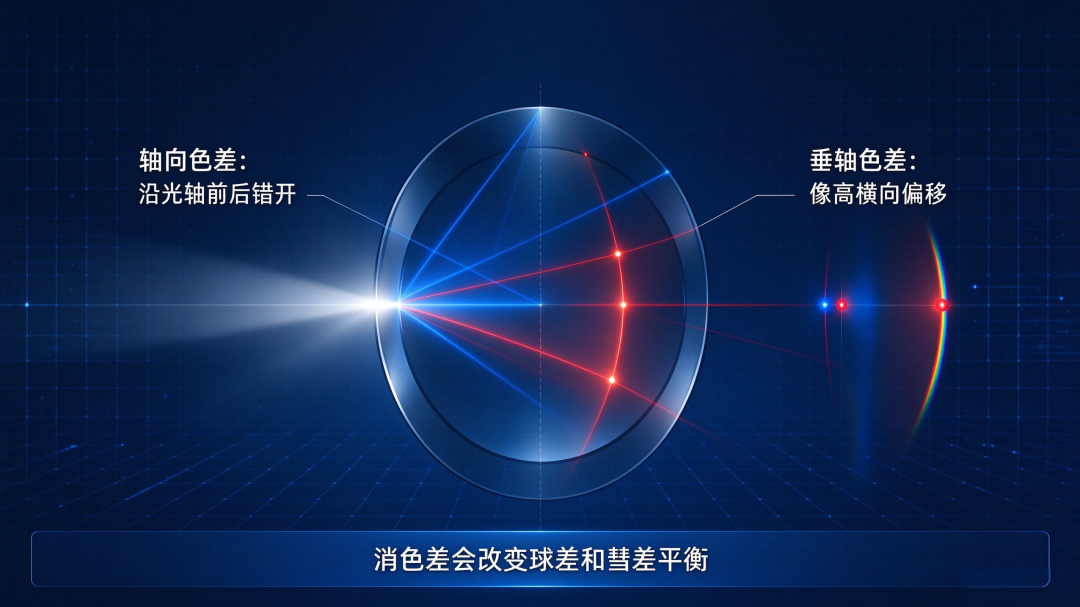
Axial chromatic aberration: different colors of light have different refractive indices. Blue light has a higher refractive index and its focus is farther forward; red light has a lower refractive index and its focus is farther back.
When imaging with white light, a colored blurred halo appears at the center of the image. Lateral chromatic aberration (also called magnification chromatic aberration) is when image heights differ at different wavelengths.
Even if the focal points of all colors of light fall on the same plane, the image points of different colors will still shift laterally. The larger the field of view, the more obvious the shift, and colored fringing grows at the edges of the image.
Lateral chromatic aberration appears only off-axis; there is no such problem on the central axis. The most commonly used method to correct chromatic aberration is an achromatic lens group: pairing two types of glass with different dispersion characteristics, such as crown glass plus flint glass, so that the focal points of the two main colors coincide.
However, the introduction of achromatic lenses will change the original balance of spherical aberration and coma. This is the third layer of coupling. In many cases, after changing chromatic aberration, the previously adjusted monochromatic aberrations drift again.
Debugging tip: infer the type of aberration in reverse from the spot appearance

When optical engineers perform on-site simulation or prototype debugging, they often rely on spot morphology to quickly locate problems: an on-axis spot showing concentric ring-shaped diffuse spots → dominated by spherical aberration.
An off-axis spot pointed at one end and spreading at the other, like a comet → dominated by coma. The spot is elongated to different degrees in the horizontal and vertical directions → dominated by astigmatism. The center of the image is clear and the edge is blurry, or the reverse → dominated by field curvature.
Lines are curved, but sharpness is fine → dominated by distortion. The edge of the spot has colored fringing → dominated by chromatic aberration. If color is superimposed on concentric rings, it is a mixture of axial chromatic aberration + spherical aberration; if color is superimposed on a comet-shaped spot, it is a mixture of lateral chromatic aberration + coma. Only by first distinguishing the dominant aberration can you know which parameter to adjust. If you look in the wrong direction, you will only make it more chaotic.
Closing: the seven aberrations are not isolated faults, but a set of variables that pull against one another. Correcting one of them often introduces new deviations in other dimensions.
What optical design pursues is never the complete elimination of aberrations. Finding a balance point among multiple aberrations that suits product requirements is the core of design. Understanding this system of checks and balances is far more critical than memorizing aberration definitions.
Interactive topic: In your optical design process, which type of aberration is the most troublesome? And with which aberration does it exhibit a seesaw relationship? You are welcome to leave a comment and share your debugging experience.
[Risk note] The aberration classification and correction methods in this article are based on classical Seidel aberration theory (the primary aberration range); actual lens design also involves higher-order aberrations (fifth-order, seventh-order), non-rotationally symmetric structures (such as unconventional aberration terms introduced by freeform surfaces), temperature drift, tolerance sensitivity, and other factors. Specific solutions are subject to actual design and simulation verification.
—— AR Andy | Focused on the optical waveguide and AR microdisplay track, deeply analyzing the underlying logic of the optical industry
-
![]()
Volkswagen's Crash Course in Car Making
-
The Second Round of the AI Office Battle Begins
-
![]()
Why Does Correcting One Aberration Often Make Another Worse?
-
![]()
BYD Puts a 5-Million-Yuan Bounty on the Table — and Exposes a Hidden Industry Chain
-
![]()
Chopsticks Catch a Spacecraft! Musk Wins Another Bet—Whose Face Does This Slap Wake Up?
-
![]()
Five Years After the Huawei Spinoff: xFusion Seeks 8 Billion Yuan in IPO — Why Is the No. 2 Server Maker Turning to Energy? The Next Battle in Computing Power Is All About Power Supply
-
![]()
Double 11 Token Rush: Discounts Alone Can't Secure AI's Commercial Future
-
![]()
NIO Main Brand October: ES8 Sells Out, Accounting for Nearly Half