AI Tidal Wave Is a Matter of Life and Death—How Is Tencent Responding?
 11/18 2026
 327
The sense of crisis is at its peak—Tencent's birthday this year was far more serious than in previous years.
On November 16, Tencent Culture's official account published on-site notes from the LinkTime executive office meeting, which went viral.
Previously, Pony Ma's speech at the meeting had already been very serious.
According to insiders at Tencent, the senior management's remarks sparked heated discussion within the company.
The meeting notes provide a more comprehensive and detailed explanation of the views, from the changes faced to how to respond.
One can also foresee from the content some of Tencent's upcoming strategic directions.
At the shareholders' meeting in May this year, Pony Ma said this: a year ago I thought we had boarded the ship, later I found the ship was leaking, now we have managed to get on board, but still cannot sit down, and I hope the ship can go a bit faster.
This article, by contrast, is about how to make the ship go faster.
What has Tencent done in AI this year? Why does the AI wave make Tencent's helmsman so anxious?
01 Key Information from Internal Meetings
A few days ago, Pony Ma already made many points in the 28th anniversary LinkTime livestream, and some points were taken out of context and spread online as layoffs, which Tencent later refuted.
This article, however, provides a more comprehensive account of the transformation and strategic shift, and is more in line with the background and intent of senior management's desired expression of strategic redirection.
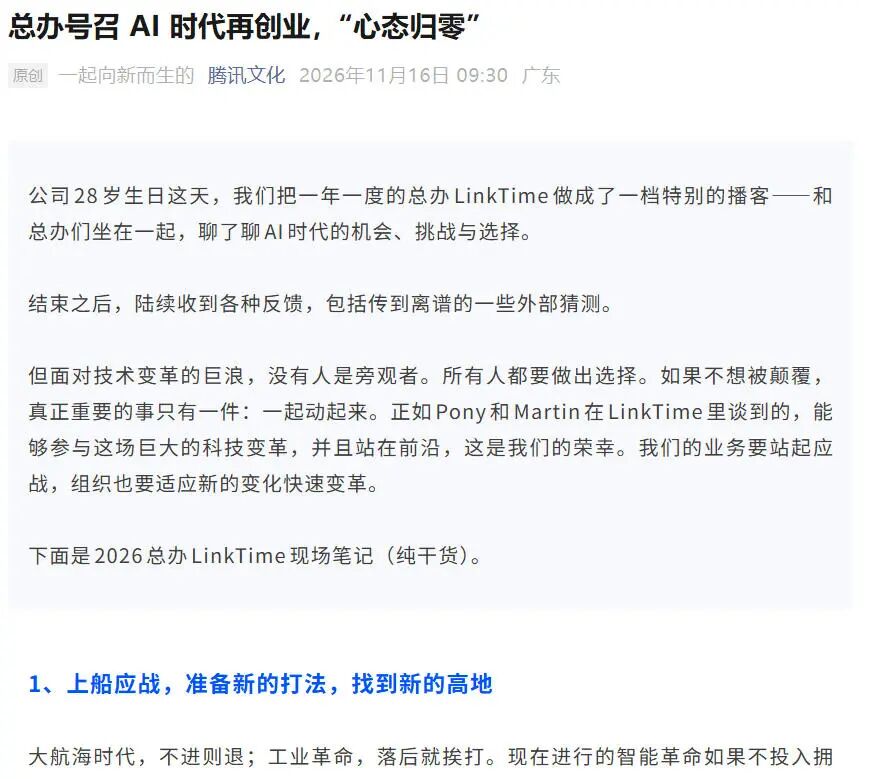
The article is divided into five parts; let's look at the key information together.
First, it clarifies the current situation, which is already a matter of life and death.
According to the judgment of Tencent's senior management, computing power is continuously being invested, AI will penetrate more industries, and will disrupt traditional businesses in a short time, which means the wave of technological change has already arrived.
The broad strategy is that some people are responsible for defending the core business, while some go to explore and innovate, roughly a 50-50 split.
Moreover, the traditional core business is not unchanging either; it needs upgrading and efficiency improvement.
Then, it explains why investment in AI should be increased.
From the end of last year to the beginning of this year, Tencent's investment in computing power was relatively restrained; at the time it was speculated that Tencent's strategy was to keep pace through large models and run a long race.
But starting from the second quarter, infrastructure and computing power investment continued to increase, and it is also made clear here that if they do not invest now, they may not even have the chance to participate in the future.
Tencent believes the market needs diverse AI, and Tencent also has the foundation to create enormous value.
Next, the article briefly lists the highlights of Tencent's AI business.
It has first-tier large models, as well as Xiaowei, Yuanbao, and WorkBuddy.
Among them, it can be seen that senior management rates WorkBuddy relatively highly and hopes to create more such products in the future.
The development of AI application-layer products has only just begun in the market, and Tencent still has opportunities.
The next part is about internal teams.
Internal teams need to change their mindset and need an entrepreneurial spirit.
In the future, the organization will be flatter and will operate in small teams, which will increase the probability of producing successful products.
At the same time, people cannot rest on past achievements, and many previous organizational structures will be broken to prevent factionalism and territorial thinking.
In fact, judging from Pony Ma's previous remarks, he is somewhat worried about departmental barriers and bloated structures within the company.
Of course, as a company grows larger, such big-company diseases will appear.
So the last part of the article hopes that teamwork can increase and unleash greater creativity and productivity.
02 The AI Business This Year
In the course of a year, Tencent AI has improved its models and rolled out products, but the situation is hardly easy.
In the previous critical transition period of the mobile internet, Zhang Xiaolong was the key man; now, in the AI wave, the camera has turned to new young faces.
In December 2025, Yao Shunyu, born in 1998, took office as Tencent's Chief AI Scientist, fully managing the large model team and coordinating computing power, data, infrastructure, and model training.
This young man, a graduate of Tsinghua's Yao Class, participated in the development of some core products at OpenAI before joining Tencent.
Bringing the perspective of overseas frontier laboratories and familiar with the underlying logic of next-generation models and agents, he was exceptionally promoted by senior management and given decision-making power that would have been hard to imagine in the past.
Subsequently, the pace of Tencent's AI business clearly accelerated.
On November 4, the official version of Hy4 landed; the Hy4 preview version was ranked 25th in August, and more than two months later the official version rose to 14th.
Compared with the domestic top model ranked 13th, the intelligence score differs by less than 1 percentage point, while the single-task cost is only 0.55 US dollars, about 60% cheaper.
The product matrix is also being rolled out.
In addition to the WeChat AI assistant Xiaowei and Yuanbao, WorkBuddy, as an office agent, is a highlight product of Tencent's current AI applications.
In October, Yao Shunyu and Pony Ma sat next to each other during a research discussion at headquarters.
After solving the model and product issues, the computing power issue was also put on the table.
If task efficiency is to be improved, the cost is consuming more computing power, and this cannot be avoided.
Money is being poured in at an accelerated pace.
Second-quarter capital expenditure was 52.8 billion yuan, up 176% year on year; together with 31.9 billion yuan in the first quarter, the first-half total was 84.7 billion yuan, already exceeding the full-year 2025 level of 79.2 billion yuan.
Financial reports show that computing power prepayments under operating cash flow were about 51.4 billion yuan, and free cash flow turned negative for the first time in history in the second quarter.
In October, Tencent also issued about 5.7 billion US dollars in offshore bonds, mainly directed toward AI capital expenditure.
This investment in computing power, as Tencent said, is one that if not made now, there will be no chance to participate in the future.
-
![]()
Share Link Won't Open: Tracing a URL Parameter Placement Bug
-
![]()
BAIC Group | October Terminal Sales: Product Mix Across Four Brands and 31 Models
-
![]()
Mercedes-Benz China Retail Sales in October: 28,820 Units — How Did Beijing Benz and smart Perform?
-
![]()
Tesla Invests €3 Billion to Upgrade German Factory, Sells Robotaxi — but You Still Pay Monthly to Drive
-
![]()
ARCFOX Slashes Huawei Smart Driving Threshold to the 150,000 Yuan Mark
-
![]()
The Korean Car Conundrum: Boxed In by the Supply Chain, Outmatched in Overseas Markets
-
Has Apple Really Cured the "Rogue App" Epidemic Among Domestic Apps?
-
![]()
AI Short Dramas: A Successful Capital Relocation?