Control Over AI Companies Is No Longer Written Into Equity
 11/24 2026
 498
Documents Anthropic submitted to the U.S. Securities and Exchange Commission (SEC) show that after completing its initial public offering (IPO) and concurrent private placement, Amazon and Google are expected to hold nearly 15% and 14% of issued shares respectively—more than 28% combined.
Yet in the first nine months of 2026, sales of access to the Claude model through the existing accounts of three cloud providers—Amazon, Google, and Microsoft—generated about 44% of Anthropic's revenue for the same period.
Notably, Amazon, Google, and Microsoft are simultaneously its investors, customers, and distribution partners—and its competitors.
In other words, Anthropic has been hand-delivering orders and compute bills to its own rivals.
01. Cloud Marketplaces: A Growth Shortcut Created by Enterprise Procurement Rules
In Anthropic's prospectus, a set of curves showing channel revenue share outlines the underlying pattern of this large-model company's growth path: in 2023, 2024, 2025, and the first half of 2026, revenue sold through cloud providers' application marketplaces accounted for approximately 11%, 32%, 47%, and 48% of Anthropic's total revenue, respectively.
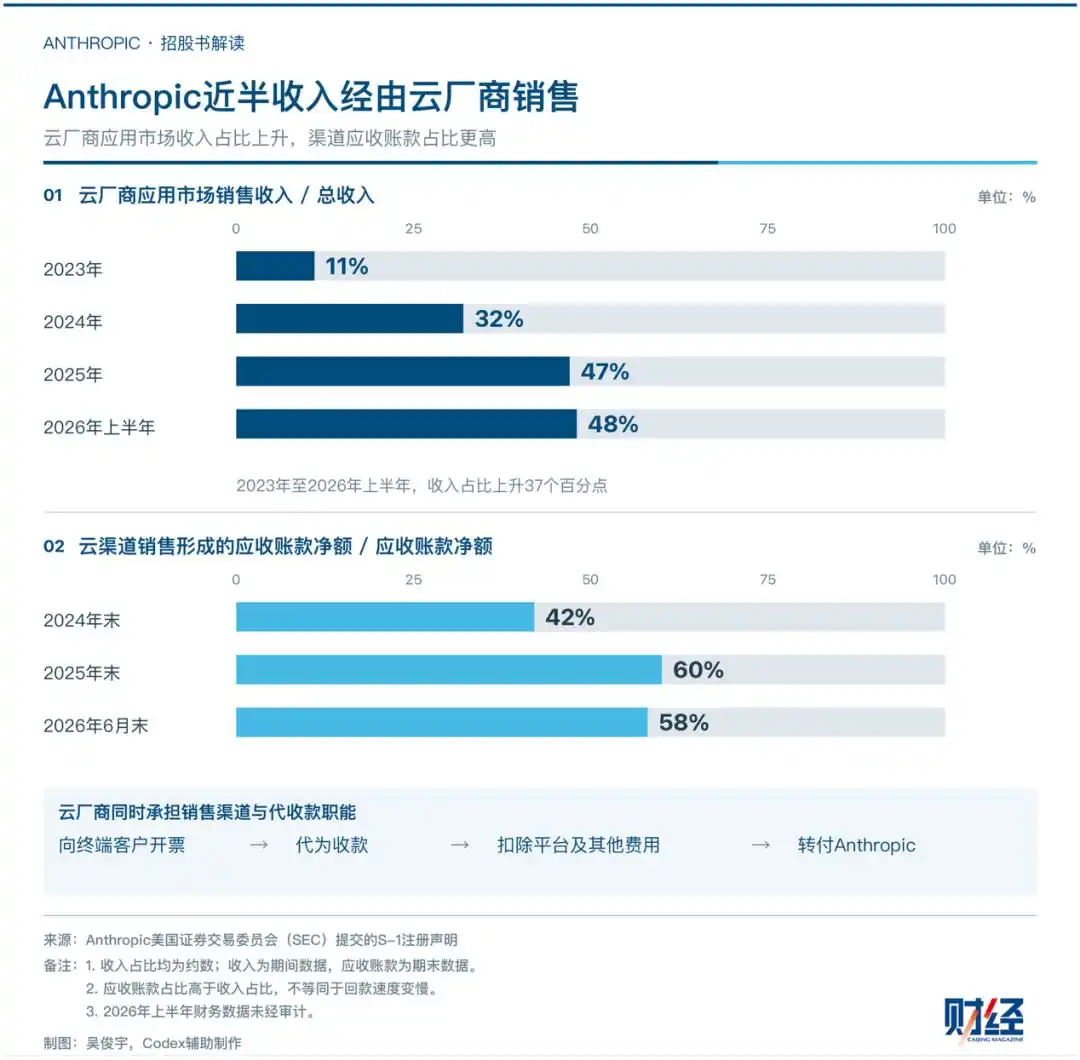
This steeply rising curve is often read by outsiders as direct proof of Claude's product strength.
Strip away that model-competition narrative, however, and the procurement systems inherent to large enterprises may be a force driving this round of channel expansion that is hard to ignore; model capability may not be the only decisive variable.
For the vast majority of medium and large enterprises, adding a new AI large-model vendor is not merely a technology selection.
Enterprises that have already signed annual framework contracts with cloud providers such as AWS and Google Cloud have long-established internal supplier admission mechanisms—qualification verification, security compliance audits, budget account filing, legal contracting, and financial reconciliation and settlement. For business scenarios involving sensitive data, completing the entire process often takes months.
The lengthy approval chain raises the threshold for independent contracting. Even if many IT departments want to trial Claude, they may be deterred by the process costs of adding a new supplier and instead look for a simpler procurement path.
The value of cloud providers' marketplaces lies precisely in the flexibility they offer within this procurement system.
Once Claude is integrated into the application marketplace of a cloud console, enterprise IT leaders no longer need to add Anthropic as an independent supplier and go through the entire admission process. They only need to add the corresponding SKU to an already effective cloud contract, with invocation, billing, and reconciliation all managed uniformly within the original cloud bill.
For customers, this is a lower-friction way to add AI procurement. For Anthropic, it is a distribution channel that leverages the giants' existing customer pools to scale quickly—and commercial infrastructure it would have struggled to build independently in the short term.
This cooperation model allows Anthropic to retain control over benchmark pricing—channel parties cannot independently adjust Claude's base rates—but the corresponding channel cooperation costs should not be underestimated either.
Data shows that in the first half of 2026, the company's revenue was $16.286 billion, and total operating expenses were $16.979 billion. Among them, compute and infrastructure expenses were $8.945 billion, about 55% of revenue; personnel expenses were $3.152 billion, and sales, marketing, and partner expenses were $3.168 billion, each accounting for about 19%.
Compared with investment on the asset side, in the first half of 2026, the company's spending on its own properties and equipment was only $482 million, while compute and infrastructure expenses during the same period reached $8.945 billion, already exceeding the full-year 2025 figure of $7.326 billion.
So on one hand there are rigid expenditures locked in by long-term compute contracts; on the other, cooperation costs rising in tandem with channel scale. Together they form the two layers of cost support in its growth process.
Cloud marketplaces bring it customer traffic, and most revenue generated through channels requires paying cloud providers a portion as cooperation revenue share. This model undoubtedly has higher customer acquisition efficiency and can also lower the admission and trust thresholds for enterprise customers, but the foundation of growth is highly dependent on third-party distribution channels.
For example, the recommendation weight of marketplaces, settlement rules, and channel revenue sharing are all controlled by cloud providers—and these partners are also Anthropic's shareholders and direct competitors.
Embedded tools such as Claude Code and Cowork aimed at business workflows have a clearly different transaction logic from simple model API calls. What customers purchase is an application product that can be embedded in their own businesses, rather than a standardized model-invocation SKU on a marketplace. Such orders are often better suited to direct sales through the official website or in-depth engagement by presales teams.
The shortcoming of the direct sales model is a longer customer acquisition cycle and higher upfront investment, but its core value is escaping the distribution rules of cloud marketplaces, with more initiative in customer relationships and pricing negotiations remaining in Anthropic's hands.
Viewed within the industrial division of labor, this is a two-way supply-demand match.
Independent large-model teams have model R&D and product refinement capabilities but lack mature enterprise-level sales reach networks. Cloud providers, meanwhile, have accumulated a large number of enterprise customers, and their compliance systems and settlement links are already in place. They also need to introduce third-party models to enrich marketplace supply and hedge against customer churn risks caused by reliance on a single in-house model.
It is worth noting that cloud marketplaces are accelerators of growth, but they are not fully controllable territory of one's own.
The peak and decline in channel share look more like Anthropic seeking a dynamic balance between two growth paths. One is leveraging the giants for rapid scaling, which requires continuously bearing channel costs and accepting external distribution rules; the other is building a direct sales system to accumulate its own customers, with the corresponding costs being a slower expansion pace and higher front-end sales investment.
This marketplace path created by procurement rules has helped Anthropic push its revenue scale to a new level in a short period and has also brought it a long-term structural proposition. It can rely on marketplaces to achieve scale breakthroughs, but it is difficult to build a fully independent commercial foundation relying only on marketplaces.
Fluctuations in channel share are precisely signals of the ongoing evolution of this balance.
02. It Handed Its Two Heaviest Links to the Same Group of People
On November 10, Anthropic's IPO documents showed that as of September 30, 2026 and thereafter, the company's total expenditure under signed procurement commitments and lease agreements was approximately $900.9 billion, of which $451.6 billion is expected to occur before the end of 2030, with most of the remainder expected to occur between 2031 and 2045.
Among them, within the 12 months before September 2027, Anthropic needs to pay about $70.7 billion in related amounts; by 2033, Anthropic will pay Google at least $114.5 billion; by 2036, it will pay Amazon at least $110 billion; and by May 2033, it will pay Microsoft at least $31.4 billion.
All three contracts stipulate minimum obligations; regardless of actual compute usage scale, Google and Amazon additionally require the difference to be made up when usage falls short. This take-or-pay mechanism was originally more common in long-term supply contracts for natural gas and electricity, and is now being transplanted into compute procurement.
As can be seen, bills and actual invocation volume are thus decoupled, and the risk brought by insufficient compute utilization shifts to the buyer.
On the revenue side, metered billing still dominates: customers pay for what they use. With rigid costs locked in on one side and revenue fluctuating with invocation volume on the other, leverage is stretched to the extreme.
The S-1 prospectus shows that in the first half of the year, compute and infrastructure expenses were $8.945 billion, nearly four times the same period last year and exceeding the full-year 2025 figure of $7.326 billion; revenue during the same period was $16.286 billion, with expenses accounting for about 55% of revenue.
Overall, Anthropic's sales are highly dependent on cloud providers' marketplaces, and its compute supply relies on the data centers and chips of the same group of players, while it retains only models, products, and brand in its own hands. The former has brought four years of rapid growth, and the latter has secured cost certainty during the contract period, but the price is that control over these two core links is not in its own hands.
From the perspective of the entire AI industry, this is also a common challenge for many leading third-party model vendors. Competitiveness is no longer determined only by the model itself; the discourse power over supporting resources such as compute supply and enterprise customer distribution systems mostly rests with a small number of cloud providers.
Anthropic chose to exchange long-term minimum contracts for stable compute supply and to rely on cloud providers' mature marketplaces to reach enterprise customers. This is a relatively easy growth path to get working, and it also comes with some difficult-to-reconcile conflicts of interest.
Customers can reduce or even shrink invocation scale, while Anthropic must pay compute minimum commitments on schedule; cloud providers simultaneously play multiple roles such as shareholders, channels, and competitors, and misalignment among the demands of various parties can easily emerge.
Marketplaces can become growth accelerators, but it is difficult for them to become territory that Anthropic can independently control.
Whether this model can go far in the long run depends mainly on two things. First, whether enterprise AI demand can continue to expand to support continually rising compute minimum expenditures; second, whether Anthropic can increase the share of direct sales customers, reduce reliance on cloud marketplaces, and improve its bargaining position in channels.
As long as the two key links of compute and distribution remain highly dependent on the same group of giants, the risks brought by rigid costs behind this high growth will continue to exist.
03. Commercial Contracts Reshape the Actual Control of AI Companies
On November 20, tech media Business Insider reported that after going public, AI company Anthropic used a special equity design to give seven co-founders, including CEO Dario Amodei, joint control of 50.1% of shareholder voting rights.
The report also pointed out that the core of the arrangement is special Class F shares. Even if Anthropic continues to issue ordinary shares in the future, the founders' voting rights proportion will not be diluted.
In addition, the prospectus also mentions that a long-term interest trust and founder entities are expected to jointly have the ability to elect all directors, and ordinary Class A shareholders can hardly change the results of shareholder votes or director elections.
Viewed from another angle, however, the discourse power in compute procurement and channel distribution agreements is not fixed; it shifts with contract renewals, capacity scheduling, and changes in marketplace recommendation weight.
It can be said that voting rights in equity define the helmsman and long-term development direction, while discourse power in contracts influences order scale and compute costs, and also defines the boundaries of growth.
Specifically, voting rights are a static governance chassis that is hard to shake once established; discourse power is a chip in dynamic bargaining, and the holders of this chip are precisely Amazon, Google, and Microsoft, the three cloud providers that simultaneously serve as investors, channel partners, and direct competitors.
In the current AI track, the definition of control is undergoing subtle changes. It is no longer determined purely by equity share; marketplace entrances, compute capacity, and settlement channels are becoming new carriers of power.
It should be understood that model companies can rely on special equity governance structures to hold the steering wheel and preserve the independence of their R&D route, but it is difficult to break through the growth boundaries set by compute supply and enterprise distribution channels by equity alone.
On one hand, cloud providers building application marketplaces and introducing external models such as Claude is essentially about filling the supply gaps of their in-house models and retaining enterprise customers.
If in-house models such as Google Gemini and Amazon Nova continue to iterate and gradually catch up with external models in capability and pricing, the necessity of keeping third-party SKUs on marketplaces will decline. Once cloud providers shift to mainly promoting their own models, Anthropic's channel recommendation priority and revenue-share negotiation space will shrink accordingly, and the threshold for this fastest-scaling growth channel will continue to rise.
On the other hand, when compute supply is abundant, model vendors have more alternative suppliers in hand, long-term agreement minimum clauses leave room for negotiation, and they can compare prices across multiple compute resources, reducing the risk of being unilaterally locked in.
Once compute re-enters a shortage cycle, take-or-pay long-term contracts will flip their attributes. The instrument originally designed to lock in compute and stabilize costs will become rigid expenditure under sustained pressure. Customer invocation volume may rise and fall with demand, but minimum compute bills will not shrink in step with revenue—and the mismatch between revenue elasticity and cost rigidity will be further amplified.
From this vantage point, the pace of demand expansion for AI companies, the speed of compute infrastructure deployment, and the in-house R&D progress of cloud providers are all fraught with uncertainty.
Even if Anthropic holds the strategic initiative, its distribution channels and compute foundations remain built on competitors' infrastructure. In other words, while it retains product definition power, it struggles to influence marketplace traffic, compute quotas, and contract negotiation outcomes.
From the perspective of the entire AI industry, this is a proposition that independent model vendors must collectively confront. Model R&D is no longer the sole barrier, because resources such as compute supply and enterprise customer distribution networks are highly concentrated in the hands of a small number of cloud platforms.
Independent model teams possess model R&D and product refinement capabilities but lack mature enterprise sales networks and stable compute foundations; cloud providers hold customers, compliance systems, and compute resources, yet also need third-party models to enrich marketplace supply and prevent customer loss driven by single-model choices.
The two sides form a short-term supply-demand match, yet conflicts of interest are inherent.
Overall, control at the capital level is only the first half of the game; what truly determines a company's long-term survival space is still the discourse power embedded in contracts.
-
![]()
US in a Panic! Apple CEO Cook Endorses "Made in China" Before Stepping Down, Making Shocking Remarks
-
![]()
Control Over AI Companies Is No Longer Written Into Equity
-
![]()
When the Law Advances One Step, the Devil Advances Ten? EU Moves to Cap Hybrid Imports, Chinese Automakers Pivot to Extended-Range Vehicles
-
Lingguang Wants to Keep Users Coming Back After the Job Is Done
-
Single-Day Subsidies Exceed Ten Million Yuan: Pinduoduo's "Appeal Compensation" Offers Merchants a Safety Net
-
Jietu Traveler EV Set to Launch on November 24; Official Pricing Predicted to Undercut Presale Figures
-
![]()
Honor 700 Pro Review: A Light Flagship with Over-Tier Specs and an Unmistakable Rear Screen Advantage
-
![]()
Second-Hand Domestic Phones: African Buyers' Alternative to Transsion