Han Xinyi's 150 Million Users Are Not Ant Afu's Ticket Into the AI Era
 11/25 2026
 356

Tide Surge AI Editorial Desk
"'AI + healthcare' is turning long-term health value that was once difficult to commercialize into sustainable industrial growth."
That was the judgment Ant Group CEO Han Xinyi delivered on November 23 at the 2026 Ant Afu Medical Health Ecosystem Conference.
He also announced that Afu had reached 150 million users in just over a year since launch.
But what Han Xinyi talked about next was not advertising, membership fees, or revenue—it was a "payment mechanism that pays for health value," a call for medical insurance and commercial insurance to extend their coverage from "treatment" to "health."
On one side is user scale; on the other, the payer. These two keywords capture where Afu truly stands at this moment.
Afu is still a growth machine powered by group investment.
Han Xinyi previously disclosed that in 2024 and 2025 Ant invested several billion yuan in the health business each year;
in the month after AQ was renamed Afu, advertising spend ran to "a few hundred million," and the 2026 target is to keep investing until the user base reaches a scale where it can spread on its own.

Ant Afu offline advertising
These investments bought scale, but no corresponding revenue figures have yet emerged.
Strictly speaking, not all of the 150 million can be attributed to the subsidy ledger and the marketing ledger; hospital and doctor resources, the health Q&A experience, and the Alipay entry point all drive growth.
Afu did indeed complete its cold start using the methods Internet companies know best: advertising, free service, and group synergy—building scale first.
The launch event showcased a more complete health service network: the new App, AI hardware, open-source models, the doctor workbench, and insurance partnerships are all expanding the entry points.
But the more entry points there are, the more it must answer who will pay continuously—the cost of every model call, every human doctor review, and long-term health management will not simply vanish because users reached 150 million.
So 150 million users is not the answer to Afu's commercialization; it is only the start of the question: can it convert free consultations into verifiable, settleable health value? And how long is Ant Group willing to keep investing in this still-unprofitable growth curve?

Subsidies can buy scale, but they cannot buy a ticket into the AI era
Internet companies are used to treating user scale as an asset: with enough users, advertising, transactions, memberships, and financial services all have room to monetize.
Afu has already gained scale, but these two numbers must be read separately: the 30 million disclosed in January 2026 is monthly active users, while the 150 million announced in November is cumulative since launch. The former is the number of people actually using it each month; the latter is the sum of everyone who has ever used Afu.
Nor is Afu an App growing independently of Alipay: its predecessor AQ launched first inside the Alipay app, and only in June 2025 did it get an independent App; capabilities such as online registration and electronic medical insurance codes come from Alipay, and the two sides have also connected "direct medical insurance payment + direct commercial insurance claims."
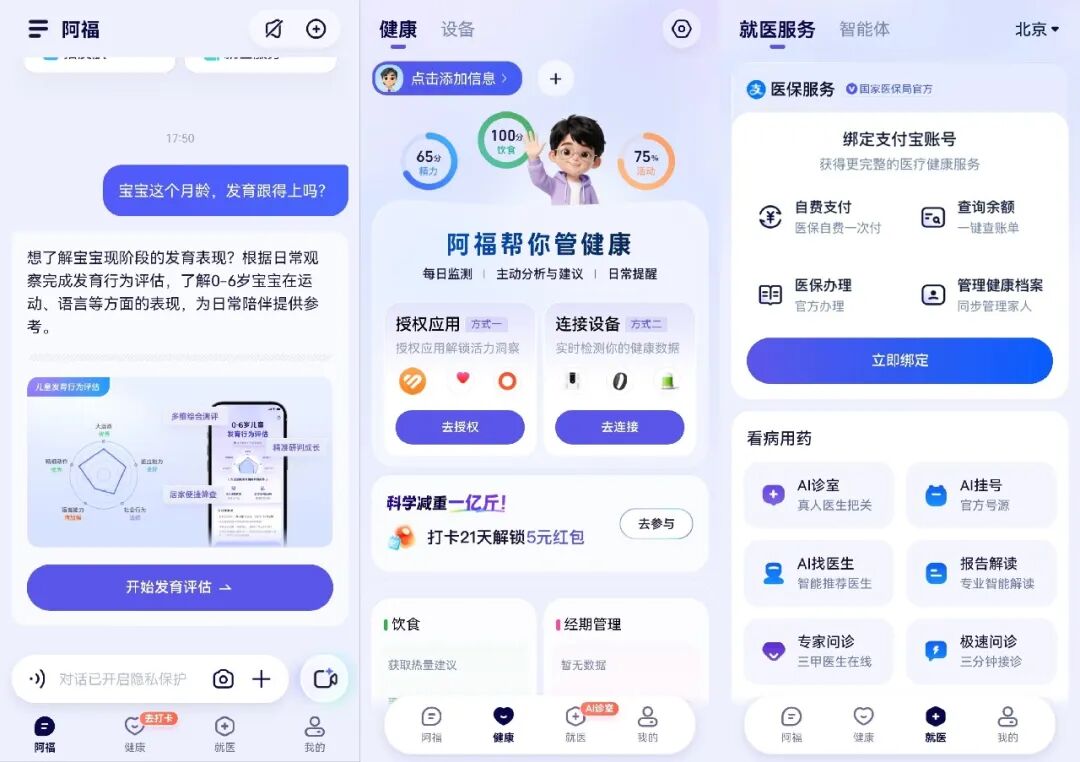
Ant upgraded its former "Digital Medical Health Business Unit" to the Health Business Group, listing it alongside Alipay, digital payment, wealth and insurance, and credit as one of the group's five core business segments (Ant International, Ant Digital Technologies, and OceanBase remain independently operated). One month later, AQ was renamed Afu, and advertising quickly rolled out.
None of this diminishes Afu's achievements.
Not understanding physical examination reports, a child feeling unwell in the middle of the night, parents needing long-term control of blood pressure and blood sugar... Afu has turned these problems outside the hospital into services available at any time—and demand has been released in a concentrated burst as a result.
Subsidies lower the threshold for a first try; experience determines whether users stay.
Han Xinyi himself has said that advertising will continue until "user scale begins to spread on its own."
Even if self-propagation appears, Afu has only crossed the threshold of product growth; it still has to face another cost sheet.

AI lowers the cost of health services, but it does not make costs disappear
Li Feng, founding partner of FreeS Fund, locates the difference between AI and the Internet in the cost structure: Internet information services rely on static databases, processed once and reused many times; large models must recompute every new question, with both input and output consuming computing power.
Internet money burns on front-end customer acquisition, while AI money also keeps burning on back-end services.
Afu already handles nearly 20 million health consultations per day, and also provides real-time audio and video "health checkups," health record analysis, and access to human doctor review in some scenarios.
Every service improves accessibility, and every one also corresponds to real model, doctor, and service costs.

Beyond computing power, there is another layer of cost that users do not easily see: data.
There are claims in the market that Ant paid costs to obtain hospital- and medical-insurance-related data.
Public information is not yet sufficient to directly write this part of the investment as "purchasing medical insurance data." A more accurate statement is that Ant needs to continuously bear the costs of medical data acquisition, annotation, governance, authorization, and compliant use.
Afu's product and research team previously revealed that Ant's medical large model used about 1T of high-quality medical corpus, invested a thousand-person-level medical team for annotation, and cooperated with universities, top-tier hospitals, the Chinese Medical Association, and other institutions to obtain data.
Ant also uses privacy computing in scenarios such as medical insurance, hospitals, and health commissions so that data can be computed "without leaving its domain"; these compliance actions are also costs.
Han Xinyi said at the same conference that AI has greatly reduced the marginal cost of personalized health services. This is not contradictory to Li Feng's judgment.
Compared with doctors providing long-term one-on-one service to patients, AI does indeed lower costs; but every model call still consumes computing power, and every piece of high-quality medical data costs money. Efficiency improvements can lower unit costs, but cannot dilute costs to zero as users grow.

Doctors use Ant Afu in postoperative follow-up
This is also what makes Afu different from the previous generation of Internet health platforms: it cannot only calculate how much money was spent to acquire a user; it must also calculate how much money is needed to continuously serve a user.
Free can validate demand; only payment can validate the business
Manus co-founder Zhang Tao recently offered a similar judgment in a sharing session at Peking University: "Free subsidies are the biggest trap for this generation of AI startups." His reasoning is not just that subsidies cost money.
It is difficult for free products to distinguish whether users truly need something or are simply not paying; the needs and feedback of paying users are closer to the real market.
Applied to Afu, this logic cannot simply lead to the conclusion that "membership fees should be charged to 150 million users."
Public information shows that the Health Business Group where Afu sits has three core businesses: medical insurance and commercial insurance payment services, digital medical treatment services, and AI medical health services, corresponding to a clear product structure—at the bottom is the Bailing medical health model, above it are the Afu App and the Alipay dual entry points, outward it connects doctors, hospitals, and health hardware, and finally medical insurance, commercial insurance, and individual payments complete settlement.
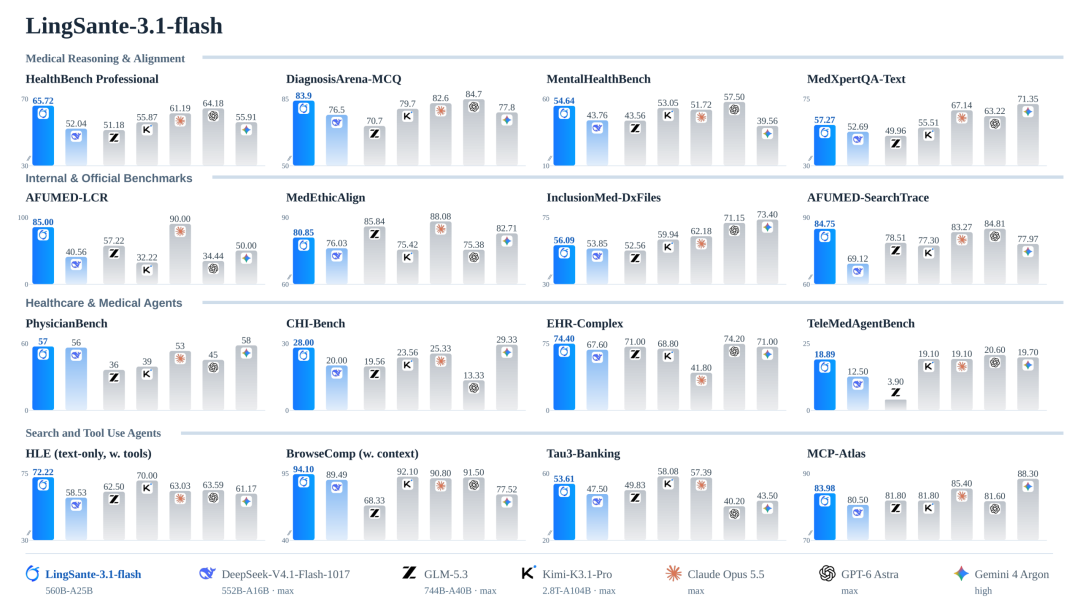
LingSante-3.1-flash scored on HealthBench Professional
Afu is not an isolated Q&A product, but the demand entry point at the very front of this service chain.
Its future business model will most likely not be just App membership fees, but will occur in layers around this service chain: individuals pay for consultations, accompaniment, and chronic disease management; hospitals pay for AI tools; the government procures digital family doctor services; and insurance pays around risk management.
But for a vertical model, what is truly valuable is not these service entry points, but the data that continuously flows behind the entry points.
If a general large model obtains the same high-quality medical data, it may also be able to make health Q&A as good as or even better than Afu—model capabilities will be caught up, computing power can be purchased, and the moat cannot rest only on the model.
What is harder to replicate is the continuous data loop: users record health changes, AI gives recommendations, doctors review and supplement, users complete registration, consultation, follow-up, and medication, and service results in turn validate the recommendations.
Once this loop forms, what Afu learns is not only "how to answer questions," but "what kind of intervention is truly effective for what kind of person."
Data also does not naturally become an asset: unannotated consultation records and files that cannot be linked to outcomes are only storage costs and compliance risks;
only when data is continuously obtained, structurally processed, linked to real health outcomes, and fed back into services can it possibly become a moat.
At present, Afu has not disclosed the number of paying users, ARPU, or payment conversion rate.
Zhang Junjie, vice president of Ant Group and president of Ant Health Business Group, still said in an interview with Beijing News Shell Finance at the end of 2025 that Afu is in an early stage of development, is not considering commercialization, and there are no advertising recommendations in Q&A. It is not that there are no paid samples within the Ant system.
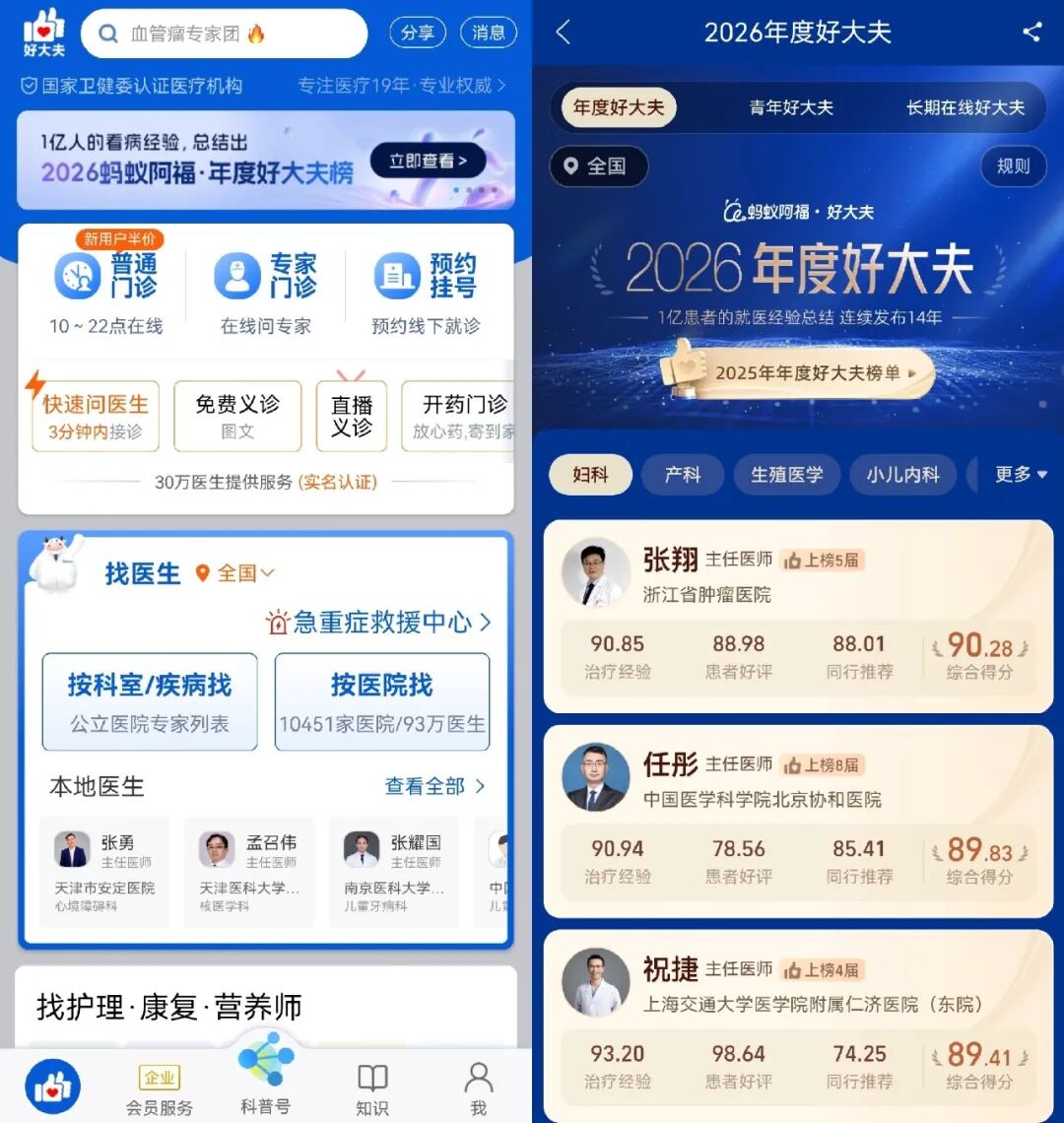
According to a review by TMTPost, Haodf Online, acquired by Ant in 2024, has 280,000 real-name doctors, began charging for consultations in 2016, started charging platform service fees in 2022, and announced full-year profitability in 2023.
But what Haodf proved is online consultation, not AI health management.
There are more paid samples in overseas medical AI.
Abridge, which makes AI medical records, charges medical systems subscription fees of about $250 per doctor per month and serves more than 300 institutions;
Hinge Health, which does chronic disease management, sells to employers and insurers and, according to its financial reports, had revenue of $235 million and net profit of $57.4 million in the third quarter of 2026; Tempus AI licenses medical data to pharmaceutical companies, with its data business generating more than $100 million in single-quarter revenue;
OpenEvidence, which is free for doctors, makes money from pharmaceutical advertising and, according to 36Kr, has annual revenue of $50 million... The common point of these companies is that none of them expects to charge ordinary users membership fees, but instead has found institutions willing to pay for efficiency, outcomes, and data.
Whether Afu can convert free health consultations into long-term paid services also lacks public data verification.

What Afu lacks is not monetization entry points, but a settlement method for health value
Afu is already building a service network beyond individual payments.
The November 23 conference was a concentrated display: the Afu App was upgraded to version 2.0, adding real-time video "health checkups";
it released its own-brand AI health band "Fu Band" and ring "Fu Ring," extending data entry points to the wrist and fingers;
the Bailing medical health model family was announced as fully open source, and medical institutions can deploy it directly; a PC workbench for doctors was launched at the same time, and an international version of the App is also about to launch.

AI health band Fu Band
The service network is also extending deeper into hospitals.
In June 2026, the International Peace Maternity and Child Health Hospital launched the AI medical assistant "Fubao" on Afu and Alipay—the name is taken from the homophony of "Fubao, Fubao (maternal and child health)"—using large models plus digital humans for triage, health consultation, medical insurance services, and full-process cloud accompaniment;
the Zhiyuan Lingxi X2 humanoid robot connected to the Afu AI medical assistant has also undertaken triage in the outpatient department of Peking University People's Hospital, operating for 66 working days with cumulative interactions exceeding 46,000.
In addition, the outline of this service network has taken shape: as of October 2026, official digital family doctor agents have partnered with nearly 80 cities across the country, covering 5 million online contracted residents, with more than 20 insurance partners and 18 health hardware partners announced at the conference.
But the number of partnerships does not equal a commercial closed loop. The conference did not disclose service pricing, revenue contribution, or the renewal status of each partnership, so outsiders cannot yet determine which services have formed stable settlement models and which remain at the stage of Ant's investment and ecosystem co-construction.
What is more difficult is that health value itself needs to be proven.
A user's drop in blood pressure may stem simultaneously from medication, exercise, diet, doctor follow-up, and family care; Afu's contribution requires long-term tracking before it can be identified.
Whether an insurance company is willing to pay for health management also does not depend on consultation volume, but on whether it can see actual changes in morbidity, hospitalization rates, and claims risk.
This is also why Han Xinyi placed "a payment mechanism that pays for health value" in an important position at the same conference: calling for the coverage of medical insurance and commercial insurance to extend from "treating illness" to "health," saving expenditure over a longer cycle by keeping people healthier.

Han Xinyi speaks at the 2026 Ant Afu Medical Health Ecosystem Conference
And the deeper the payment mechanism goes, the clearer the data boundaries must be—health records can improve services, but they cannot automatically become the basis for differentiated insurance pricing.
Afu must simultaneously prove that its services are effective, its recommendations are credible, and data use has boundaries, before payers dare to commit for the long term.

Chaoyong AI Viewpoint:
Internet thinking can open the door, but it cannot walk this road for Afu. Afu is not a case of Internet thinking failing.
On the contrary, it proves that advertising, free services, and platform synergy can still rapidly build a new entry point.
The real change happens after the entry point is established. In the Internet era, platforms could first retain users and then slowly look for advertising and transaction opportunities;
In the AI era, continuous service itself has costs, and health AI must also be accountable for professional advice and human services.
User scale is no longer naturally equal to assets; only scale covered by sustainable revenue is a commercial asset.
Afu's organizational position is already high enough, and its product chain has extended from health Q&A to doctors, hospitals, medical insurance, commercial insurance, and hardware.
What it needs to supplement next is two sets of data: one is payment data—how many users, hospitals, governments, and insurance institutions are willing to continuously pay for services;
The other is outcome data—whether Afu's continuous intervention has truly improved health and reduced medical costs.
The former determines whether it can become a business, and the latter determines how far this business can go. US peers have already provided a reference: charging institutions and letting data generate pricing is more realistic than charging 150 million users membership fees.
From this perspective, Afu's ticket to the AI era is not written in model parameters, nor only in its 150 million users, but in whether it can continuously obtain high-quality health data and transform that data into verifiable, payable health outcomes.
Constraints at the group level have also emerged.
In 2025, Ant Group invested 35.03 billion yuan in technology, with net profit of about 15.3 billion yuan, a year-on-year decline of about 60%; it also needs to continue feeding Lingguang and upgrading it again and again into the current narrative in order to have occasional flashes of brilliance;
Therefore, neighboring Ant Lingbo has launched its first round of independent financing, planning to raise 1.5 billion yuan... This does not mean Ant lacks money, nor does it mean Afu will immediately spin off, but it shows that "saturation investment" does not come without financial boundaries, and external financing and independent cash generation are becoming a way for the group to manage heavy-asset AI businesses.
For Han Xinyi, the pressure is not to make Afu profitable immediately, but to deliver what he called "must win": making health the third leg alongside payments and finance. Ant can support Afu for a few more years, but it is difficult to indefinitely support a business that has only scale and no closed loop.
Internet thinking helped Afu open the door. The business behind the door needs another set of algorithms to complete.
-
![]()
Xiaomi: Out of the Woods, but What Lies Ahead?
-
![]()
AI Enters the Factory: The First Revolution Is in the Enterprise
-
![]()
Shenzhou-24: Reallocating Time in Space
-
![]()
Han Xinyi's 150 Million Users Are Not Ant Afu's Ticket Into the AI Era
-
![]()
The Profit Fulcrum Shifts Outward as the Arbitrage Window Closes
-
Lei Jun Is Having a Really Tough Time: Xiaomi Auto Made Only 900 Million Yuan in Profit Last Year, but Lost 9.1 Billion Yuan in the First Nine Months of This Year!
-
After Raising Over HK$24 Billion, Luxshare Precision Issues Bonds Again: Just How Cash-Intensive Is Its Automotive Expansion?
-
![]()
Can Carmakers No Longer Sustain the Price War?