Shenzhou-24: Reallocating Time in Space
 11/25 2026
 440
Shenzhou-24 has successfully entered orbit — and the return spacecraft for one of its astronauts arrived at the China Space Station half a year in advance.
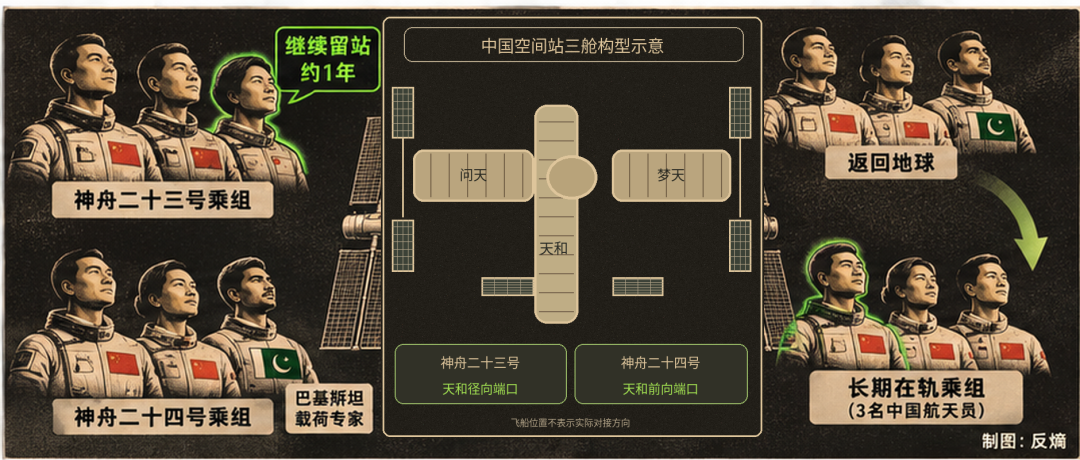
That astronaut is a Pakistani payload specialist. After completing a short-term mission, he will return to Earth aboard Shenzhou-23 alongside two Chinese astronauts. Shenzhou-23 commander Zhu Yangzhu, meanwhile, will remain on the station to carry out China's first one-year in-orbit residency experiment, working alongside the two newly arrived Chinese astronauts of Shenzhou-24.
Three go up, three come back, and the space station keeps a steady three-person long-duration crew. No extra seat was added to any spacecraft — yet a single crew handover now accommodates both a year-long research program and a short-term international visit.
The China Space Station already runs on a crew rotation cycle of roughly six months, but scientific missions do not all fit that timetable. Shenzhou-24 folds two different mission cycles into one rotation, bringing a question into sharper focus: when crewed transport capacity is limited, how can more of the right kind of space time be secured for research?
01 A Crack, Two Spacecraft Swaps
In November 2025, a crack in the return capsule of Shenzhou-20 changed the homeward journey for two consecutive astronaut crews.
As the Shenzhou-20 crew prepared to return to Earth, the astronauts noticed an anomaly in the window glass. Through photographic interpretation, design review, and test analysis, ground teams confirmed that the glass had developed fine cracks — most likely caused by a space debris impact. The return capsule must withstand intense aerodynamic heating during reentry, and the damaged window meant the spacecraft no longer met the conditions for a safe crewed return.
On November 14, the three Shenzhou-20 astronauts switched to the Shenzhou-21 spacecraft already docked at the space station and landed safely. The Shenzhou-21 crew remaining on the station thus lost their originally assigned return spacecraft.
Eleven days later, Shenzhou-22 was launched in an emergency unmanned configuration to restore return capability. It was not until May 29, 2026, that the Shenzhou-21 crew returned aboard Shenzhou-22, having logged 210 days in orbit.
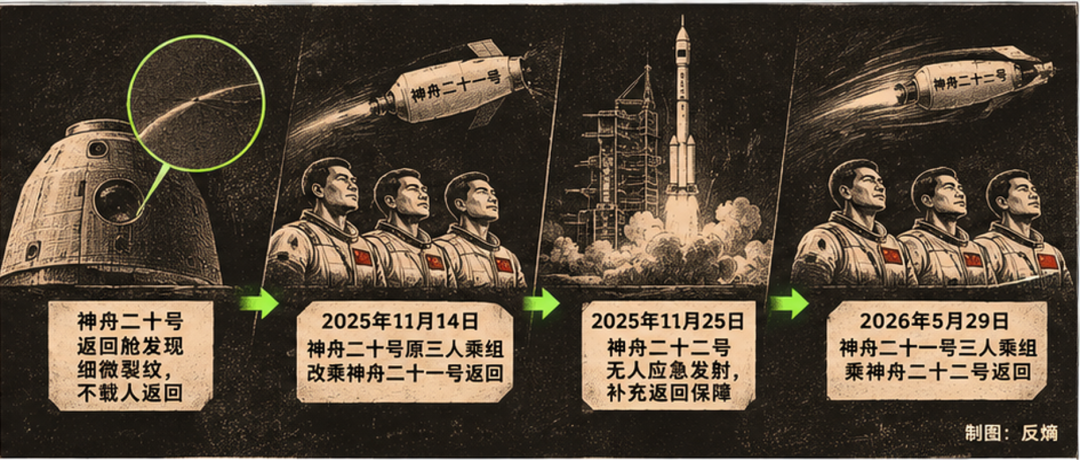
This emergency response put China's crewed spaceflight "launch one, prepare one" rolling backup mechanism to the test. After delivering a crew to the station, a Shenzhou spacecraft must remain docked for months to provide an emergency evacuation means for the in-orbit astronauts. When the originally assigned spacecraft cannot return safely, the ground must rearrange personnel assignments and supply a usable return spacecraft as soon as possible.
The previous two spacecraft swaps both involved an entire three-person crew moving to another spacecraft. Shenzhou-24, by contrast, requires recombining astronauts from different crews, with each person's return method determined before launch.
From adjusting the return spacecraft after an accident to arranging cross-spacecraft return in advance, a new practice is taking shape in how Shenzhou spacecraft are used. What drove this change is that one astronaut needs to stay half a year longer than his companions.
02 One Person Stays, Two Missions Served
Two astronauts each staying half a year can accumulate one year of observation time in total — but they cannot provide physiological change data for the same person over a continuous year in space.
From 2015 to 2016, NASA astronaut Scott Kelly stayed continuously on the International Space Station for 340 days while his identical twin brother Mark Kelly remained on the ground. Researchers compared the physiological changes of the two in different environments, and the results were published in Science magazine in 2019. This famous twin study showed that long-term continuous observation can yield unique data for understanding the effects of spaceflight on the human body.
On May 24, 2026, Zhu Yangzhu, Zhang Zhiyuan, and Li Jiaying lifted off aboard Shenzhou-23. The mission press conference on November 24 further confirmed that Zhu Yangzhu will continue to stay on the station to carry out China's first one-year in-orbit residency experiment.
Under the plan, this experiment will establish a new space human research system, study human adaptation and changes during long-duration spaceflight, accumulate human research data combining macroscopic and microscopic perspectives, and systematically verify the health, work, and living support capabilities required for long-term astronaut residency.
Extending the stay by half a year primarily serves this research — and it also changes the return arrangements for Shenzhou-23. Three go up, but only two need to return during rotation, so the third seat can be reserved for a short-term visitor.
China and Pakistan signed an astronaut cooperation agreement in February 2025. In April 2026, two Pakistani reserve astronauts went to China for training, among whom Muhammad Zeeshan Ali will lift off aboard Shenzhou-24 together with Chinese astronauts Tang Hongbo and Wu Yi. Under the plan, after completing short-term work on the space station, he will return together with the two Chinese astronauts of Shenzhou-23; the Chinese astronaut remaining on the station will form the next long-duration crew with the two newly arrived Chinese astronauts of Shenzhou-24.
Shenzhou-24 has only three seats going up. Compared with the usual full three-person crew rotation, one seat is allocated to the Pakistani payload specialist, so this round carries one fewer new long-duration resident astronaut. One member of the original crew extends the stay to continue space station work — and in doing so frees up one return seat.
Under limited crewed transport capacity, adding one kind of research opportunity often means adjusting the personnel arrangements for another task. This time, the two research efforts share the originally planned crewed round-trip mission, with no additional launch needed for the short-term visit.
During the handover of the two crews, every in-orbit astronaut must have a reliable emergency return plan; cross-spacecraft return also involves seat adaptation, operational training, and life-support preparations. Such an arrangement can only be implemented when the research plan, personnel combination, and spacecraft support all line up.
If short-term visits become more frequent, can we still rely on each long-duration residency experiment to free up a seat?
03 How to Allocate Space Time
Sending a short-term visitor to the space station and having them return on another spacecraft was already used by the International Space Station more than two decades ago.
In October 2005, American private space participant Gregory Olsen entered the International Space Station aboard the three-seat Soyuz TMA-7. After completing an eight-day visit, he switched to the previously docked Soyuz TMA-6 and returned to Earth with two long-duration resident astronauts. This cross-return arrangement both served the short-term visit and coordinated with the regular replacement of Soyuz spacecraft at the time.
Shenzhou-24 adopts a similar arrangement this time, accommodating both the one-year human research and the China-Pakistan joint short visit.
Beyond spacecraft seats, astronauts' in-orbit working time is also limited. After entering the space station, they must also complete equipment maintenance and their own health support, and scientific experiments need to be arranged in advance.
This time, China and Pakistan have arranged four cooperative science projects, involving biotechnology and materials research. The Pakistani payload specialist will conduct a photosynthetic microorganism cyanobacteria experiment in orbit and handle the installation of experimental samples and experiment units.
Such short-term missions place higher demands on preliminary preparation and in-orbit operational efficiency. Astronauts have limited time on the space station and need to concentrate work as much as possible on steps that must be completed in space.
Larger spacecraft can increase round-trip opportunities, but cannot solve the personnel accommodation problem alone. The basic configuration of the China Space Station supports three-person long-duration residency and six people on orbit simultaneously during rotation. The under-development Mengzhou next-generation crewed spacecraft can carry up to seven people for low Earth orbit missions; even if single-mission transport capacity increases in the future, the space station's life support conditions and actual round-trip frequency must also match.
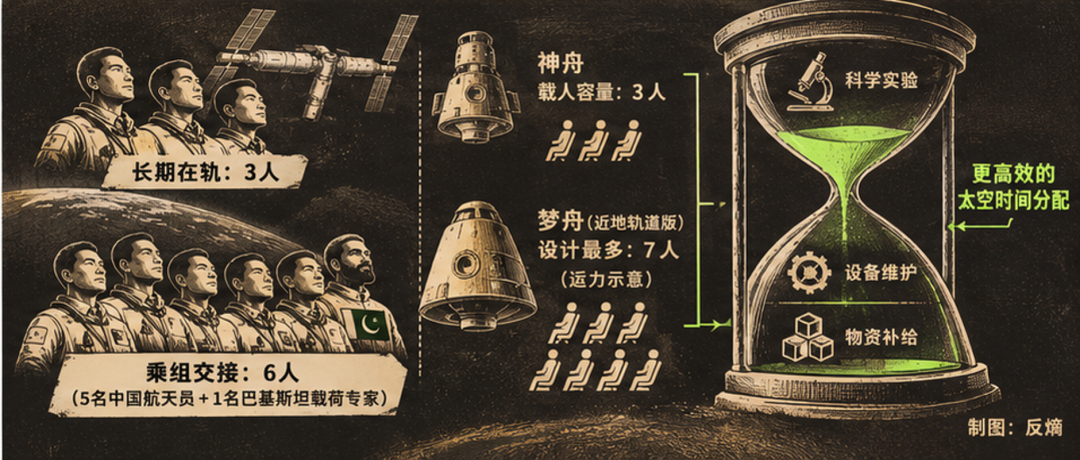
The scientific research capability of a space station depends both on how many people can be sent into space and on how their time in space is used.
* All images above were generated by AI.
* If you have different views on the article content, you are welcome to contact us.
-
![]()
Xiaomi: Out of the Woods, but What Lies Ahead?
-
![]()
AI Enters the Factory: The First Revolution Is in the Enterprise
-
![]()
Shenzhou-24: Reallocating Time in Space
-
![]()
Han Xinyi's 150 Million Users Are Not Ant Afu's Ticket Into the AI Era
-
![]()
The Profit Fulcrum Shifts Outward as the Arbitrage Window Closes
-
Lei Jun Is Having a Really Tough Time: Xiaomi Auto Made Only 900 Million Yuan in Profit Last Year, but Lost 9.1 Billion Yuan in the First Nine Months of This Year!
-
After Raising Over HK$24 Billion, Luxshare Precision Issues Bonds Again: Just How Cash-Intensive Is Its Automotive Expansion?
-
![]()
Can Carmakers No Longer Sustain the Price War?