AI Enters the Factory: The First Revolution Is in the Enterprise
 11/25 2026
 507
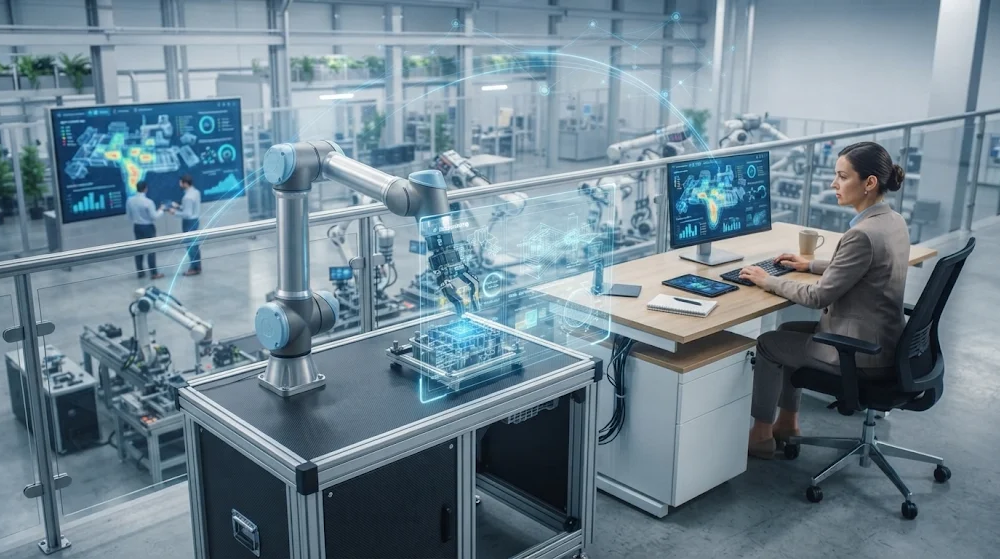
The ultimate battleground for AI giants is the enterprise workflow.
Over the past two years, the capital market has valued AI on the strength of technological imagination and computing scale. Now, however, valuation logic in the secondary market is returning to commercial fundamentals—profitability has become the new yardstick for measuring AI giants.
The evidence: Anthropic previously went public at an issue price as high as $83, gaining 17% on its first day. But over the next two trading days, its share price fell steadily. Even the sensational news that Fable had proved the Riemann Hypothesis failed to reverse its decline in the secondary market. Clearly, the market has not treated technological breakthroughs as a proxy for future profitability.
So where will this company—holder of the world's top large models—anchor its profit model next? Anthropic's prospectus may hold the answer.
01 AI Is No Longer Content to Answer Questions; It Wants to Take Over the Work
In its prospectus, Anthropic puts forward a core positioning of great signal significance: Claude as a Virtual Collaborator. From the "conversational assistant" of ChatGPT's debut in 2022 to the "AI assistant" widely championed by the industry since, the role of large models is undergoing yet another evolution.
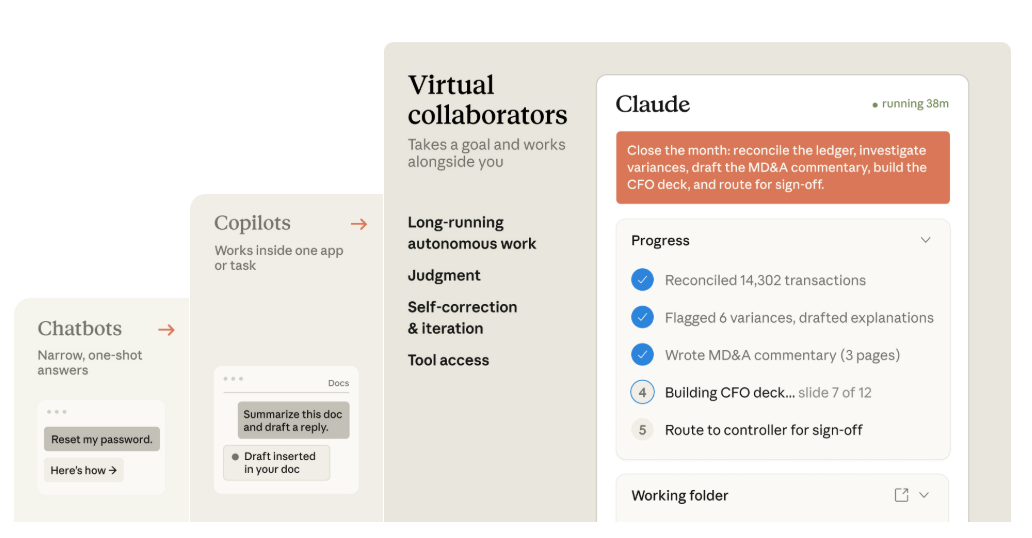
(Image source: Anthropic)
By Anthropic's definition, a "virtual collaborator" is an AI system that can work side by side with humans and independently handle complex, multi-step tasks at a professional level.
In practice, virtual collaborators are currently delivered mainly through two landmark products. The first is the well-known Claude Code, which countless entrepreneurs and Vibe Coding full-stack engineers use across the entire project development lifecycle—from planning and writing to testing and even debugging.
The second, Claude Cowork, is even more intriguing. It targets the vast ranks of non-technical staff and cuts into broader daily office scenarios, requiring autonomous completion of knowledge work such as research, drafting, and data analysis. As of September 2026, adoption of Claude Cowork has even surpassed that of Claude Code.
It is not difficult to see that Anthropic's blueprint for the future is precisely to drive AI from a mere conversational tool to a concrete business executor, thereby racing to stake out territory in the enterprise market.
Almost simultaneously, at the recently concluded Baidu AI Conference, Robin Li put forward the judgment that "an intelligent organization is the new factory of the AI era," focusing on reshaping internal enterprise collaboration. Its "Kuku" agent, for example, attempts to connect enterprise cloud drives and chat records directly, allowing cross-role tasks such as image editing, typesetting, and review to relay and circulate based on the same "work context," reducing information loss in traditional communication.
In addition, Tencent and ByteDance, which hold the entry points of office software, also fired the starting gun early in the battle for enterprise-level AI positioning. Tencent fully integrated the Hunyuan large model into WeCom and Tencent Docs, directly transforming daily communication, meeting minutes, and customer follow-up into automated business flows; its flagship product WorkBuddy officially launched its enterprise edition in June this year. ByteDance, relying on Feishu, launched multidimensional table AI and intelligent workflows, linking data and approval nodes scattered across departments into a closed loop, allowing AI to directly take over the team's collaboration hub.
Although Chinese and foreign giants have different entry paths and strategies, they converge at the same destination: AI competition is extending from model capabilities to organizational productivity.
02 Enterprise Workflows Are Becoming the New Moat for Large Models
To understand this shift, it helps to first return to the starting point and see how AI initially entered the market.
In the early stage of large language model development, AI entered the market in the form of a "conversational assistant," whose underlying logic was exactly the same as that of the traditional consumer internet: use free strategies to capture traffic, do not directly ask C-end users for money, but instead complete the commercial loop by selling advertising space to B-end enterprises—what the industry often calls "wool comes from the pig."
This path was also continued in the early AI era: whether overseas Claude and ChatGPT, or domestic DeepSeek and Doubao, almost all provided free versions.
However, AI is not suitable for directly copying this monetization model of embedding ads. The reason is that AI not only has internet attributes but is also a productivity "tool." If ads are indiscriminately inserted during use and answers, it will directly damage its objectivity and professionalism, thereby shaking the trust of core users and ultimately leading to no one paying for the paid version.
With the advertising path ruled out and the ceiling for C-end individual payment visible to the naked eye, the only stage left that can truly unleash AI's commercial value is the B-end. After all, the most fertile soil for the "tool" attribute has never been C-end daily chatting, but complex, high-frequency B-end office scenarios. Compared with individual users, enterprise customers have both high average order value and high stickiness: AI is no longer a scattered Q&A add-on, but is deeply coupled into continuously operating production flows.
(Image source: Anthropic)
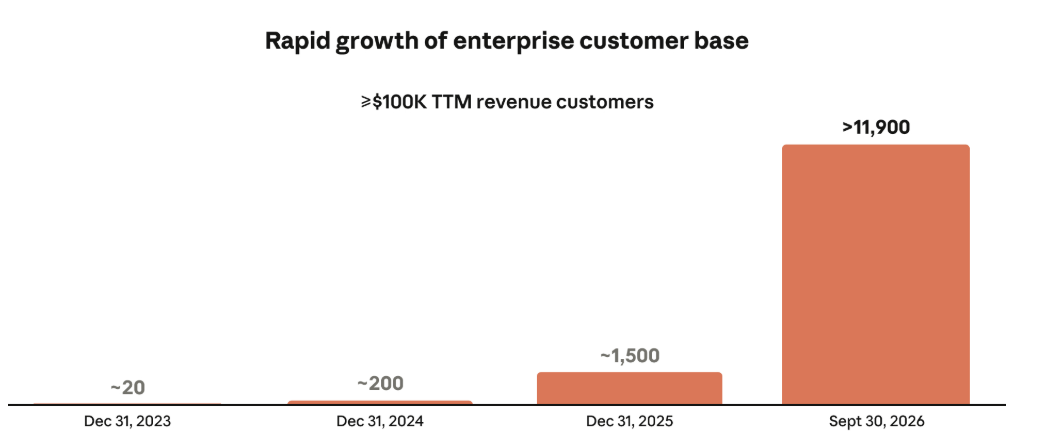
Anthropic's prospectus also confirms the explosive power of the enterprise market. In the prospectus, Anthropic defines customers spending more than $100,000 annually as "Enterprise Adoption": in December 2023, this number was only 20; by the third quarter of this year, it had soared to an astonishing 11,900.
Domestic giants' B-end commercialization is also gaining momentum rapidly. Baidu's "Famou 3.0" has industrial customers covering 25 of China's 41 industrial categories; Tencent's WorkBuddy has surpassed 10 million daily active users, and its enterprise edition has already achieved 60% penetration among China's top 100 enterprises since its launch.
So many enterprises are willing to pay real money, which is inseparable from substantive breakthroughs in underlying technology.
(Image source: Anthropic)
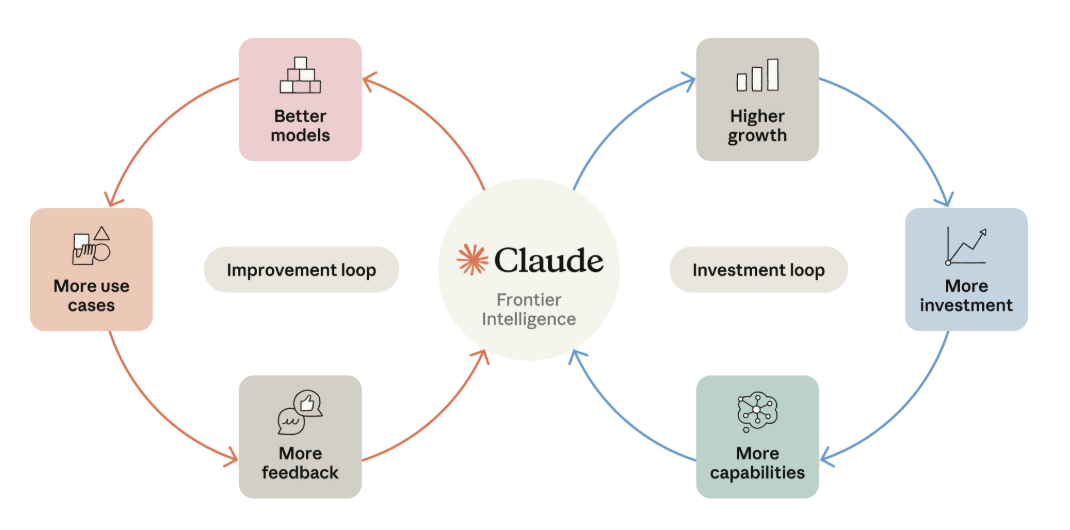
Anthropic introduced RSI (Recursive Self-Improvement) technology, allowing existing models to directly participate in the experimental design, training data generation, security auditing, and code writing of next-generation models, and based on the insights accumulated in these processes, feed back into algorithm iteration and optimization of training and inference methods. This is what they call a "compute multiplier," aimed at leveraging better model performance from the same compute investment. For example, compared with Opus 5, Opus 5.5 significantly reduced customers' per-task cost by about 40%.
Thanks to this, Anthropic has built a positive self-reinforcing loop: first use RSI to polish stronger-performing, lower-cost models; significant cost reduction and efficiency improvement directly stimulate high-frequency, large-volume enterprise calls; massive real calls in turn continuously feed back higher-quality data and feedback; ultimately, these data once again drive the model to evolve to a higher level.
(Image source: Wenxin Large Model)
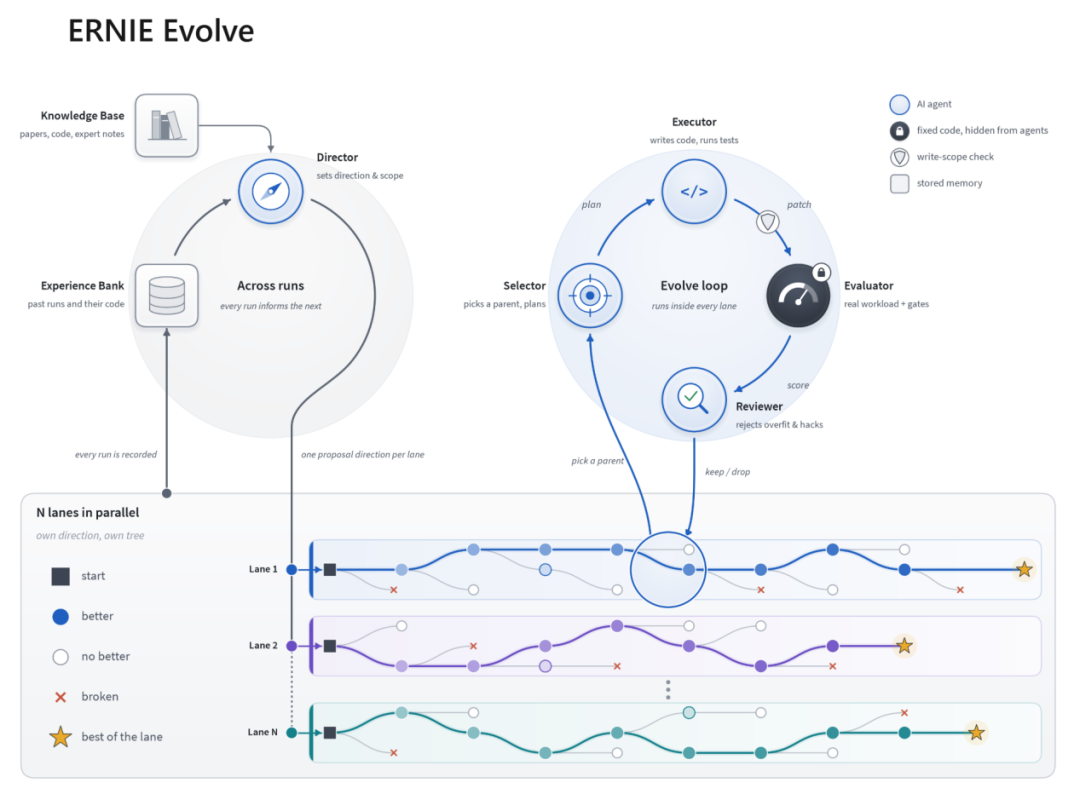
Baidu is also applying RSI technology. They have built an "internal and external dual-loop" collaborative evolution mechanism: the outer loop relies on literature and experience libraries to give the general direction and break down tasks, while the inner loop is responsible for high-frequency trial and error, code running, and evaluation feedback on subdivided tasks, thereby achieving rapid iteration of R&D routes. With this mechanism, when Baidu optimized the low-latency inference of the ERNIE-5.5-Flash model, through multi-directional parallel exploration, it increased the final generation speed to 623.6% of the original baseline.
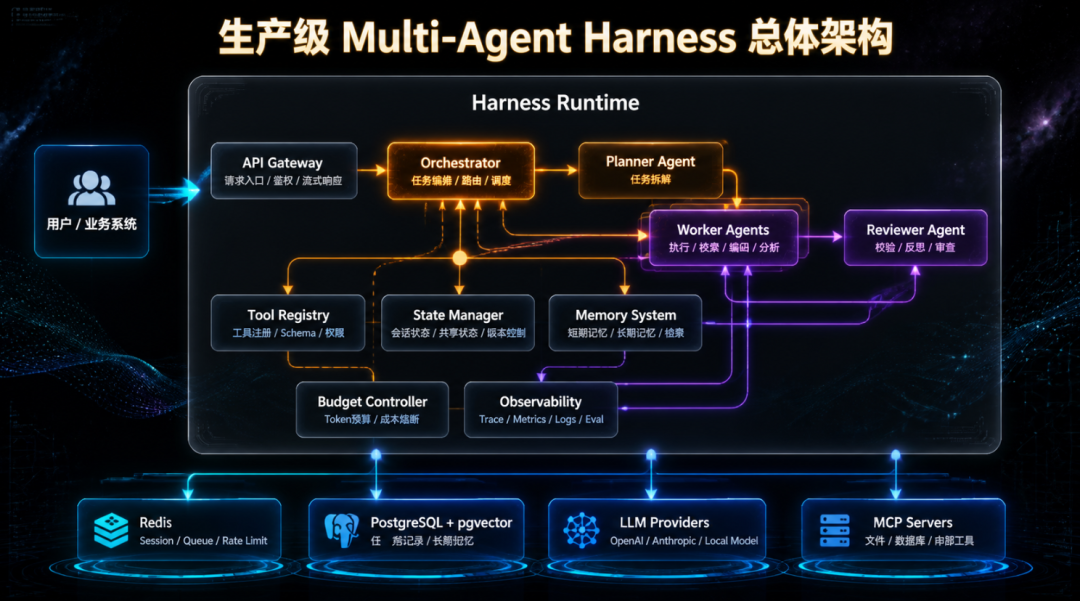
(Image source: Tencent Cloud)
If Anthropic and Baidu focused on iteration of underlying models, Tencent has landed optimization on the specific application side. It adopted the idea of a "Multi-Agent Harness": after decomposing complex tasks, assigning them to different agents for parallel execution, and finally integrating them into a complete result, thereby effectively avoiding pain points such as excessively long context, overly complex tasks, and mutual interference among different stages.
For Anthropic and Baidu, RSI can help them raise the model ceiling faster and reduce call costs; for Tencent, the multi-agent architecture gives AI the ability to undertake complex business chains. The former lowers the threshold for enterprises to use AI, while the latter broadens the work boundaries AI can participate in. With the two working together, the ROI of enterprise-level AI applications will be substantially improved, pushing enterprises to accelerate from using "AI assistants" into a new stage of using "virtual collaborators."
In addition to business models and technological breakthroughs, the core consideration for giants crowding into the enterprise market is to build deep commercial barriers.
The underlying logic is: once an enterprise deeply integrates AI tools into its business, it will form extremely strong path dependence; if it wants to switch midway in the future, the migration and labor costs paid will be difficult to estimate.
Take an enterprise introducing Claude as an example: it needs to deeply read the internal codebase, become familiar with the company's development standards, connect to testing systems and internal databases, and write, test, and modify code strictly according to the enterprise's established processes.
Even if a competitor later launches a stronger-performing model, the enterprise must still weigh the heavy cost of re-migrating configurations, rebuilding workflows, adjusting permission systems, and re-validating results.
In Anthropic's prospectus, in addition to the self-reinforcing loop of model capabilities, it also outlines a clear "capital and R&D loop": stronger models bring higher revenue growth, abundant funds then feed back into R&D investment, and further nurture top-tier models, keeping core competitiveness firmly in place.
In summary, AI has both "internet" and "tool" attributes: leveraging internet attributes for free traffic acquisition, and relying on tool attributes to enter enterprise office scenarios. Considerable financial returns, continuous technological breakthroughs, and commercial barriers expected to be built in the future further strengthen AI giants' determination to heavily bet on the enterprise market.
03 AI Can Work, but That Does Not Mean Enterprises Dare to Hand Work Over to It
The commercial loop of AI entering enterprises seems impeccable, but for it to truly enter enterprises is by no means easy. After all, within any mature organization, there is natural inertia and resistance to change.
On the one hand, enterprises' migration costs are extremely high—this occurs not only when switching between AI tools, but also in the process of introducing AI "from zero to one." To embed products such as Claude, WorkBuddy, and Famou into existing IT architectures, enterprises must invest substantial engineering time, manpower, and budget upfront.
Moreover, even if an enterprise makes up its mind to embrace AI, whether this high upfront investment can bring back matching commercial returns remains a huge unknown.
As we know, in the investment world, Buffett has always believed in that old proverb: "The core of valuation is what Aesop said: 'A bird in the hand is worth two in the bush.'" Future potential gains, when discounted to the present, are inherently greatly reduced, and moreover this gain is currently far from certain.
Anthropic also admits in the "Risk Factors" section of its prospectus: "In recent years, the market for AI technologies, including frontier AI and related models, platforms, and applications, has grown rapidly, but this market is still at a relatively early stage and is changing rapidly. It is currently uncertain whether such AI technology markets can achieve widespread adoption and sustain it at the speed or to the extent we expect."
On the other hand, modern enterprises' processes, permissions, systems, and accountability systems are all built around "human employees," and AI is by no means able to take up a post directly just by connecting to an API. Take the simplest example: when an AI Agent independently generates a financial report, who exactly reviews it? Once the data is wrong, who is responsible? If it exceeds its authority and calls the wrong internal database, how should it be traced afterward? These are all extremely specific enterprise implementation challenges.
Therefore, what enterprises need is not only a model that can work, but also an organizational mechanism that can manage "AI employees" and reshape accountability boundaries—this is probably also the deeper reason Robin Li repeatedly emphasizes "organizational evolution." The original departmental walls and division-of-labor models can no longer accommodate the integration of AI. How to bridge the gap between technical capabilities and business logic is giving rise to entirely new industrial division of labor and organizational forms.
To help customers bridge the gap between technology and business, AI giants are deploying their most tech-savvy people directly to the business front line. Recently, Anthropic announced a $100 million investment, planning to train 10,000 FDEs (Forward Deployed Engineers) by the end of 2027; Tencent Cloud followed suit by launching an FDE certification system.
The role of the FDE is to embed deeply within customer organizations, restructure workflows, clean up data pipelines, and transform general-purpose models into tailored solutions that fit each enterprise's organization. The growing popularity of this position signals that selling models is no longer a "one-off deal"—vendors must genuinely participate in their customers' business transformation to turn technology into productivity.
The second half of enterprise-level AI competition may be shifting from a pure contest of model capabilities to a contest of "who understands enterprises better and who can better complete last-mile delivery." And as AI continues to penetrate deeper into business territory, what new industrial divisions of labor will emerge in the future is also worth looking forward to.
* The image is sourced from the internet. If there is any infringement, please contact us for removal.
-
![]()
Xiaomi: Out of the Woods, but What Lies Ahead?
-
![]()
AI Enters the Factory: The First Revolution Is in the Enterprise
-
![]()
Shenzhou-24: Reallocating Time in Space
-
![]()
Han Xinyi's 150 Million Users Are Not Ant Afu's Ticket Into the AI Era
-
![]()
The Profit Fulcrum Shifts Outward as the Arbitrage Window Closes
-
Lei Jun Is Having a Really Tough Time: Xiaomi Auto Made Only 900 Million Yuan in Profit Last Year, but Lost 9.1 Billion Yuan in the First Nine Months of This Year!
-
After Raising Over HK$24 Billion, Luxshare Precision Issues Bonds Again: Just How Cash-Intensive Is Its Automotive Expansion?
-
![]()
Can Carmakers No Longer Sustain the Price War?