Stock Price Soars to New Heights: Lenovo Breaks Free from 'Computer Seller' Label, Transforms Fate with AI
 09/20 2026
 345
345
From 'computer vendor' to AI infrastructure powerhouse.
Recently, the stock price performance of Lenovo Group on the Hong Kong Stock Exchange has been particularly noteworthy.
On September 18th, Lenovo's stock price surged to HK$36.76 during intraday trading, setting a new all-time high.
It's worth mentioning that its performance in the two preceding trading days was also robust. On September 16th, it rose by 8.33%, and on September 17th, it climbed an additional 1.54% to HK$34.32. This is particularly impressive given the overall context of the technology sector in the Hong Kong stock market this year.
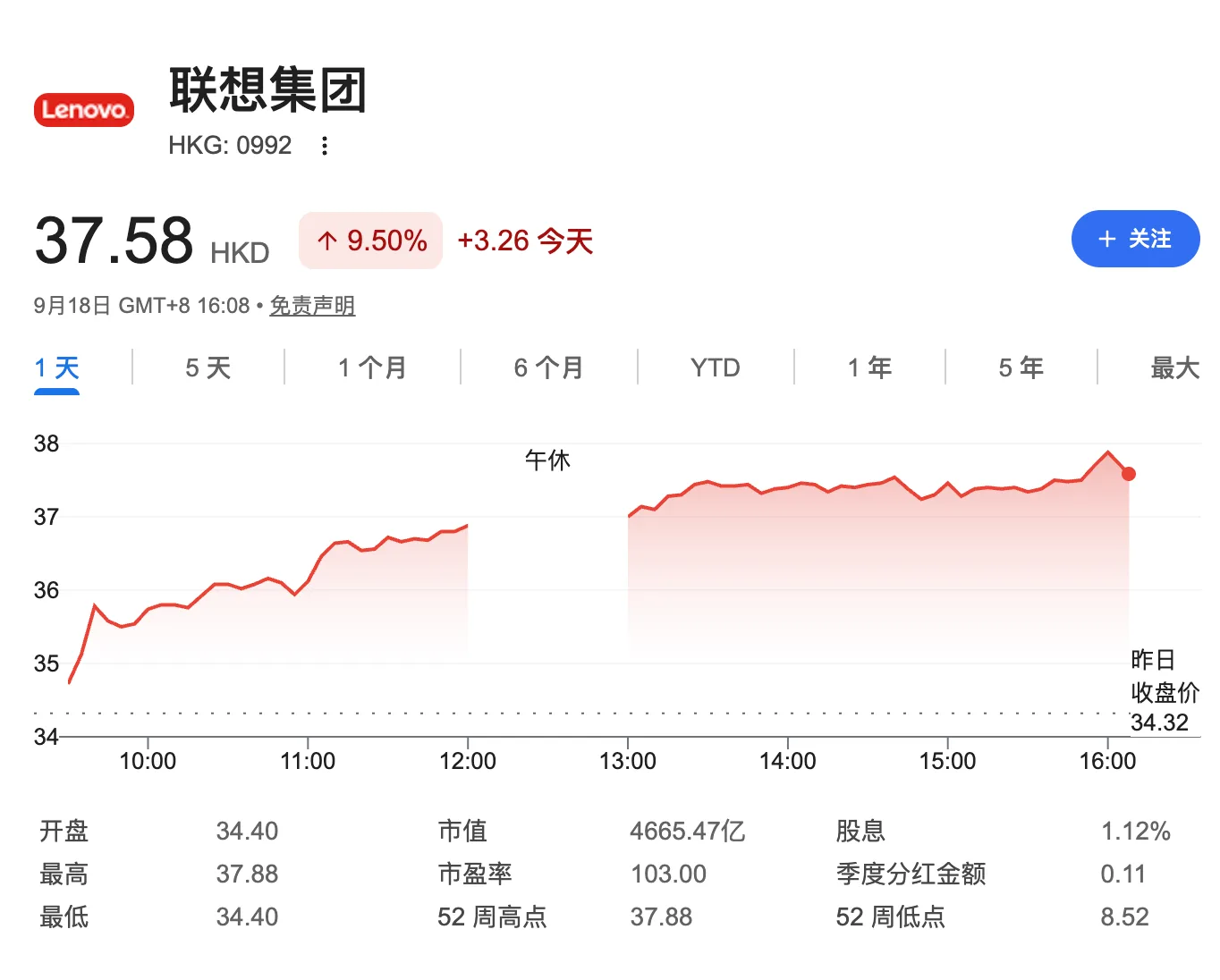
Image source: Google
I've also observed that, beyond the stock price itself, there's a significant signal hidden in Morgan Stanley's report.
On September 17th, Morgan Stanley released a report predicting that Lenovo's ISG (Infrastructure Solutions Group) revenue growth will further accelerate. The firm maintained its 'overweight' rating on the stock and set a target price of HK$46.
Morgan Stanley's rationale is clear: Lenovo is poised to benefit from robust demand in both general-purpose and AI server sectors, leading to a further acceleration in ISG revenue growth. ISG is Lenovo's solutions and services business group, primarily focused on enterprise-level AI infrastructure, including servers and storage.
Previously, when people thought of Lenovo, their first reaction was often 'computer vendor.' However, the focus of institutional attention has clearly shifted. For a traditional PC giant, the AI server business is emerging as a key factor in redefining its valuation logic.
According to Morgan Stanley's research data, cloud customers now contribute approximately 70% of Lenovo's server business revenue, including new cloud customers like neocloud, with enterprises and small-to-medium-sized customers accounting for the remaining 30%.
This neocloud is a topic that Leitech (ID: leitech) must delve into.
Unlike traditional public cloud giants such as Amazon and Microsoft, neocloud is a new generation of cloud service provider that has emerged in the past two years. It specializes in providing computing power for AI training and inference, experiencing rapid demand growth and scalability.
Image source: Baidu
Morgan Stanley's inclusion of these new cloud customers in Lenovo's server growth narrative underscores that the core driver of Lenovo's server growth stems from cloud providers' purchasing demand.
Institutions predict that Lenovo's year-on-year server revenue growth in the second fiscal quarter of FY2026/27 will continue to rise, with margins expected to remain stable quarter-on-quarter. If AI demand growth further surpasses expectations, revenue could be even stronger.
In other words, as long as the demand for AI computing power remains robust, Lenovo's server business is confident in continuing to accelerate.
Besides AI servers, enterprise demand for general-purpose servers is also strong. Morgan Stanley believes this segment is expected to continue driving overall server margin improvements.
Leitech considers this point crucial. Although the AI server sector is fiercely competitive, its gross margins are not as high as those of general-purpose servers. This is because the entire industry is still in a phase of burning cash for expansion, with subsidies essentially present and commercial validation yet to be achieved. If demand for general-purpose servers can remain steady, it will be beneficial for Lenovo's profit structure.
There's also a noteworthy detail regarding the product side. The report mentions that Lenovo's entry into the GB300-related market will be relatively late, but its VR200 shipment rhythm can align with industry-leading suppliers.
In the AI server arena, hardware delivery capabilities and shipment rhythm directly determine whether a manufacturer can capture and how much of the market dividend it can secure.
In terms of profitability, Lenovo's management maintains the group's near-term target of achieving a net profit margin of 5%, with a medium-to-long-term goal of further increasing it to 5%-8%. This target may not seem overly ambitious, but for a company of Lenovo's scale, every percentage point increase is challenging. Moreover, given its large revenue base, the resulting profit growth is substantial.
Image source: Baidu
As for the PC business, which is of concern to many, Morgan Stanley expects industry demand to slow down in the second half of 2026. Lenovo itself anticipates that its IDG operating margin will remain at around 7% quarter-on-quarter in the second fiscal quarter of FY2026/27, relying on continuous cost reduction and product mix optimization to offset demand pressures from the broader environment.
Therefore, the core reason behind Lenovo's stock price hitting a new high is a recalibration of the market's valuation logic towards the company. Accelerated server revenue growth, enterprise general-purpose servers driving margin improvements, and a medium-to-long-term net profit margin increase to 5%-8% are becoming key variables for institutions to reassess Lenovo's profit potential.
From Leitech's (ID: leitech) perspective, the most noteworthy aspect of Lenovo's current trend is whether it can transform the narrative of AI server growth from expectations into consistently delivered financial results. Although the server business is growing rapidly, the AI computing hardware industry is fiercely price-competitive. How to convert revenue scale into stable profits is a major challenge Lenovo will face next.
For the broader technology industry, Lenovo's transformation is also a microcosm. Traditional hardware manufacturers are seizing the opportunities of the AI computing era by vigorously expanding their server infrastructure business. Lenovo demonstrates the strong transformational resilience of an established hardware giant. Facing industry cycle fluctuations, it has maintained profitability in its mature businesses while resolutely increasing investments in the new AI sector, leveraging its technological foundation, customer resources, supply chain, and global capabilities to capture the dividends of the cloud and AI wave. This veteran technology company has rediscovered its second growth curve and forged its own growth path in the AI era, giving off a strong sense of 'a second spring.'
Source: Leitech
The images in this article are from the 123RF licensed image library. Source: Leitech
-
![]()
Doubao Mobile Phone Launched: AI Agents Enter the 'Terminal' Race
-
Apple’s Annual Online Sentiment Journey: From Launch Price Dip to Market Dominance in 5 Phases
-
![]()
Can AI Truly Annihilate All of Humanity? Are Those Chilling Doomsday Predictions Actually Plausible?
-
![]()
iPhone 18 Pro Max First Launch Review: Not Many Surprises, But Not Entirely Without Them
-
![]()
Stock Price Soars to New Heights: Lenovo Breaks Free from 'Computer Seller' Label, Transforms Fate with AI
-
![]()
The Clash of Agent Systems Among Chinese Smartphone Brands: From 'Photo Editing Pros' to 'Task Doers'—Who Leads the Race Among Huawei, Xiaomi, OPPO, Vivo, and Honor?
-
![]()
In-Store Investigation of the iPhone 18 Pro's First-Day Sales: Prices Drop Sharply Right After Launch, Overseas 'Scalpers' Pay Cash to Resell New Phones
-
![]()
AI's Accuracy Rate Only 21.2%! UN Teams Up With Google to Revamp Global Public Data