Is the Mate 90 Huawei's Ace, and Is the Rumored Sub-Brand 'Xingyao' Its Trump Card for AI?
 10/08 2026
 434
434
Editor: Liu Zhicheng
Reviewer: Xu Xu
The news of the Huawei Mate 90 series launching on October 1st has trended on social media, with the new Mate 90's contrasting color design catching the eye. Beyond the new phone release, another industry-worthy development is brewing: Huawei's smartphone division is planning a new sub-brand, 'Xingyao,' while its nova series is evolving from a product line into an independent sub-brand. Huawei has yet to respond to the rumors, but launching an independent sub-brand makes logical sense from a fundamental perspective.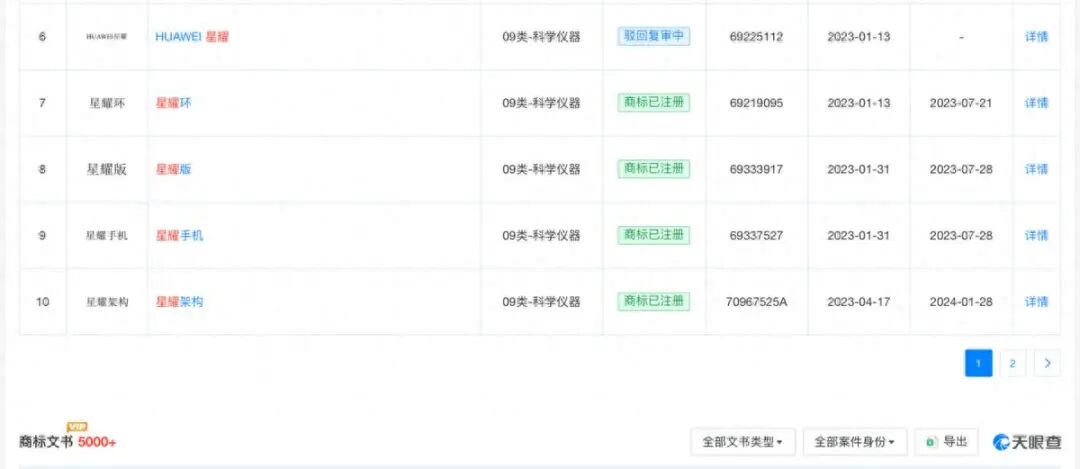
According to the Tianyancha app, Huawei applied to register multiple trademarks related to 'Xingyao' as early as 2023, including categories like 'Xingyao smartphones,' 'Xingyao Edition,' and 'Huawei Xingyao.' The registration process for these related brand trademarks was completed long ago. So, what does 'Xingyao' signify after Honor? Six years after Honor's independent operation, will Huawei launch another sub-brand? If 'Xingyao' does exist, how will it impact the current smartphone industry landscape? These questions are worth exploring.
Does Huawei Need a 'Second Honor' in the AI Smartphone Era?
Looking back, Honor's independent operation was a result of necessary compromise. In hindsight, Honor may represent one of Huawei's biggest regrets in its smartphone development journey.
In the early days of independent operation, Honor's domestic market share plummeted from a peak of around 20% to just 3%. However, by the second quarter of 2022, it claimed the top spot in the Chinese market with a 19.5% share.
By 2025, although Honor's domestic market share had dropped to 13.4%, ranking sixth, it remained one of the major smartphone brands, with global shipments exceeding 71 million units for the first time in 2025.
Imagine a parallel universe where Honor remained under Huawei's umbrella. What scale would Huawei's smartphone business have achieved today?
The loss isn't just about tens of millions of shipments; more importantly, Huawei lost significant market share and user base in the mid-to-low-end segment. This has forced the nova series to shoulder the burden of supporting Huawei's vast user base.
However, relying solely on the nova series may not be enough to fill the strategic gap left by Honor.
So, what can a 'second Honor' bring to Huawei today?
I believe there are three key points:
First: Scale effects. While the nova series has shown impressive growth in recent years, its shipment volume still lags behind Honor's. The future growth of the HarmonyOS ecosystem may require more mid-to-low-end models to support it.
Over the past two years, as Huawei's smartphone business has made a strong comeback, the number of HarmonyOS ecosystem devices has grown rapidly.
In July 2025, it surpassed 10 million units, with Yu Chengdong stating that it had crossed the 'survival line.' By the end of September 2025, it reached 20 million units. On September 7, 2026, at the HarmonyOS 7 launch event, Yu announced that the number of HarmonyOS native application terminal devices had exceeded 85 million, with an expected breakthrough of 100 million units in the fourth quarter of 2026.
However, objectively speaking, even reaching 100 million units still lags behind Android and iOS by an order of magnitude.
In comparison, Android has 3.9 billion global monthly active users, while iOS has 1.56 billion. The importance of system ecosystem user base and scale is evident.
One reason for Microsoft's failure with the WP system was its insufficient ecosystem scale. Of course, unlike WP, HarmonyOS is more advanced and has greater scale effects, but it objectively requires more devices to drive even larger scale effects.
In the future, when system installations reach the billion-unit level, application development costs within the ecosystem will be lower, and the APP market will be more prosperous.
To fulfill this mission, the key lies not in the high-end market but in mid-to-low-end models. From this perspective, Huawei indeed needs another 'Honor.' Even if not now, launching 'Xingyao' in the future would align with commercial logic.
Second: Providing greater demand space for the supply chain. The rationale behind Huawei launching another sub-brand is essentially the same as Apple's launch of the SE series—both aim to create more demand space for the supply chain.
Apple's SE series may not aim for significant sales success but rather focuses on the scale effects within the supply chain.
Similarly, the scale effects brought by Huawei's new sub-brand are important not only at the system ecosystem level but also in the chip industry.
What's different about Huawei today compared to six years ago?
The biggest difference is its stronger comprehensive strength. Today, Huawei has the growth of the automotive industry as a solid backbone. Technologically, it has the 'Tao's Law' as its greatest confidence in reshaping the chip industry's underlying logic, while its foldable smartphone series maintains a solid high-end position.
In short, compared to six years ago, Huawei is more confident and capable. At this point, Huawei needs to consider how to bring greater increment to the supply chain, with chips being the most critical aspect.
After Huawei announced 'Tao's Law,' a second path in the chip industry has emerged, with the Mate 90 serving as a validation at this launch event.
Currently, Kirin chips have a stable position and influence in the high-end market, but they objectively lack influence in the mid-to-low-end market and need a strong foundation.
MediaTek relied on volume in the mid-to-low-end market to eventually compete with Qualcomm. The future Kirin chip ecosystem may need stable demand from more mid-to-low-end product lines to drive the entire industry's development. From this perspective, launching another 'Xingyao' is highly necessary.
Third: Beyond the industry, there's another reason—AI. Recently, major internet companies have intensified their AI layout (layout/deployment), starting with AI-powered office tools and then moving into AI hardware. In the smartphone industry, ByteDance launched the Doubao AI smartphone, while Qianwen released a full-stack AI smartphone solution.
Why are these major companies accelerating their moves? I believe a key reason is that today, AI users are numerous, and the habit of using AI is strong. AI's evolution no longer relies solely on algorithmic breakthroughs in laboratories but increasingly on the massive interactive data generated by real users.
In this regard, major companies have a core advantage. The smartphone industry is no different. In the era of major AI smartphone transformations, Huawei needs a sufficient scale of user samples to drive AI's continuous evolution and iteration.
From a data perspective, the growth of Xiaoyi (Huawei's AI assistant) has validated the 'data flywheel.' Currently, Xiaoyi has 180 million daily active users, with 3 billion daily invocations. Over the past year, the daily average Agent distribution volume has increased by 4.5 times.
It's the real interactions from these 180 million users that continuously feed and optimize Xiaoyi's model capabilities. In the long run, 180 million daily active users are far from enough for AI's continuous evolution. Why has Gemini gained an advantage overseas?
One reason is its ability to continuously evolve AI through the scale of billions of Android users. Huawei doesn't lack technical capabilities but rather more data samples, and mid-to-low-end models are the most efficient way to obtain 'AI training samples.'
Users in this market segment represent the broadest mass audience, with diverse usage scenarios—students, elderly users, users in sink markets (lower-tier markets)... These differentiated real-world scenario data are invaluable for training a 'universal' AI assistant.
This is also one of the underlying logics behind my speculation that Huawei may launch 'Xingyao' in the future. In reality, Huawei's next new brand may not necessarily be 'Xingyao' but could also be a refreshed nova. Regardless, it's time to fill this strategic gap.
Are Honor, Xiaomi, Oppo, and Vivo Ready?
If there's real demand, Huawei has the strategic determination, organizational capabilities, and sufficient resources to build a chip brand.
Today, with Huawei launching Xingyao, chips have the N+3 Capacity ramp up (capacity ramp-up) in progress, the system has the ecological foundation of 85 million HarmonyOS devices, and the channel has the multi-brand methodology validated by HarmonyOS Zhixing.
This isn't starting from scratch but rather applying proven strategies to a new category.
In the AI smartphone era, as Huawei begins to penetrate the lower-end market, all vendors must answer a question: How to respond to the upcoming competition? The rivalry among Honor, Oppo, and Vivo will intensify.
A reality that must be faced is that in the current smartphone industry, replacement cycles have lengthened to 33-48 months, meaning more Stock game (inventory competition) in the market.
Under such circumstances, brands are focusing on 'categories.' For example, Apple is launching foldable screens, Huawei is introducing expanded straight-screen models, Xiaomi is promoting small foldables, and various companies are releasing expanded foldables.
Why? They all aim to shorten replacement cycles and find new growth spaces through new categories.
However, competition at the category level is temporary and lacks sufficient differentiation, making it difficult to create truly unique products. Eventually, everyone will return to a core track: AI.
From the perspective of the internet industry, compared to experiments with categories, AI is likely a key factor in breaking the inventory cycle and stimulating market replacement demand.
This judgment is validated by data. According to Counterpoint Research, by 2026, models supporting generative AI will account for 45% of global smartphone shipments. The end-side AI market size is expected to surge to 12.2 trillion yuan by 2029, with a compound annual growth rate of 40%.
From this data, AI for smartphones is like new energy for automobiles—a must-answer question.
The first to realize this wasn't smartphone vendors but ByteDance.
Previously, ByteDance launched the Doubao smartphone, achieving cross-application operations with system-level intelligent agent capabilities, with an end-to-end task success rate exceeding 80%. By choosing Nubia, it hoped to replicate the success of 'Seres + Huawei' in the automotive industry, with large model vendors providing core technologies and hardware vendors handling manufacturing and channels, attempting to break through the existing pattern (landscape).
Although it was later halted by major APP vendors, this approach was viable. Subsequently, more smartphone vendors truly recognized the importance of AI.
They then began exploring their own paths. Among them, Honor chose to 'co-create' with Alibaba, deeply integrating Honor MagicOS's system capabilities with Qwen Intelligence's foundational model capabilities. Honor hopes to achieve its AI capabilities by redesigning the underlying logic of the operating system.
This process isn't simply about integrating the Qianwen large model but expanding resource management from memory and computing power to models and agents, achieving deep soft-hardware collaboration.
The benefits were immediate, with the entire Honor Magic9 series (Honor Magic9 Pro Max, Honor Magic9 Ultra Edition, Honor Magic 9) officially receiving 'first batch of AI intelligent agent smartphones' network access certification. Honor is reportedly one of the first smartphone vendors in the industry to receive such certification.
By entrusting its large model to Alibaba, Honor has outsourced its core semantic understanding and task planning capabilities. Will this lead to a smartphone version of the 'soul theory' debate in the future? Unlike Honor, Vivo has chosen a different path: deep in-house research.
Vivo's Blue Heart Intelligence strategy focuses on 'personalized intelligence,' adopting a technical route of 'large model + Harness + intelligent agent security architecture,' with end-cloud collaborative deployment of voice, end-side, and cloud-based large models.
The benefit of the in-house research route is the ability to explore the underlying layers toward an intelligent agent operating system. However, it comes with costs.
Zhou Wei, Vivo's vice president, calculated that scaling a large model to 400 billion parameters would require around 5 billion yuan in computing power purchases alone, with annual electricity costs reaching 1.5 billion yuan—costs that would recur every year.
As a result, Vivo abandoned its pursuit of a hundred-billion-parameter general-purpose large model after the end of 2023, shifting toward lighter end-side models.
Even so, in the long run, the economic model of the in-house research route remains questionable.
First, market competition is fierce, making it difficult to raise terminal product prices, especially during memory price hikes. How can the market be convinced to pay a premium for AI?
Second, in-house research means greater weight, requiring consideration of subsequent model evolution, computing power costs, and end-side deployment issues.
For Huawei, these two problems may be easier to solve.
First, for Huawei, this isn't about building a new structure from scratch but deeply embedding it within the HarmonyOS + Kirin + Pangu in-house closed-loop system. It can both scale user acquisition and continuously feed AI data.
Second, Huawei has been one of the most heavily investing vendors in in-house AI model research.
In 2025, Huawei's R&D investment reached 192.3 billion yuan, accounting for about 21.8% of its annual revenue, with cumulative investment exceeding 1.38 trillion yuan over the past decade. This R&D investment rate is about three times that of Apple.
Currently, Huawei's AI capabilities are deeply integrated into the operating system's underlying layer, with Xiaoyi able to invoke over 2,100 system capabilities, more than 2,000 HarmonyOS intelligent agents, and over 500 partner skills.
This ability to deeply integrate system permissions, data, and AI models is difficult for other vendors to replicate in the short term.
Next, if Huawei launches the 'Xingyao' sub-brand and brings system-level AI capabilities to the 3,000-yuan-and-below market, how should other vendors respond? This is a question that other industry players need to ponder.
Today, competition in the smartphone industry has shifted from 'whose flagship is stronger' to 'whose ecosystem is larger, whose data is more abundant, and whose flywheel spins faster.'
As AI becomes another era-defining innovation beyond system ecosystems, the final landscape of the AI smartphone era becomes increasingly clear.
Next, as smartphones truly transform from 'communication terminals' into 'personal AI terminals,' who will once again disrupt the industry landscape? Let's wait and see.
-
![]()
Volkswagen Lays Off 100,000 Employees but Builds Three Battery Factories in Europe with Gotion High-Tech
-
![]()
GAC Group: Pioneering Integration Among Domestic Automakers
-
![]()
Huawei and Seres Forge Alliance: A Strategic 'Remarriage'!
-
![]()
The Largest IPO in History, But Its Future Prospects Are Cause for Concern!
-
![]()
BYD's Export Surge: A Global Triumph!
-
![]()
Is the Mate 90 Huawei's Ace, and Is the Rumored Sub-Brand 'Xingyao' Its Trump Card for AI?
-
![]()
Xpeng Optimizes Product Lines, Changan Merges Similar Businesses: China's Auto Industry Embarks on a Major Consolidation Era
-
![]()
September Sales Soar: BYD Shifts 464,000 Vehicles, with Half of Growth Driven by Overseas Markets. Fangchengbao Shines!