Why Are Smartphones Selling Fewer Units but at Higher Prices?
 10/25 2026
 509
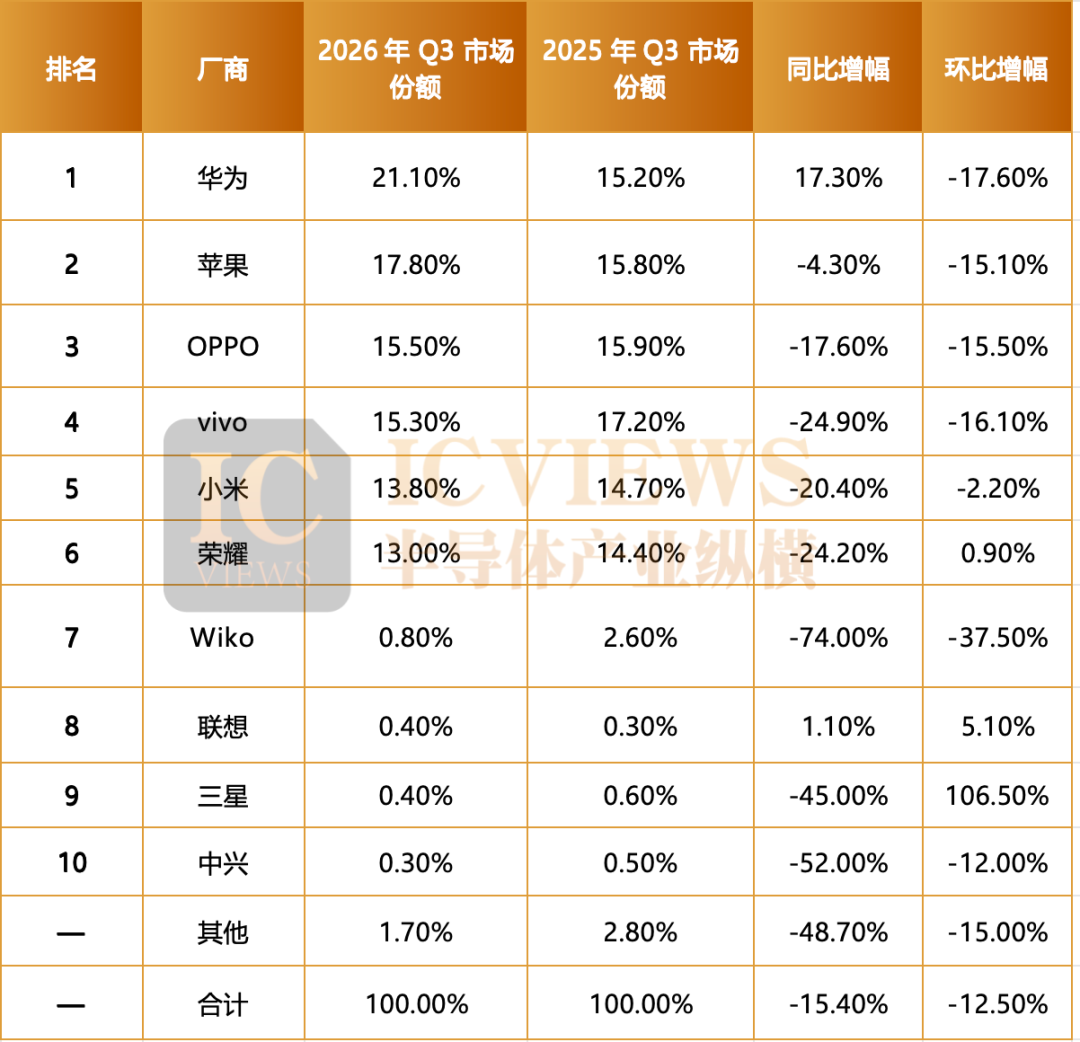
One notable trend in this year's smartphone market: shipments are collapsing, but sales revenue is swelling. IDC data projects a 13.9% year-on-year decline in global smartphone shipments to approximately 1.08 billion units for the full year, marking the lowest annual total since 2013. The third quarter alone saw a 22% drop, the steepest quarterly decline recorded by the firm. However, the same forecast indicates a 27.6% year-on-year increase in the global average selling price (ASP) of smartphones to $581, with market revenue defying the downturn to grow 7% in Q2 and reach a record $109 billion. The Chinese market mirrors this trend: 59.3 million units shipped in Q3, down 12% year-on-year and the lowest for that quarter since 2013. Yet, new flagship models saw price hikes exceeding RMB 1,000, representing a 20-25% increase.
When these two sets of figures are viewed together, they reveal not weakening demand for smartphones but a structural realignment. The diversion of storage costs to AI infrastructure is merely a surface-level phenomenon. The real change is that manufacturers are being forced to retreat from cutthroat low-price competition, with the manner of retreat varying dramatically depending on market positioning.
01
The Disappearance of Affordable Smartphones: Not a Demand Issue
The starting point for understanding the changes in 2026 is how storage has shifted from a routine component in the bill of materials (BOM) to a factor determining product viability. Typically accounting for 10-15% of a phone's material costs in normal years, this figure jumped to 30-40% by 2026, nearing 50% for mid-to-low-end models. For affordable smartphones, storage costs now exceed those of the processor itself. Manufacturers like Samsung and Micron have redirected capacity to HBM chips for AI servers, pushing back production of LPDDR5 and NAND for smartphones. DRAM and NAND contract prices surged 350% within a year. Counterpoint calculates that for phones priced under $200, BOM costs rose 70% year-on-year compared to similarly specced models from the previous year, with nearly all the increase coming from storage.
This cost curve effectively sentenced affordable smartphones to obsolescence. A phone originally priced at RMB 1,499 saw its storage costs rise from over RMB 200 to nearly RMB 700. Manufacturers faced the choices of raising prices, cutting specifications, or discontinuing the model—all leading to the same outcome. Models priced under $100 plummeted nearly 60% year-on-year in Q2. Shenzhen-based ODMs halted numerous affordable smartphone projects, and some smaller brands exited the market entirely. Xiaomi's shipments fell over 30% year-on-year in Q3, the largest drop among major vendors, with its market share dropping to 10%. Counterpoint characterized this as a "strategic retreat"—cutting low-priced models to concentrate resources on foldable and premium series. This was not due to an inability to compete but because it was no longer worth it: after storage costs tripled, the old model of relying on low-margin hardware for volume and recouping costs through backend services became untenable, with payback periods extending beyond cash flow pressures.
Samsung's order cuts most directly reflect this chain reaction. In late September, Samsung set a 120 million-unit shipment target for its 2027 Galaxy A series. By October, it had slashed this by 20 million units. Its overall smartphone shipment target for the year, originally exceeding 250 million units, was also under revision, with total reductions likely surpassing 20 million units. The Galaxy A series, while not a flagship line, is the world's largest mid-range product portfolio by volume. An 8GB+256GB storage configuration is standard at this price point. A 15-20% increase in the unit price of storage components alone was enough to push gross margins, originally between 12-18%, into negative territory. As the world's largest storage manufacturer and the only vertically integrated player with both storage production capacity and a smartphone business, even Samsung's decision to cut 20 million units from its mid-range shipment targets due to storage costs underscores how far-reaching this cost shock is—well beyond what smaller vendors can withstand.
02
The Clustering of RMB 10,000 Foldable Phones: Less Transparent Pricing
While affordable models disappear, the high end is actively pushing upward. During September's new product launches, Huawei's Mate XT 2 started at RMB 19,999, Apple's first foldable iPhone Duo at RMB 15,999 for the China model, and Xiaomi's 18 Fold at RMB 10,999. The RMB 10,000 price bracket has transformed from symbolic experiments by one or two vendors into a collective race among leading brands. Foldable phones are being thrust into the spotlight at this juncture not merely because high-end users are less sensitive to price hikes. Counterpoint data shows that the average wholesale price of foldable phones has risen 28.8% from two years ago, while IDC projects that by 2030, foldable phones will account for 3.1% of shipments but generate 10% of sales revenue. More critically, foldable phones offer a pricing environment with less transparency. Consumers and review organizations can easily dissect the costs of chips, screens, and memory in a traditional flagship phone. However, the addition of hinge technology, UTG glass solutions, and form factor differences muddies the pricing reference points, allowing vendors to layer on proprietary chips, on-device AI, and ecosystem experiences without being subjected to itemized price comparisons.
TrendForce data indicates that global foldable phone shipments reached approximately 20.2 million units in 2026, up just 0.5% from 2025. Excluding Apple's contribution, Android brands' combined foldable shipments totaled around 15.2 million units, a year-on-year decline exceeding 20%, primarily due to sharp increases in component costs. Most brands saw shipments flat or declining compared to the previous year. In other words, the "growth" in the foldable market came almost entirely from Apple's entry as a new player, not from existing brands expanding their scale. Pre-orders for the iPhone Duo opened on October 16, starting at RMB 15,999 for the China model. JD.com's reservations surpassed 2.2 million units, with the earliest official delivery date pushed to late January 2027. First-day retail inventory sold out. However, TrendForce forecasts approximately 5 million units shipped globally in 2026, giving Apple a 24.8% share of the foldable market—tied with Huawei for second place, behind Samsung's 35.1%. Reservations do not equate to actual orders; production ramp-up is the real constraint. Apple's Chief Operating Officer stated at Foxconn's Zhengzhou plant, "We have never manufactured a product like the iPhone Duo before"—a comment more telling than any sales figure about the manufacturing challenges involved. Foldable phones in 2026 are not validating a surge in demand for this form factor but demonstrating that in a supply-constrained premium market, consumers willing to pay a premium still exist, while the number of vendors capable of delivering such products remains extremely limited. The collective push into the RMB 10,000 foldable segment essentially represents vendors' attempt, amid shrinking shipments, to re-establish a profit model where each unit sold generates substantial profit through form factor innovation and technology.
03
Huawei and Apple's Market Share Gains: Driven by the Same Core Competence
Amid an overall market decline of 12-15%, only two vendors achieved growth. Huawei reclaimed the top spot in domestic shipments in the first half of the year, with sales volume up nearly 20% year-on-year. It shipped 13.9 million units in Q1, capturing a 20% share—an over 80% year-on-year increase. Apple's China market shipments surged 42% year-on-year to 13.1 million units in Q1, with its share jumping from 13% to 19%. The iPhone 18 Pro series captured 33% of weekly market share in China within three days of its debut, with the Pro Max accounting for 55.5%. While their growth drivers differ, both vendors share a foundational capability in supply assurance.
Huawei relies on a vertically integrated ecosystem from its Kirin chips to HarmonyOS. At its September flagship launch—its first detailed introduction of a self-developed Kirin chip in six years—the Mate XT 2 debuted with the Kirin 9050 Pro. The Pura X View, positioned as a mainstream premium model, started at RMB 5,999 and sold over 300,000 units in its first five days, with approximately 30% of buyers switching from Apple. The combination of self-developed chips and an operating system provides Huawei with a buffer for internal resource allocation when external component prices rise, shielding it from the full impact of spot market pricing. By January 2026, Huawei commanded a 34.4% share of China's premium market (above RMB 600), narrowing the gap with Apple to just 2.5 percentage points. This reflects not only product strength but also the cost flexibility afforded by self-developed chips.
Apple, meanwhile, leverages its global supply chain bargaining power and procurement scale to redistribute cost pressures. It extended the inventory cycle for OLED panels, used expanded procurement volumes to drive down per-unit screen costs, and tested ChangXin Storage's products to diversify its supply sources. The BOM cost of the iPhone 18 Pro Max rose nearly $300, but Apple concentrated these increases in higher-capacity versions, maintaining the price anchor for the base model. The debut gained extra momentum because simultaneous price hikes for Android flagships reduced the relative price difference.
04
A Counter-Trend Example: Transsion
While leading brands converge toward the RMB 10,000 segment, Transsion is charting a different course in Africa and South Asia's low-to-mid-price markets. In the first half of 2026, Transsion's revenue reached RMB 35.431 billion, up 21.85% year-on-year; net profit attributable to shareholders hit RMB 1.773 billion, a 46.22% increase, with profit growth far outpacing revenue. It had accumulated a stockpile of low-priced storage components before prices surged. While most industry players began procuring at inflated spot prices, a portion of Transsion's BOM costs still reflected older, lower prices. Simultaneously, its 47% share of Africa's smartphone market granted it sufficient pricing power. The average selling price of its smartphones rose from RMB 538.8 to RMB 705.5, a 31% increase, while shipments dipped slightly from around 28 million to 27.3 million units—yet revenue still climbed. By raising prices ahead of cost increases, Transsion expanded its gross margin through this timing advantage.
However, the limits of this strategy are clear. The proportion of storage chip costs in Transsion's cost of goods sold rose from 20.9% in 2023 to 48.4% in the first four months of 2026. Net operating cash flow was -RMB 5.861 billion in the first half, as inventory buildup consumed significant cash. Its deep channel penetration and brand recognition in Africa allow it to maintain most sales volumes despite price hikes, but the room for further increases is not unlimited. Transsion's real differentiation lies not in discovering a superior smartphone business model but in its market positioning, which eliminates the need to compete with Apple and Huawei for the same high-end consumers in the RMB 10,000 foldable arena. It can sustain profits in a market with an average selling price well below the global mean through channel density and product line extensions—advantages that leading brands' low-end models have lost under the same cost pressures.
05
Conclusion
When these trends are viewed together, it becomes clear that this year's smartphone industry differentiation is occurring along two axes: supply assurance capabilities and market positioning. Samsung has internal storage capacity allocation rights; Apple wields supply chain bargaining power and pricing tolerance among high-end users; Huawei benefits from a vertically integrated ecosystem spanning chips to systems; and Transsion possesses sufficient channel control in low-end markets to pass on cost increases. Vendors lacking any of these attributes face the same storage price hikes and price-sensitive consumers but lack a buffering fulcrum. Xiaomi, OPPO, and Vivo all saw shipment declines exceeding 18% and adopted a common strategy of shifting resources to high-end segments while contracting low-to-mid-range product lines. However, they lack Apple's supply chain bargaining power or Huawei's vertical integration capabilities. IDC projects that supply constraints will not ease until 2028, meaning the industry must operate at low shipment volumes for at least another two years.
These two years will mean very different things for different vendors. For Samsung, cutting 20 million units from the Galaxy A series shipment target represents a rational retreat after weighing pros and cons. For Honor, which has entered the fourth phase of IPO counseling, "determining the investment direction for raised funds" remains a key issue listed in counseling reports. In a year when storage costs have driven mid-range product line margins below zero, forcing leading vendors to rely on supply chain bargaining power and vertical integration to maintain profits, a vendor like Honor—whose core market lies in the RMB 2,000-6,000 mid-range segment—faces far greater challenges in crafting a capital market story that inspires confidence than it did two years ago.
-
Has Tesla Lost Its Lead and Missed the Chance to Enter China? Time is Running Out for Tesla's FSD in the Chinese Market
-
![]()
When Ambition Meets Boundaries, Building a Step-Change Future is Tougher Than Building a Phone
-
NIO’s Battery Swap Stations Now Accommodate an Additional Battery Model
-
![]()
Why Are Smartphones Selling Fewer Units but at Higher Prices?
-
iPhone Duo Sees Just 900 Yuan Price Hike, Scalpers in Frenzied Resale Race
-
![]()
Focus | Warburg Pincus Considers Selling Chinese Parking Operator Yangguang Haitian, Valuation May Reach US$300 Million
-
![]()
What? The Audi A8 is Set to Be Manufactured in China, in Partnership with Huawei
-
![]()
AUMOVIO’s Latest MTXN3 Automotive Remote Key: Powered by NXP NCF29A1/A2 Chip, Supporting 125kHz, 433MHz, and UWB Frequencies!