The Sky Has Fallen on the Wait-and-See Crowd! Blogger Reveals Manufacturers Are Stockpiling and Locking Up Production Capacity—No Hope of Phone Price Drops for the Next Three Years
 11/05 2026
 409
Once upon a time, the phone industry operated on a simple rule: wait long enough, and the price will drop. This gave rise to the "wait-and-see crowd"—a consumer habit unique to the phone market. Over the past two years, however, a new script has been playing out: the longer you wait, the more expensive it gets. "Good thing I bought early" has become a familiar refrain in social media comment sections.
Behind this shift, the phone market is staging a drama that has left everyone scratching their heads. Institutional data shows global shipments in the quarter fell roughly 20–22% year-on-year to around 255 million units—the lowest for the same period since 2012. Logically, if things aren't selling, prices should come down. Yet the global average selling price of phones in the same period rose 27%, surging to $442.
These two seemingly contradictory sets of data reveal that the phone industry—once a race to the bottom on price—is no longer driven by "demand" but has shifted to "supply," specifically continued price increases in upstream components such as memory. And this situation will persist for the next few years, and may even worsen. Recently, tipster Digital Chat Station revealed that the industry expects the memory shortage to last until 2029–2030, with phone manufacturers reporting that BOM procurement prices continue to climb.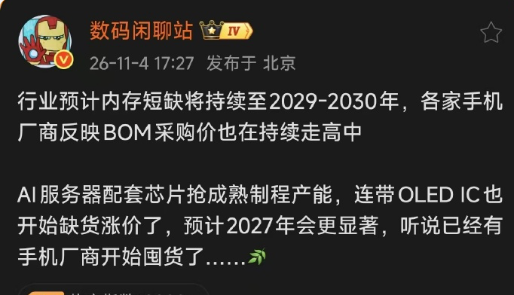
He also noted that AI server supporting chips are gobbling up mature-process capacity, and OLED ICs have also begun to run short and rise in price—a trend expected to become more pronounced in 2027. Word has it that some phone manufacturers have already started stockpiling... So what is the subtext here? At the most intuitive level, phone manufacturers are doing everything possible to survive. For consumers, phones will not get cheaper over the next two or three years, and may continue to rise. Once this revelation came out, netizens erupted. The first thing they thought of was that phone price increases will continue—meaning that in the coming years, phone costs will remain high, and phones are slowly becoming "luxury goods."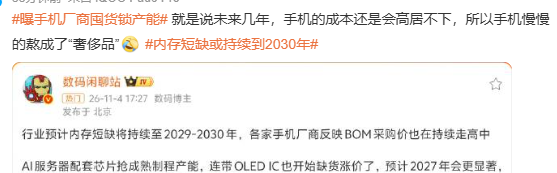
"Be prepared not to change phones for 5 years."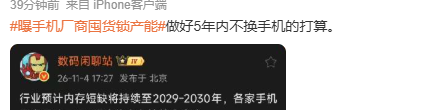
"Memory prices haven't peaked yet, and the cheap inventory left over from before is almost depleted. It will definitely be reserved for higher-premium products. If you want to buy a phone now, you really need to act quickly."
"Friends who want to change phones, don't wait anymore—because if you keep waiting, the price may be even higher. In the future, everyone should aim for the two time points of Double 11 and 618 when buying phones. Don't buy at other times; prices will only get more and more expensive."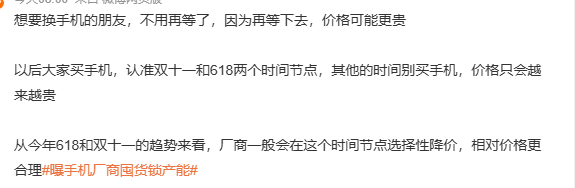
But some netizens believe this is a smoke bomb released by manufacturers to confuse consumers, since phones aren't selling. At the Double 11 node, saying such things more or less nudges everyone to buy phones at this point...
But in fact, such views also appeared during last year's Double 11 and this year's 618, yet phone price increases have continued. At this point, thousand-yuan phones have basically disappeared, and flagship phones generally cross the ten-thousand-yuan threshold. Breaking down the logic again, phone manufacturers may now be more passive than consumers. For example, some netizens said: consumers can choose not to buy and make do with what they have. The greatest pressure is actually on phone manufacturers. They can't just stop releasing new products, so they are forced to streamline product lines.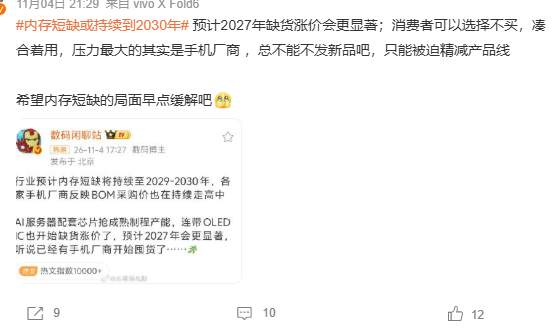
In other words, phone manufacturers know full well that they may not sell that many phones, but they still have to grab memory first. Because the cost of not getting goods is far greater than the cost of stockpiling a little more. For today's phone manufacturers, stockpiling has become buying insurance. And the premium for this insurance policy is becoming exorbitantly expensive. Data shows that memory chip costs have risen about 350% from last year, and some industry practitioners say original manufacturers' quotes to leading phone companies have risen to about four times the original. 1TB flash memory has risen from more than 200 yuan to nearly 600 yuan, and Samsung's LPDDR5X quote for the iPhone 17 has directly doubled; memory's share of total device cost has soared from 10%–15% to 30%–40%, surpassing the processor for the first time in history. Even more painful is that upstream price increases are not only continuing in memory but also expanding in scope—OLED, ICs, and more.
From another perspective, phone shipments falling by double digits while average selling prices rise by double digits shows that the industry is actively or passively abandoning the old path of "trading scale for profit" and turning to a defensive posture of "using unit price to protect revenue." Under this situation, the profit space of mid-to-low-end phones is continuously squeezed by memory costs, and some manufacturers have already reduced mid-range capacity investment. IDC data points in the same direction: in 2026, the share of the Chinese market above $600 is expected to rise to 35.9%, while the low-end share below $200 will shrink to 20%. In other words, in the coming years, phones will not only continue to rise in price, but the choices of mid-to-low-end models will also become fewer and fewer. This means that the rhythm the phone industry has been accustomed to for more than a decade—annual iteration, spreading costs through volume, and filling price bands with mid-to-low-end models—is being rewritten bit by bit by the hard constraints of memory capacity. Another point worth pondering: when big manufacturers sign long-term agreements and lock up next year's capacity, small and medium-sized manufacturers have no bargaining power and can only buy goods at high prices from the spot market and agents. What is the result? Besides small and medium-sized manufacturers issuing... it is price increases.
Looking back at this whole matter, it is actually quite lamentable.
Phone manufacturers have worked hard for more than a decade, pushing cost-effectiveness to the extreme, but in the end, with a slight turn of the rudder upstream, the entire industry has no room to fight back.
END
-
![]()
Keboda, the Single-Item Champion in Vehicle Lighting Control, Sees Lighting Control Revenue Drop by 479 Million Yuan in Q3, Net Profit Down 47.17%; Intelligent Driving Domain Controllers Up 72.29%
-
AI Marketing: The 10 Fastest-Growing and Most Profitable Companies
-
![]()
Chinese Companies Going Global: Don’t Put on a Stern “Strict Father” Face
-
![]()
The Sky Has Fallen on the Wait-and-See Crowd! Blogger Reveals Manufacturers Are Stockpiling and Locking Up Production Capacity—No Hope of Phone Price Drops for the Next Three Years
-
![]()
Tech Stocks Plunge Across the Board, but Industry Giants Say "Don't Panic"
-
![]()
Domestic Android Needs a New Benchmark
-
![]()
Aerospace and Aviation Lead Cities: An Analysis of the Industrial Structure of Beijing, Shanghai, Chengdu, Xi'an and Shenyang
-
![]()
Chinese Large Models Are Going Open Source in Droves: AGI Ideal or Ecosystem Positioning?