Even DJI Can't Hold the Line on Prices! This Memory Price Surge Is Hurting Far More Than Just Phones
 11/16 2026
 454
This wave of price hikes is far more brutal than anyone imagined.
News from November 13: DJI announced today that starting November 18, it will raise prices on some of its products. Core component costs have continued to soar, and the company simply can no longer absorb the pressure. This time it did not specify which models or disclose the size of the increase, stating only that specific product models and prices will be subject to what is listed on the product detail pages of its official store.
Xiaolei's take: the fact that even DJI can't hold out and has to raise prices can only mean that this wave of price increases in electronic components is far more ferocious than we imagined.
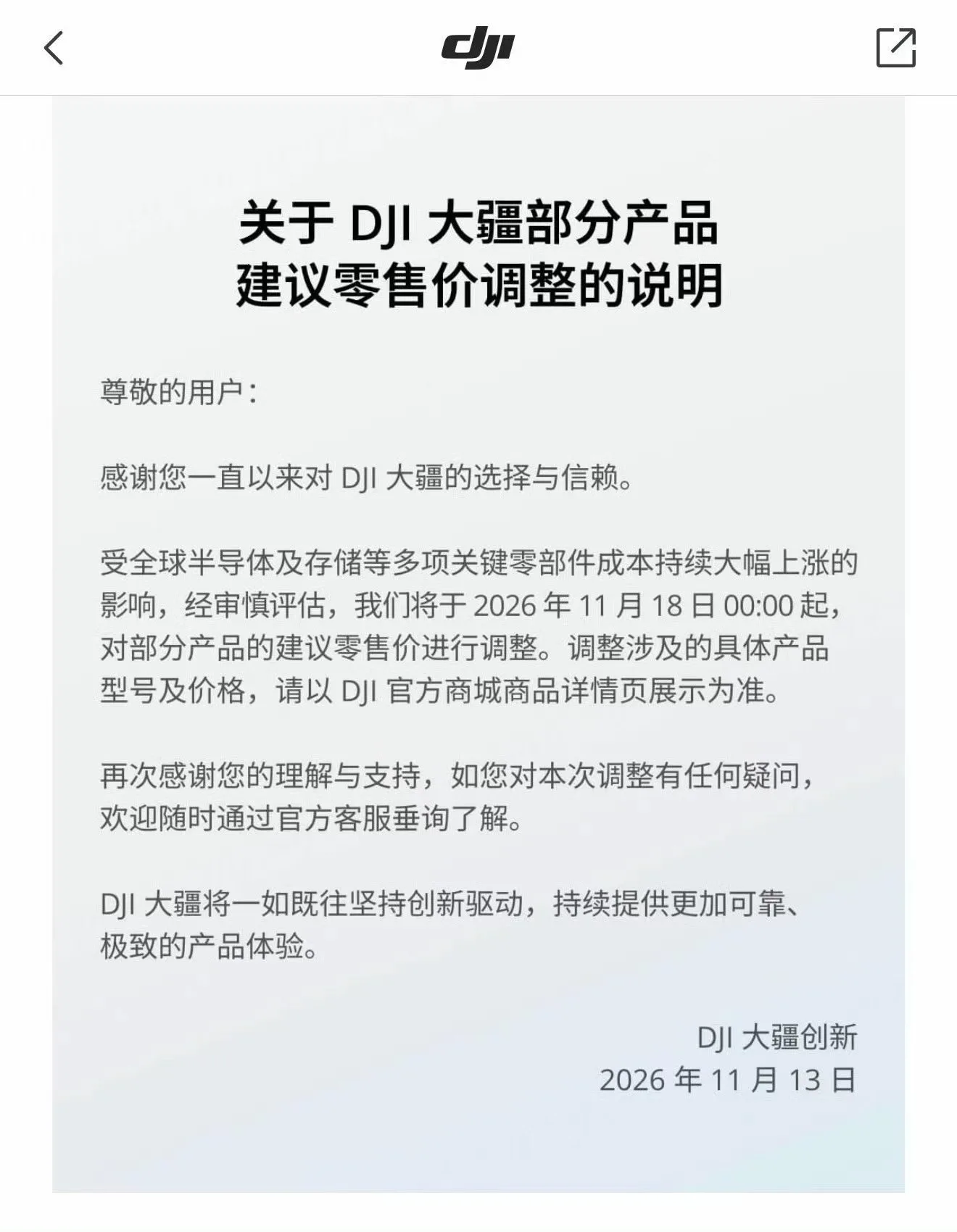
(Image source: Weibo)
The Culprit Behind the Price Hikes: Memory Chips That AI Has Snapped Up
If you had to name the culprit behind the collective price increases of electronic products over the past year or so, it is almost entirely memory chips.
According to Xiaolei Bibi, from the fourth quarter of 2025 to now, memory chip prices have risen by as much as nearly 90%, and TrendForce statistics on memory contract prices for the first half of 2026 show an increase of more than 100%. That is equivalent to memory alone more than doubling in cost within a single year.
Why did prices suddenly shoot up so outrageously? There is only one reason: AI is too hot, and it has gobbled up all the memory chips.
Right now, large models, AI servers, and data centers are springing up everywhere, and these things have a huge appetite for memory. A single AI server needs several times as many memory modules and solid-state drives as an ordinary server. To secure production capacity, major companies have maxed out their memory chip orders, and wafer fabs are prioritizing capacity for the more profitable enterprise market. By the time it trickles down to consumer electronics, supply naturally falls short of demand, and prices keep climbing.
Put simply, a considerable part of the extra money we now spend on phones and computers is going toward paying for the AI boom.
The Wildly Inflating Phone Market
In this wave of price increases, the market that has been most visibly hurt and is most keenly felt by everyone is the phone market.
In last year's phone market, from budget thousand-yuan value-for-money models to top flagship imaging phones and foldables, the processor tiers were actually very clear: either that year's main flagship chip or the previous generation's sub-flagship chip. Everyone knew where they stood and would not be fooled.
This year the style has completely changed. Thanks to memory chips soaring all the way, the current phone processor market is truly a chaotic free-for-all. Current-generation, previous-generation, and even the generation before that are all competing on the same stage—a scene that would have been unimaginable in previous years.
Manufacturers are crafty, too. They know it sounds bad to directly admit they are using old chips from two years ago, so they play the renaming game. They take old chips from the previous generation or the one before that, give them a new name, change the model suffix, and package them as derivative versions of a new generation. The spec sheet looks quite new and sincere, but peel back the surface and the essence is still old goods, with hardly any performance improvement.
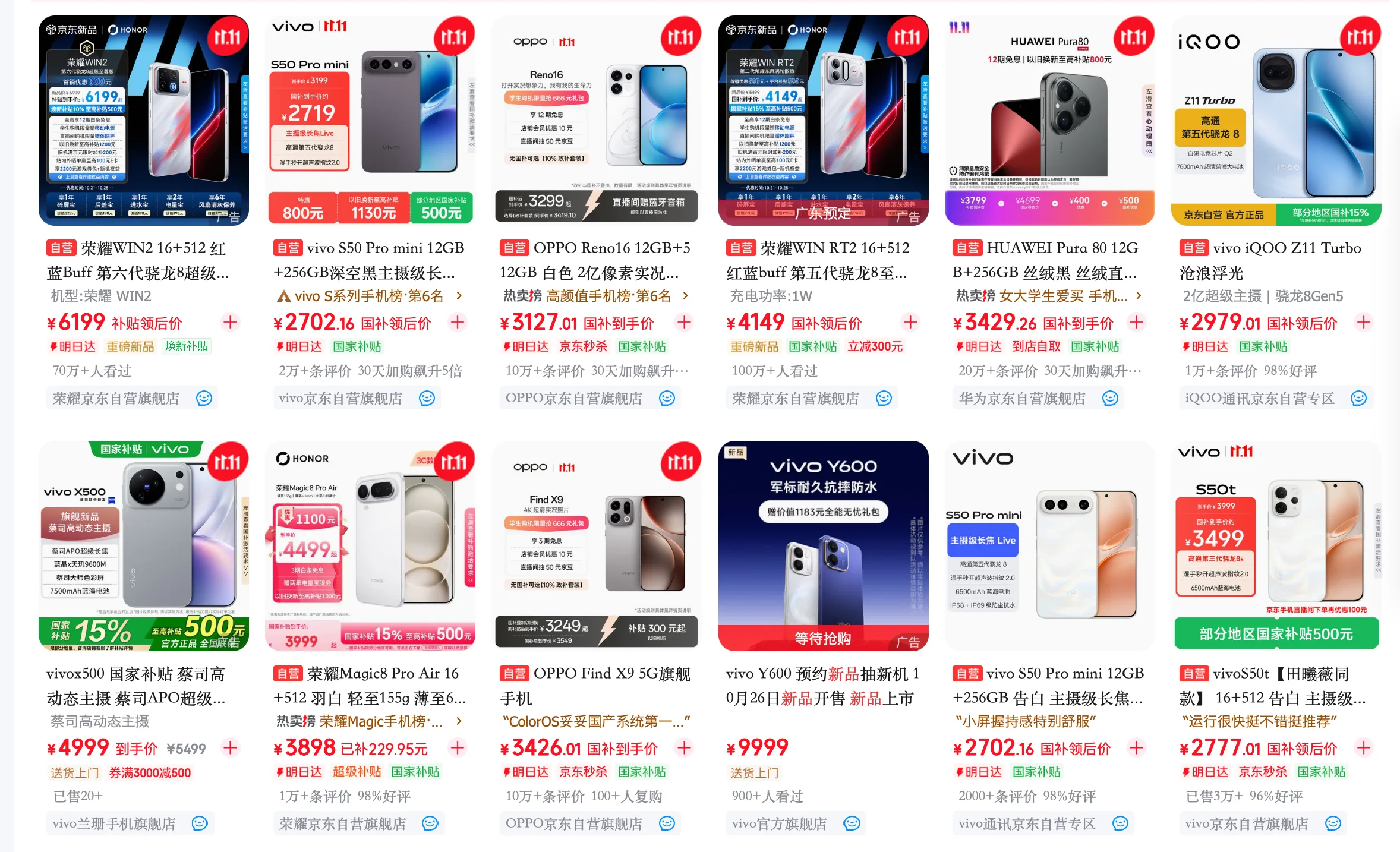
(Image source: JD official)
Xiaolei also found that even more concealed than processor downgrades is the collective downgrade of product positioning. What used to be Pro-level models have now quietly dropped to the configuration and materials of the former standard version; the former standard version has moved directly toward the youth edition or entry-level edition. Memory specs, cooling modules, peripheral interfaces—everything that can be cut has been cut back a notch, while the price cannot drop and may even have to rise.
Interestingly, this year Apple raised prices across its entire iPhone lineup, yet sales exploded instead—truly rare in previous years. It also shows from another angle that people are gradually becoming desensitized to price increases. As long as product recognition is strong enough and ecosystem stickiness is high, people will still pay even if prices rise a bit.
The worst off are still the thousand-yuan and mid-range phones that focus on value for money. A year has passed, and not only have the processors not been upgraded, but prices have even gone up. To make the price increase seem reasonable, manufacturers can only go all out on the screen and battery: make the screen a bit bigger, brightness a bit higher, refresh rate a bit faster; add a few hundred mAh to battery capacity and speed up charging by a dozen or so watts, creating the impression of more for the same price.
Why pick screens and batteries to make an issue of? Xiaolei Bibi (ID: xiaoleibbb) believes that these two may be among the few remaining components whose costs have barely risen or are even falling. Circuit boards, internal connectors, packaging materials, and almost everything else are rising, leaving only screens and batteries with some cost room to squeeze out a perceptible upgrade for users.
Don't Just Stare at Phones; Every Product with Memory Is Shrinking
Many people think the memory price increase only hurts phones and computers, but it is far more than that. Almost anything that uses memory chips has not been spared; it is just that many cuts are deeply hidden and people have not noticed.
Take smart TVs at home. People may not have noticed that many newly released models have quietly cut their memory configurations. Previously, mid-range TVs came standard with 4+64GB, making app installation and system operation very smooth; now many models at the same price have quietly changed to 3+64GB, and some even 3+32GB. You would never find out unless you carefully check the spec page, and only after using it for a year or two and installing a few apps does it lag, making you realize it had been downgraded.
Now even DJI has joined the price-increase ranks, which is even more of a reminder that the wave has long spread from phones and PCs. For products like drones and action cameras, although memory is not the biggest cost component, core components and main control chips are all rising across the board. Small amounts add up, and even the biggest manufacturers cannot hold out. At this rate, more categories and more brands may join the price-increase ranks in the future because they cannot withstand cost pressure, and we consumers need to be mentally prepared for that.

(Image source: photographed by Leitech)
How to Choose Digital Products Now to Spend Less Wastefully
In the current market, how should you choose digital products to avoid pitfalls and spend money where it counts? Based on market information previously compiled by Leitech, Xiaolei will summarize a few categories here for everyone's reference.
Our core principle is just one: avoid the memory tax as much as possible. Either prioritize categories with low memory dependence, or within the same category, do not pay extra wastefully for large capacities you will not use.
The first is audio products, especially headphones.
Headphones themselves have extremely low memory requirements, and the main costs lie in sound drivers, noise-cancellation chips, and wireless solutions, so the pressure from memory price increases basically does not reach here. In addition, the TWS market has now become saturated, and everyone is engaged in a price war, so prices are actually still falling.
The second is camera products.
The main costs of a camera are the CMOS sensor, optical lens, stabilization motor, and so on. The body itself basically carries little memory, and memory cards are purchased separately by consumers, so memory price increases have very little impact on the camera body. Of course, one reminder: the body has not risen in price, but memory cards indeed have. For daily use, capacity takes priority over speed; 128G and 256G are basically enough, and there is no need to spend several times more for extreme read and write speeds.
The third is desktop peripherals such as keyboards and mice.
Peripherals have even lower memory requirements, and costs are basically in the main control chip, mold, and switches. In recent years, domestic brands have competed especially fiercely, from entry-level models costing tens of yuan to custom models costing thousands, with particularly abundant choices and prices that have remained very affordable. Even if individual models rise a bit due to chip costs, the fluctuation is only tens of yuan and basically has no impact on purchase decisions. Just buy according to need.
The fourth is monitors and TVs. If you genuinely need one, it is advisable to buy early.
The core cost of monitors and TVs is the panel, which has little to do with memory. However, some panel makers have already issued price-increase notices. If you genuinely need to replace a monitor or TV, it is advisable to buy before the year-end price increases take effect, saving whatever you can.
As for phones and laptops, which everyone cares about most, Xiaolei's advice is: if it is not absolutely necessary to replace them, wait if you can; if you really must replace, prioritize old flagship models or choose the base memory version, and do not blindly rush for large memory and large storage. Especially for phones, the markup on large-capacity versions is now outrageously high, far exceeding the cost of the memory itself.
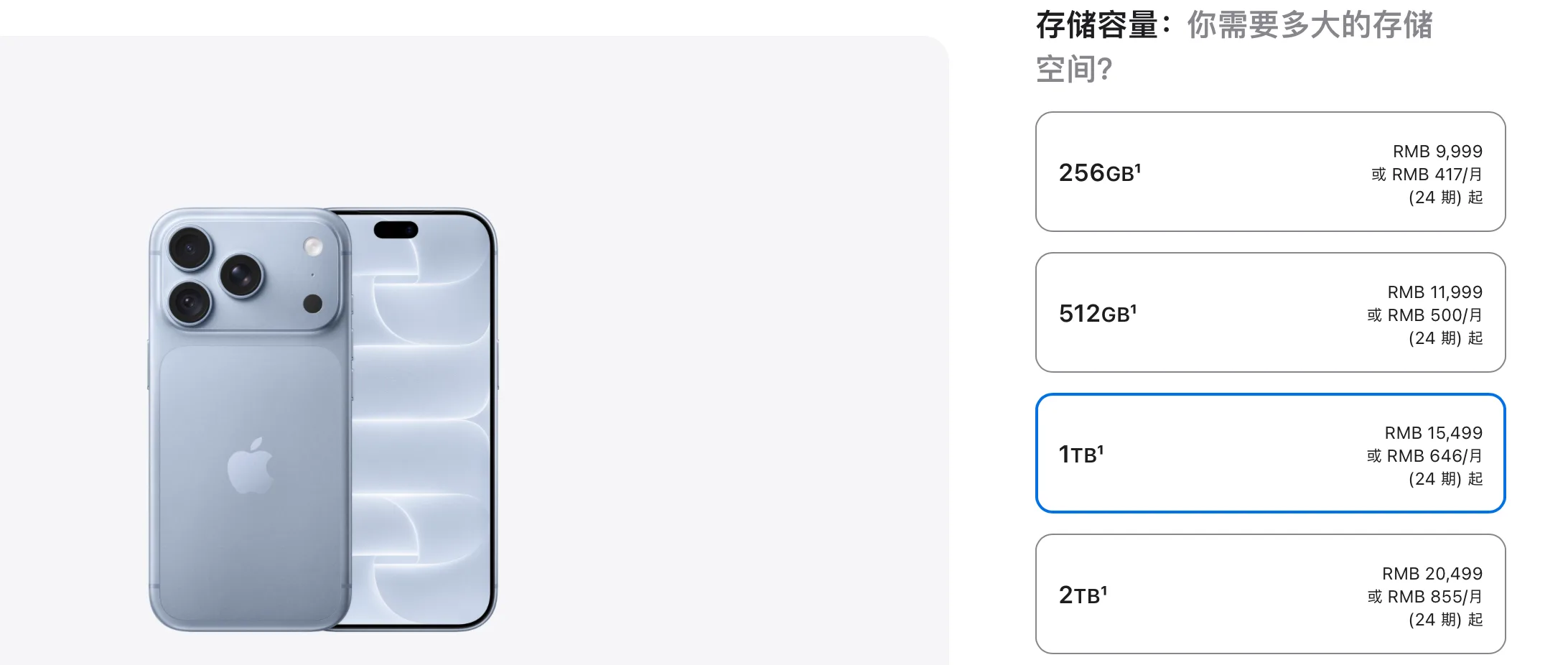
(Image source: Apple)
Final Thoughts
Overall, that is the situation. Price increases for electronic products will most likely continue for a while, and it is basically impossible to return to the previous era of low prices in the short term.
Xiaolei Bibi (ID: xiaoleibbb) believes that for ordinary people like us, there are simply two choices. Either take good care of the old devices in hand, use them carefully, and make them last as long as possible; or work hard to earn more money so you do not have to agonize over increases of a few hundred or a thousand yuan.
But looking at it from another angle, this wave of price increases is not entirely a bad thing. In the past, phones were cheap, and people replaced them casually, wanting every spec: 256G was considered small, and 1T was merely the starting point. In reality, there were not many functions people actually used often, and money was spent on specs they did not need.
Now that prices have risen, people will think a bit more when paying: How much storage do I actually need? Do I really use this feature?
Gradually everyone will understand what is most important to them within a limited budget. Consumption is no longer blind spec stacking but a return to real needs, which is actually a good thing. There is no need to burden yourself by chasing novelty and stacking specs when buying digital products. Avoiding unnecessary memory taxes and spending money on things that truly improve the experience is the most rational way to consume right now.
Finally, let me ask everyone: what electronic products did you buy during this Double 11? Feel free to chat in the comments.
Source: Leitech
Images in this article are from: 123RF licensed image library Source: Leitech
-
![]()
Double Pay Reward! Sales Soar Continuously, This Automaker's Head Says They "Want to Incentivize"
-
Changan Automobile to Shed 10% Avatr Stake Ahead of IPO
-
Changan Automobile Divests 10% Stake in Avatr: High-End Strategy Remains Intact as Marketization Accelerates
-
iPhone Air 2 Reportedly Brings 5 Major Upgrades—Will Apple Finally Fix All the First-Gen Air's Shortcomings?
-
![]()
AI Recording Devices Vie for the Title of "Best Listener"
-
![]()
Even DJI Can't Hold the Line on Prices! This Memory Price Surge Is Hurting Far More Than Just Phones
-
![]()
The AI Pioneers Who Built the Technology Are Now Sounding the Alarm: Hinton Warns a "Chernobyl-Scale" Disaster May Be Looming
-
![]()
Domestic Auto Sales Post "Seventh Straight Monthly Decline" — CAAM: Overall Pressure on the Auto Market Remains Relatively High