AI Recording Devices Vie for the Title of "Best Listener"
 11/16 2026
 456
Author | Yang Zi
Editor | Li Xiaotian
AI-powered recording hardware is proliferating.
In early 2026, Nooklab secured backing from Sequoia China and Linear Capital at the idea stage, reaching a valuation approaching $100 million. In October of that same year, Flowtica raised tens of millions of RMB from Vertex, Source Code Capital, Morningside, and Clear Water Bay Fund for its new product, Verso. Both companies landed on a similar concept—using an e-ink screen to open a window onto a magnetic recording card.
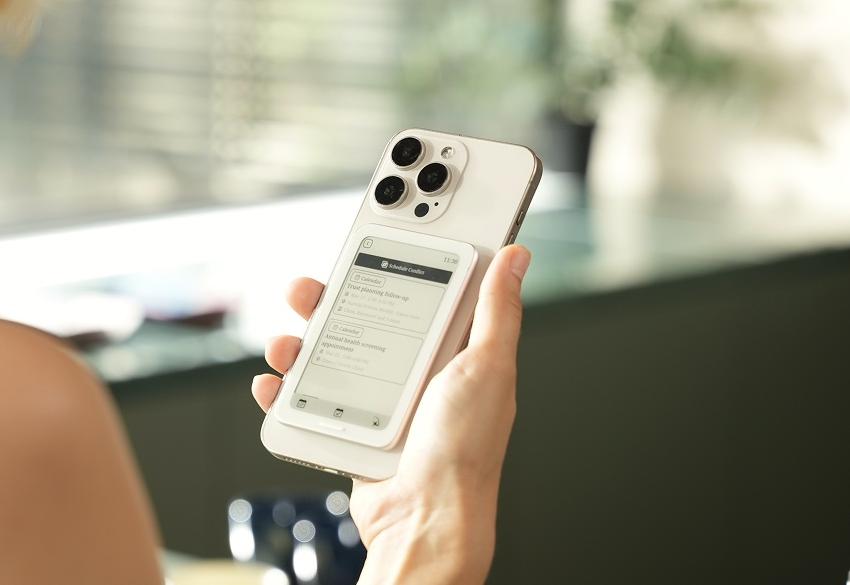
Image source: nooklab.ai
Nooklab's first product, Moonphase Flip, weighs just 54 grams. At its core, it automatically extracts to-dos and schedules through unobtrusive recording—no deliberate nudging, no disruption. Flowtica's Verso weighs 78 grams. Press to record, get real-time transcription, summaries, and automatic to-do generation, with a focus on the complete closed loop before, during, and after meetings.
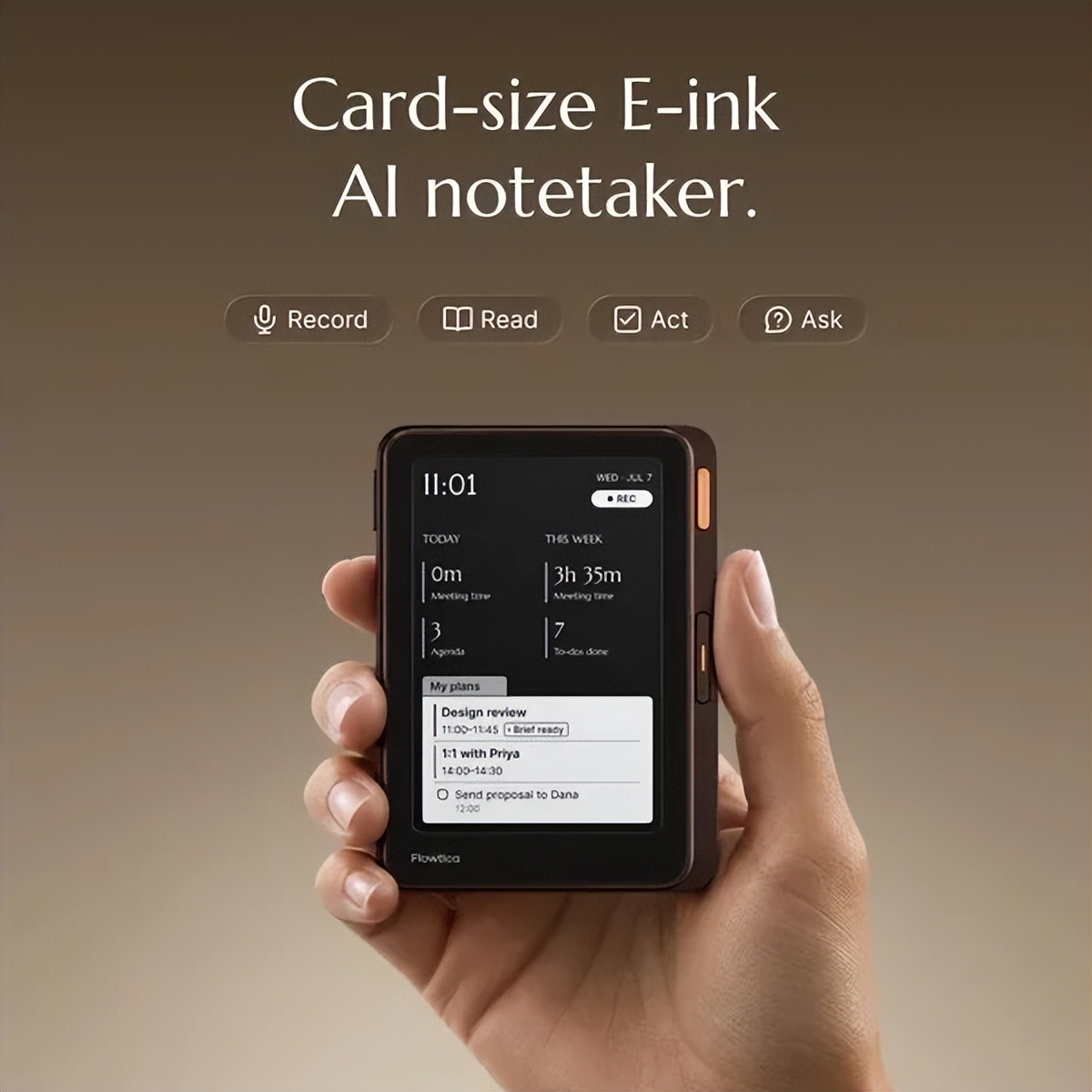
Image source: flowtica.ai
This low-key display is their new answer to the question of "what happens after recording"—but the idea didn't come out of nowhere.
As the pioneer of the magnetic recording card, Plaud released a set of figures half a year ago: its software subscription ARR soared from $1 million to $100 million within two years, device shipments exceeded 2 million units, and nearly 50% of hardware users upgraded to paid subscribers.
Hundreds of millions of dollars in revenue and millions of users simultaneously confirmed two things—that sticking a card on the back of a phone is a sufficiently light, high-frequency, and low-barrier entry point, and that AI is the core source of its value. As former Plaud China CEO Mo Zihao put it, rather than calling it an "AI recording pen," he prefers to place Plaud in the coordinate system of "AI Work Companion."
This market is being endowed with new imagination. It is no longer just a hardware business of "recording sound"—it has been placed into the narrative of a "personal context agent." To find their respective positions on this path, brands are working hard from various dimensions, and the market is no longer converging along a single line.
Looking at current products, their forms each have their strengths and their functions are dazzling, yet what they are fighting for is still just a few inches of space on the wrist, the ear, and the back of the phone.
When everyone is trying every possible way to find their own position, a very concrete problem emerges: there are so many AI recording devices that they can no longer fit on the desk.
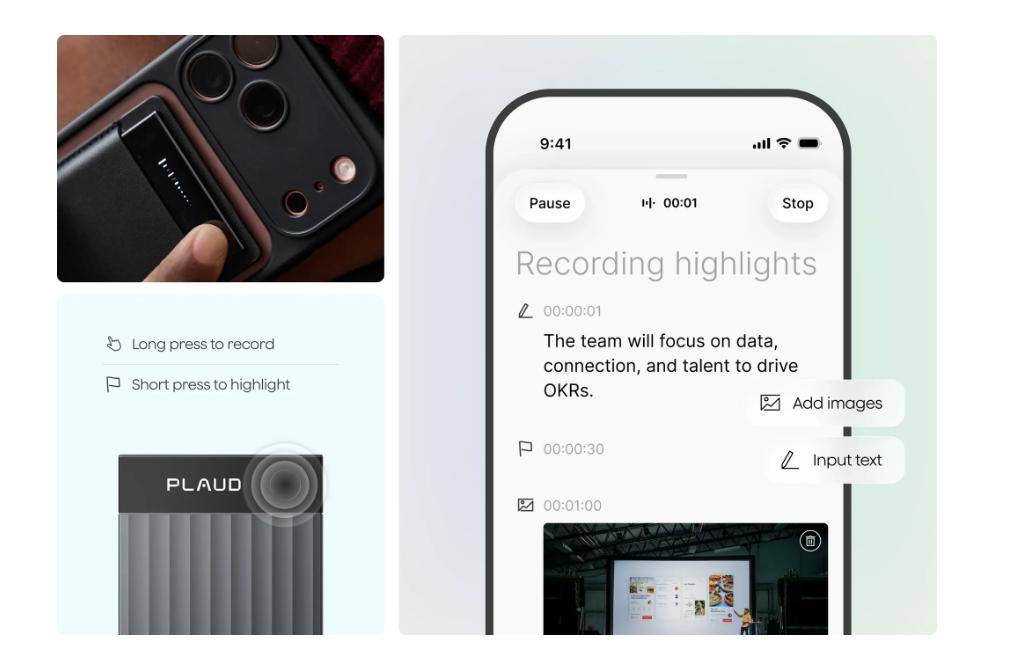
Image source: Plaud official website

Hardware Is the Trojan Horse, Subscription Is the Real Cash Flow: The Truth About AI Recording Cards
To see this crowded battle clearly, one must first understand how consumers use recording devices.
Before Plaud appeared, this was a standard "old digital product" category. Phones could record, software could transcribe, and Sony and Philips had worked the professional market for years. For most people, a recording device was not a rigid necessity.
The turning point came with hybrid work after the pandemic. Online meetings often lasted three or four hours, offline communication came one after another, complete working hours were disrupted, and asynchronous communication required audio traces. Plaud bet on this complexity.
The phone itself carries too much information and too many functions, and recording needs an entry point that is separated out. A card that sticks to the back of the phone, press once to start recording, with transcription, summaries, and to-dos automatically generated in the app—it throws a combination punch.
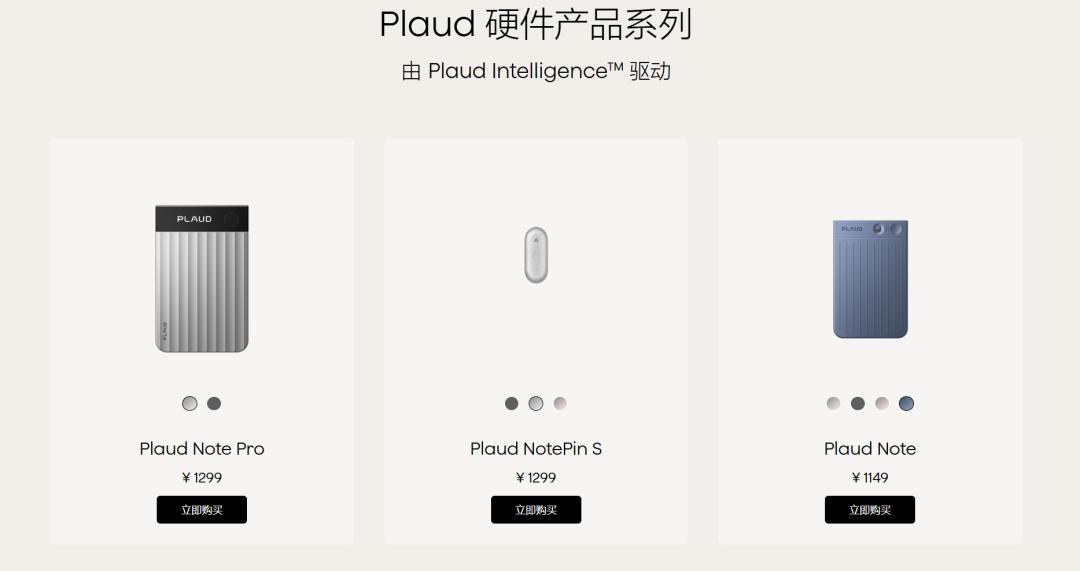
Plaud official website product information
Hardware is the Trojan horse for customer acquisition, and software subscription is the real cash flow. A valuation of $2 billion, a 25% profit margin per unit, and validation of the software-hardware closed loop in a market where "hardware does not make money"—this is a striking enough signal.
Once the signal was released, the speed of follow-up was astonishing, and the card table was quickly filled with people from different backgrounds—which physical position to occupy, and what irreplaceable functional increment to squeeze into a few centimeters of space.
The back of the phone is the most crowded. Plaud Note first set the benchmark with a credit card size, less than 3 millimeters thick, and 30 grams. Later entrants no longer only compared "thinness," but compared "what else this back can do." DingTalk A1 Pro thickened the card, stuffed in a 2980mAh battery, supported 180 hours of continuous recording and 180 days of standby, and could serve as a magnetic power bank for emergency phone charging. Dreame put an NFC electronic business card into the recording card, using crocodile leather and 3.5mm real diamonds to turn it into a business accessory. Flowtica Verso added an always-on e-ink screen, moving the device toward a "second interface."
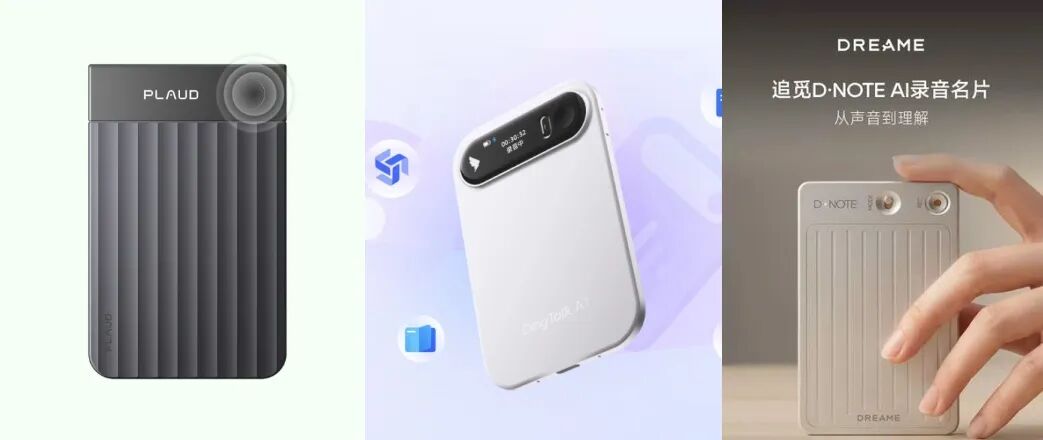
From left to right: Plaud, DingTalk, and Dreame products
Wearables go the opposite way, with the logic being lightness and unnoticeability. Anker's AI recording bean weighs only 10 grams and can be used both as a pendant and as a magnetic button. Stream Ring chose a ring, offering squeeze-to-talk whispered text conversion. Memoket makes an 11-gram wristband, provides a strap for wearing alongside an Apple Watch, and combines with existing devices. Only if it can be "worn comfortably" is there a possibility of being incorporated into work habits.
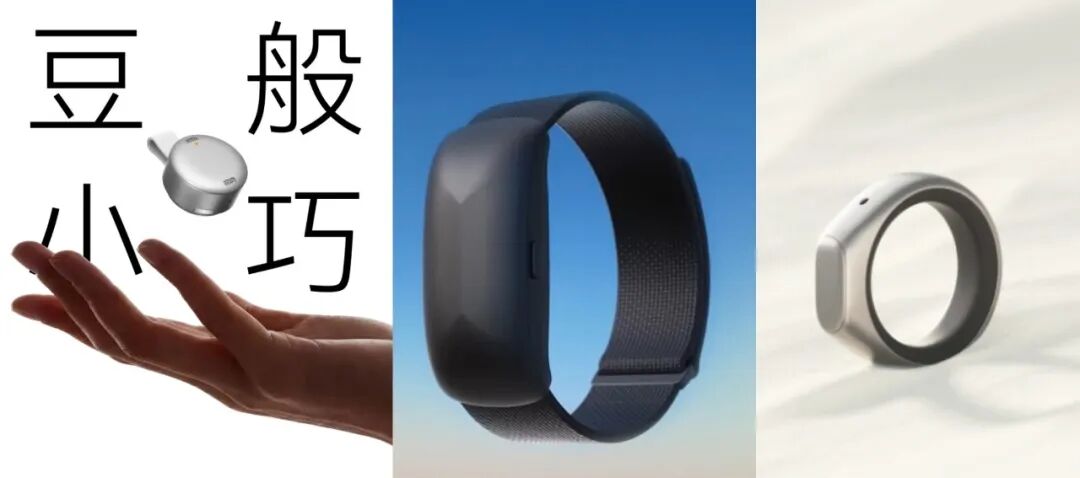
From left to right: Doubao, Stream Ring, and Memoket products
In addition to new forms, Bluetooth earphones and traditional recording pens familiar to consumers are also actively transforming. Shokz studied open-ear hooks, treating comfort as a prerequisite for recording productivity. Mobvoi TicNote Pods put 4G into earphones, and the charging case supports independent audio pickup, making "independent collection away from the phone" a selling point. Pen-shaped devices are doing multimodal work on hardware. iFlytek Magic became a compact recording terminal with a touchscreen. Flowtica Scribe retains writability and adds a shooting function in the app, allowing handwritten notes, whiteboards, and slides to be merged into audio context.
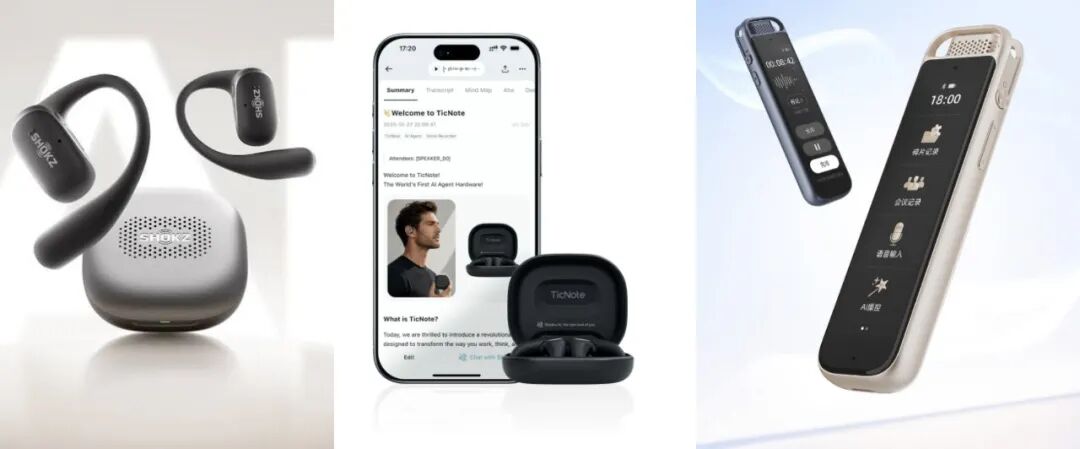
From left to right: Shokz, Mobvoi, and iFlytek products
On November 4, Apple pushed the first developer beta of iOS 27.3 and watchOS 27.3, including two brand-new AI features. One can help users review conversations from the past 15 seconds, and the other records the user's conversations over the past whole day and organizes them into a summary.
In terms of appearance—with or without a phone, for social use or for concealment—each has its own focus. But when taken apart, the internal structures are largely similar, especially in audio pickup.
Once a device needs to pursue thinness, lightness, and unnoticeability, the MEMS micro electret condenser microphone is almost the default answer. For wearables, to be lightweight, at least only 2 MEMS are used. Cards are far from the sound source, making it convenient to arrange arrays and add bone conduction. Recording pens have the most space and need to stack up in quantity to strive for a larger pickup range. MEMS microphones are low-cost—at most less than ten RMB—yet they are an important physical entry point for the above products. As a result, hardware competition quickly becomes specification-sheet competition, and specification sheets are most easily flattened by the supply chain.
The answer given by Huaqiangbei is cruel—the hardware itself is not worth that much money.
An entrepreneur working on AI meeting minutes told Xiaguang Society that for a card-style recorder selling for around a thousand RMB, the BOM cost is roughly within 100 RMB, including the chip, storage, motherboard, and casing. The most expensive chip is "purchased through agents" from Malaysia and can still be 20% cheaper than domestically. On e-commerce platforms, 199 RMB magnetic AI recording cards have already appeared, and on 1688, 260 to 300 RMB can get "factory goods" with five microphones and 360-degree audio pickup. Walking into the market, countless white-label products have similar functions, use the same promotional words, and can fill glass display counters.
China's supply chain has pressed the hardware cost of products to the floor, and thinness, magnetic attachment, and one-key recording at the hardware level are no longer barriers. The domestic entry ticket has dropped from a thousand RMB to 499 RMB, hardware profits have been compressed, and a price war is almost inevitable.
That being said, why do new products still keep coming? Because hardware only answers two questions: where to be positioned, and at how low a cost. The more critical question is: after occupying the position, why do users stay and why do they pay?

A Global Answer Sheet for a Recording Card
Hardware is the entry point for user interaction, and in the current market environment, what is more important is that data is the value point behind it.
In Q1 2026, domestic online retail sales of recording pens were 140 million RMB, and the average price rose all the way from 334.8 RMB in January to 386.3 RMB in March. Volume was rising and prices were rising too, but what rose was hardware itself. "Chinese users have low willingness to pay for software" is a consensus repeatedly confirmed by multiple practitioners.
According to research by the Tencent Research Institute, the monthly payment amount of Chinese AI users is mainly in the 30–100 RMB range. Data from institutions such as a16z and Bessemer shows that the consumer payment rate for AI products in the North American market is between 15% and 40%, while in the Chinese market it is only 3% to 13%—a gap of 3 to 4 times.
The high degree of differentiation in payment behavior means that if domestic recording cards want to change from a hardware business into a subscription business, what they need to cross is not the product threshold, but more solid behavioral habits. Unlimited transcription time, free use for the first 90 days, and even labeling as "lifetime"... The common direction of these actions is: hardware can be sold, but money cannot be collected at the software layer.
The underlying tone of overseas markets is completely different. The software subscription system has been running there for more than a decade, and users have long accepted "spending a dozen or so dollars a month to buy a tool that solves a specific problem."
A survey by Deposit Accounts shows that U.S. consumers hold an average of 4.5 digital subscriptions and spend an average of $84 per month. This habit happens to catch the product structure of AI recording devices—hardware starting at $159 paired with an annual fee of $99 to $240. For North American users, it feels more like a familiar extension of subscriptions rather than a new consumption decision that needs to be persuaded. Plaud's path verified this: before formally entering the Chinese market, nearly 50% of its hardware users eventually upgraded to Pro or Unlimited paid plans.
But "overseas" cannot be generalized, and internal differences cannot be ignored.
Plaud first gained traction in the United States, surpassing $1.1 million on Kickstarter in less than two months, but the largest market for software subscription revenue later became Japan, where the number of active users even exceeded that of the United States. In 2025, sales in Japan reached 4 times those of 2024, making it the second-largest market for Plaud hardware sales.
This structure of "blossoming inside the wall while fragrant outside, and more than one flower outside the wall" shows that demand for AI recording devices is not determined by any single habit, environment, or country, but is defined by a work culture—high-density meetings, demands for accuracy, the habit of efficiency tools, and a sufficiently mature subscription consumption environment.
The emphasis on "recording" and "leaving traces" in Japanese workplace culture has allowed Plaud's transcription and summary functions to take root. Europe contributes another kind of demand. Meetings in the Belgian public sector often mix Dutch, French, and English. For them, multilingual transcription is not just a bonus feature, but a prerequisite for cross-border collaboration. Singapore and Southeast Asia provide a third sample. As an Asia-Pacific regional headquarters hub, English is the working language, but regional accents frequently interweave. Transcription tools must not only recognize but also stably handle accents and terminology.
When a product hits multiple willingness factors at the same time, its revenue ceiling is no longer determined by the average price of any single market. But the more diverse the demand, the more layered the threshold. Multiple markets bring revenue elasticity and also push privacy compliance from the back office to the front.
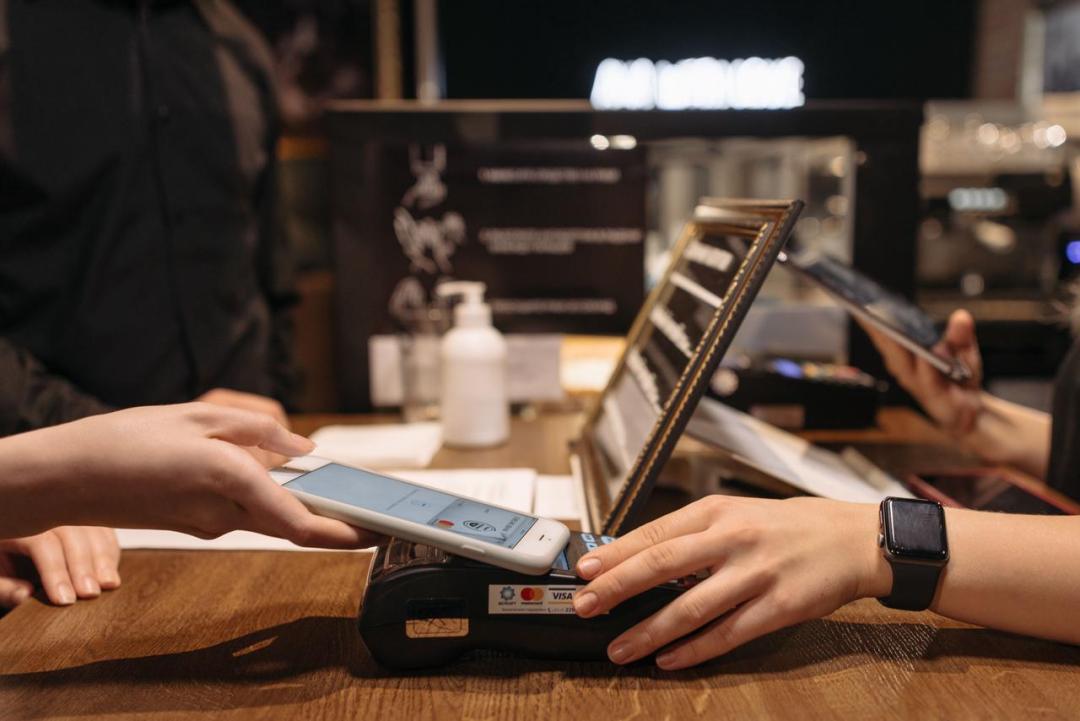
European regulation scrutinizes "continuous listening" very strictly. When German media discussed AI recording devices going overseas from China, they directly put the conflict between DSGVO and always-on recording in the headline.
Plaud has stacked certifications layer by layer—GDPR, HIPAA, SOC 2 Type II, ISO 27001—and written privacy compliance into the product description on its official website and channel pages. Among brands preparing to go overseas, a considerable number are adopting designs where "data does not leave the device or the jurisdiction" to solve the problem at the root. An always-on recording device sticks to the back of a phone or clips to a collar, and what users hand over to it is not just a few audio clips.
In such markets, privacy is not a bonus feature but an entry threshold. If this hurdle cannot be passed, no matter how light the hardware is, it cannot enter. Moreover, this threshold is not a local issue. The value center of the market and the degree of regulation are highly overlapping. The more a market has subscription habits and payment capacity, the less likely it is to treat privacy as optional.
But this does not mean AI recording devices can only do regional business. On the contrary, it is a category naturally suited to globalization—hardware forms are standardized, the supply chain is highly concentrated, the AI value-added layer can be delivered via subscription, and work scenarios such as meetings, customer communication, doctor-patient conversations, and lawyer meetings can be reused across different mature markets.
In China, pushing hardware down to 199 yuan is trading price for an entry point; in mature overseas subscription markets, selling subscriptions at annual fees of $99 to $240 is trading the entry point for recurring revenue.

Feature iteration and price competition in the domestic market will not disappear, but their role is closer to supply chain support and product form experimentation; overseas relies on compliance trust and subscription relationships, making it suitable for converting a one-time hardware entry point into an accumulable revenue stream. The two are not two sets of products, but different monetization priorities under different markets.
For some products, retention comes from "no need to replay" becoming muscle memory; among new product directions, some recordings turn the "main thread of life" into something to glance at every day, while Pocket's free strategy is a bet that users who use it long enough will need premium features.
Privacy compliance is market entry, hardware cost is a prerequisite for adoption, and voice accuracy is the baseline experience. Once established, the longer-term competitive moat is the ability to organize, understand, and deliver information into the user's next workflow.

The next stop for recording cards is "your context"
Zhao Qinping, an academician of the Chinese Academy of Engineering, once proposed a concept—"human-oriented intelligence" (Human Intelligence)—explicitly distinguished from "embodied intelligence" (Embodied Intelligence). Embodied intelligence answers "how to make machines do things more intelligently," while human-oriented intelligence answers "how to make intelligence better understand people and couple better with them, making people more powerful."
His core view is that AI is not an independent replacement, but a collaborative partner continuously guided by human intent in perception, decision-making, and action. The carriers of this kind of intelligence are precisely AI glasses, rings, pendants, recording devices, and other close-to-body, continuous, wearable terminals; their evolution direction is from "passive tools" to "proactive companions"—"the more you use it, the better it understands you; the more you use it, the more in sync it becomes."
When NOOKLAB determined its product form, founder Raymond chose a magnetic screen-equipped recording card because of "sufficiently low friction." Indeed, the recording card is small, visible at hand, and sufficiently unnoticeable. During the conversation between Xiaguang Society and NOOKLAB, it became even clearer that this low friction does not stop at the hardware form.
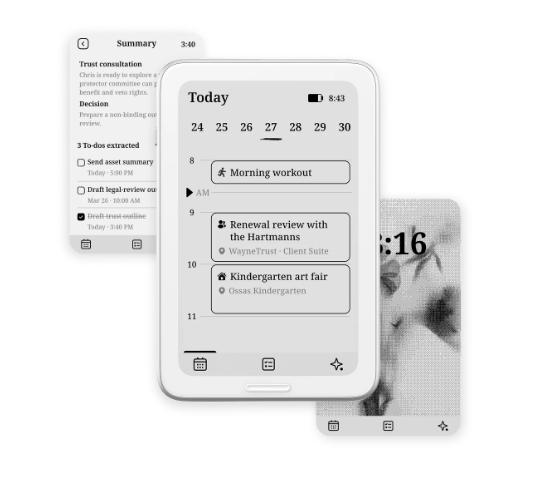
Image source: hellomoonphase
He gave a vivid example: when you are busy with something and suddenly remember the cat food is gone and the air conditioner needs cleaning, this thought flashes by and is easily forgotten entirely a few hours later. The barrier between "thinking of it" and "getting it done" lies not only in willpower, but also in recording and retrieval—opening an app gets you carried away by push notifications, and the phone itself is a source of attention distraction; writing it in a notebook buries it, and writing conditions are not always available. At such times, an additional carrier is needed to provide "lubrication."
The logic of Moonphase Flip is already touching this layer—it does not merely leave behind an audio clip, but like "tying knots to record events" in primitive times, strings together the preceding and following conversations, tasks, and progress into threads, and learns from the user's filtering behavior. For example, if among the five to-dos extracted in the first week the user deletes three, the AI remembers this weighting, and the summary given the next week will be closer to this person's judgment.
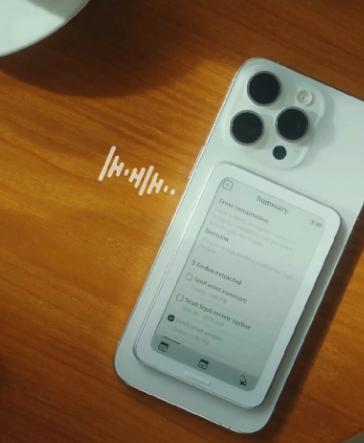
Image source: hellomoonphase
If a card only helps people with dense meetings save time organizing minutes, it is still answering "how to make machines do things more intelligently." But when it begins to catch the thoughts, promises, appointments, and threads in the mind that might slip away at any moment, it is answering another question—how to make intelligence better understand this person, and understand them better the more it is used. This also means the value of data lies not in a single collection, but in the model of "how this person operates" formed after continuous collection.
Similar products are approaching this endpoint in different ways; this kind of "cross-scenario data asset" is spilling over from office to life, initiated by the product positioning itself.
Plaud founder Xu Gao once broke down what to do in the future into four steps: capture, extract, utilize, and then he added route. The reason is that target users usually do not work in just one ecosystem, so Plaud's role is, after capture, to help users distribute this context to different tools. The weight of this positioning lies in the fact that it flips the recording device from "an accessory to a workflow" into "a common data source for multiple workflows."
The Limitless Pendant is a pendant worn all day; its lightweight presence facilitates continuous capture of conversations, thoughts, and daily activities, producing a searchable lifelog rather than meeting minutes. Through an MCP server, this lifelog is connected to agents such as Claude and Cursor, allowing those originally fleeting things to be repeatedly invoked.
SwitchBot's AI MindClip explicitly writes "working parents" in its product description; more critically, through OpenAPI it opens the context captured by MindClip, with authorization, to agents such as ChatGPT and Claude Code, enabling different agents to understand the user's work and life context and assist in planning, organizing, and executing.
The term "conversation data" is easy to talk about emptily, but "voice is the cheapest and densest context for AI to understand a person." "Workflow" and "life flow" converge in this description; even if it is only a kind of proactive "existence," there is still a large gap with conversational AI on the matter of "understanding people"—the reason for recording devices to remain lies not in hardware parameters, nor in free quotas, but in whether the context precipitated by the device becomes irreplaceable.
Therefore, even if the price war is the most easily observable competition at present, it measures only the victory or defeat at the entry layer. Although recording and transcription constitute a moat, the quality of audio material is only the starting point; what is truly scarce is the filtered context and the agent entry point.
When the reader of audio changes from a human to an agent, hardware will become an "organ" that absorbs information at the physical level; the management, services, and tasks surrounding this information are precisely why the device is "indispensable."
*Intern Zhou Hanchi also contributed to this article.
-
![]()
Double Pay Reward! Sales Soar Continuously, This Automaker's Head Says They "Want to Incentivize"
-
Changan Automobile to Shed 10% Avatr Stake Ahead of IPO
-
Changan Automobile Divests 10% Stake in Avatr: High-End Strategy Remains Intact as Marketization Accelerates
-
iPhone Air 2 Reportedly Brings 5 Major Upgrades—Will Apple Finally Fix All the First-Gen Air's Shortcomings?
-
![]()
AI Recording Devices Vie for the Title of "Best Listener"
-
![]()
Even DJI Can't Hold the Line on Prices! This Memory Price Surge Is Hurting Far More Than Just Phones
-
![]()
The AI Pioneers Who Built the Technology Are Now Sounding the Alarm: Hinton Warns a "Chernobyl-Scale" Disaster May Be Looming
-
![]()
Domestic Auto Sales Post "Seventh Straight Monthly Decline" — CAAM: Overall Pressure on the Auto Market Remains Relatively High