In the AI Era, Xiaomi's Years of Accumulated Assets Are Beginning to Pay Off
 11/26 2026
 509
Yangtze Delta MOMO
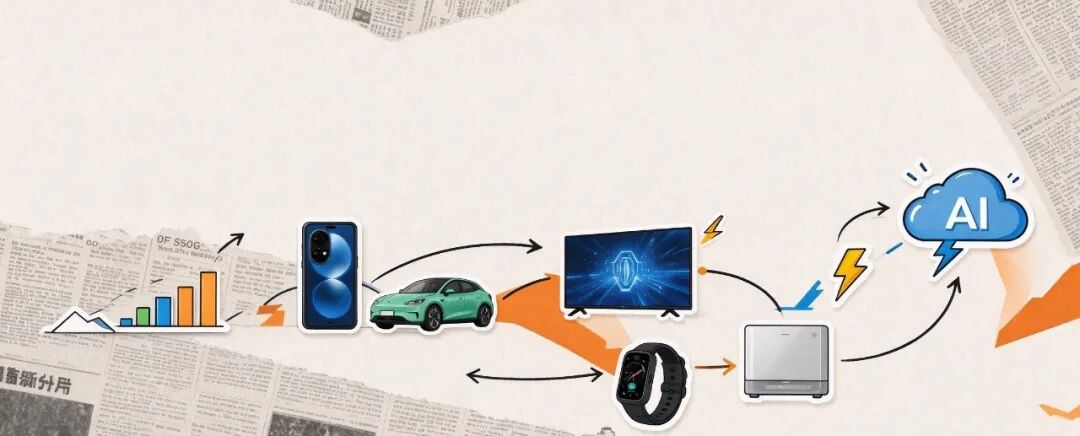
The AI revolution cuts both ways: on one hand, it drives up the cost for tech companies to make hardware; on the other, it opens up new growth space for the hardware business. For Xiaomi, which owns full-ecosystem entry points across Human-Car-Home, AI is expected to become an important catalyst for business growth in the coming years.
In the past few years, when we talked about the AI competitiveness of tech companies, we were accustomed to looking at some new metrics.
How many GPU cards they have, where their large models rank on leaderboards, how many AI talents they have poached, and how much money they plan to spend on AI in a year.
This gave the impression that when a technological revolution arrived, all tech companies were once again standing on the same starting line.
But as AI accelerates toward application, the industrial accumulation that tech companies have built over the past decade or even decades is once again finding new uses.
Yesterday (November 24), Xiaomi Group (01810.HK) released its third-quarter report. Xiaomi Group President Lu Weibing admitted at the earnings call that this was the toughest quarter for the smartphone industry since he entered the business.
The wave of memory chip price increases brought by the AI revolution is precisely one of the important drivers of this round of winter in the smartphone industry.
Yet against such an industry backdrop, Xiaomi's third-quarter revenue reached 107.2 billion yuan, standing firm above 100 billion for two consecutive quarters, and the group's gross margin improved sequentially to 20.2%. The smartphone business improved quarter by quarter, the vehicle business advanced on both battery-electric and range-extended lines, and the premiumization strategy also made new progress.
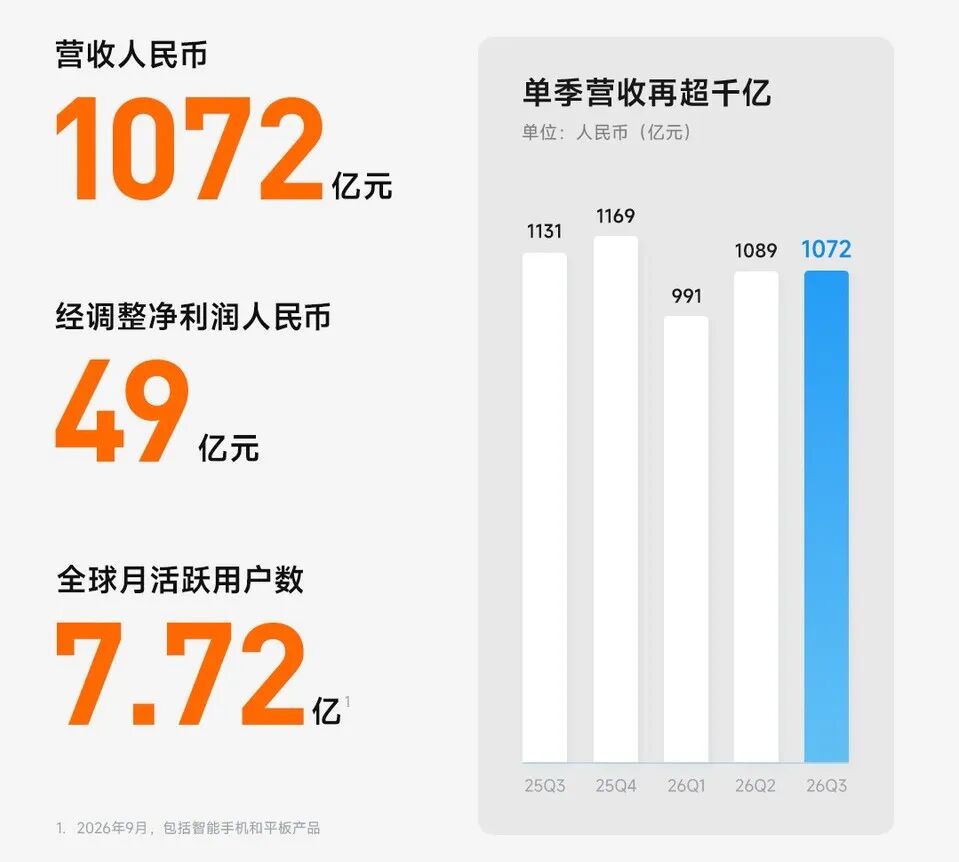
At the same time, Xiaomi's single-quarter R&D investment reached 9.2 billion yuan, and the going-global push of the full Human-Car-Home ecosystem is still accelerating.
The capital market also gave positive feedback. After the Hong Kong stock market opened today, Xiaomi's share price rose steadily, once climbing more than 8% during intraday trading. In their latest research reports, Bank of America and Daiwa Securities also respectively favored the business synergy brought by Xiaomi's AI implementation and the growth potential of overseas markets.
Over the past few years, Xiaomi has been pursuing premiumization, tackling underlying technologies, and laying out overseas channels. These are all money-consuming and time-consuming tasks, and when the industry was enjoying smooth sailing, the benefits of doing these things were not necessarily so obvious.
Now, a cold wind is blowing through the industry, and the AI revolution is arriving head-on. The assets accumulated over these years have instead begun to show new value.
01 The colder the industry, the more the value of premiumization becomes visible
In the past, when the smartphone industry was booming, manufacturers only needed to improve supply chain efficiency and sell a few million more phones, and their financial reports would look much better.
But this year's memory price increase wave has made this business somewhat difficult to run.
Especially for low-end volume-driven models, the profit margin itself is not large. If memory costs rise by another one or two hundred yuan, manufacturers will feel the pain. If they raise prices, these consumers are precisely the most price-sensitive; if they do not, the more they sell, the greater the profit pressure may be.
Therefore, when looking at smartphone manufacturers' financial reports this year, the importance of the shipment volume metric may need to be ranked lower.
In the third quarter, Xiaomi's global smartphone shipments were 30.7 million units. Although this declined year on year, smartphone business revenue reached 45.6 billion yuan, up 8.2% sequentially, and gross margin rose 0.6 percentage points sequentially to 9.2%.
Among these, a particularly noteworthy metric is ASP (average selling price) — Xiaomi's global smartphone ASP in the third quarter was 1,486 yuan, up 39.8% year on year, setting a record high.
Lu Weibing also discussed Xiaomi's operating approach this year at the earnings call: the requirement for ASP is higher than that for shipments, and the pursuit of product mix optimization is higher than that of scale.
Of course, actively reducing shipments of low-end models can itself raise the average selling price. Therefore, to judge how well Xiaomi is doing in premiumization, one still needs to look at several other sets of data.
In the third quarter, Xiaomi's market share in China's 6,000-yuan-and-above price segment increased by 1.2 percentage points year on year. The mid-range foldable flagship Xiaomi 18 Fold launched in September had a starting price of 10,999 yuan, and its first-sale retail volume increased 300% compared with the previous generation of large foldable phones.
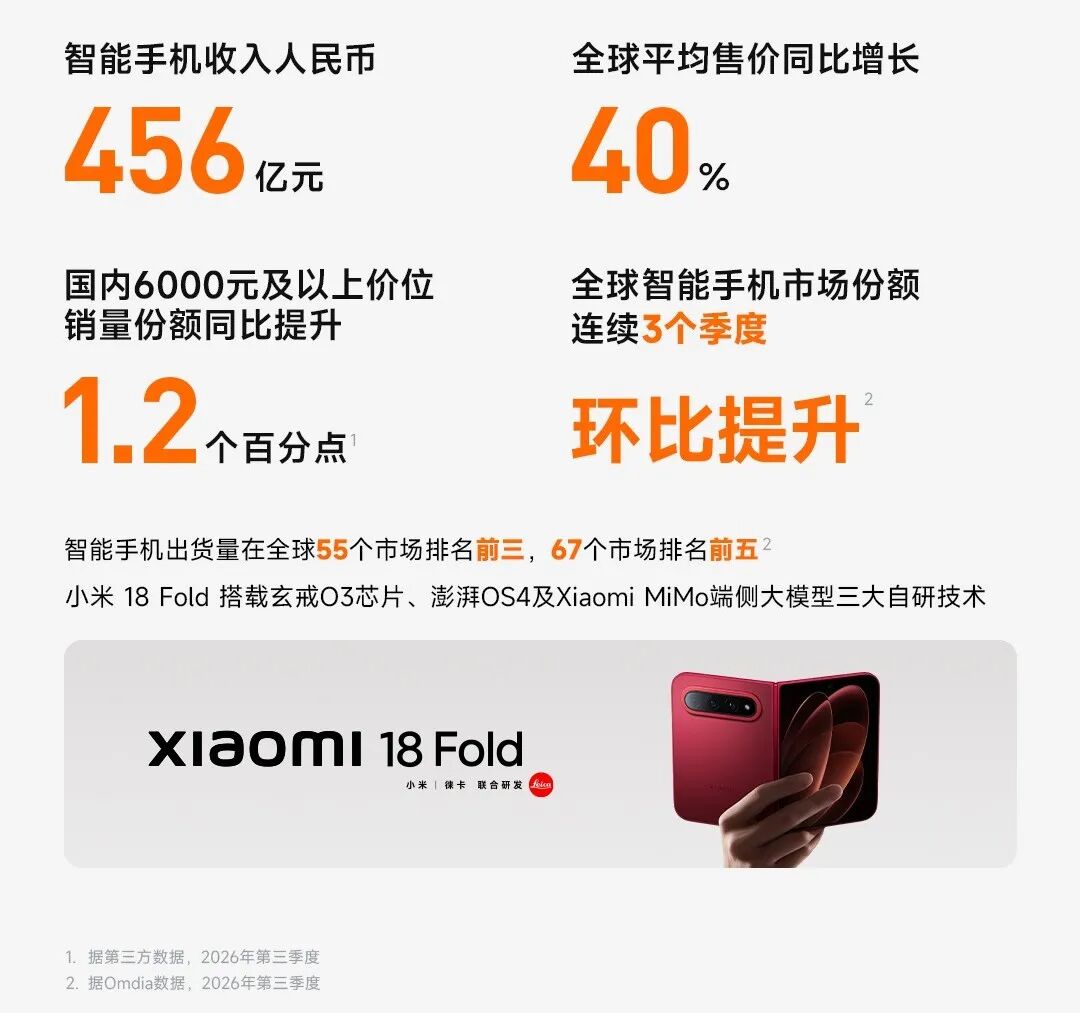
For a company that opened the market fifteen years ago with a 1,999-yuan phone, it is quite interesting that a phone priced above 10,000 yuan can now receive such market feedback.
Similar changes have also occurred in the vehicle business.
In the third quarter of this year, China's overall auto market declined by double digits year on year, and the range-extended vehicle market was also under pressure. At this point in time, Xiaomi completed a dual-line layout of battery-electric and range-extended vehicles, and the first-sale-month locked orders of the all-new Pengcheng series exceeded 70,000 units.
Throughout the third quarter, Xiaomi's vehicle deliveries exceeded 100,000 units, and new energy vehicle business revenue reached 22.7 billion yuan.
In October, Xiaomi's monthly vehicle deliveries exceeded 50,000 units. According to the sales ranking published by Xiaomi, the Pengcheng N70, Xiaomi SU7, and Pengcheng N90 swept the top three in sales among models priced above 200,000 yuan in China.
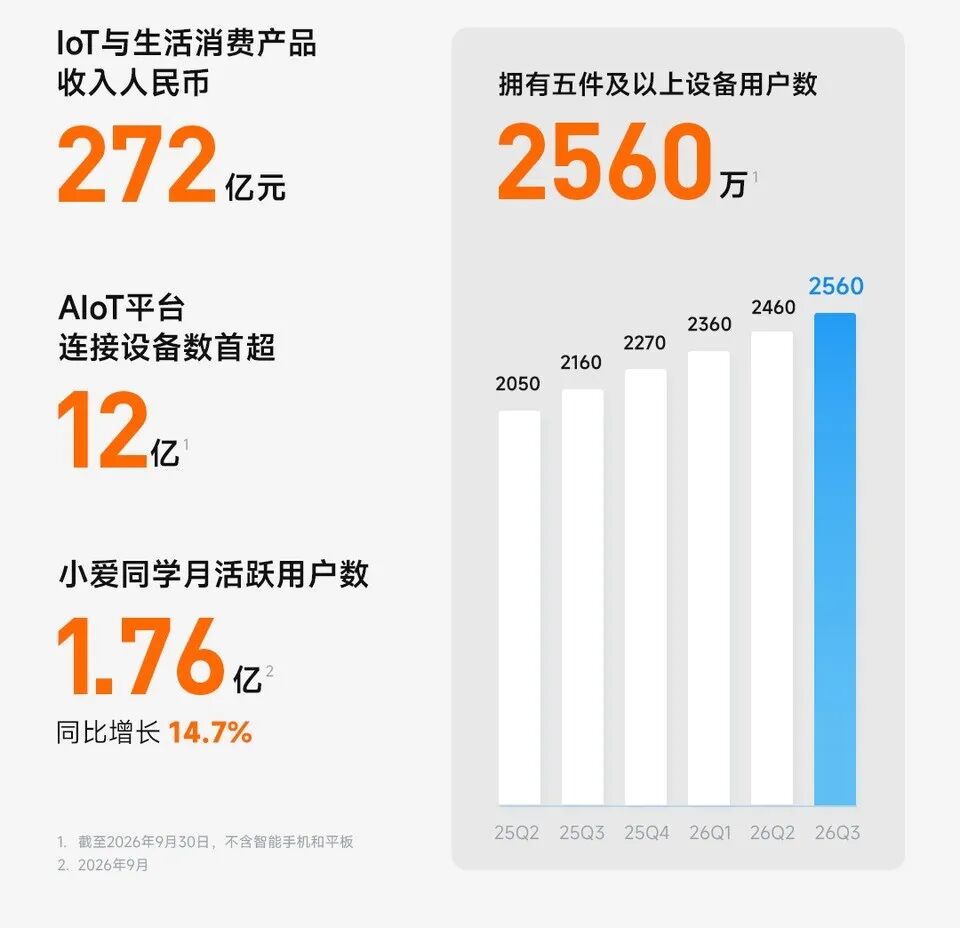
Now look at the other two businesses. In the third quarter, Xiaomi's IoT (Internet of Things) and lifestyle products business revenue was 27.2 billion yuan, with gross margin rising sequentially to 21.7%; internet services revenue was 9.5 billion yuan, achieving growth both year on year and sequentially.
Today, the smartphone business accounts for only a little over 40% of Xiaomi Group's total revenue. The several new businesses expanded over the past few years have also given Xiaomi more room for operational adjustment during the industry's headwind period.
It is worth noting that, in response to memory chip price increases, Xiaomi has proactively adjusted its operating strategy for three consecutive quarters. If memory prices reach an inflection point in the future, the cost pressure on smartphones, IoT, vehicles, and other businesses is expected to ease simultaneously, and the profit recovery space at that time will be worth watching.
After all, the AI competition in the coming years will still require tech companies to spend a lot of money.
02 As AI moves toward application, the value of the Human-Car-Home ecosystem begins to amplify
In the toughest quarter for the smartphone industry, Xiaomi's R&D investment still reached 9.2 billion yuan. According to the plan disclosed by management at the earnings call, Xiaomi's investment in AI this year will reach 16 billion yuan for the full year.
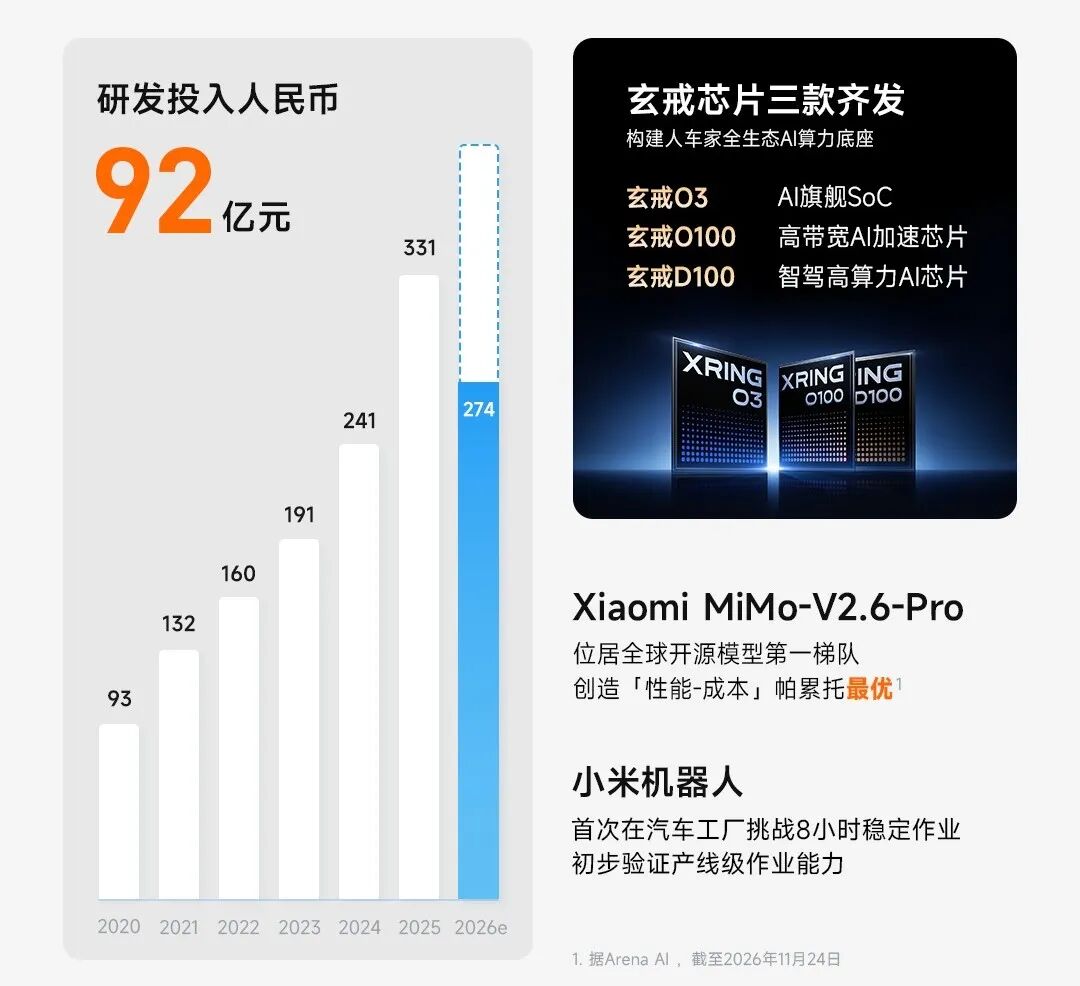
With so much money spent on AI, where are the future growth opportunities?
This requires looking at several other sets of data in Xiaomi's financial report.
As of the end of the third quarter, the number of connected devices on Xiaomi's AIoT (Artificial Intelligence of Things) platform exceeded 1.2 billion for the first time (excluding smartphones, tablets, and laptops), users owning five or more connected devices reached 25.6 million, up 18.7% year on year, and cumulative vehicle deliveries also exceeded 800,000 units.
Of course, 1.2 billion connected devices does not mean Xiaomi now has 1.2 billion AI terminals. But as AI gradually enters phones, cars, and home appliances, these hardware and users accumulated in the past have become potential AI application resources.
Particularly noteworthy are those 25.6 million users who own five or more connected devices.
For these users, Xiaomi's products have already entered multiple scenarios in their daily lives. As AI capabilities improve, previously relatively independent smart devices also have the opportunity to better understand users' needs and collaborate to complete some tasks that previously required users to operate themselves.
In the past, when buying a smart home appliance, consumers mainly looked at whether the appliance was easy to use. In the future, when buying a smart home appliance, they may also need to consider whether it can work with the devices already in the home to make better use of AI.
This also brings new growth imagination to Xiaomi's hardware business.
And over the past few months, Xiaomi has clearly accelerated the pace of AI implementation across the full Human-Car-Home ecosystem.
In August this year, Xiaomi launched three chips — Xuanjie O3, O100, and D100 — targeting AI computing power needs in different scenarios across the Human-Car-Home ecosystem. On the subsequently launched Xiaomi 18 Fold, the self-developed chip Xuanjie O3, the MiMo on-device large model, and HyperOS 4 achieved the first convergence of three core technologies.
This brings us back to the premiumization discussed earlier.
A flagship phone priced above 10,000 yuan not only improves the product mix but also provides a testing ground for commercial validation of new technologies. Once the technology matures, it can then gradually spread to more products and scenarios.
In September this year, Xiaomi released and open-sourced the MiMo-V2.6 series large models, with improved intelligence while API (Application Programming Interface) call prices remained unchanged. According to management, both API call volume and AI-related revenue for Xiaomi's large models are continuing to grow.
At the same time, in Xiaomi's released HyperOS 4, Super Xiao Ai 2.0 has deeply integrated the MiMo large model, further enhancing cross-device and cross-scenario interaction experience.
For Xiaomi, chips solve the AI computing power problem, large models provide intelligence capabilities, and the operating system is responsible for bringing these capabilities to different hardware and application scenarios.
There is also an economic calculation for R&D here.
When a company invests heavily in chips, large models, and operating systems, as the technology gradually matures, if the R&D results can be reused across multiple businesses such as phones, cars, and home appliances, the economic calculation for this R&D will clearly become more favorable.
Bank of America also mentioned this in its latest research report, believing that in the long run, as AI is deeply deployed across Xiaomi's various internal businesses, its ecosystem will drive significant synergies among different business segments.
Moreover, the application scenarios brought by AI continue to increase.
Just this month, Xiaomi's self-developed robot completed an 8-hour long-duration operation at a car factory, and even went to charge itself twice during the process. At Xiaomi Youth Apartments, the robot has also begun trial operations, capable of completing long-range task chains lasting more than 30 minutes, covering three rooms and more than 50 tasks.
These attempts also give Xiaomi's future AI applications the opportunity to further expand from existing consumer electronics, cars, and home appliances into areas such as smart manufacturing and home services.
There are many global tech companies, but enterprises that simultaneously possess underlying technology layouts and hardware ecosystems and application scenarios of such scale are rare.
This also gives Xiaomi's full Human-Car-Home ecosystem new scarcity in the AI era.
03 From selling products to selling an ecosystem, the overseas business has changed
In September this year, Xiaomi participated in the IFA consumer electronics show in Berlin, Germany, bringing nearly 400 products across seven major tracks and nearly 40 categories at once.
If it were ten years ago, when Xiaomi attended such overseas exhibitions, it would probably still mainly showcase phones and some consumer electronics products. Now, from phones, TVs, and air conditioners to cars, Xiaomi can already display a complete set of smart lifestyle scenarios at overseas exhibitions.
At this exhibition, Xiaomi announced that the Mijia brand would officially enter the European market at scale, and Xiaomi Auto also completed signing with the first batch of 8 leading German dealers, preparing for entry into the European market in 2027.
For a Chinese automaker to enter the European market, just making local consumers aware of its brand requires considerable time and money.
Yet Xiaomi has already been selling phones in Europe for many years. According to Xiaomi's financial report disclosure, in the third quarter of this year, based on smartphone shipments, Xiaomi's market share in Europe reached 18.8%, ranking third. European consumers may not yet have sat in a Xiaomi car, but many have already used Xiaomi phones, bands, or TVs.
This kind of brand awareness can at least save Xiaomi Auto one task of starting from zero when going overseas.
Lu Weibing revealed at the earnings call that in overseas markets where Xiaomi's phone business performs relatively well, Xiaomi's brand awareness has reached 98.9%. Even in some Nordic markets where the phone business does not perform as well, Xiaomi's brand awareness has reached 60% to 70%.
More noteworthy is that in these markets, Xiaomi Auto has not yet officially started selling, but awareness has already exceeded 40%.
Lu Weibing also shared an interesting detail: some overseas distributors were willing to spend €100,000 to €200,000 out of their own pockets to study local users' expectations for Xiaomi Auto, using those insights to shape their market entry strategies. From his perspective, overseas users show a strong receptiveness to and anticipation for Xiaomi's full "Human-Car-Home" ecosystem.
Conversely, if Xiaomi Auto can establish a solid foothold in Europe down the road, a high-value smart car could also reshape some overseas consumers' preconceptions about the Xiaomi brand—an upside that could prove valuable for the premiumization of its phones and home appliances abroad.
Beyond brand, there are also channels to consider.
In the third quarter, overseas revenue accounted for 49.1% of Xiaomi's smartphone × AIoT business—nearly half. Its overseas new retail stores surpassed 750, while overseas TV shipments and revenue both hit record highs.
The overseas channels originally built for selling phones are now carrying an expanding array of products. With domestic demand under pressure, overseas markets are giving Xiaomi more room to maneuver.
Daiwa Securities noted in its latest research report that overseas markets are expected to become Xiaomi's growth engine in the next phase.
As the full Human-Car-Home ecosystem accelerates its global expansion, Xiaomi's multi-year investments in chips, large models, and operating systems also stand to reach consumers in more countries through a broader product lineup—and to generate greater commercial returns.
A few years ago, when the industry was enjoying smooth sailing, pursuing premiumization, investing in foundational technologies, and building overseas channels all seemed like costly, time-consuming endeavors.
Now, the industry downturn has made the value of these long-term investments all the more evident, and the AI revolution has opened up new applications for the hardware and use cases accumulated over the years.
Once this industry trough passes, as AI accelerates its rollout across the full Human-Car-Home ecosystem, the assets Xiaomi has built up over the years may yet unlock even greater growth potential.
-
![]()
Rocket Hasn't Flown Yet — So How Is Qianyi Aerospace a Generation Ahead?
-
![]()
NetEase Games' Dilemma Is Not Short Dramas' Fault
-
![]()
AI Is Taking a Heavy Toll on Phones! Counterpoint: Global Smartphone Shipments to Fall for Two Straight Years, Down Another 6% in 2027
-
New AI Stock Trading Trend: Targeting 30 Million Retail Investors, Predicting Trading Behavior 24 Hours in Advance
-
Xiaomi's Quiet Build-Up Amid Industry Headwinds
-
![]()
In the AI Era, Xiaomi's Years of Accumulated Assets Are Beginning to Pay Off
-
Why Are Listed Companies' Financial Reports Starting to Take Douyin E-commerce's Business Logic Seriously?
-
AI Steps on the Gas: A 167-Year-Old Cold Case Finally Hears an Echo