Rocket Hasn't Flown Yet — So How Is Qianyi Aerospace a Generation Ahead?
 11/26 2026
 431
A rocket that has yet to make its maiden flight is already being touted as beating Falcon 9 on cost projections.
A recent promotional piece on Qianyi Aerospace's technical approach put the per-kilogram launch cost of conventional vertical recovery at roughly 23,000 yuan, claimed the high angle-of-attack aerodynamic deceleration solution could bring that down to 6,000 yuan, and even suggested it might eventually fall below 1,000 yuan.
Qianyi Aerospace's Xuanniao-R is designed to have its first stage turn sideways during return, use air resistance to slow down, and land horizontally. The company calls this "second-generation recovery technology" and says it can sharply cut the propellant consumed on the return leg and lower launch costs.
In November 2026, the second stage of Starship's 15th test flight was successfully caught by the tower arms for the first time. Qianyi Aerospace's decision three years ago to bet on high angle-of-attack deceleration was promptly folded into this success story. A rocket that has never flown thus appeared to have completed a generational leap — and even its cost advantage suddenly had a basis.
But reality is far more complicated than a recovery animation. Xuanniao-R first has to prove that a rocket tens of meters long can reliably land sideways. Even if it can, whether the propellant saved can offset the added structural weight and maintenance costs is another battle entirely.
Neither hurdle has been cleared. So where exactly does this so-called generational lead come from?
01 A Borrowed Generational Gap
On November 14, 2026, Starship's second stage, Ship 42, returned after about 14 orbital laps, bled off speed through high angle-of-attack flight, then reignited, flipped, and was caught by the tower arms in a vertical attitude.
That was a genuine breakthrough. But packaging Starship's success as an endorsement of Qianyi Aerospace's technology is pure bait-and-switch.
The two vehicles fly entirely different missions. The Starship second stage returns from near-orbital velocity, so the kinetic energy it must dissipate per unit mass is far higher than that of the Xuanniao-R first stage. Their return trajectories, thermal environments, and mass distributions also differ.
The more fundamental difference lies in the final step: Starship is caught vertically, while Xuanniao-R is supposed to land horizontally.
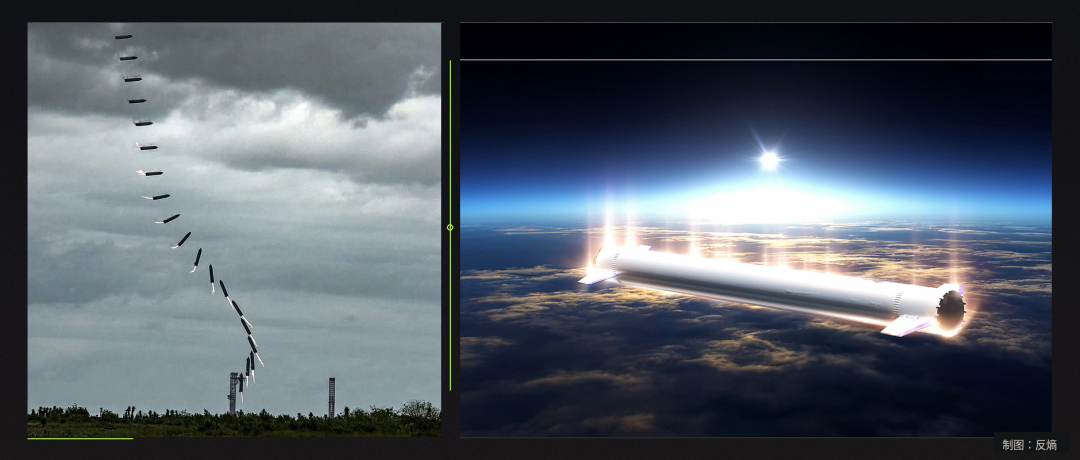
High angle-of-attack aerodynamic deceleration is engineering-feasible, but that is a completely different proposition from whether a first-stage rocket can safely land sideways.
In a public interview in August, Qianyi Aerospace founder Li Rui labeled vertical powered recovery "first generation" and high angle-of-attack aerodynamic deceleration "second generation." A November 20 article echoed that framing. And just like that, the Xuanniao-R — which has yet to make its first flight — appeared to have surpassed Falcon 9, a rocket with hundreds of recoveries to its name, in technological generation.
But the framing itself doesn't hold up. SpaceX states plainly in the Falcon User's Guide that the Falcon 9 first stage uses both engine retropropulsion and aerodynamic deceleration during return. The reentry burn reduces speed and thermal and mechanical loads, the grid fins use aerodynamic forces to correct the trajectory, and only in the final phase do the engines complete the landing.
Falcon 9 does not rely on engine deceleration alone, and Xuanniao-R has not abandoned powered braking either. The difference between the two lies in how much of the deceleration task is borne by the engines and how much by the air — and what structural and control costs are paid for that split.
Forcing different engineering tradeoffs into a sequence of technological generations, then declaring yourself a generation ahead on that basis, looks more like manufacturing a technological gimmick.
During Starship's 9th test flight in 2025, SpaceX tried increasing the Super Heavy booster's descent angle of attack to boost aerodynamic drag and cut propellant consumption. First-stage recovery failed: after the landing burn over the sea, the booster exploded about 1 kilometer above the surface and never completed the planned controlled splashdown. SpaceX's subsequent investigation concluded that the larger angle of attack pushed structural loads beyond predictions, affected internal propellant feed lines, and was the most likely cause of the landing burn failure. SpaceX then decided to reduce the descent angle of attack for subsequent boosters of the same version.
The irony is hard to miss: Qianyi Aerospace's promotion uses Starship to show how advanced the high angle-of-attack approach is, while SpaceX's own flight data remind us that increasing the return angle of attack can bring structural loads beyond design expectations.
Starship's success cannot be borrowed. Xuanniao-R will ultimately have to face its own landing tests.
02 The Last Kilometer
For a rocket returning sideways, the hardest part may not be slowing it down but bringing it to a safe stop. During high-speed return, air resistance can dissipate a large amount of kinetic energy. Near the ground, the rocket must also control horizontal velocity, vertical descent rate, and touchdown attitude.
Previously published plans from Qianyi Aerospace show that during return, Xuanniao-R controls attitude through large control surfaces, reignites its engines at about 1 kilometer above the ground, uses tank relief valve jets to assist attitude adjustment, and finally lands horizontally supported by the control surfaces.
The rocket's main engines produce thrust along the vehicle's longitudinal axis. As the vehicle turns horizontal, the vertical component of the main thrust also changes. When to complete the main powered deceleration, how to control the descent rate during the attitude transition, and what to rely on to eliminate the remaining velocity before touchdown all require strict coordination. At the same time, airflow conditions and aerodynamic torques are continuously changing. The lower the altitude, the less time the control system has to correct deviations.
Xuanniao-R uses large control surfaces with a chord of about 3 meters. These surfaces must not only control attitude in high-speed airflow but also bear support loads at the moment of touchdown. That places extremely high demands on structural strength, joint sections, and control precision. Power, attitude, and structure are tightly coupled, and any deviation may affect landing safety.
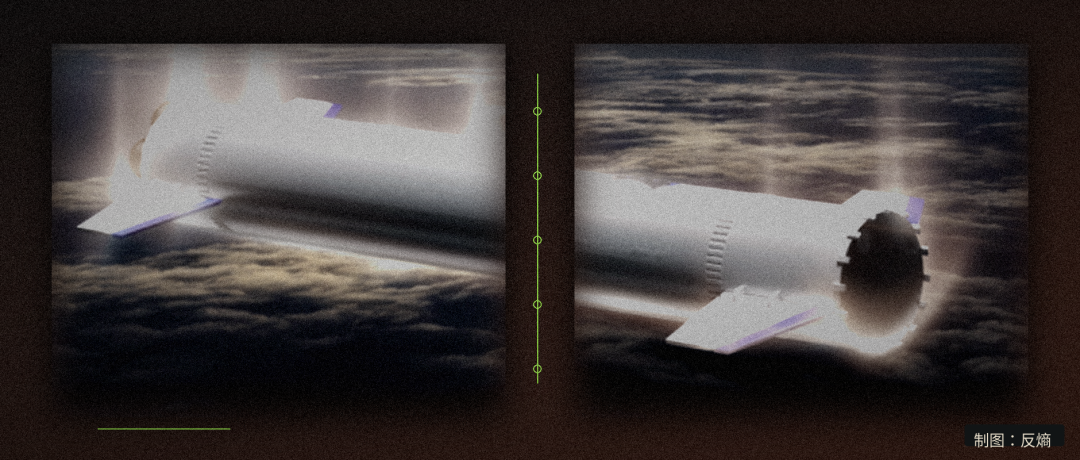
One important consideration behind Qianyi Aerospace's choice is reducing dependence on repeated engine ignition and deep throttling. But lowering the control difficulty of one link does not prove that the entire landing system is easier to realize. Starship has already demonstrated the path of vertical capture after high angle-of-attack deceleration. If Xuanniao-R chooses horizontal landing, it must independently prove its reliability.
In June 2026, Xuanniao-R completed ascent-phase force-measurement wind tunnel tests from Mach 0.3 to 4. That is very solid engineering progress, but it cannot replace flight verification of hypersonic return and full-scale horizontal landing.
For an approach with such complex terminal control and no complete flight verification, it is clearly too early to talk about technological maturity. Risks can be gradually resolved through testing, but reliability cannot be obtained through technical description.
Even if Xuanniao-R lands steadily sideways in the future, another debate will only just begin.
03 The Illusion of Fuel
For reusable rockets, the most expensive weight sometimes comes precisely from the equipment added to save return propellant.
In June 2026, a technical report introducing Xuanniao-R marked its expected payload capacity loss as 3%, and compared it with the roughly 30% payload loss of conventional recovery schemes. The numbers are very attractive, but unfortunately the comparison conditions were never clearly explained.
In the article High Angle-of-Attack Aerodynamic Deceleration — the Low-Cost Recovery Approach Qianyi Aerospace Bet On Three Years Ago, the author stated that Falcon 9 first-stage recovery requires reserving 30-60 tons of propellant, about 7%-15% of the first stage's total propellant, and estimated the resulting payload loss at 23%-40%.
The former measures the share of recovery propellant, while the latter measures loss of payload capability.
Even more puzzling is that the 3% in the June report originally referred to Xuanniao-R's expected payload loss. By the November article, the gap between 30% and 3% had been presented as "fuel loss reduced from 30% to 3%."
Payload loss and propellant consumption are not the same metric at all. Even if payload loss were uniformly adopted as the comparison standard, the mission orbit, recovery method, and overall vehicle mass distribution of the two rockets would still have to be considered. Without identical calculation conditions — and with even less reviewable performance data — how much engineering basis is there for the claim that payload loss falls from 30% to 3%?
Even if propellant demand is reduced, Xuanniao-R still has to pay the mass penalty of added structure. Large control surfaces and their actuation devices, reinforcement of joints, thermal protection, and load-bearing designs required for horizontal landing all have to lift off from the launch site with the first stage.
Propellant saved on the return leg absolutely does not mean it can be converted into an equal mass of payload. How much propellant is reduced, how much dry mass is added, and how much final payload is increased must be determined through a complete vehicle mass model.
Research by the German Aerospace Center (DLR) on recovery configurations such as winged aerial capture and vertical powered landing shows that propellant consumption, structural dry mass, and reuse costs jointly determine the final benefit. Emphasizing only how much less fuel is burned cannot prove an advantage in overall vehicle payload and cost.
Even if net payload ultimately increases, economic viability is still unproven. After control surfaces experience high-temperature airflow and touchdown impact, how much inspection is needed? How soon can the rocket be launched again, and how many times can it actually be reused? These are the variables that determine operating costs.
The Space Shuttle completed 135 missions but was always constrained by complex maintenance procedures; Falcon 9, by contrast, has established a verifiable operating record through years of high-frequency launches and repeated recoveries.
Treating propellant savings as the main evidence of low cost is to pass off a local performance gain as the economic advantage of the entire transportation system. If even the added dry mass and refurbishment expenses are not fully addressed, the so-called cost reduction remains only a projection.
How much money Xuanniao-R can actually save must wait until it truly flies, lands, and flies again before even beginning to be answered.
04 Victory Before First Flight
In August 2025, Qianyi Aerospace planned to achieve Xuanniao-R's first orbital flight and recovery by the end of 2026. By April 2026, the first-flight time had been pushed to 2027, and founder Li Rui said that breaking through ADHL recovery technology would still require two to three years. In August of the same year, according to Qianyi Aerospace, the first-flight mission would prioritize ensuring orbital insertion, verify aerodynamic deceleration during first-stage return, and use sea splashdown or net-based recovery at the terminal stage.
Orbital insertion first, then accumulating high-speed return data, and afterward attempting full recovery conforms to the laws of rocket development. What is truly difficult to understand is why the economic advantage has moved ahead of engineering verification.
Li Rui has given multiple sets of cost projections in public interviews: about 5,000 yuan per kilogram after successful orbital insertion, about 3,000 yuan after first-stage recovery; and if both stages are fully recovered, the long-term target is expected to fall to just over 900 yuan.
Then, the November 20 article arranged the Space Shuttle's roughly 400,000 yuan per kilogram, vertical recovery's roughly 23,000 yuan, and the high angle-of-attack approach's roughly 6,000 yuan into a declining curve, even using the phrasing that the cost had been "further pressed down to" 6,000 yuan.
The Space Shuttle's historical costs, Falcon 9's cost estimates, and Xuanniao-R's unrealized long-term targets were placed on the same curve. The calculation bases are all different, yet the so-called cost advantage seems already to have become fact.
True unit launch cost also depends on the rocket's payload, manufacturing and launch expenses, recovery success rate, refurbishment expenses, reuse count, and launch frequency. For Xuanniao-R, which has not yet made its first flight, a considerable portion of these key variables remain only design targets.
What is hardest to accept is that before technological development is complete, economic victory has already been declared. Qianyi Aerospace has put forward aggressive cost targets, and the promotion around it has further written flight-unverified projections into achieved advantages. Xuanniao-R has not completed its first flight, horizontal landing has no complete flight record, the net payload advantage lacks independently reviewable data, and long-term reuse costs have even less practical basis. If the technological generation cannot even be defined, how can cost leadership be discussed?
Declaring leadership so eagerly weakens precisely the credibility that serious engineering innovation should have.
China's commercial space sector certainly needs new approaches different from Falcon 9. But truly valuable breakthroughs must be built on test results.
First send the rocket into the sky and bring the first stage back under control; then achieve horizontal landing and use repeated flights to prove reliability and economic viability.
Until then, the claim of being a "generation ahead" amounts to nothing more than calling victory before the rocket has even left the pad.
* If you have differing views on this article, you are welcome to reach us through the backend.
The main reference materials used in writing this article:
1. High Angle-of-Attack Aerodynamic Deceleration—the Low-Cost Recovery Approach Qianyi Aerospace Bet On Three Years Ago, Investment Community, November 20, 2026.
2. Falcon User's Guide, SpaceX, May 2025.
3. Flight 9 and Ship 36 Report, SpaceX, August 2025.
4. Pushing Through Aerodynamic Deceleration Recovery Technology, Qianyi Aerospace Targets Thousand-Yuan/Kilogram Rocket Launch Cost, China Business Journal, April 29, 2026.
5. Options for Future European Reusable Booster Stages: Evaluation and Comparison of VTHL and VTVL Costs, German Aerospace Center (DLR), CEAS Space Journal, published online in December 2024, formally published in 2025.
6. Qianyi Aerospace and Oriental Spaceport Sign Agreement to Build Liquid Rocket Sea Launch Project, STAR Market Daily / Cailian Press, August 5, 2026.
7. Canglong Capital's Huang Huixin × Qianyi Aerospace's Li Rui: Do Not Copy SpaceX, Use Qian Xuesen's Theory to Drive Rocket Launch Costs Down to the Hundred-Yuan Level, original by Daily Angel, reposted by Huxiu, August 3, 2026.
8. China's Only Aerodynamic Deceleration Recovery Rocket! Qianyi Aerospace's Xuanniao-R Completes Key Wind Tunnel Test, Kuai Technology, June 26, 2026.
9. Qianyi Aerospace: "Xuanniao-R" Completes Ascent-Phase Subsonic, Transonic, and Supersonic Force-Measurement Wind Tunnel Test, Securities Times Online, June 26, 2026.
10. Chinese Commercial Space Startup Qianyi Aerospace Completes Overall Design Scheme for "Xuanniao-R" Liquid Launch Vehicle, Plans to Achieve First Orbital Flight + Recovery by the End of Next Year, IT Home, August 22, 2025.
11. Starship's 15th Test Flight: Ship Captured by Mechanical Arm for the First Time, SpaceNews, November 17, 2026.
-
![]()
Rocket Hasn't Flown Yet — So How Is Qianyi Aerospace a Generation Ahead?
-
![]()
NetEase Games' Dilemma Is Not Short Dramas' Fault
-
![]()
AI Is Taking a Heavy Toll on Phones! Counterpoint: Global Smartphone Shipments to Fall for Two Straight Years, Down Another 6% in 2027
-
New AI Stock Trading Trend: Targeting 30 Million Retail Investors, Predicting Trading Behavior 24 Hours in Advance
-
Xiaomi's Quiet Build-Up Amid Industry Headwinds
-
![]()
In the AI Era, Xiaomi's Years of Accumulated Assets Are Beginning to Pay Off
-
Why Are Listed Companies' Financial Reports Starting to Take Douyin E-commerce's Business Logic Seriously?
-
AI Steps on the Gas: A 167-Year-Old Cold Case Finally Hears an Echo