Profit, Yield, and Bargaining Power in the Foldable Screen Industry Chain Restructured After Apple's Entry with iPhone Duo
 09/14 2026
 398
398

Produced by | Smart Machine Island
Since the 2019 release of the Samsung Galaxy Fold, foldable smartphones have continuously evolved in form, featuring inward, outward, triple, and broad folds. The aim is to either resemble a tablet when unfolded or a traditional bar phone when closed, oscillating between phones, tablets, and computers.
Chinese manufacturers have been relentlessly iterating to transform foldable phones from a niche interest into a mainstream business. Xiaomi has lowered the price to 9,999 yuan, while OPPO has brought it down to 7,999 yuan. By 2025, China's foldable phone shipments are expected to exceed 10 million units, with Huawei alone capturing 71.8% of the market share.
Everyone is asking: When will Apple enter the market?
Waiting for the market to mature, for the supply chain to stabilize, and for finding the right approach before entering as a defining player—this has been Apple's most adept strategy in the past.
In fact, Tim Cook is interested in foldable phones. In China, he noticed an increasing number of consumers using Huawei and Samsung foldable devices. After his Asian tour in 2020, he returned home and accelerated the project.
However, Apple set extremely stringent benchmarks for its engineering team: crease depth must be less than 0.15 millimeters, crease angle less than 2.5 degrees, and the yield rate for liquid metal hinges must exceed 85% for mass production. Due to the supply chain's actual yield rate hovering between 60% and 70%, Apple initially halted progress.
Seven years have passed, and foldable phones have yet to truly break out of the niche market. Penetration rates remain around 2%, with global shipments declining by 21.6% year-on-year in the first half of 2026, and small foldable models plummeting by 47%.
Is there a genuine demand for foldable phones, or is it a fabricated need pushed by manufacturers?
In 2026, Apple finally entered the market with its answer. At Apple's latest fall event, new CEO Ternus unveiled the iPhone Duo, priced starting at 15,999 yuan and topping out at 26,499 yuan, making it the most expensive iPhone ever.
Apple's entry will undoubtedly reshape the foldable phone landscape. Counterpoint predicts that global foldable phone panel shipments will increase by 23% year-on-year in 2026, with second-half shipments surging 53% compared to the first half. Apple is expected to contribute 27% of annual shipments, all concentrated in the second half, marking a widely anticipated inflection point from niche to mainstream adoption.
But what will the new landscape look like? At least in the foldable phone arena, Apple is no longer a latecomer seeking to overtake rivals.
The iPhone Duo measures 11.3 millimeters thick when folded and weighs 254 grams, significantly bulkier than the Samsung Z Fold 8's 9.7 millimeters and 201 grams. It omits the telephoto lens and Face ID, with creases still palpable and visible at certain angles.
The iPhone Duo was not unveiled because it achieved perfection but rather to capitalize on the momentum of the new CEO and to secure a belated entry into the market. After all, if Apple delayed further, Huawei and Samsung would dominate the high-end foldable phone market.
To compensate for hardware compromises, iOS 27 has been redesigned for foldable form factors, featuring split-screen and sidebar functionalities. iPad apps can deliver a decent experience on the Duo without requiring additional developer adaptation. However, the value of software and ecosystem moats in the foldable phone market remains uncertain.
The competition in foldable phones extends beyond just smartphone manufacturers.
1. The Diseconomies of Scale in Foldable Phones
The most significant cost variable in the smartphone industry in 2026 is memory.
Rising memory chip prices have severely squeezed DRAM and NAND supply for smartphones, driving up costs across the board. Foldable phones have seen price increases far exceeding the industry average.
The general rule in consumer electronics is that increasing scale leads to lower costs and prices. However, foldable phones have broken this rule. Why do foldable phones become more expensive as production volumes increase?
An iPhone Duo priced at 15,999 yuan reflects Apple's pricing strategy, but behind it lies a bill of materials (BOM): screen, hinge, chip, memory, structural components—every yuan is accounted for. Several cost components in foldable phones are entirely absent in traditional bar phones.
The situation for foldable phones differs from mid-range and low-end models. For a phone priced around 4,000 yuan, a 1,500 yuan increase in memory costs would force manufacturers to either raise prices or reduce specifications, both of which directly impact sales. However, for foldable phones, which already retail for over 10,000 yuan, the same 1,500 yuan cost increase represents a much smaller proportion.
This is the profit refuge effect of foldable phones. It's not that foldable phones are cheaper to produce, but rather that they have greater pricing flexibility to absorb costs.
Source: Huawei Consumer Business Group
Rising memory costs have provided smartphone manufacturers with an opportunity to readjust their pricing strategies.
When all brands face the same cost curve, Huawei, Xiaomi, and Honor have taken the lead in raising prices. Consequently, the incentive for other manufacturers to maintain low prices diminishes. This industry-wide cost increase has inadvertently achieved a collective de-escalation of price competition, which manufacturers would struggle to initiate independently.
So, how do foldable phones restructure smartphone manufacturers' profit pools?
The significance of foldable phones for manufacturers can be divided into two layers: hardware profits and ecosystem profits.
Hardware profits: The high BOM costs and premium pricing of foldable phones result in higher gross profit per unit. IDC predicts that global foldable phone shipments will increase by 30% year-on-year in 2026, with Apple capturing approximately 22% of the market share in its first year.
Ecosystem profits: Apple's services business boasts significantly higher margins than its hardware. For Apple, foldable phones represent an opportunity to retain users within the iOS ecosystem through larger screens, enhancing the long-term value of each user. As smartphone AI shifts from answering questions to completing tasks, users require larger screens to view and process information and switch between apps, making foldable phones particularly suitable for AI-driven multitasking.
However, a profit refuge does not equate to pricing power. Having the capacity to absorb costs and passing them on to consumers are two distinct matters.
Taking mainstream foldable phone manufacturers as examples, the pricing strategies of Apple, Huawei, and Xiaomi reflect three entirely different strategic intentions.
Apple's iPhone Duo, priced starting at 15,999 yuan, aims to defend its high-end user base. QuestMobile data shows that 15.3% of Huawei users switch to Apple, while 19.1% of Apple users switch to Huawei, making them each other's largest sources of high-end user attrition. Currently, some high-end iPhone users are switching to domestic foldable phones for the foldable experience.
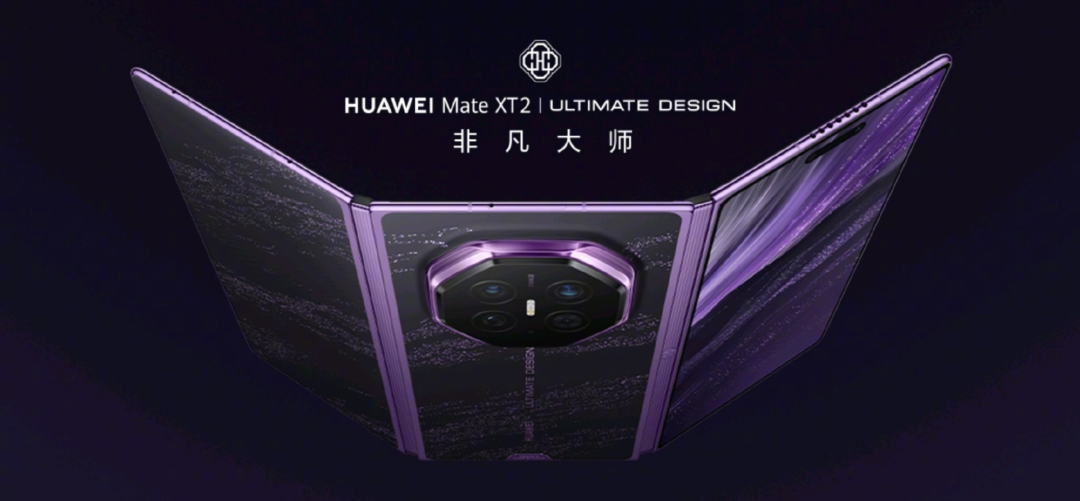
Huawei's triple-fold Mate XT 2, priced starting at 19,999 yuan, defends the ultra-premium price point. Its scarcity and brand momentum create a premium, with the primary goal not necessarily to expand the foldable phone market but to maintain Huawei's pricing power in China's ultra-premium smartphone segment.
Xiaomi's 18 Fold, priced starting at 10,999 yuan, is Xiaomi's first 10,000 yuan phone, balancing high-end branding with volume demand through price tiering. The 18 Fold accounts for only 0.8% of total shipments but boosts the overall average selling price (ASP) by 32 yuan. Its mere existence elevates the entire pricing structure. For Xiaomi, the strategic significance of foldable phones lies in establishing price benchmarks and providing a platform for self-developed chips and high-end branding narratives.
Behind the pricing strategies of these three companies lies a shared assessment: foldable phones are currently the only category in the smartphone industry capable of commanding high premiums with a competitive landscape yet to solidify. Whoever holds pricing power can define the price system in the high-end market.
2. Hinges: From Zero to One
A foldable phone is not simply two bar phones joined by a hinge. Compared to traditional bar phones, foldable phones incorporate three additional core components: hinges, precision structural parts, and UTG (Ultra-Thin Glass).
Among these, the hinge is an entirely new component absent in bar phones and represents the most significant industrial innovation in foldable phones.
A single hinge set contains 50 to 100 microscopic functional parts, with MIM (Metal Injection Molding) components accounting for 60% to 70%. Key dimensional tolerances range from ±0.01 to ±0.03 millimeters. The iPhone Duo's hinge comprises over 100 components, featuring a 3D-printed titanium hinge cover with titanium plates and ceramic fiber inserts to enhance rigidity.
Why are hinges considered the most significant industrial growth area in foldable phones?
Bar phones lack hinges, while foldable phones introduce an entirely new core mechanical system, creating an industry from scratch. In 2025, the global consumer electronics foldable hinge market was valued at approximately $500 million, with projections to reach $1.3 billion by 2032, representing a compound annual growth rate of around 15%.
Unlike traditional smartphone components, which have multiple suppliers, the hinge assembly market is highly concentrated. First-tier suppliers Amphenol and Nippon Seiko virtually monopolize Apple's orders.
This highly concentrated supply landscape, with no short-term alternative suppliers, makes hinges one of the most bargaining-powerful segments in the foldable phone supply chain.
The iPhone Duo's hinge supply chain exhibits a clear hierarchical structure: first-tier assembly is dominated by Amphenol and Nippon Seiko, while domestic companies primarily participate as second-tier component suppliers.
This is a classic example of first-tier assemblers securing orders, setting standards, and allocating part numbers, while second-tier suppliers manufacture according to specifications. Although Chinese companies are deeply integrated into Apple's foldable phone supply chain, they are involved in the most labor-intensive segments rather than the most profitable ones.
For example, LY Technology is heavily involved in precision structural parts such as hinge stamping and carbon fiber reinforcement brackets; Jingyan Technology focuses on MIM precision component processing; Yi'an Technology supplies liquid metal hinge shafts; and Shanghai Futai, a subsidiary of Dongmu Co., Ltd., is also a key supplier in this segment, with its MIM technology widely applied in smartphone internal precision structural parts.
Notably, Amphenol, the original first-tier supplier, was replaced by Nippon Seiko as the primary supplier due to low yield rates. Currently, Nippon Seiko only screens golden sample hinges that meet Apple's standards for iPhone Duo supply, with production remaining unstable.
In other words, the hinge supply bottleneck lies not in capacity but in yield rates, which are constricting the entire industry.
Yield economics is the most critical factor in understanding profit distribution in the hinge industry and represents the most extreme case in the foldable phone supply chain.

Source: Apple
During the mass production verification phase, Apple's liquid metal hinge yield rates ranged from 30% to 65%, later improving to 60% to 70%, still falling short of the 85% target. To obtain 8.5 million qualified components, producing approximately 13.08 million units at a 65% yield rate is required, compared to just 10 million units at an 85% yield rate—a difference of about 3.08 million units.
The material properties of liquid metal pose significant challenges. Zirconium-based liquid metal is approximately 2.5 times stronger than titanium alloy, with a tensile strength of 1,500 to 2,000 megapascals and enduring over 300,000 opening and closing cycles.
However, its processing difficulty is immense, with some pilot batches achieving yield rates below 50%. Despite multiple rounds of optimization, yield rates have only improved to 60% to 70%, consistently failing to meet Apple's 85% mass production threshold.
This is the harsh reality of yield economics: it's not merely about optimizing laboratory parameters but directly determines where profits accumulate in the supply chain.
The 3.08 million unit shortfall entails additional raw material procurement, processing hours, inspection costs, and scrap losses, with the resulting cost differential ultimately deducted from suppliers' profits.
3. Do BOE and Others Still Have a Chance?
Delving deeper reveals that the true battleground for foldable phones lies not in hinges but in material stacking.
Apple's product launch diverted global attention to the term "crease-free," as most consumers believe a foldable phone without visible creases signifies maturity.
A foldable phone screen may appear to be a bendable plastic sheet, but it consists of over a dozen stacked material layers: a surface protective layer, flexible glass, OLED display layer, adhesive layer, support plate, and titanium baseplate.
When folded, each layer bends to a different degree. A neutral layer exists that neither stretches nor compresses, serving as the safety line during bending.
Source: Xiaohongshu
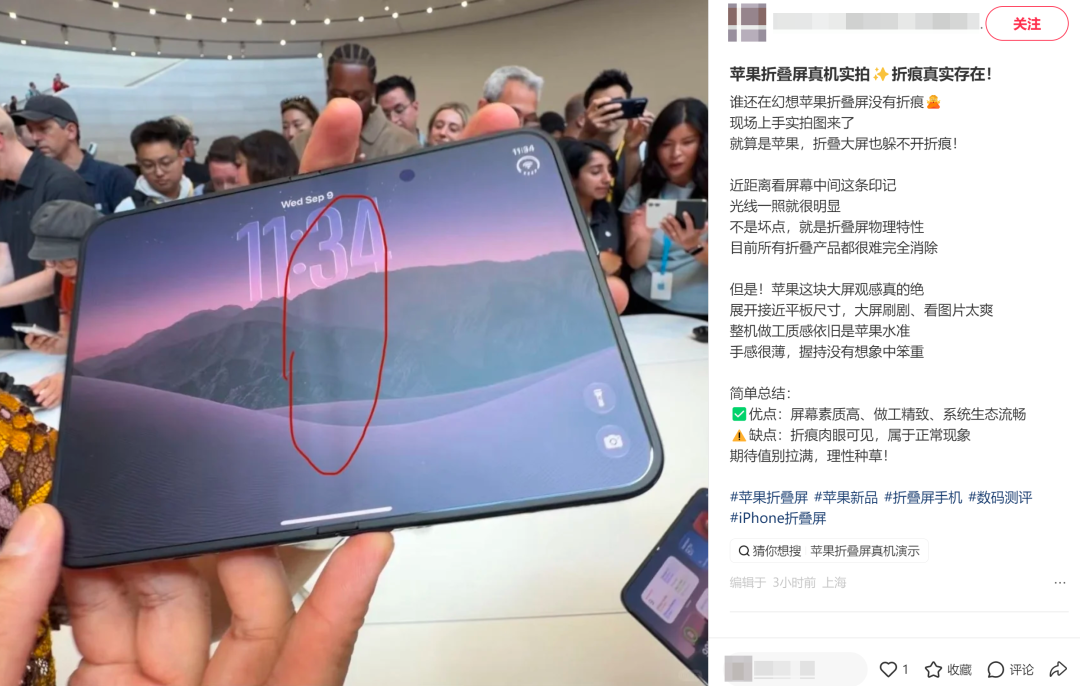
If this safety line deviates from its critical position, certain layers may be overstretched, leading to microcracks or even permanent deformation over time—the source of creases.
The essence of creases lies not in inadequate hinges but in the neutral layer within the panel's material stack deviating from its critical structural position.
The iPhone Duo employs a ten-layer ultra-thin material OLED display stack architecture, combined with nano-texture surface treatment, to minimize crease visibility. However, physical creases still exist but are less noticeable. Admittedly, Apple's solution exemplifies engineering compromise.
This screen represents the most expensive component in a foldable phone. Currently, Apple's foldable OLED panels are exclusively supplied by Samsung under a three-year agreement.
Samsung aims to ship 8 million units of its 7.8-inch foldable OLED panels for Apple in 2026, with the target surging to 15 million units in 2027, representing an 87.5% year-on-year increase.
What about Chinese panel manufacturers? Does BOE still have a chance?
BOE is China's largest semiconductor display panel manufacturer and the world's second-largest supplier of AMOLED smartphone panels, trailing only Samsung Display. In the LCD segment, BOE consistently ranks first globally in shipments, serving as a core screen supplier for domestic brands like Huawei and a primary OLED screen supplier for Apple's iPhone 18 series.
However, foldable panels are a different story. BOE's situation must be viewed from two perspectives. Data shows that BOE's foldable panel shipments declined by 41% year-on-year in the second quarter, with its market share dropping approximately 9 percentage points to 22%, while Samsung Display's share increased by 13.5 percentage points to 66%.
The decline stems from Apple's entry rapidly expanding the overall market, with most incremental growth flowing to Samsung, unrelated to competitiveness.
BOE's exclusion from Apple's foldable phone supply chain is primarily due to its yield rates failing to meet Apple's certification thresholds. Apple mandates a minimum panel yield rate of 70%, with Samsung ultimately achieving over 80% in mass production, while BOE's yield rates and quality control stability have yet to reach Apple's entry requirements.
Of course, BOE remains strong in non-Apple supply chains. In the first quarter of 2026, BOE maintained its lead in global foldable smartphone panel shipments with approximately 45% market share, primarily supported by Huawei's demand.
Although the growth rate of overall shipments from Chinese panel manufacturers is diluted by the incremental effect brought by Apple's entry, their foundation in the Android camp (Android camp) is far deeper than the outside world imagines.
More importantly, foldable screens are changing the competitive logic of the panel industry.
The first change is in product structure. Counterpoint data shows that in 2026, shipments of large foldable panels increased by 107% year-on-year, while shipments of clamshell panels are expected to decline by 59% year-on-year.
This means that book-style large foldables have become the absolute mainstream, and panel manufacturers need to concentrate their production capacity and technical resources in this direction.
The second change is an increase in value. The ASP of foldable OLED panels is significantly higher than that of OLED panels for traditional bar-style phones. In 2026, the price gap between foldable screens and ordinary bar-style phones widened from 2.55 times to 2.78 times.
For panel manufacturers, foldable screens represent a high-value product line. Securing more foldable screen orders can better improve product structure and boost gross profit margins.
The third change is the reshaping of the competitive landscape. After the expiration of Samsung and Apple's three-year exclusive supply agreement, whether Apple will open its doors to Chinese panel manufacturers depends on whether Chinese panel manufacturers can match Samsung in high-end yield rates and consistency. BOE has significantly improved the yield rate of its UTG production lines below 18 microns.
4. Conclusion
The next phase of competition in foldable screens is not just about being thinner, lighter, and having fewer creases, but about who can occupy indispensable nodes in areas such as hinges, panels, and UTG.
What Apple is waiting for is not just supply chain capacity, but capacity across different segments that can simultaneously become qualified and deliverable.
This standard is becoming the new passing grade for the entire industry chain.
Cover source: Black Myth: Wukong
Header image source: Apple
Disclaimer: The content of this article is for reference only and does not constitute investment advice. Investors act at their own risk.
Copyright of Zhixie Island. Reproduction is prohibited without authorization.
-
[Data Microscope] 100 Million Foldable Phones Split the Smartphone Market in Half
-
Every "Hello" to AI Comes with a Price Tag
-
![]()
Why Does a More Mature End-to-End Autonomous Driving System Require More Error-Prone Data?
-
![]()
Profit, Yield, and Bargaining Power in the Foldable Screen Industry Chain Restructured After Apple's Entry with iPhone Duo
-
Tianlong-3 Yao-1 Mission Update: Insights from the 189.5-Second Flight
-
The Untold Undercurrent of CIFTIS: Chinese Tech Goes Global, Shifting from Quick Profits to Sustainable Value
-
![]()
Confirmed! Apple CEO Cook Admits to ‘Drawing Inspiration’ from Huawei; Luo Yonghao Offers Direct Criticism
-
![]()
Zhang Yiming’s Global Empire Surges: TikTok Achieves Scalable Profitability Across Key Markets!