“Double 11” at Eighteen: From Bustle to Blandness
 11/20 2026
 430
Produced by Radar Finance | Text by Zhou Hui | Edited by Shen Hai
“It suddenly dawned on me that today is actually Double 11.” On this year’s Double 11, a veteran media professional lamented in a WeChat Moments post.
For quite a long time, “Double 11” was known as Singles’ Day, a celebration circulating among college students. On November 11, 2009, Taobao Mall partnered with 27 stores and, for the first time under the banner of “Singles’ Day,” launched a “50% off” campaign. The event generated over 50 million yuan in transaction volume.
Since then, the concept of “Singles’ Day” gradually faded, and “Double 11” became synonymous with the shopping festival.
Since 2010, the transaction volume of Taobao Mall (Tmall) on Double 11 has continued to climb. On Double 11 in 2021, Tmall’s total transaction volume reached 540.3 billion yuan.
In 2022, Double 11 passed its 14th year. Unlike before, neither “old players” such as Tmall and JD.com nor e-commerce “newcomers” such as Douyin and Kuaishou published GMV (gross merchandise volume) data. Tmall said that “the transaction scale was flat compared with last year” (Tmall’s total transaction volume in 2021 was 540.3 billion yuan), while JD.com said it “set another new record” (JD.com’s cumulative order amount in 2021 exceeded 349.1 billion yuan).
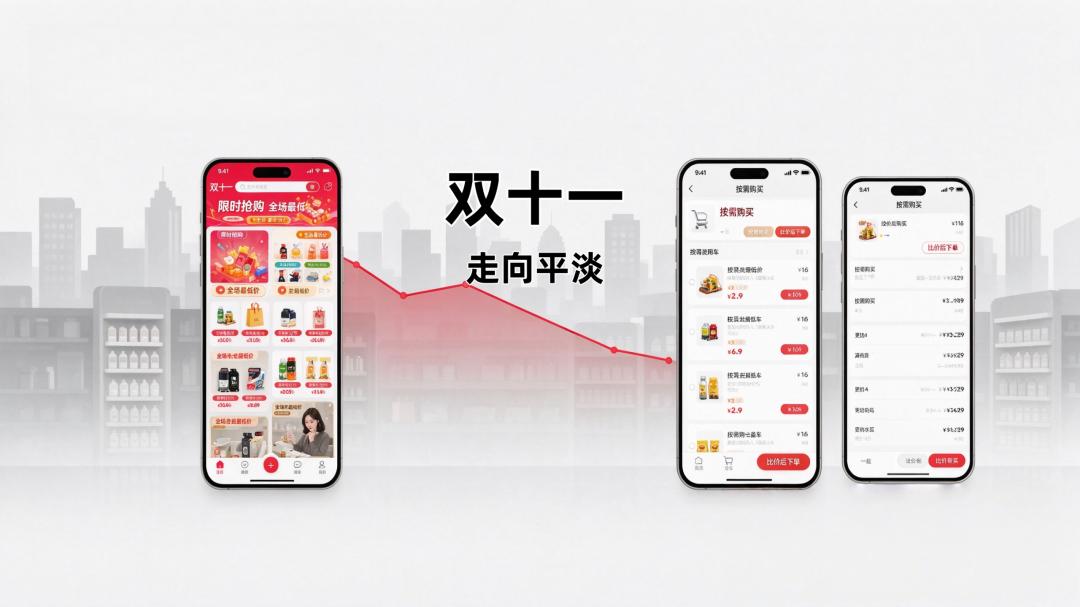
At the same time, major e-commerce platforms spread discounts across multiple nodes throughout the year. Coupled with shifts in users’ consumption habits, Double 11 became increasingly bland in the following years, and this year’s Double 11 could be described as “silent.”
How did it come to this?
Glory
As for the origin of Singles’ Day, one account holds that in 1993, during a late-night dormitory chat in a male dorm at Nanjing University, students seized on the four “1”s in “November 11” as a metaphor for being single and coined the concept of “Singles’ Day.” The idea spread through campus BBS, spawning subcultural rituals such as issuing “singles certificates” and dormitory socials, and by around 2000 a fixed-date awareness had taken shape.
“When I was in college, Singles’ Day was really lively. In my sophomore year, all my roommates were single. On Double 11, everyone went to a small restaurant at the school gate for a meal and then went crazy at KTV all night,” recalled Mr. Peng, who works in Beijing. With the rise of the Double 11 shopping festival, “Singles’ Day” has become increasingly diluted.
Materials show that the Double 11 shopping festival began in 2009 with the first promotional event held by Taobao Mall (renamed “Tmall” in 2012). At the time, Taobao Mall decided to plan a shopping festival belonging to online shoppers themselves. Taobao Mall’s purpose was simple: October had Golden Week, December had Christmas, and November was the off-season for sales. Taobao Mall hoped to plan an event to gain something during November, the traditional off-season for commercial sales.
On November 11, 2009, Taobao Mall partnered with 27 stores and, for the first time under the name of “Singles’ Day,” launched a “50% off promotion” campaign. The transaction volume of this event exceeded 50 million yuan, far exceeding expectations.
Taobao Mall got a taste of success, and November 11 became a large-scale promotion day.
In 2010, Taobao Mall prepared carefully, with 711 brands participating and sales reaching 936 million yuan.
In 2011, 2,200 brands participated in Taobao Mall’s Double 11 promotion, with sales reaching 3.36 billion yuan.
On January 11, 2012, Taobao Mall held a strategic press conference in Beijing and announced the change of its Chinese brand “Taobao Mall” to “Tmall.”
Regarding the reason for the rename, then Taobao Mall President Zhang Yong said that one reason for choosing the name was that “Tmall” sounds close to tmall, and more importantly, with the development of B2C, consumers needed a new synonym tied to Alibaba’s large platform. Cats are sexy and tasteful. Tmall online shopping represents fashion, sexiness, trendiness, and quality, which is exactly the city of quality that Tmall online shopping aims to build with all its strength.
In 2012, Tmall’s Double 11 sales hit a new high, reaching 13.2 billion yuan, with 10,000 participating brands.
From 2013 to 2021, Tmall’s Double 11 sales continued to grow. Among them, Tmall’s total transaction volume on Double 11 in 2021 reached 540.3 billion yuan.
Controversy
Along with sales growth, Double 11 has been accompanied by endless controversy.
Since 2012, many consumers have complained that brands falsely marked prices during Double 11. On November 22, 2017, the China Consumers Association published a follow-up survey experience report on online shopping product prices during that year’s Double 11. The report confirmed that 16 e-commerce platforms, including Tmall, Taobao, and Suning.com, all engaged in practices such as fabricating original prices, raising prices before lowering them, and even raising prices instead of lowering them during the Double 11 promotion period.
Points on which consumer complaints were relatively concentrated also included non-refundable deposits, spot goods being cheaper after paying a deposit, final payment price increases, and strict price protection thresholds.
In addition, the discount rules set by platforms were once overly complicated (“Double 11 math problems”): deposit expansion, cross-store full reductions, category coupons, red envelopes, and membership discounts stacked layer upon layer, with conflicting rules that could not be automatically combined and requiring order padding, giving rise to “buying things you don’t need just to meet full-reduction thresholds.”
Thousand-person pricing and big-data price discrimination were also among the more frequently complained-about issues.
Over the past year or so, a relatively notable Double 11 incident was Tmall’s “limited-time subsidy” event.
On the evening of October 21, 2025, just one day after Tmall’s Double 11 final payment channel opened, the Taobao platform suddenly terminated two core discount activities: “limited-time subsidies” and Taobao Coin additional deductions in influencer livestream rooms. As a result, the prices of a large number of products whose final payments had not yet been paid instantly rose by dozens or even hundreds of yuan.
According to a report by The Paper, at 11 p.m. on October 20 of that year, the homepage of Winona’s official flagship store suddenly popped up limited-time subsidies of 59 yuan, 68 yuan, and other amounts, covering products of the same type as those in Li Jiaqi’s livestream room. Netizens found that the in-stock price after stacking the subsidy was actually far lower than the presale final price in the livestream room. However, the subsidy was distributed in a limited-time, limited-quantity manner, so consumers who did not grab the coupons could not enjoy the price discount.
In addition, the sudden termination of the Taobao Coin additional deduction function further triggered dissatisfaction among netizens. Shanghai consumer Ms. Chen (pseudonym) told The Paper that the “SkinCeuticals” anti-wrinkle serum she selected in Hu Ke’s livestream room, after stacking a 10% off host coupon, Taobao Coins, and other discounts, had an estimated final price of 619 yuan. But when she went to settle payment, the system prompted that the Taobao Coin activity had ended, and the final price rose back to 644 yuan. At the same time, other netizens also posted screenshots saying they had encountered similar situations.
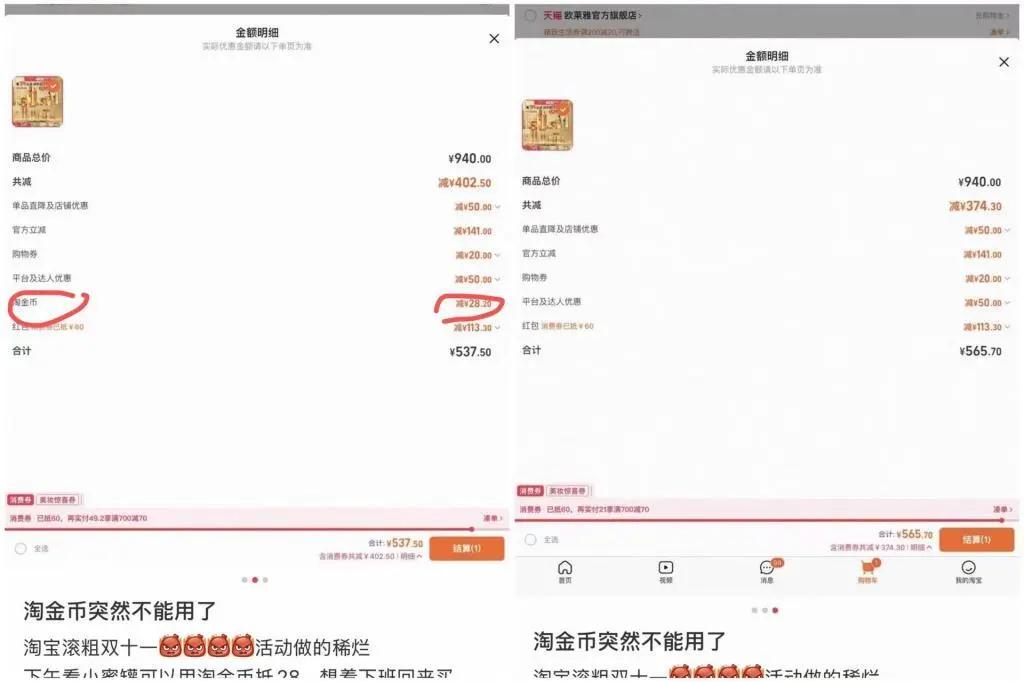
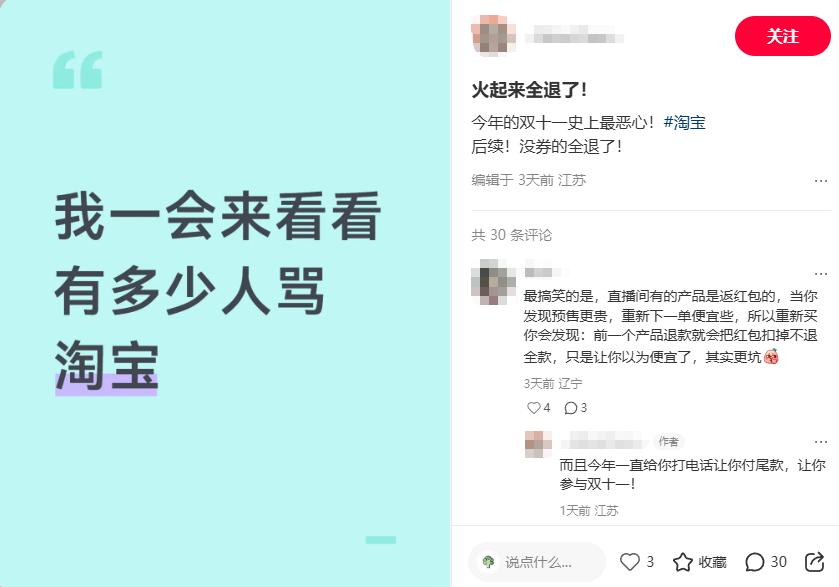
Taobao platform’s “little tricks” quickly triggered a chain reaction. Top influencer Li Jiaqi’s livestream room bore the brunt, with concentrated returns occurring, and the topic “Double 11 wasn’t cheap” quickly surged onto trending searches. On social platforms, a large number of consumers also posted complaints such as “I’ll come back later to see how many people are cursing Taobao; if it gets big, I’ll return everything” and “I’m angry, why won’t you let me use Taobao Coins?”
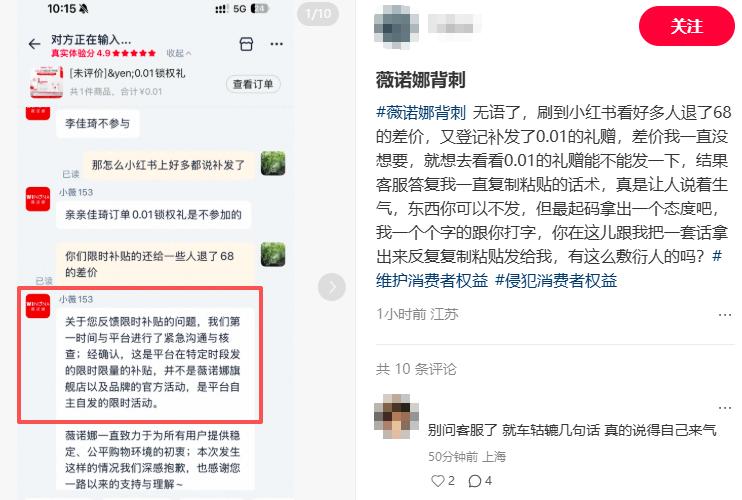
Consumers who failed to grab the Winona subsidy during the subsidy suspension incident at one point demanded price differences from the brand and Li Jiaqi’s livestream room. But store customer service responded that the limited-time, limited-quantity coupons were issued by the platform during a specific time period, were not an official Winona brand activity, and that price differences could not be refunded; only refunds and returns were possible.
Regarding the Taobao Coin invalidation issue, SkinCeuticals brand customer service first said that “influencer livestream rooms and the Taobao Coin channel are either-or and cannot be used at the same time.” After consumers presented screenshots of netizens successfully stacking payments, the service changed its tune and said that “there are many activity formats, and the checkout interface shall prevail.” The contradictory statements triggered even greater dissatisfaction among netizens.
The division of rights and responsibilities between livestream hosts and the platform was also obvious. Facing surging return demands, Li Jiaqi clearly stated in the livestream that the issuance and termination of subsidies were both independent actions of the platform, that he had no authority to intervene, and that he could not provide consumers with price-difference refunds, even saying bluntly that “Tmall doesn’t even reply to my messages.”
At the same time, he also denied online rumors such as “8 billion yuan in returns in one night” and “losing 2 billion yuan on Double 11.” Li Jiaqi responded: “Fake, fake, don’t listen. The real ones are those people who smear me. Can you change your method? It’s the same every year, already 10 years.”
It is worth noting that the platform’s vague response to the incident further intensified the conflict. Regarding the losses caused to consumers by the subsidy suspension, Taobao officially responded that “perhaps the limited-time Taobao Coin discount period had passed,” that “limited-time, limited-quantity subsidies do not support price protection refunds of differences,” and that “discounts can be used to purchase other goods,” but never explained the specific reason for terminating the discounts.
Radar Finance noted that some netizens pointed out that Tmall and Taobao had not previously publicly disclosed the random subsidy discount policy, nor had the product pages in Li Jiaqi’s livestream room separately explained the relevant rules, and that the platform might be suspected of using information asymmetry to evade responsibility.
Regarding this Taobao subsidy suspension incident, Cao Lei, director of the E-commerce Research Center at 100EC.CN, told the media that there may be two reasons behind it: first, after the presale ends, e-commerce platforms may issue limited-time, limited-quantity large subsidies or coupons for some products, and these subsidies are usually not within the scope of price protection; second, brand price management. The platform dynamically adjusts prices according to factors such as inventory and time, causing limited-time subsidies to differ at different time points.
Involution
Another major problem brought by fierce competition among e-commerce platforms is involution.
For a long time, low-price strategies have been regarded by most platforms as the main means of competing for market share. But as competition intensifies, the platform economy is gradually becoming a severely affected area of “industry involution.”
Cao Lei pointed out that a low-price strategy does not necessarily equal low quality. For example, merchants clearing inventory at a loss, and subsidies from platforms and the government, can all allow consumers to buy qualified products at lower prices. But in fierce market competition, merchants have to try their utmost to cut prices, even at the cost of sacrificing quality, to attract consumers.
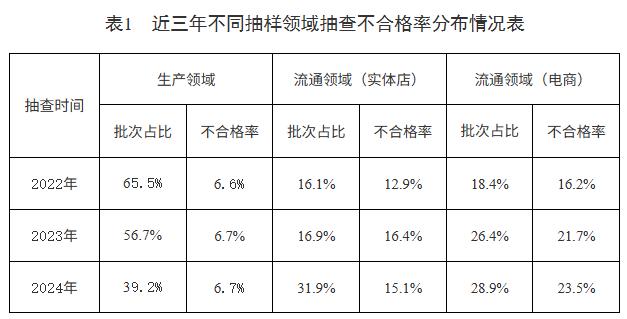
In 2024, the State Administration for Market Regulation’s bulletin on national supervision and spot checks of product quality showed that among 7,297 batches spot-checked in the circulation field (e-commerce) (accounting for 28.9% of the total number of spot-checked product batches), the failure rate was as high as 23.5%, up 1.8 percentage points from the previous year, far higher than the failure rates in the production field and physical stores.
The 2025 instant retail war was a concentrated manifestation of involution.
In February of that year, JD.com forcefully entered the food delivery industry. JD.com’s goal was never just food delivery, but to use dining, the highest-frequency entry point, to leverage the entire instant retail track.
JD.com food delivery showed strong data explosiveness: daily orders exceeded 10 million in April 2025, and the peak surged to 25 million orders in June.
At this time, it happened to be not long after Jiang Fan returned to Taotian Group, and he smelled danger and opportunity.
Tianyancha shows that Jiang Fan holds a bachelor’s degree in computer science and technology from Fudan University. He joined Alibaba Group in August 2013 and was fully responsible for Taobao’s wireless business.
In 2017, Jiang Fan became president of Taobao, and in 2019 he also served as president of Tmall.
On April 27, 2020, due to the “Jiang Fan and Zhang Dayi incident,” he was stripped of his Alibaba partner status, and his internal rank was downgraded from M7 (senior vice president of the group) to M6 (vice president of the group).
In 2022, Jiang Fan was transferred to head the overseas digital commerce segment, with remarkable achievements.
In November 2024, Jiang Fan became CEO of the newly established Alibaba E-commerce Business Group, and since then has taken charge of Taobao and Tmall again.
In order to seize the instant retail market, on April 30, 2025, Taobao under Jiang Fan’s leadership announced its entry into the food delivery war, upgrading “hourly delivery” to “flash purchase,” which rolled out nationwide on May 6.
On the evening of July 5, two major platforms—Meituan and Taobao Flash Purchase—began distributing large numbers of food delivery red envelope coupons. On July 8, JD.com Food Delivery announced the official launch of its "Double Hundred Plan." On July 10, "Meituan free orders" topped the Weibo trending list, sparking extensive discussion among netizens. After that, food delivery platforms continued to ramp up their efforts, raising discount levels one after another.
However, while the "food delivery war" brought massive traffic and orders, it also led to some food resources being discarded. This competitive approach at the cost of profits also greatly worried merchants.
On July 18, the State Administration for Market Regulation summoned three platforms—Ele.me, Meituan, and JD.com—and required them to compete rationally.
On August 1, 2025, Ele.me, Meituan, and Taobao Flash Purchase jointly issued statements calling for a boycott of "vicious competition."
Blandness
After the instant retail war subsided, major platforms entered a quiet period.
This year's Double 11, e-commerce platforms collectively did away with the complicated "arithmetic problems." Tmall replaced the years-long "cross-store full reduction" with official direct reductions; JD.com canceled deposit presales, shipping all items in stock directly and providing 30-day price protection; Douyin mainly promoted "buy in-stock directly" with direct reductions plus consumption coupons.
In addition, major platforms no longer held large galas, no longer bombarded users with text messages, and no longer released GMV battle reports, greatly reducing marketing noise.
On the merchant side, because traffic costs, influencer commissions, and return costs remain high, many merchants are trapped in a dilemma: "no traffic if you don't participate, no profit if you do." The marginal returns of low-price involution are getting lower and lower, and many brands choose to hold prices and cut investment in major promotions, unwilling to sell at a loss just to boost sales.
On the consumer side, many users found that low prices are no longer scarce: livestream rooms, tens-of-billions subsidies, the 618 major promotion, and everyday flash purchases spread discounts throughout the year, so there is no need to wait specifically for Double 11.
An iResearch survey shows that nearly 70% of consumers believe that "if Double 11 is just discounts, it is not attractive enough." More than 60% of online shopping users are willing to pay for hobbies and emotional value, and about 40% will actively study product parameters and ingredients. The yardstick for consumption decisions has changed from "is it cheap" to "is it worth it."
With various factors combined, this year's Double 11 was very bland.
Baidu Index shows that this year's Double 11 search popularity shrank by more than 80% from its peak.
In the view of some observers, the Double 11 shopping festival reaching its 18th year and fading into blandness essentially means bidding farewell to the carnival of incremental growth and entering a stage of deep cultivation of existing stock. "Silence" is not a collapse of consumption; it is the normalization of promotions diluting its scarcity. When consumption expectations are relatively cautious, residents give priority to allocating budgets to rigid-demand and service expenditures, and impulsive demand for non-physical and non-essential goods contracts. This is a signal that resident consumption is maturing.
-
![]()
Two Years into End-to-End: Has the Gap Between Smart-Driving Suppliers Widened?
-
Fangchengbao Titan 9 Launches at 279,900 Yuan: A New Luxury-Tech Six-Seat Flagship Arrives
-
![]()
Rocket Companies All Want to Build Their Own Engines—So How Do Jiuzhou Cloud Arrow and Others Make Money?
-
Tencent Chooses to Break Out from Within
-
![]()
Apple Support Community Shuts Down After 28 Years: Once the World's Largest Apple Fan Community
-
![]()
Lei Jun's APEC Nerves and Xiaomi Auto's Overseas Ambitions: A Closer Look
-
![]()
“Double 11” at Eighteen: From Bustle to Blandness
-
Alibaba Burns Through 79.1 Billion Yuan in Cash Flow in Half a Year, Then Counters with an HK$80 Billion Placement to Replenish Capital