Lei Jun's APEC Nerves and Xiaomi Auto's Overseas Ambitions: A Closer Look
 11/20 2026
 428
Lei Jun announced that Xiaomi Auto will "go overseas" next year and will pursue deep cooperation with local supply chains. He had previously stated that the company's first overseas stop in 2027 would be Germany.
According to China Newsweek, the 2026 APEC CEO Summit was held on November 17 at the Qianhai International Convention Center in Shenzhen under the theme "Jointly Promoting Prosperity, Winning the Future Together." More than 2,000 political and business representatives from 21 APEC economies and 13 non-regional economies—including the United Kingdom, France, and Germany—attended, among them 115 Fortune Global 500 companies.
Lei Jun, founder, chairman, and CEO of Xiaomi Group, took the stage to speak. That day, two topics—"Xiaomi responds to Lei Jun being nervous during APEC speech" and "Lei Jun hands out business cards one by one at APEC"—surged to the top of trending searches.
After the summit, a netizen commented under Lei Jun's Weibo post: "I watched CEO Lei's speech the whole time. He seemed to have a slight touch of 'social anxiety.'" The Xiaomi service account replied: "On such a big international occasion, it's completely normal to be nervous." That lightly worded explanation sent "Lei Jun nervous during APEC speech" to trending searches.
For Lei Jun, routine Xiaomi launch events are familiar home turf, with Mi Fans, media, and partners in the audience. APEC, by contrast, is the highest-level business gathering in the Asia-Pacific, and the audience consists of peers operating under different regulatory systems.
The other half of the nervousness may have stemmed from the content of the speech itself. That day, Lei Jun did not talk about new phones or vehicle delivery numbers, but about AI, which has yet to achieve commercialization. He pointed out that over the past four years, large model technology has advanced rapidly, but the industry faces problems such as huge investment, limited application scenarios, and an incomplete commercial loop; "companies that can truly achieve a commercial loop and make money in this round of AI cycles are also relatively few." Yet he also judged that "AI is a brand-new era," and that in the next three to four years, disruptive products are expected to emerge in areas such as AI phones and AI cars.
In Lei Jun's view, embodied intelligence is an important direction for AI to enter the physical world. According to him, Xiaomi has been working on robots for about six years, and recently humanoid robots have been "interning" at the Xiaomi Auto factory, able to complete 8 hours of work with two autonomous recharges in between. "I believe that in the future, embodied intelligent robots will definitely be a huge industrial opportunity, and their imagination should exceed that of the automotive industry," Lei Jun said.
In his speech, Lei Jun also mentioned that Xiaomi's "Human x Car x Home" AIoT platform has connected 1.16 billion devices. As of June 30, 2026, the number of IoT devices connected to Xiaomi's AIoT platform (excluding phones and tablets) was 1.1608 billion, up 17.4% year on year. He anchored cooperation in trust: "Our cars and phones require thousands or tens of thousands of components, and they are the result of global supply chains working together." According to APEC in Charts 2025, manufactured goods in the region account for more than 70% of APEC's total imports and exports, and APEC economies account for 61% of global GDP.
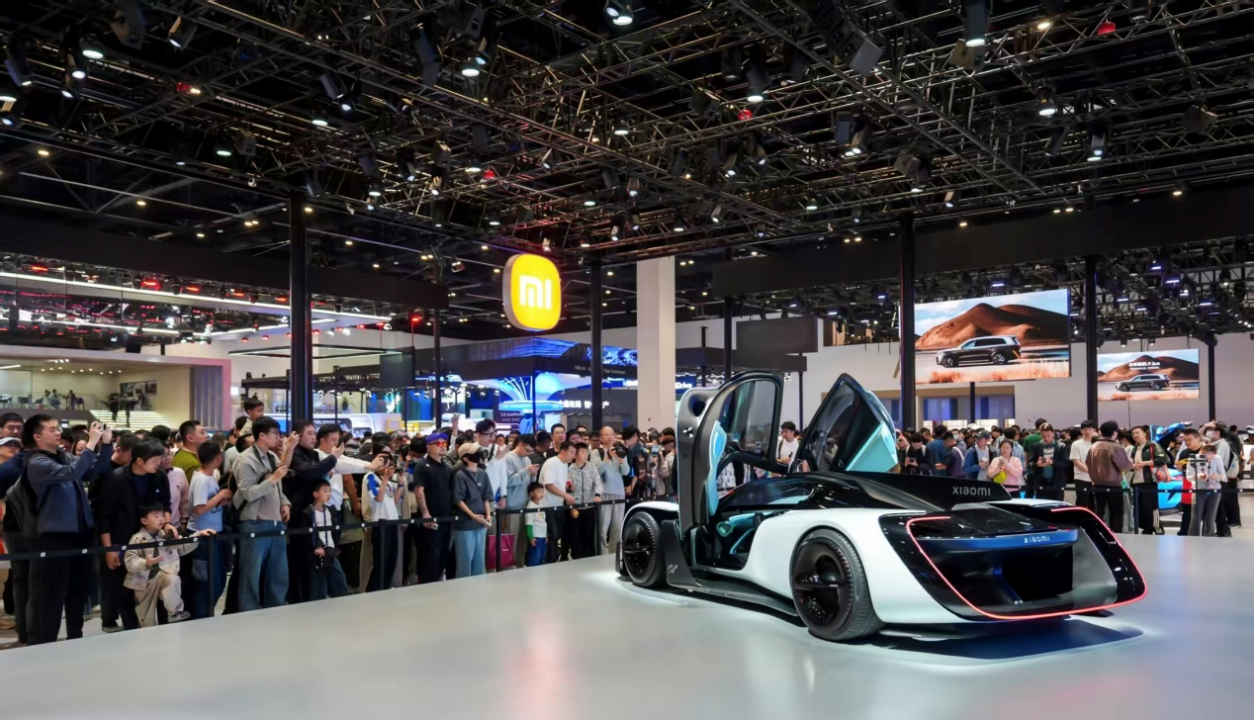
Image source: China Automotive News
More closely watched than the "nervousness" was Lei Jun's statement on Xiaomi Auto going overseas.
On November 18, in an exclusive interview with People's Daily, Lei Jun pointed out that Xiaomi Auto will officially go overseas next year. "The auto industry is a pillar industry in many countries. Cooperating with local supply chains can enable products to better serve local consumers, so Xiaomi has always maintained a very open mindset and is deepening cooperation with local partners."
Xiaomi Auto's globalization path already has a timetable.
In July 2025, Lei Jun revealed that Xiaomi Auto's overseas layout would prioritize Europe, Southeast Asia, and the Middle East, and set 2027 as the key year for its first official landing in overseas markets.
In March 2025, Xiaomi established a European R&D center in Munich, Germany, positioned as a design capability center for high-performance and luxury vehicles, with a team bringing together international talent from more than 20 countries and regions.
To advance its overseas expansion, Xiaomi Auto has established a dedicated automotive international business department and appointed Yu Liguo, vice president of the automotive department, as general manager, reporting directly to both Group CEO and Automotive Department President Lei Jun and Group President Lu Weibing to ensure decision-making efficiency. At the Beijing Auto Show in April this year, Lei Jun publicly presented the construction results of the European R&D center to a global audience for the first time and officially announced that Xiaomi Auto would enter the international market in 2027, choosing Europe—the market with the highest threshold and strictest standards—as its first stop.
Xiaomi Group's financial report for the second quarter of 2026 showed that the group's total revenue in the quarter was 108.9 billion yuan, with adjusted net profit of 6.2 billion yuan; revenue from innovative businesses such as smart electric vehicles and AI was 24.9 billion yuan, up 17.1% year on year, of which smart electric vehicle revenue was 23.9 billion yuan. In the second quarter, Xiaomi delivered 104,199 new vehicles, up 28.2% year on year; as of August 17, cumulative deliveries of the SU7 series exceeded 500,000 units.
However, the gross margin of Xiaomi's smart electric vehicles fell from 26.4% in the same period last year to 19.2%, with an operating loss of 2.6 billion yuan. The average selling price of vehicles fell 9.6% year on year to about 229,300 yuan, mainly affected by a decline in the delivery share of the SU7 Ultra, rising prices of core components, and increased AI R&D investment.
Going overseas is also not smooth sailing.
Retail sales in China's passenger vehicle market fell 22% year on year in the second quarter, with intensifying industry competition; since October 2024, the EU has imposed countervailing duties of up to 35% on Chinese-made pure electric vehicles on top of the original 10% ordinary import tariff; the European market has strict regulations on emissions, information security, and battery recycling, and with the implementation of new policies such as the New Battery Law, higher requirements are placed on automakers' proactive R&D and compliance adaptation capabilities. Whether Xiaomi Auto can replicate its domestic delivery efficiency and brand momentum overseas still needs time to verify.
From the "social anxiety" trending topic to the official announcement of going overseas, what Lei Jun presented at this APEC summit were two sides of a Chinese automaker turning toward the global market: on one side, the founder's cautious wording before an international audience; on the other, an already arranged overseas timetable.
As growth in the domestic auto market slows and price wars and cost pressures coexist, bringing R&D centers, sales networks, and cooperation with local supply chains overseas is becoming a common choice for Chinese automakers. Xiaomi Auto's European answer sheet has only just begun to be written.
-
![]()
Two Years into End-to-End: Has the Gap Between Smart-Driving Suppliers Widened?
-
Fangchengbao Titan 9 Launches at 279,900 Yuan: A New Luxury-Tech Six-Seat Flagship Arrives
-
![]()
Rocket Companies All Want to Build Their Own Engines—So How Do Jiuzhou Cloud Arrow and Others Make Money?
-
Tencent Chooses to Break Out from Within
-
![]()
Apple Support Community Shuts Down After 28 Years: Once the World's Largest Apple Fan Community
-
![]()
Lei Jun's APEC Nerves and Xiaomi Auto's Overseas Ambitions: A Closer Look
-
![]()
“Double 11” at Eighteen: From Bustle to Blandness
-
Alibaba Burns Through 79.1 Billion Yuan in Cash Flow in Half a Year, Then Counters with an HK$80 Billion Placement to Replenish Capital