Rocket Companies All Want to Build Their Own Engines—So How Do Jiuzhou Cloud Arrow and Others Make Money?
 11/20 2026
 493
A rocket's maiden flight was rated a "qualified success," yet the company that supplied its engines is now preparing to go public.
On December 23, 2025, the second stage of the Long March 12A reached orbit successfully, while first-stage recovery failed. Its first stage was powered by seven Longyun liquid oxygen methane engines from Jiuzhou Cloud Arrow. On November 5, 2026, this company—which does not build entire rockets and specializes in propulsion products—began IPO coaching, making it a rather unusual contender in China's commercial space listing race.
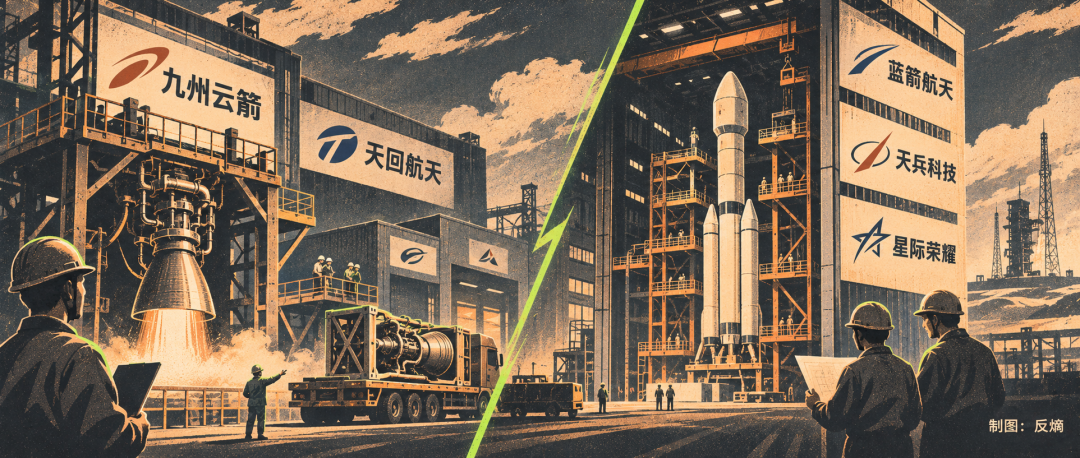
Beyond Jiuzhou Cloud Arrow, companies such as Yuhang Propulsion, Tianhui Aerospace, and Juqing Technology are also competing for commercial rocket propulsion orders. At the same time, leading whole-rocket companies such as LandSpace, Tianbing Technology, and iSpace insist on developing their propulsion systems in-house.
When your potential customers are also building engines, how do Jiuzhou Cloud Arrow and others make money?
01 The Cost of a Full Stack
In the commercial rocket industry, SpaceX has become almost synonymous with vertical integration.
From the Merlin engines on Falcon 9 to the Raptor engines aboard Starship, SpaceX has chosen to develop them all in-house. This allows it to tune rocket structures and flight control plans around propulsion performance and avoid the time losses that come with cross-company coordination.
For rocket manufacturers that need frequent testing, this organizational approach offers a strong efficiency advantage.
China's leading commercial rocket companies are adopting similar strategies. LandSpace's TQ series has accumulated flight experience on Zhuque-2 and Zhuque-3, and in August 2026 the second flight of Zhuque-3 also achieved a successful first-stage landing recovery. LandSpace is also advancing a 220-ton-class full-flow staged combustion cycle engine. Tianbing Technology is developing the Tianhuo engine around the Tianlong series, while iSpace is developing the Focus No. 2 for Hyperbola-3.
Engines affect a rocket's payload capacity, overall design, and recovery control. Reusability also requires them to handle complex operating conditions such as multiple ignitions and deep throttling. Mastering propulsion technology means whole-rocket manufacturers can set their own R&D pace more independently.
SpaceX's ability to sustain vertical integration over the long term also benefits from its continuously expanding launch scale. From design to flight, engines require repeated test firings and costly facility investment, and production must also ensure batch consistency. If a whole-rocket company builds only a small number of rockets each year, the fixed costs of self-developing engines may well exceed those of buying mature products. Even if it ultimately masters the technology, it may not be able to achieve a cost advantage.
The aviation industry went through similar choices. Boeing and Airbus have long purchased engines from specialized manufacturers such as GE Aerospace, Pratt & Whitney, and Rolls-Royce, forming a mature industrial division of labor and allowing propulsion R&D investment to be spread across more customers and aircraft models.
China's commercial space sector is still at a relatively early stage. Most rocket companies have not yet built stable, high-frequency launch demand, and there is a tension between self-funded propulsion development and actual production scale. For rocket manufacturers with limited R&D funds that hope to complete model verification as soon as possible, buying mature propulsion products may be more economical than developing from scratch.
That also leaves room for Jiuzhou Cloud Arrow and others.
02 The Ledger of Outsourcing
Jiuzhou Cloud Arrow's most significant flight verification came from the national team, which has a mature propulsion development system.
The Long March 12A was developed by the Eighth Academy of China Aerospace Science and Technology Corporation. Its first stage carried seven Longyun engines, while its second stage used the YF-209V developed by the Sixth Academy. The Eighth Academy's decision to use a private supplier for an important model shows that specialized procurement has practical value.
Before that, the Longyun engine had participated in the Eighth Academy's 10-kilometer-class vertical takeoff and landing test in 2024, as well as JianYuan Technology's sea-based flight recovery test in 2025. Although the Long March 12A failed to complete first-stage recovery, the orbital flight still gave the Longyun engine important practical application experience.
For whole-rocket companies like JianYuan, using external propulsion can reduce duplicate R&D and concentrate resources on the rocket body, overall design, and recovery tests. But to turn support for individual models into a stable business, Jiuzhou Cloud Arrow still has to face competition from other propulsion suppliers.
In June 2026, Yuhang Propulsion completed a full-system hot test of its 100-ton-class liquid oxygen methane engine, Canglong-5; Tianhui Aerospace's 85-ton-class liquid oxygen kerosene engine, Qiaolong-1, has completed a 200-second long-duration test and high-condition tests; Juqing Technology's liquid oxygen kerosene engine "Chi" also completed multiple long-duration hot tests in 2026. Companies with different technical routes are competing for customers, but moving from test firings to batch sales still requires verification through actual flights and stable delivery.
Independent private suppliers also face competition from the Sixth Academy of China Aerospace Science and Technology Corporation and its commercialization system. The YF-102 series liquid oxygen kerosene engines have already entered orbit on commercial rockets, and their mature development foundation and practical application experience make it difficult for independent private suppliers to win orders on test indicators alone.
Whether outsourcing pays off depends on whether rocket manufacturers can obtain stable propulsion at acceptable prices, delivery cycles, and technical risks. Passing tests is only the starting point for a product; customers' willingness to keep buying is the key to commercialization.
03 Who Is Paying
Independent engine companies appear to have a large potential market.
A medium-to-large liquid rocket often uses multiple engines. If domestic commercial launch frequency grows substantially in the future, that would seem to imply a huge procurement market. But reusable technology is changing the demand structure for engines.
Traditional expendable rockets discard their engines along with the rocket body after launch. Reusable rockets, by contrast, aim to have the same set of engines fly multiple missions. As launch frequency grows, operators may need to increase the number of rockets in service, but more engine reuse will also reduce the number of new engines needed to complete the same launch tasks. The future market size for suppliers will increasingly depend on demand for new rocket manufacturing and the actual number of engine reuses.
Jiuzhou Cloud Arrow once proposed a production capacity plan of 150 to 200 Longyun engines per year. As of 2025, the Longyun series had delivered 19 units in total. In October 2025, Jiuzhou Cloud Arrow disclosed that confirmed orders for the year exceeded 400 million yuan.
These figures show that Jiuzhou Cloud Arrow has moved beyond the pure technical verification stage and begun to accumulate actual orders and delivery experience. But expanding production capacity requires sustained procurement demand, and investment in test stands, precision machining equipment, and R&D teams also needs to be gradually amortized through more product deliveries.
Customer structure also affects profitability. Engines and rocket bodies require long-term adaptation, and whole-rocket manufacturers usually do not easily change propulsion solutions once selected. This helps suppliers that enter a model early maintain cooperation, but it may also make revenue dependent on the launch plans of a small number of customers.
Jiuzhou Cloud Arrow has accumulated a certain scale of delivery experience, while companies such as Yuhang Propulsion and Tianhui Aerospace are still promoting product verification and customer applications. They face different commercialization progress, but all need to expand revenue through continuous delivery and customer repeat purchases. As for how much of Jiuzhou Cloud Arrow's confirmed orders will translate into operating revenue and how large the actual profit margin is, public data are still lacking. Compared with technical indicators, these data better explain how much independent propulsion companies can actually earn and will also directly affect their capital market prospects.
04 A Ticket
When Jiuzhou Cloud Arrow started IPO coaching, the listing rules for commercial space had already undergone important changes. LandSpace chose the fifth set of standards for the STAR Market, while Zhongke Aerospace chose the second set. For an independent engine supplier, capitalization first faces the issue of institutional applicability.

In December 2025, the Shanghai Stock Exchange issued Guideline No. 9, clarifying the review requirements for commercial rocket companies applying the fifth set of STAR Market standards. Its applicable targets and recognition of phased achievements are all designed around whole-rocket R&D, manufacturing, and launch businesses. Jiuzhou Cloud Arrow's main business is engines and propulsion systems, which is clearly different from whole-rocket companies. Although the fifth set of STAR Market standards has expanded support for the commercial space sector, whether Jiuzhou Cloud Arrow can apply and which specific listing standards it will adopt still need to wait for formal application documents.
In October 2026, Hubei Hangju Technology, which focuses on aerospace thermal protection materials, also started IPO coaching, showing that upstream suppliers have begun seeking capital support, but coaching filing does not mean a listing standard has been determined.
Beyond institutions, the market will ultimately test operating quality. The flight application of the Longyun engine helps prove technical maturity. If the prospectus discloses revenue, customer concentration, actual deliveries, and profitability, investors will be able to judge whether orders are sufficient to support long-term capacity expansion.
Other independent propulsion companies may take different paths. Participants still advancing test firings and flight verification need continued financing to improve their products; for whole-rocket manufacturers lacking propulsion R&D capabilities, strategic investment in or acquisition of mature engine teams may also be more efficient than developing from scratch.
Specialized propulsion supply has industrial value, but it may not be able to support a large number of independent listed entities. Jiuzhou Cloud Arrow is seeking listing qualification, while the harder task for the entire industry is to make external procurement a long-term, repeated choice for whole-rocket manufacturers.
From its founding in 2017, to entering orbital-class rockets in 2025, and then starting IPO coaching in 2026, Jiuzhou Cloud Arrow has gone through an important stage for independent propulsion companies from technology R&D to commercial application.
But how far this path can go still depends on the future industrial division of labor in China's commercial space sector. If leading whole-rocket companies continue to insist on self-development while procurement scale at other manufacturers remains slow to expand, independent engine suppliers will find it difficult to obtain sufficient profit margins even if they master mature technology.
For Jiuzhou Cloud Arrow and others, listing may solve the financing problem for the next stage, but sustainable operations require more customers and stable orders. After all, what ultimately determines how large the independent engine industry can become is how much whole-rocket manufacturers are willing to spend to buy engines.
* If you have different views on the content of this article, you are welcome to contact us.
-
![]()
Two Years into End-to-End: Has the Gap Between Smart-Driving Suppliers Widened?
-
Fangchengbao Titan 9 Launches at 279,900 Yuan: A New Luxury-Tech Six-Seat Flagship Arrives
-
![]()
Rocket Companies All Want to Build Their Own Engines—So How Do Jiuzhou Cloud Arrow and Others Make Money?
-
Tencent Chooses to Break Out from Within
-
![]()
Apple Support Community Shuts Down After 28 Years: Once the World's Largest Apple Fan Community
-
![]()
Lei Jun's APEC Nerves and Xiaomi Auto's Overseas Ambitions: A Closer Look
-
![]()
“Double 11” at Eighteen: From Bustle to Blandness
-
Alibaba Burns Through 79.1 Billion Yuan in Cash Flow in Half a Year, Then Counters with an HK$80 Billion Placement to Replenish Capital