Consolidation in China’s Auto Industry Kicks Off with the Integration of North and South Toyota
 09/15 2026
 410
410
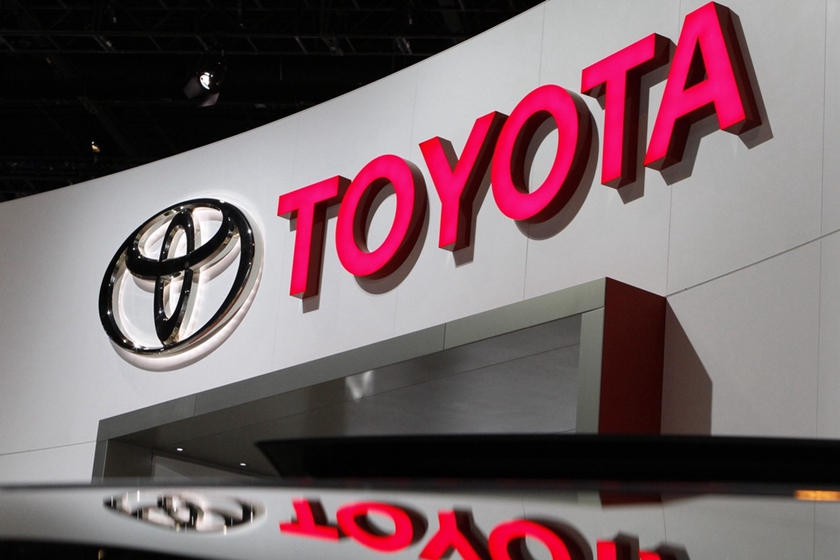
Straightening Out North and South Toyota: A Strategic Move
"
Author|Wang Lei
Editor|Qin Zhangyong
The long-anticipated collaboration between GAC and FAW has finally materialized.
On the evening of the 14th, GAC Group issued an announcement confirming the partnership, albeit with some discrepancies in the details:
GAC Group and China FAW Group Co., Ltd. signed a Letter of Intent to outline the acquisition of a portion of equity in a vehicle joint venture held by FAW Group through the issuance of shares and to raise matching funds (supporting funds). Post-transaction, FAW Group is set to become the second-largest and strategically influential shareholder of GAC Group.
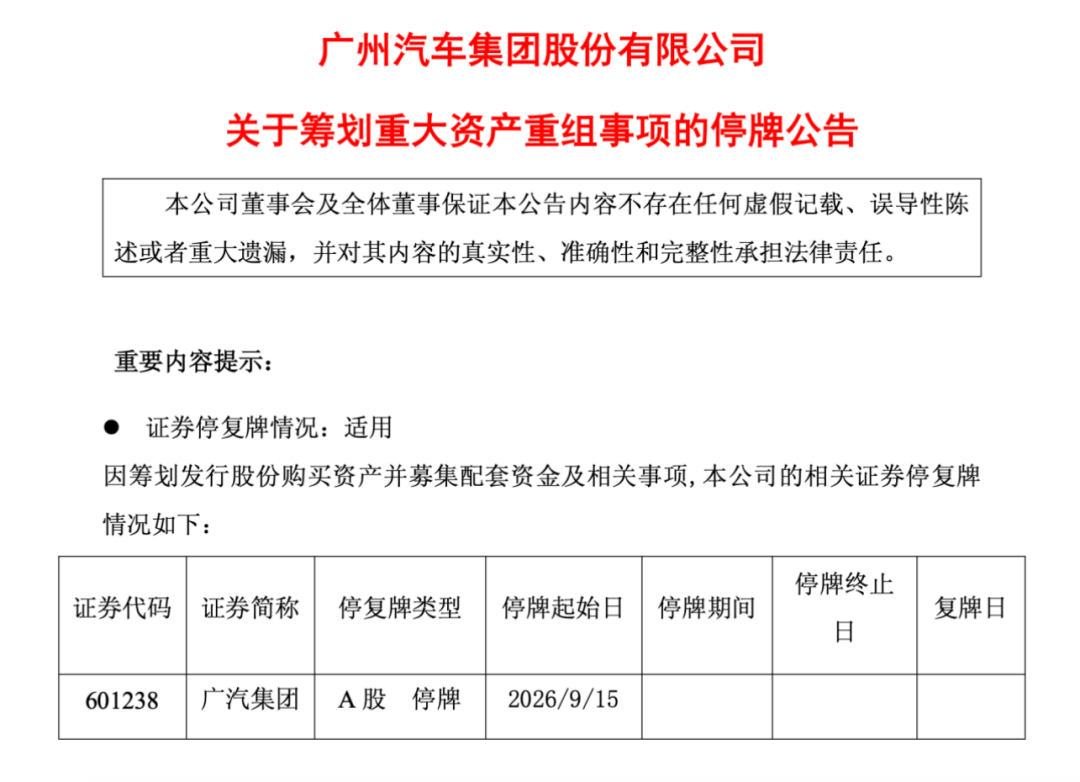
In essence, the collaborating entities remain FAW and GAC, but the specifics involve GAC acquiring shares in a joint venture under FAW Group through share issuance, thereby gaining control, while FAW secures a portion of GAC's shares, becoming GAC's second-largest shareholder.
The "certain joint venture" in question is most likely FAW Toyota.
Previous speculation suggested that FAW would seek equity participation in GAC, potentially forming a "shareholding partnership" in the future. Although these rumors contained some misinterpretations, they underscore the fact that China's auto industry is at a historic turning point.
Prior to this, the restructuring of the Chang'an system and the spin-off and listing of Dongfeng Voyah were significant events. This time, the difference is that FAW, directly managed by the SASAC of the State Council, has exchanged equity in a joint venture for shares in GAC, controlled by the Guangzhou SASAC, crossing both central and local levels.
More intriguingly, on September 11th, nine departments, including the Ministry of Industry and Information Technology, released the "15th Five-Year Plan for the Development of the Intelligent Connected New Energy Vehicle Industry," explicitly stating the need to encourage mergers, acquisitions, and cross-regional integrations among auto companies in accordance with the law. Just three days later, on September 14th, GAC officially announced the letter of intent.
In just three days, the transition from policy to implementation was swift.
01 A Marriage and an Integration
Let's delve into the "open cards" provided by the announcement.
GAC has signed a Letter of Intent with China FAW Group Co., Ltd. to outline the acquisition of a portion of equity in a vehicle joint venture held by FAW Group through the issuance of shares and to raise matching funds (supporting funds).
It was also emphasized that this transaction is expected to constitute a major asset restructuring and related-party transaction, without resulting in a change of actual controller or a restructuring listing. GAC's A-shares will be suspended from trading starting September 14th, expected to last no more than 10 trading days, after which the restructuring plan will be disclosed.
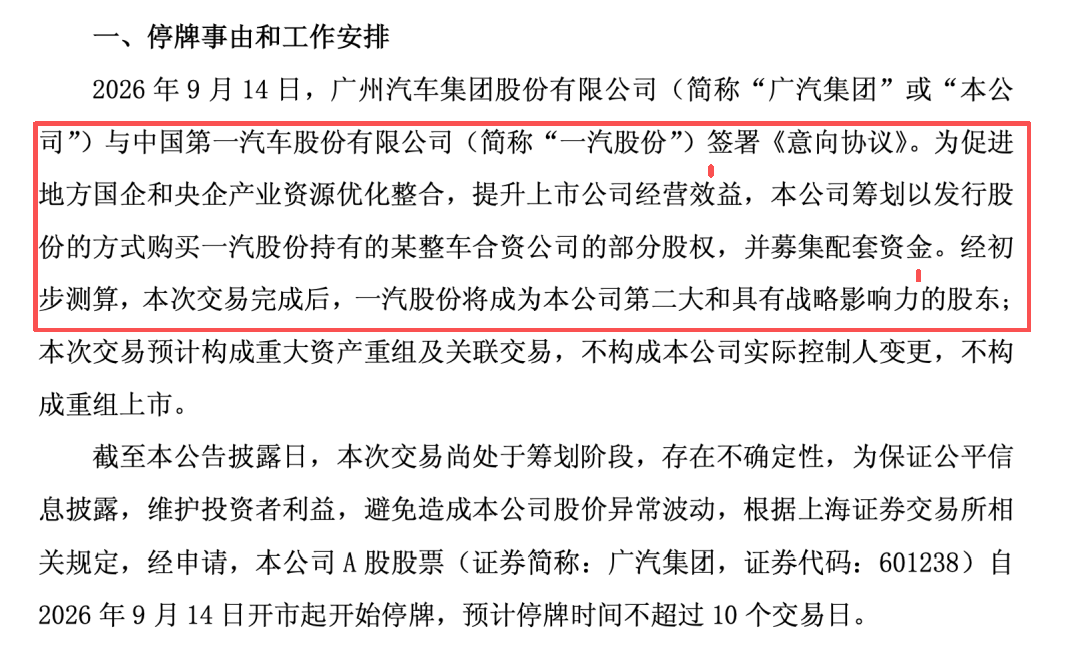
Post-transaction, FAW Group will also become the second-largest and strategically influential shareholder of GAC Group. Simply put, GAC issues shares to acquire FAW Toyota's shares, and these issued shares are acquired by FAW Group, making FAW Group the second-largest shareholder of GAC Group—essentially a swap.
According to GAC's first-half 2026 financial report, GAC Group's largest shareholder is Guangzhou Automobile Industry Group Co., Ltd., holding 54.02%; the second-largest shareholder is Hong Kong Central Clearing (Nominee) Co., Ltd., holding 27.56%.
This means that after the transaction, FAW's equity stake will exceed the latter's. Although neither side has disclosed the identity of the "vehicle joint venture" nor the amount of equity to be acquired, the target's valuation, or how much GAC stock FAW will ultimately hold, industry sources suggest that GAC may acquire approximately 25% of FAW Toyota's equity held by FAW Group through share issuance, valued at around 20 billion yuan.
Based on GAC's A-share suspension price of around 4.7 yuan, approximately 4.255 billion new shares would need to be issued. Post-transaction, FAW would hold approximately 29.44% of GAC's shares, close to 30%, making FAW the second-largest shareholder after Guangzhou Automobile Industry Group.
Meanwhile, Guangzhou Automobile Industry Group's stake may drop from about 54.02% to around 38.1%, still maintaining controlling status.
Of course, these are market speculations, and neither FAW nor GAC has responded.
GAC's announcement also provided a clue: "The target company belongs to the automobile manufacturing industry (industry code C36). As the restructuring target involves an overseas-listed company, the company is withholding disclosure of the target asset's name, which will be revealed in the restructuring plan later."
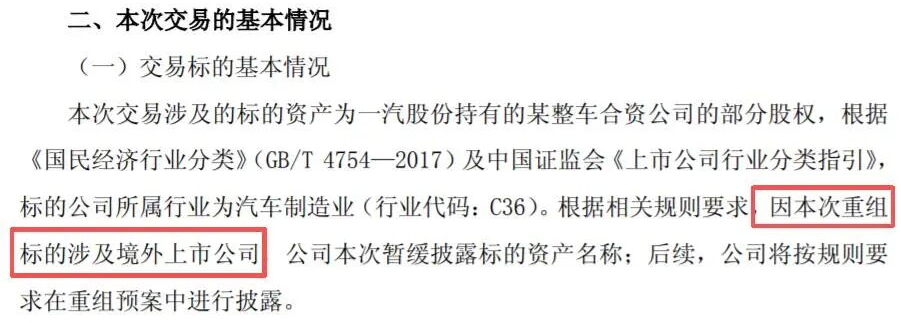
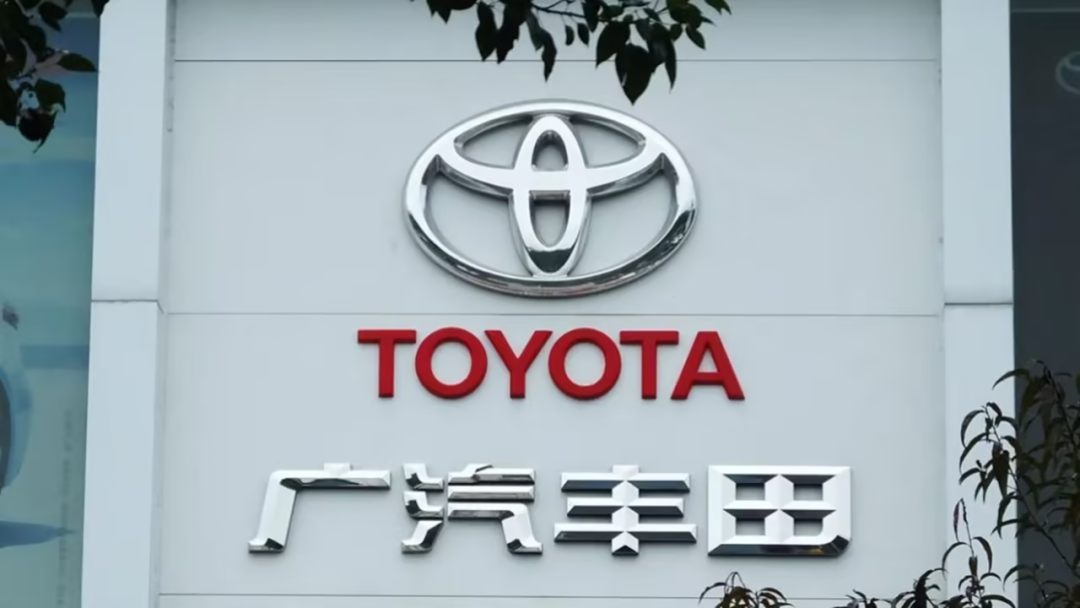
This narrows down GAC's potential equity participation to FAW-Volkswagen, FAW Toyota, and FAW Audi. Considering that both GAC and FAW have joint ventures with Toyota, and GAC's 22 years of experience operating Japanese brands, from the perspective of existing asset relationships and subsequent resource integration, the "vehicle joint venture" in question is highly likely to be FAW Toyota.
Therefore, the possibility of GAC acquiring FAW Toyota's equity from FAW is the highest.
The integration of "North and South Toyota" has long been evident. Last year, Toyota China initiated a pilot program for a "single-city, single-store" network model, where certain regions would have only one joint venture brand 4S store per city, selling both FAW Toyota and GAC Toyota's full range of models.
At the same time, there were reports that Toyota planned to optimize its "twin models" strategy in China, merging some twin models and possibly retaining only one in the future. Additionally, Hiroyuki Fujiwara, the former president of GAC Toyota, was transferred to FAW Toyota as president, seen as a prelude to integration.
This year, personnel changes have become more frequent. Nie Qiang, the general manager of FAW Toyota Sales Co., was suddenly transferred to the Hongqi brand, with no successor announced yet. Furthermore, the executive vice president and deputy general manager of GAC Toyota were also transferred earlier. Wen Dali was transferred back to GAC Group headquarters, while Wang Jun was nominated as a director of GAC Components Co., Ltd., relinquishing his positions as a member of the Party committee and deputy general manager of GAC Toyota Motor Co., Ltd.
These moves appear to be strategic adjustments for the new organizational structure resulting from the integration of "North and South Toyota."
The market has already outlined a rough picture of the merged entity's scale. A proposed plan for merging North and South Toyota into Toyota (China) Sales Co., Ltd. (tentative name) suggests Toyota may hold 50%, FAW 25%, and GAC 25%. Sister models under both companies would retain only global models, with dealer channels fully integrated to sell and service all Toyota models.
If implemented, this would mean the end of Toyota's nearly 30-year "North and South Toyota" joint venture landscape in China.
02 Why "North and South Toyota"?
This must be viewed in a broader context.
On September 11th, the Ministry of Industry and Information Technology held a press conference on the intelligent connected new energy vehicle industry. Shao Ji, Deputy Director-General of the Industrial Development Department at the National Development and Reform Commission (NDRC), explicitly stated that they would support large enterprise groups in carrying out reforms, promoting mergers and acquisitions among enterprises through market-oriented and law-based means, and supporting key enterprises in integrating resources such as R&D and production to reduce homogeneous competition in product design and technological R&D.
Three days later, the major asset integration plan between FAW and GAC surfaced. On one hand, the timing is closely linked; on the other hand, the NDRC's mention of "avoiding homogeneous competition" directly corresponds to the current situation of "North and South Toyota."
For a long time, Toyota has introduced overseas single models into its two Chinese joint ventures as two "sister models," covering different consumer groups through differentiated exterior designs and configuration combinations. Classic examples include the FAW Corolla and GAC Levin. The same model is slightly redesigned and configured differently, then allocated to the two joint ventures for separate sales, maximizing market coverage.
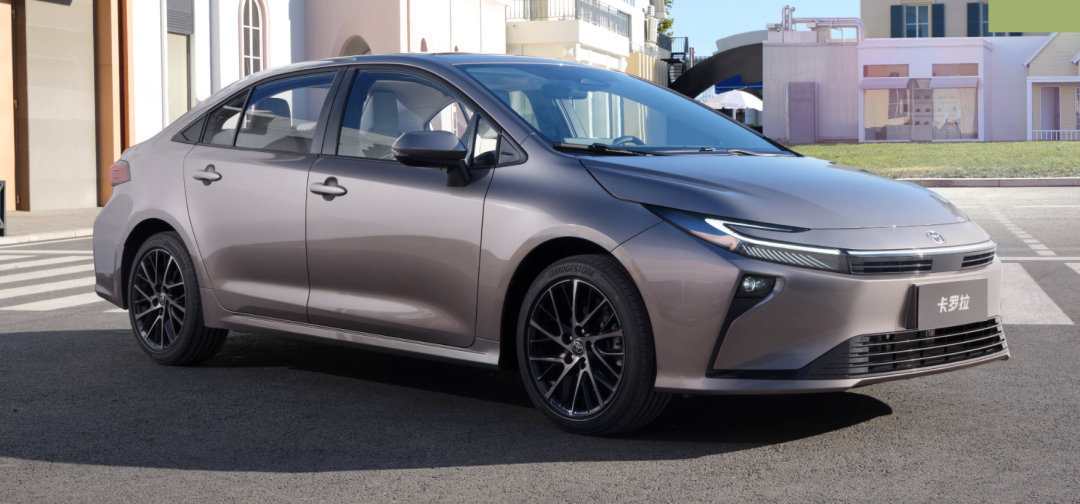
Admittedly, this "one fish, two meals" approach reaped significant benefits during China's rapid automotive market growth, greatly expanding Toyota's product coverage and market scale.
However, as the market enters a phase of stock competition (existing market competition), the marginal benefits of this strategy have declined markedly. Similar models, two sales systems, redundant supply chains, and manufacturing investments all compete for the same increasingly cautious consumer base. Especially when one side adjusts prices, the other is often forced to follow, leading to internal friction between North and South Toyota.
Looking at the two joint ventures' H1 2026 performance in China, market data already signals pressure:
In H1 2026, Toyota's sales in China reached 694,700 units, down 17.1% year-on-year, a decline of 143,000 units compared to the same period last year, marking the first half-yearly decline in two years. In June alone, sales were 115,300 units, down 26.9% year-on-year, the fifth consecutive month of negative growth.
FAW Toyota sold 273,700 units in H1, down 27.4% year-on-year. Even the "evergreen" Corolla sold only 31,400 units, down 35.5%. Other mainstay products also faced pressure, such as the Asia Dragon with 46,400 units, down 16.8%. GAC Toyota sold 341,100 units, down 6.3% year-on-year.
Once lucrative joint ventures have now become a core drag on the groups' overall performance.
In 2023, GAC Group sold 2.505 million units, but by 2025, this figure had dropped to 1.7215 million units, a decline of over 780,000 units in two years. In 2025, GAC Group reported its first annual loss since listing, with a net loss attributable to the parent company of 8.784 billion yuan.
Two sales channels, two marketing systems, and relatively decentralized parts procurement have consumed profits within Toyota's joint venture system. In today's increasingly fierce stock competition (existing market competition), finding a path to survival has become imperative.
For GAC, the most direct benefit of this transaction is "cost savings." Consolidating into "One Toyota" would directly reduce redundant investments, reclaiming some profits previously lost to internal competition and duplication, and safeguarding Toyota's joint venture business in China as the best way for GAC to stop losses and recover.
A Toyota dealer previously admitted, "The current domestic price war among Toyotas is mainly due to internal competition between FAW Toyota and GAC Toyota, such as with the Granvia and Sienna. If North and South Toyota merge and the price war eases, profit per vehicle could reach tens of thousands of yuan."
Meanwhile, FAW has its own needs. In 2025, FAW's overall production dropped from 3.727 million units in 2020 to 3.307 million units, with over 2.3 million units dependent on the joint venture sector, while the self-owned new energy business accounted for only about 13.5%. In other words, FAW still needs greater scale and faster product rhythms in the new energy passenger vehicle market.
GAC happens to possess some capabilities FAW needs, such as "national-level" pure electric assets like Aion, which has already experienced the production and sales of hundreds of thousands of pure electric vehicles. GAC has also invested for years in pure electric platforms, batteries, electric drives, and new energy supply chains.
After establishing capital relations, subsequent cooperation between the two companies need not remain at the strategic agreement level. Viewed this way, this integration is less about one saving the other and more about mutual resource benefits and meeting each other's needs.
03 This Is Just the Beginning
Of course, this is currently just a letter of intent with no legal binding force. Several steps remain, such as approvals from various departments, the board of directors, and the general shareholders' meeting.
Even after all approvals are obtained, the real challenges will just begin. Allocating dealer rights, dividing R&D team responsibilities, and other tasks will be massive undertakings.
Until then, both sides can reap the benefits. In an era of stock competition (existing market competition), where competitors are undergoing fierce trials by fire, China's auto industry is shifting from internal fragmentation to concentrate efforts to accomplish great things (concentrating resources to accomplish major tasks).
Starting with North and South Toyota, other joint venture brands—and even self-owned brands—may follow suit, seeking mutual support. As long as policy directions remain unchanged and the new energy shakeout accelerates, equity integrations will roll on like a snowball, one wave after another.
-
After GAC Group Propels Toyota’s EVs to Success for 10 Months, FAW Finally Gives In
-
The ‘Six Little Dragons’ Halo Fades Quickly for Qunhe Post-IPO
-
![]()
Zhipu and MiniMax: Cutting Sales Costs While Boosting Performance
-
![]()
Consolidation in China’s Auto Industry Kicks Off with the Integration of North and South Toyota
-
Next-Gen Snapdragon Flagship Platform on the Horizon: Can AI Agent Smartphones Truly Deliver?
-
GAC and FAW 'Marriage': The Era of 'Major Integration' in the Auto Industry Has Just Begun
-
800 Million Yuan Acquisition of Wuluo Intelligence: Can Xiangshan Share Make a Breakthrough?
-
![]()
Is It Harder for Automakers to Profit as Car Sales Increase?