Xiaomi SU7 Tops Sales Among "Peer Competitors": Are the "13 Challengers" No Match?
 09/22 2026
 539
539
Do you recall the joke that went viral when Xiaomi first announced its entry into car manufacturing? "Jun, give it up—the outside world is teeming with competition."
Lei Jun’s self-deprecating comment at the press conference: "Jun, give it up—the outside world is teeming with competition Image Source: Weibo
Looking back now, it was the biggest plot twist of the year.
At that time, the new energy vehicle sector was already a fiercely competitive red ocean, with traditional automakers deeply entrenched and new entrants vying intensely. The 200,000-300,000 RMB pure electric sedan segment epitomized cutthroat rivalry. The consensus across the industry was that Xiaomi, as a cross-industry newcomer, would inevitably be outmaneuvered by its competitors.
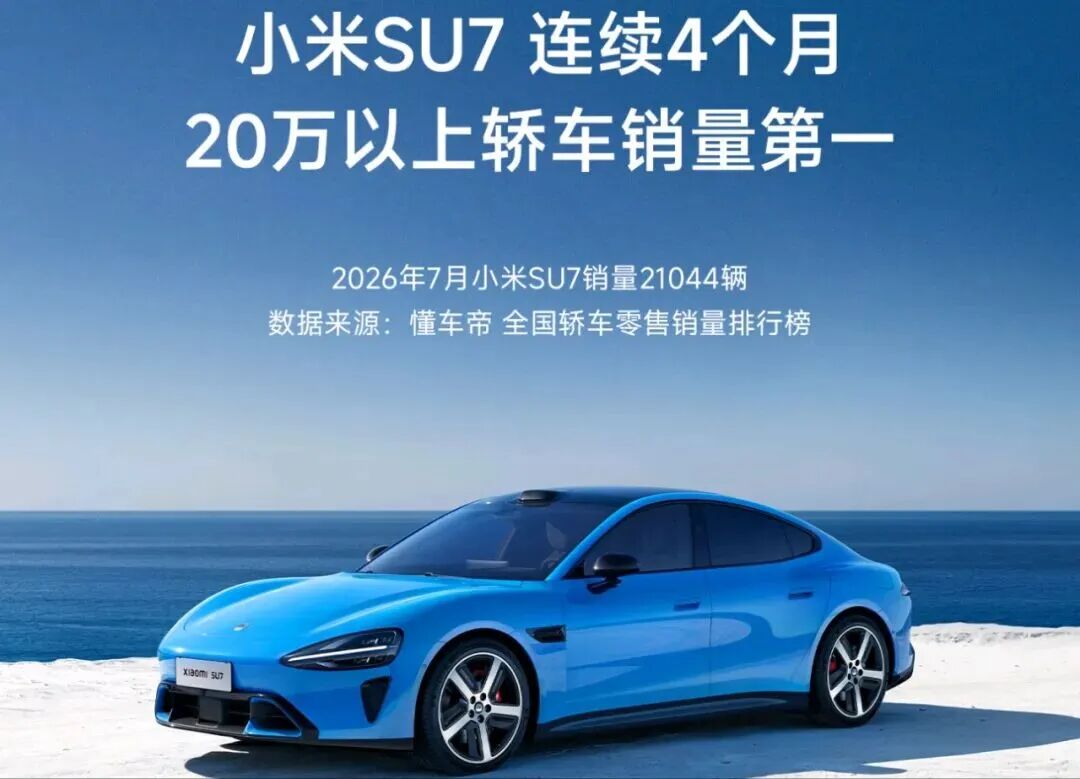 Image Source: Weibo
Admittedly, Xiaomi’s foray into car manufacturing was an uphill battle from the start—late to the game, facing a crowded market, and up against formidable rivals. However, this underdog managed to carve out a path amid fierce competition, delivering a standout performance by single-handedly outperforming 13 competitors.
13 Models Can’t Match the SU7! The Sales Gap Is Staggering
Without further ado, let’s delve into the sales data from January to August 2026 to understand the brutal competition in the mid-to-high-end pure electric sedan market.
According to industry bloggers, the Xiaomi SU7 sold a cumulative total of 118,100 units in the first eight months.
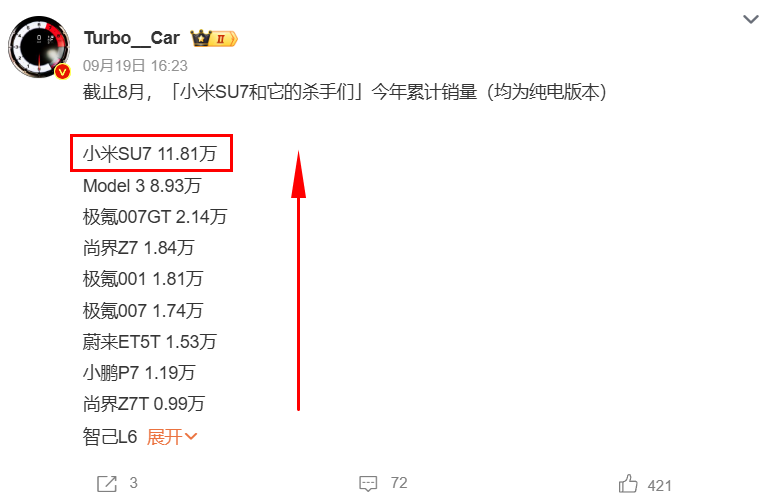 Image Source: Weibo
Its lineup of competitors was nothing short of a who’s who: three models from Zeekr, three from HarmonyOS Smart Mobility, two from NIO, plus the Tesla Model 3, XPENG P7, IM L6, Avatr 06, and Audi E5—a total of 13 mainstream models that dominate the 200,000-300,000 RMB pure electric sedan segment.
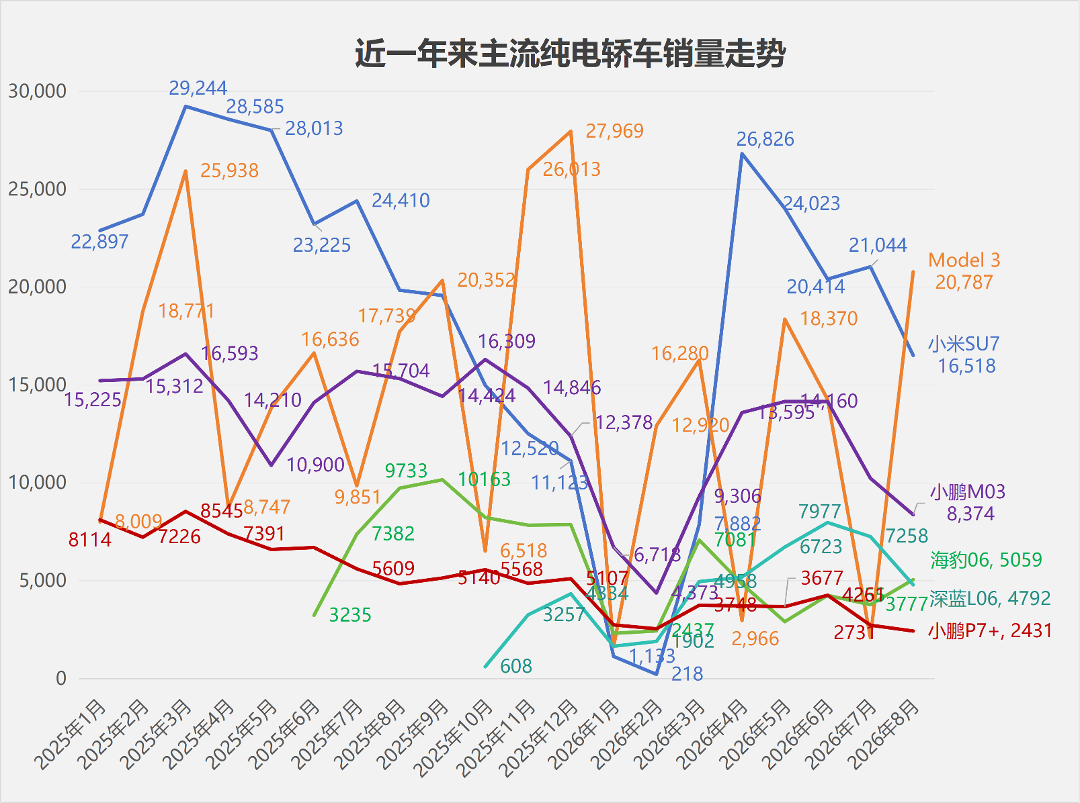 Image Source: Auto Business Community @ WeChat Official Account
Combined, these 13 competitors sold 231,400 units from January to August—seemingly double the SU7’s total. However, when broken down by model, the gap becomes stark:
The average sales per competitor model were just 17,800 units, far below the SU7’s performance.
Even the Tesla Model 3, a perennial chart-topper and former segment leader, sold only 89,300 units in the first eight months, trailing the SU7 by 28,800 units. The remaining 12 models lagged even further behind, struggling to compete. Many netizens were stunned by the data: “It even outperformed the Tesla Model 3—impressive!”
Just a few years ago, no one could have imagined a domestic model consistently outperforming the Model 3. Today, the Xiaomi SU7 and Model 3 jointly dominate the core 200,000-300,000 RMB pure electric sedan market, leaving the dozen-plus competitors to scramble for the remaining scraps—a highly awkward situation.
What’s even more astonishing is that the SU7 didn’t dominate from the start this year. Instead, it faced a period of widespread skepticism.
During the transition between old and new models, the SU7 proactively adjusted production capacity and switched versions, delivering just 1,133 units in January and a mere 218 units in February. With two consecutive months of sluggish sales, rumors swirled that the “SU7 hype had faded” and it “lacked staying power.” Many were convinced that Xiaomi’s car venture was doomed.
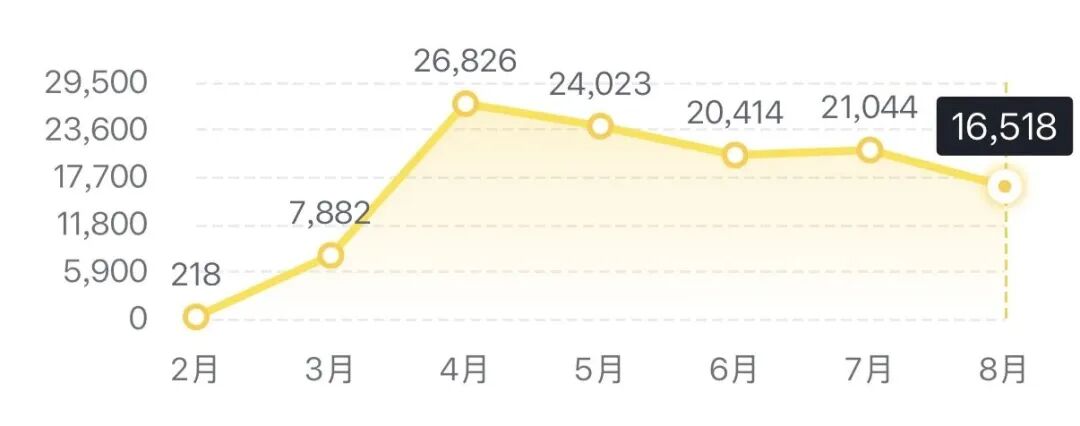 Xiaomi SU7 Sales from February to August Image Source: Weibo
However, savvy netizens saw through the narrative and pointed out a crucial detail: a harsher truth—the SU7 was actually discontinued for the first three months. This wasn’t due to weak demand but rather a proactive production halt for model updates and capacity restructuring. Some rational observers noted that the SU7’s monthly delivery volume depended on how Xiaomi allocated production capacity. Others bluntly stated that if not for the two-month production halt for the model update, the SU7’s lead would have been even more pronounced.
The slump was just a temporary lull—the comeback was swift and dominant.
After the new-generation SU7 officially began deliveries, sales rebounded sharply: 7,882 units in March, skyrocketing to 26,826 units in April. Its popularity remained high in the second half of the year, with 21,044 units delivered in July alone—surpassing the combined sales of the Zeekr 007GT and Shangjie Z7, two popular models. The SU7 locked in the sales crown for pure electric sedans priced above 200,000 RMB for four consecutive months.
By August 17, cumulative deliveries of the SU7 series had surpassed 500,000 units, achieving this milestone just 28.5 months after its launch.
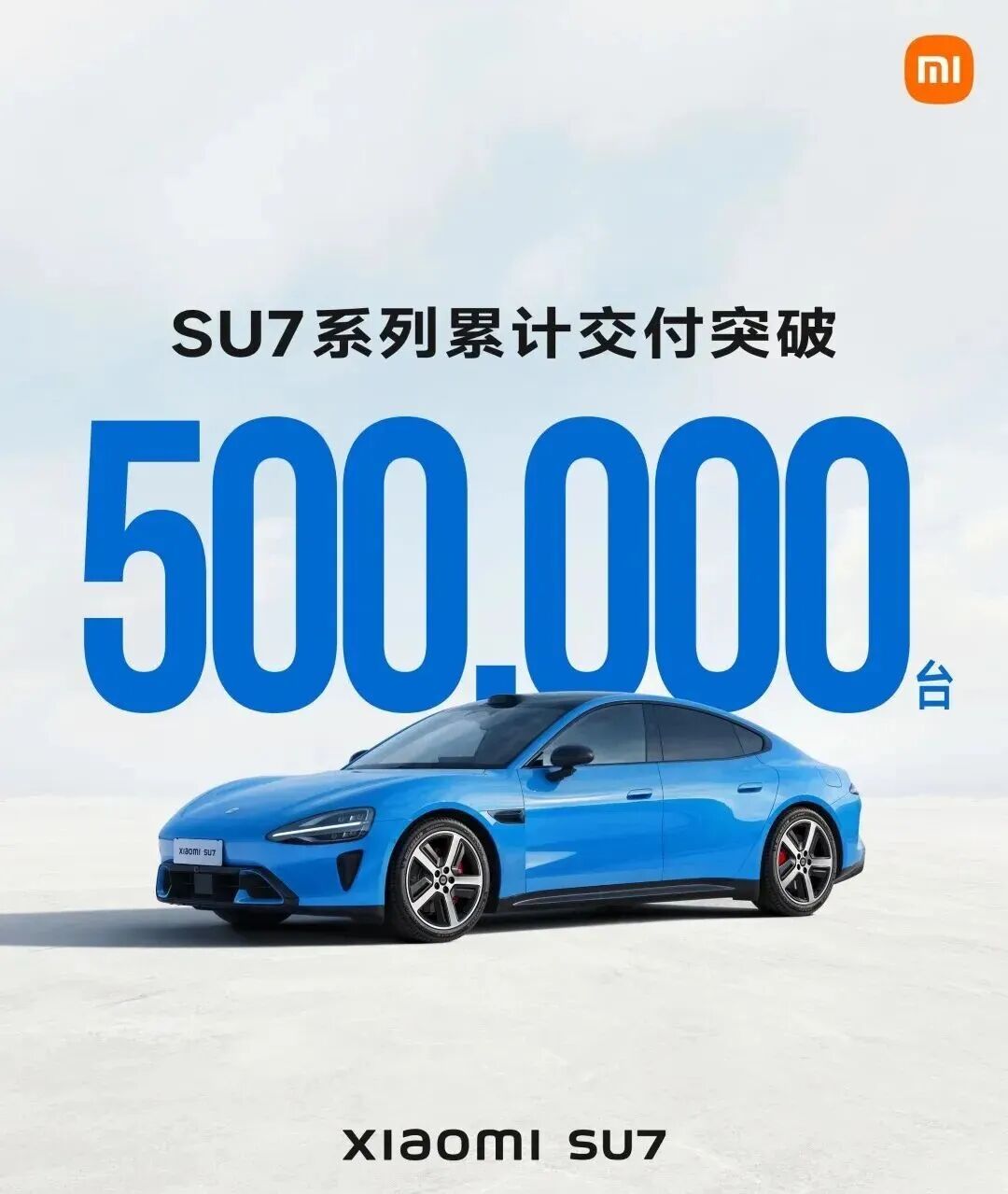
Image Source: Weibo
In the automotive industry, a model that becomes the benchmark for over a dozen competing products—sparking intense competition—is the true definition of a segment leader. Today, in the 200,000-300,000 RMB pure electric sedan segment, nearly every brand’s pricing, features, and R&D strategy revolve around the Xiaomi SU7, which has become the industry’s universal standard.
Watching as a group of so-called “killer-level” competitors teamed up to challenge the SU7 only to fall short, netizens couldn’t help but joke: “These ‘killers’ aren’t cutting it. BYD, send in the Fangcheng S!” While meant in jest, the market results don’t lie: competitors rely on matrix strategies to boost sales, while the SU7 dominates with a single model—no rival in sight.
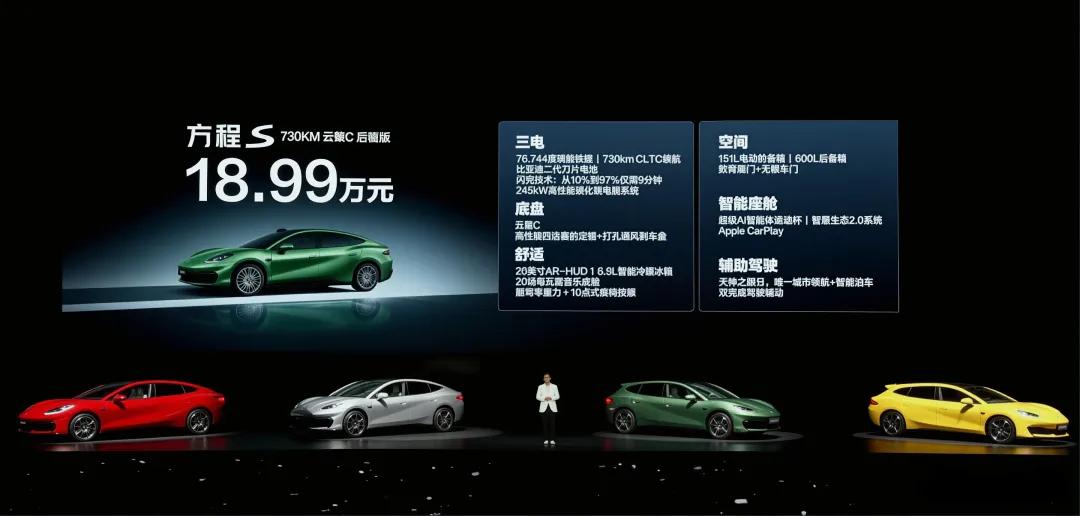
Image Source: Weibo
Controversial Yet Sales Dominant! What Makes the SU7 Win?
In the new energy vehicle sector, the Xiaomi SU7 is undoubtedly the most unconventional player: it faces the most online controversy and has the most critics, yet consistently tops sales and popularity charts—a “hate-to-love” phenomenon.
Debates about the SU7 never cease. Some praise it to the skies, while others dismiss it entirely.
Many casual observers complain: “A rushed job! Stop hyping it!” They argue that Xiaomi entered the car market too late, lacks deep expertise, and relies solely on hype—with no real technological edge.
Others offer a more sober assessment: “Lei Jun’s marketing is unmatched by traditional automakers.” There’s no denying that Xiaomi’s exceptional brand-building and buzz management capabilities give it a natural advantage over most traditional automakers.
Public opinion is sharply divided. Loyal fans lament: “This is a great car, ruined by Huawei’s smear campaign—sales could be even higher.” More objective observers note: “It’s a shame the YU7 didn’t outperform the Model Y—a rare blemish in the SU7’s journey.”
Controversy and mixed reviews are the norm for the SU7. But beyond the noise, one fact is undeniable: its sales were achieved amid fierce competition and relentless online scrutiny.
Many can’t figure out why the SU7 continues to dominate despite not being the cheapest in its class, not having the most stacked hardware, and not offering an overwhelming size advantage. Why has it remained a bestseller for two years?
The initial success of the first-gen SU7 could be attributed to the novelty of a tech giant entering the car market and fan loyalty. However, its sustained leadership after a model update, despite ongoing negative public opinion, can’t be explained by hype alone.
The core answer lies in one factor: while hype helps, its balanced and competitive product strength is the real ace up its sleeve.
Stop calling it a “rushed job.” Daring to launch a new model and immediately take it to the Nürburgring for lap records reflects extreme confidence in its chassis tuning, mechanical engineering, and overall stability. This hardcore automotive expertise is no marketing gimmick—it utterly outclasses competitors who rely solely on parameter stacking.
More importantly, Xiaomi has precisely nailed the core needs of today’s young users, addressing a major blind spot for traditional automakers.
Traditional automakers focus obsessively on hardware, specs, and chassis but often overlook the most intuitive smart experience for users. Xiaomi, with its deep roots in the digital industry, understands young drivers’ pain points: a smooth infotainment system, rapid software updates, and lag-free human-machine interaction—every detail hits the mark.
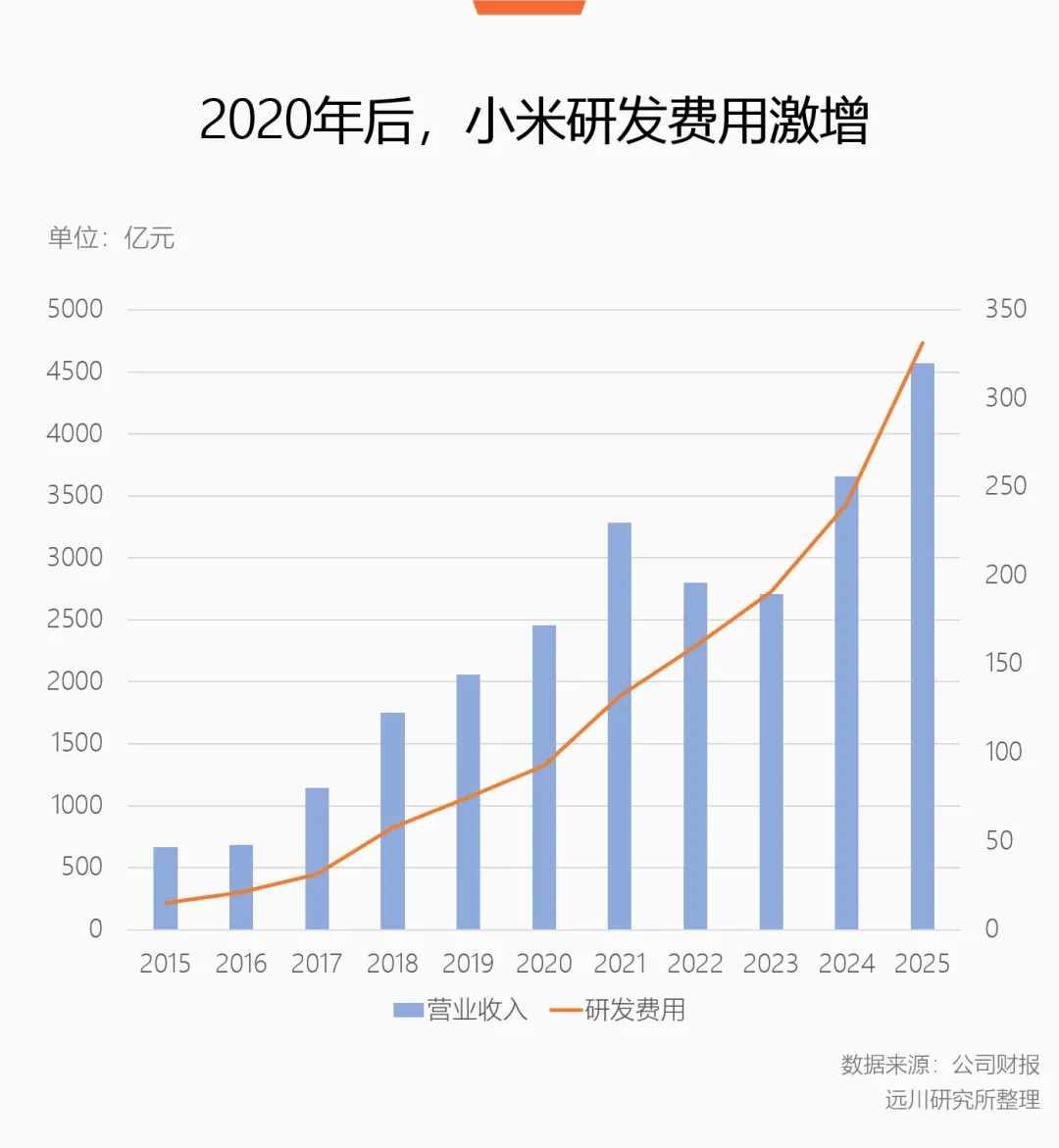 Image Source: Yuanchuan Institute
Especially its person-vehicle-home ecosystem, where smartphones, in-car systems, and smart home devices seamlessly interconnect—this unique experience is an impenetrable core advantage that no other automaker can replicate.
Today’s young buyers aren’t just purchasing a vehicle—they’re buying a smart, convenient, and lifestyle-integrated mobility ecosystem. The SU7 perfectly matches all the core demands of modern consumers: good looks, enjoyable driving, low energy consumption, and top-tier smart features.
The Entire Industry Is Going All-In on Sedans! This Hunt Was Inevitable
Before the SU7’s explosion in popularity, the new energy market clung to a rigid misconception: SUVs were the key to success, while sedans were an afterthought.
Back then, industry resources, R&D priorities, and new product launches heavily favored SUVs. The pure electric sedan segment was stagnant, with no breakout hits for years. It was the Xiaomi SU7 alone that revitalized the entire pure electric sedan market, proving to the industry that it wasn’t that consumers didn’t want sedans—it was that no one had delivered a product that met modern demands.
Recall Lei Jun’s self-deprecating joke during the SU7’s launch: “Give it up—the outside world is teeming with competitors.” That perfectly captured the reality at the time. Models like the Zeekr 007, Lynk & Co Z10, and Galaxy E8 all launched around the same time, aiming to surround and divide the SU7’s market share.
Over the past two years, the industry’s “hunt” for the SU7 has only intensified.
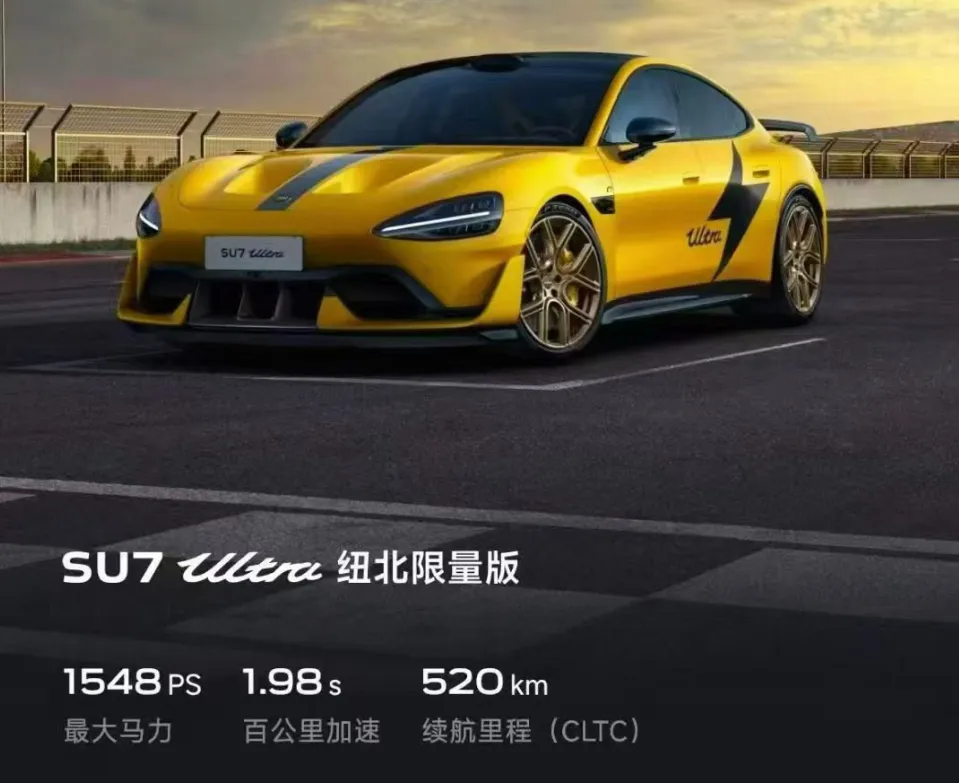 Image Source: Weibo
At the 200,000 RMB level, models like the IM L6, Smart #7, and Shangjie Z7 directly challenge the SU7. At 150,000 RMB, joint ventures are entering the fray. In the 100,000-150,000 RMB range, models like the Chery Fengyun A9, MG 07, and Aion Ray7 are flooding the market. All new entrants follow the same playbook: larger size, stronger hardware, fuller features, and lower pricing—a comprehensive strategy to counter the SU7 and Model 3.
The most extreme example is the Galaxy TT, whose dealers openly position it against the SU7: “Fully matched features, 100,000 RMB cheaper”—a relentless focus on cost-effectiveness. Yet even this fails to shake the SU7’s sales dominance.
Many wonder: If competition is already this fierce, why are automakers doubling down on pure electric sedans? Three industry trends explain it all.
First, a must-do for automaker advancement. SUVs can stabilize volume and secure a basic market presence, but sedans are the true test of a brand’s chassis tech, battery-electric fundamentals, and design prowess. To stay in the top tier, automakers must dominate the mainstream sedan segment to complete their product lineup.
Second, policy pressures force evolution. Stricter energy efficiency regulations are making large, heavy, high-drag pure electric SUVs less viable. Sedans, with their lightweight, low-drag, and energy-efficient designs, align perfectly with future sustainability standards—making them the long-term play.
Third, user preferences have shifted. With younger buyers driving the market and urban commuting as the primary use case, massive size is no longer a must-have. A stylish, agile, smart, and energy-efficient pure electric sedan fits daily needs far better than a bulky SUV.
With these factors at play, the once-niche pure electric sedan segment has exploded in popularity, becoming the most fiercely contested gold mine in the new energy vehicle industry.
Final Thoughts
Objectively, the Xiaomi SU7 isn’t a flawless “god-tier” car—it has controversies, shortcomings, and room for improvement. But there’s no denying that it single-handedly disrupted the 200,000-300,000 RMB pure electric sedan market, reshaping industry product standards and user expectations.
Its success has forced the entire industry to upgrade products, devolve technology, and lower prices—ultimately benefiting ordinary consumers with better, more affordable pure electric sedans. Meanwhile, the influx of competitors has transformed the segment from a single-model monopoly into a vibrant, healthy competition.
The “13-vs-1” showdown continues, with competitors launching ever-more aggressive product updates and price cuts. Whether Xiaomi can hold onto its single-model throne and if any new “killer-level” models can break through remains to be seen.
Discussion Topic: Do you think the SU7’s success is due to product strength or marketing hype? Which future model has the best chance of challenging its sales dominance? Share your thoughts in the comments!
Disclaimer: This article is for financial commentary only and does not constitute investment advice.
-
![]()
Xiaomi SU7 Tops Sales Among "Peer Competitors": Are the "13 Challengers" No Match?
-
![]()
T-Chain Choices Amid Auto Industry Intensification: From Car Manufacturing to Optimus Robots—Not a Dimensionality Reduction Strike
-
![]()
Mysterious New Model Cracks 100+ World-Class Problems in 24 Days! OpenAI Unveils Mathematics and AI Advisory Board
-
![]()
vivo X500 Pro Imaging Professional Review: Strong Telephoto, Powerful Video, Enhancing Imaging Dominance with High Output Rate
-
![]()
Practical Testing of Doubao AI for Work: Multimodal Video Generation Provides Differentiated Advantages for Office Scenarios, Strong in Structured Tasks
-
Why Are Chinese Cybersecurity Stocks Still Falling Despite Zhipu Securing 1 Billion Yuan in Orders?
-
The ‘Korean Bentley’ in Beijing, Shanghai, and Guangzhou Stores: Hanging On by a Thread
-
Corporate Splurge on AI Box