Decoding Tesla FSD's EU Certification: Two Pathways for China's L2++ Intelligent Driving to Go Global
 09/22 2026
 375
375
Let's start with three sets of figures. According to the China Association of Automobile Manufacturers (CAAM), China exported 4.91 million vehicles in 2023, 5.86 million in 2024, and 7.098 million in 2025; by August 2026, exports had already reached 7.153 million, surpassing the total for the previous year. The quantity hurdle has been cleared.
The second set concerns the structure: NEV exports reached 2.615 million in 2025, doubling, while traditional fuel vehicle exports decreased by 2%; by August 2026, NEVs had accounted for more than half of exports for three consecutive months, compared to less than 35% during the same period in 2024. The exported vehicles have shifted from being "cheap" to being "electric."
The third set points to the next opportunity: Data from the Ministry of Industry and Information Technology shows that over 66% of new domestic vehicles in 2025 were equipped with L2 combined assisted driving, with city NOA installations exceeding 3 million. This capability, honed through intense domestic competition, represents China's best opportunity for differentiation in the automotive sector after new energy vehicles.
Therefore, for Chinese automobiles going global, intelligent driving has become another trump card following new energy vehicles. The penetration rate of urban assisted driving in China has exceeded 20%, but when Chinese vehicles are sold in Europe, most of this capability cannot be utilized, as no Chinese brand has yet been approved for urban intelligent driving in Europe.
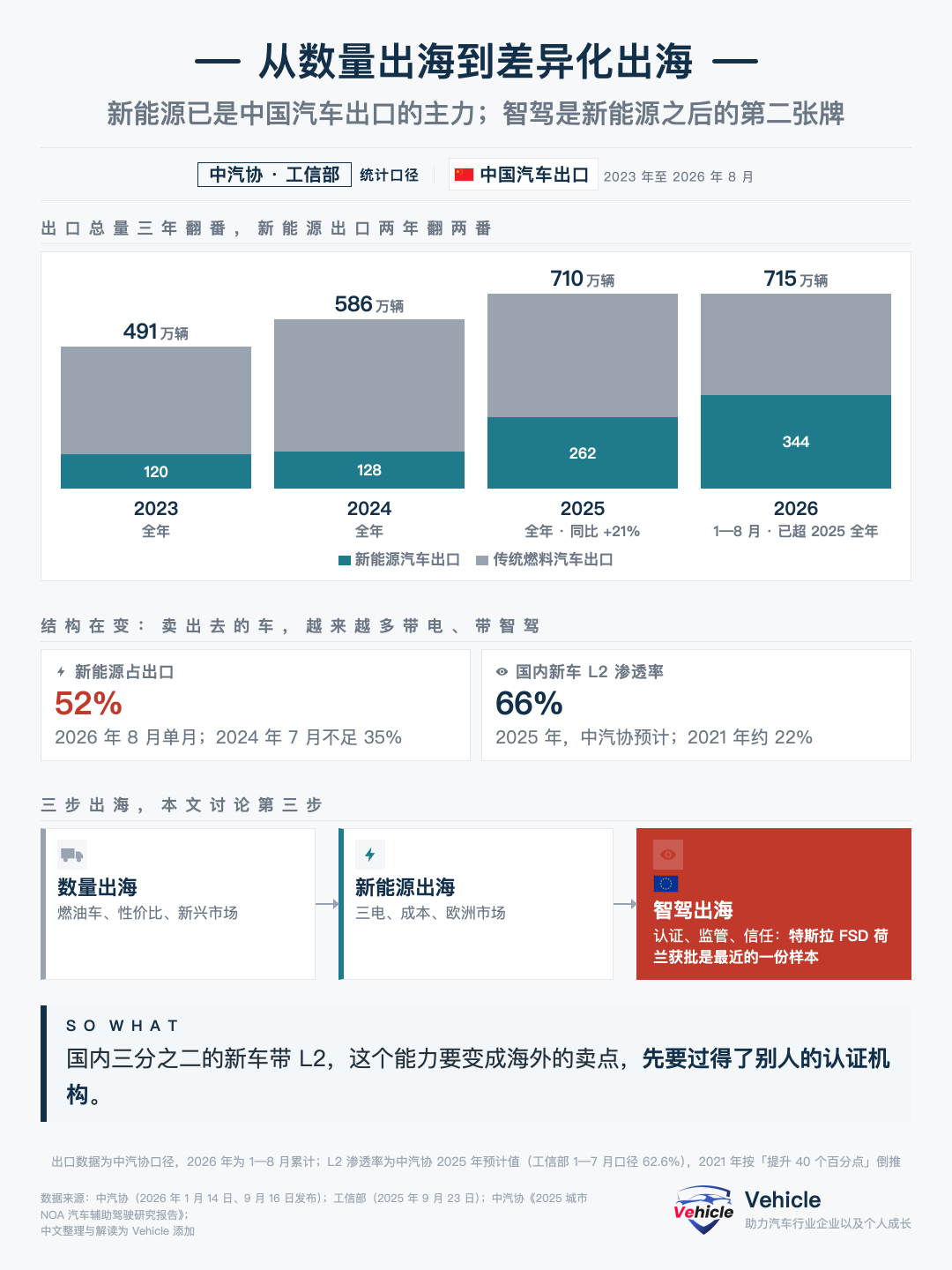
Data for 2026 covers January-August according to CAAM; data compiled and inferred by Vehicle
Tesla has opened a crack in the European door. On April 10, the Dutch Vehicle Authority (RDW) granted type approval for Tesla's FSD Supervised, the first time in Europe that an assisted driving system allowing hands-off operation in urban areas was permitted on the road. By September 21, seven EU countries had accepted this approval, with a Europe-wide vote expected on October 6. This article dissects this case to answer four questions: What was approved? What procedures were followed? What were the challenges? How will it be regulated after deployment? It aims to provide insights and inspiration for China's intelligent driving systems to go global.
What system did the Netherlands approve?
The RDW announcement repeatedly emphasizes that FSD Supervised is an assisted driving system, classified as L2 under SAE standards. The driver's hands can leave the steering wheel, but their eyes must remain on the road, with human responsibility for any incidents.
The approved version is FSD v14.2.2.5, first released in April with firmware 2026.3.6; starting in July, firmware 2026.21.100 rolled out v14.2.2.6 to more vehicles without functional changes. As of publication, the latest version in North America is v14.3.10.
Vehicles are limited to those with HW4 (AI4) hardware, accounting for approximately 44,000 vehicles in the Netherlands; a streamlined version may be available for HW3 later.
The pricing is 99 euros per month, with the option to buy outright for 7,500 euros, which was discontinued in mid-May.
The system's range is geofenced within approved countries, ceasing operation upon crossing borders; first-time users must complete a tutorial and quiz.
Compared to assisted driving systems already available in Europe, it offers two additional features: hands-off operation on roads beyond highways, with the vehicle autonomously handling actions such as turning at intersections and stopping and starting at traffic lights. The existing UN R171 (Driver Control Assistance Systems, DCAS) Series 01 only allows hands-off operation and system-initiated actions on highways. The additional capabilities lack specific regulations and can only proceed under Article 39 of the EU Framework Regulation 2018/858, which provides exemptions for new technologies.
Thus, the official name of this approval is the "EU Type Approval Temporarily Valid in the Netherlands": it is an EU approval, but only valid within the Netherlands.
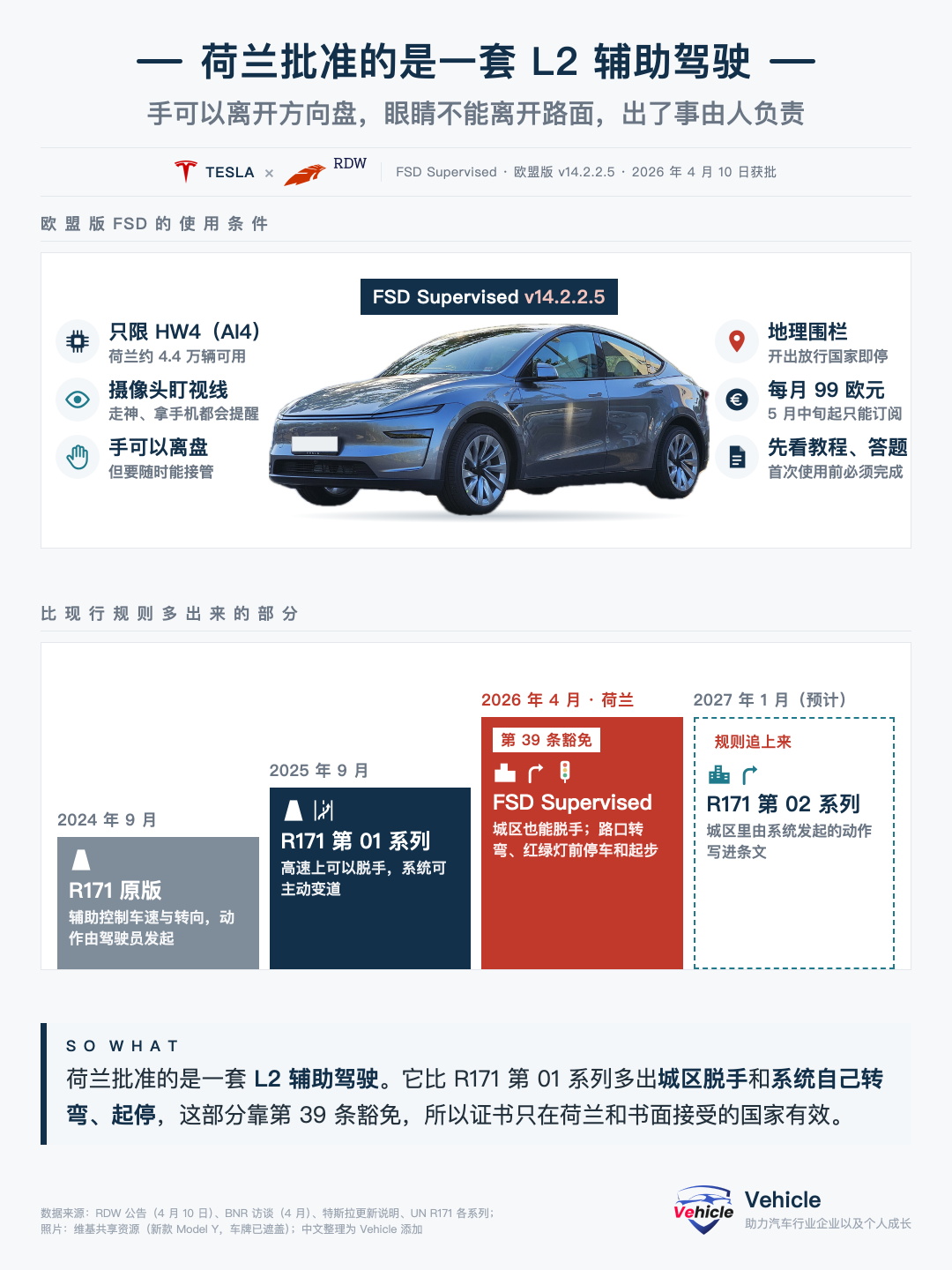
Functional boundaries based on RDW announcements and BNR interviews; version numbers from Tesla software update notes; vehicle model is a photo of the new Model Y with background removed
What procedures were followed?
The EU allows automakers to select an approval authority in any member state. Tesla had previously worked with Lotus, and RDW already had dealings with Lotus, so Tesla naturally chose RDW and has remained there since.
Article 39 sets three thresholds: explaining why the new technology is incompatible with existing regulations, demonstrating that safety and environmental protection levels are at least equivalent to compliant solutions, and providing test evidence. After approval by the authority, a temporary approval valid only in that country can be issued, with notification to the European Commission and other member states; other countries can allow deployment upon written acceptance. Lithuania, Estonia, Denmark, Belgium, Slovenia, and the Czech Republic followed this process.
For Europe-wide validity, a vote by the Technical Committee for Motor Vehicles (TCMV), composed of representatives from member states, is required, with at least 15 countries representing at least 65% of the EU's population voting in favor. If passed, the approval is valid for at least 36 months and may include quantity limits; if rejected, the temporary approval is revoked after six months. Ford's BlueCruise followed the same path, with Germany's KBA granting highway hands-off approval in August 2023 and EU approval in July 2024, taking 11 months.
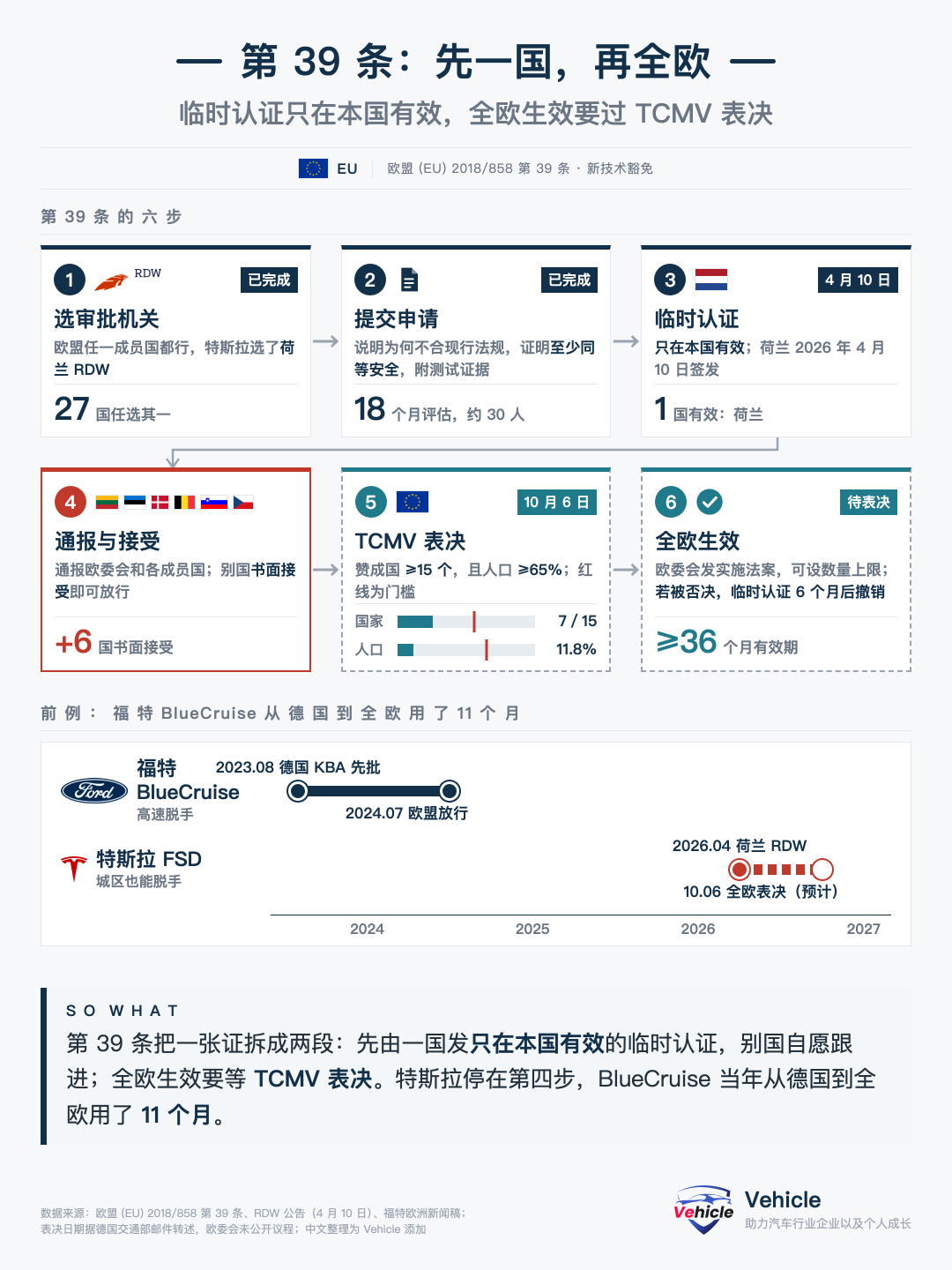
Process based on Article 39 of EU (EU) 2018/858; voting thresholds follow the EU qualified majority rule
Currently, the seven countries represent approximately 53 million people, or 11.8% of the EU population. Germany and France together account for one-third; if both vote against, nearly all remaining 25 countries would need to vote in favor to reach 65%. France's Minister of Transport stated on July 22 that the country would not allow separate deployment.
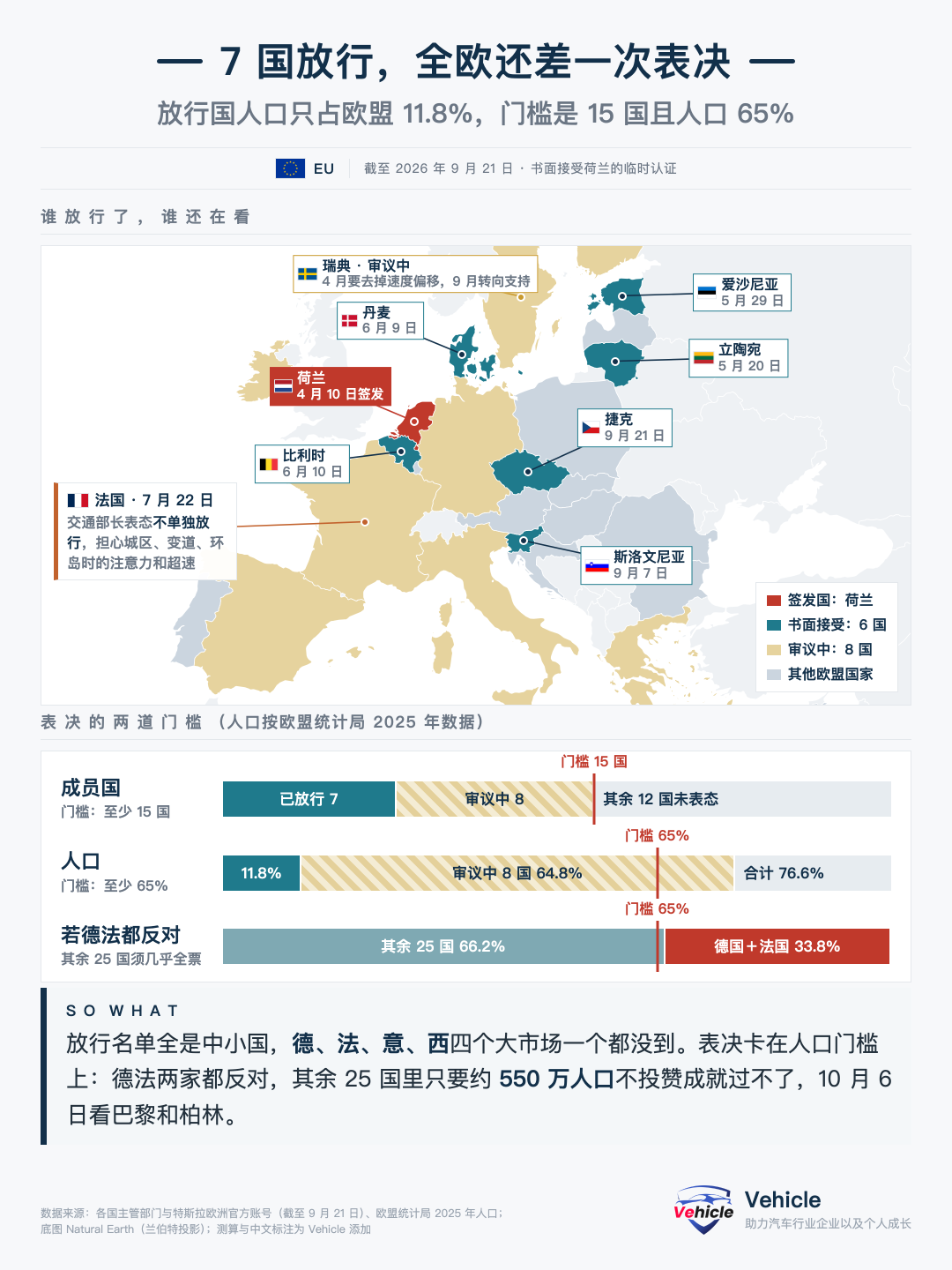
Approving countries and dates from national authorities and Tesla Europe's official accounts; population estimated based on Eurostat 2025 data
What were the challenges?
The first challenge was proving safety. The regulations require "at least equivalent safety" but do not specify comparison criteria, leaving RDW to build its own evidence chain. It audited Tesla's data collection process, had data experts independently recalculate statistical results, comparing FSD test vehicles driven 1.8 million kilometers on European roads with the latest Tesla models without FSD that comply with EU safety regulations; it also conducted over 3,000 hours and 1,000+ tests covering congested urban areas, various road types, and extreme weather, with dummies, poles, and strollers placed on test tracks. A team of approximately 30 people worked on this for 18 months.
The choice of control group directly determines the conclusion. In June, Reuters revealed that Tesla's submissions to Dutch and Swedish regulators included claims like "theoretically avoiding 32,000 deaths" if all vehicles in the U.S. were replaced with Teslas running FSD. RDW responded that it did not rely on marketing materials or external statistics.
The second challenge involved human factors. The system operates well over 90% of the time, leading to driver relaxation, yet the moment of handover requires an immediate shift from inaction to Disposal (disposal/response). RDW thus focused on driver monitoring as a review priority, with warnings triggered by holding a phone, closing eyes, or placing hands behind the head, and repeated violations resulting in up to a one-week suspension. The European Transport Safety Council (ETSC) was unconvinced, arguing that the more capable the system appears, the worse human supervision becomes, and monitoring can only mitigate this issue.
The third challenge was trust. At Tesla's request, the entire evaluation dossier was kept confidential. In April, RDW stated that FSD was "safer than other assisted driving systems," but by June, this was revised to "at least equally safe." Other countries either had to accept a conclusion they could not see or conduct their own tests. In April, Sweden's transport department wrote to the TCMV requesting the removal of the "speed offset" function, which allows exceeding speed limits; France, concerned about attention in urban areas, lane changes, and roundabouts, was conducting its own road tests.
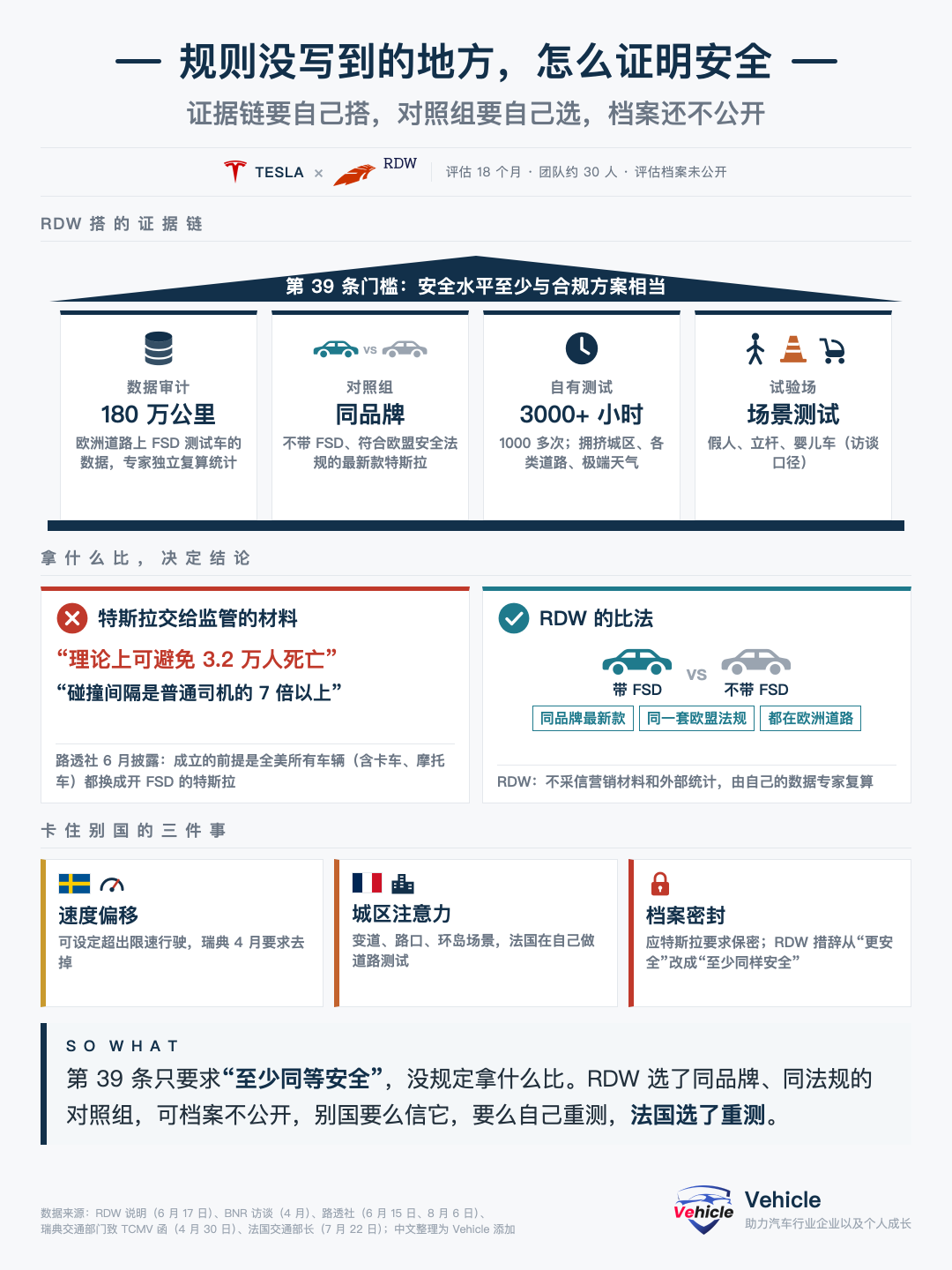
Evaluation figures from RDW's June 17, 2026, explanation and BNR interview; Tesla material content according to Reuters' June 15 report
How will it be regulated after deployment?
Under EU rules, automakers must conduct in-use monitoring and reporting (ISMR), legally required once a year. RDW temporarily increased written reports to monthly, with initial data submission approaching real-time, at least weekly. Accidents must be reported immediately, with a broad definition including regulatory-undesired behaviors across the vehicle class or driver monitoring failures.
The most significant change concerns software updates. The conventional approach is for automakers to determine whether an OTA touches on certified content and only declare it if it does; for FSD, every update must first be submitted to RDW, which decides whether retesting is needed. The version numbers reflect this: North America began rolling out v14.3.10 on September 19, while Dutch owners remained on the v14.2.2 branch.
In June, RDW announced that nearly 40,000 Teslas had driven approximately 24 million kilometers in the Netherlands using FSD since approval, with no related accidents. Tesla reported even larger figures in September: over 70,000 users in five countries accumulating 100 million kilometers, with a collision probability less than one-fourth of human driving.
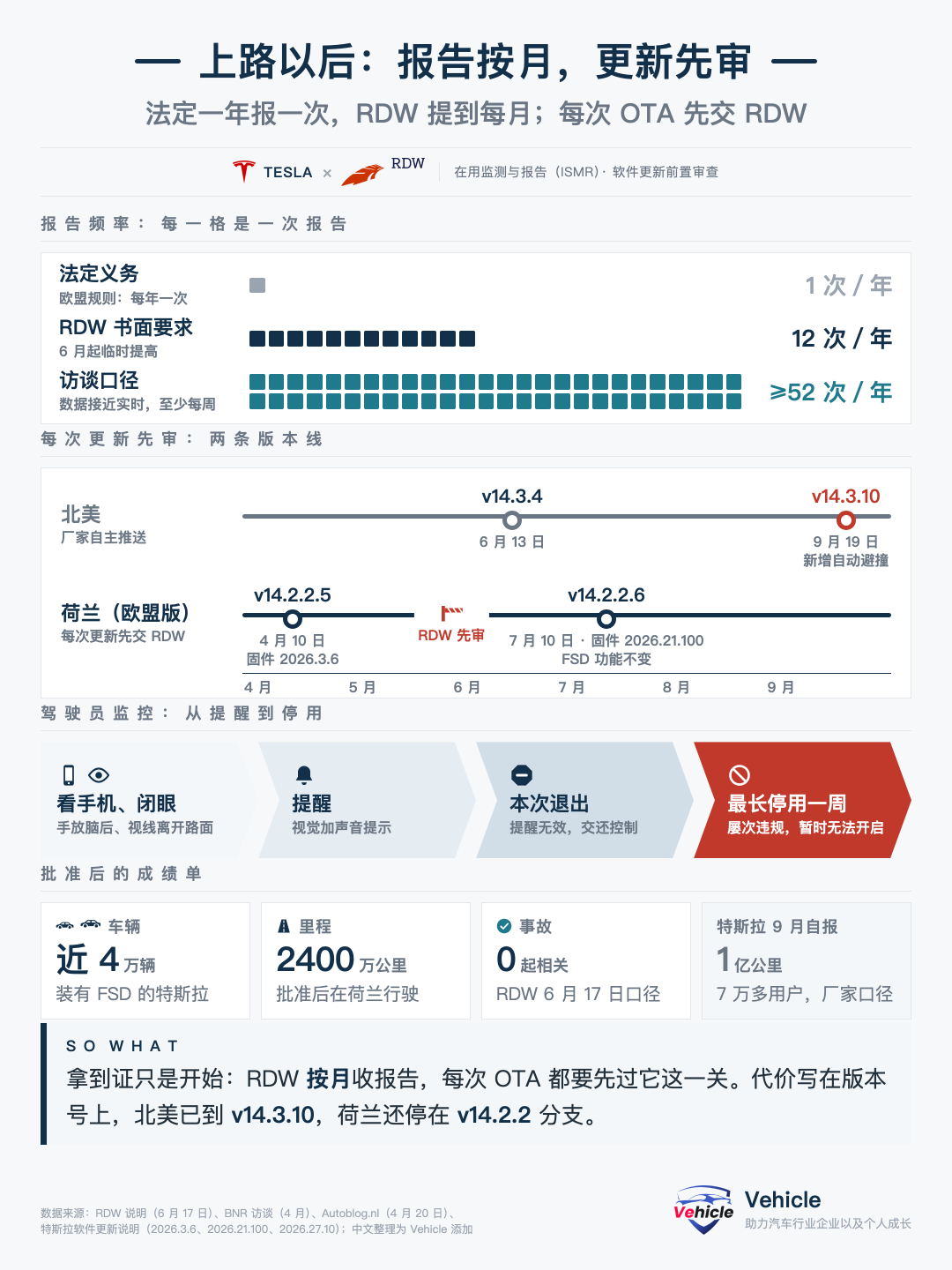
"At least weekly" from RDW manager interview; Tesla figures self-reported by the manufacturer, unverified by third parties
What does this mean for Chinese intelligent driving automakers going global?
Tesla's approval clarifies two pathways. Article 39 represents a narrow door available now: approval in one country, one by one (one by one) acceptance by others, and finally a Europe-wide vote, at the cost of 18 months of evaluation, submitting all data to the approval authority, monthly reports after deployment, and prior review of every update. Another door will open early next year. The United Nations WP.29 adopted amendments to R171 Series 02 in June this year, expected to take effect in late January 2027, codifying system-initiated actions on urban roads and allowing certification through normal procedures with mutual recognition among contracting parties.
Chinese automakers have already reached the doorstep. Geely's Qianli Haohan G-ASD obtained R171 certification in March, the first Chinese intelligent driving system to do so, limited to highways and first deployed in Lotus vehicles; XPENG announced that its VLA 2.0 completed localization verification in Germany in July, planning to deliver to overseas users in 2027.
Regardless of the pathway, Tesla has laid out the exam questions: European local mileage and auditable data, with control groups determined by regulators; no speeding allowed; warnings before actions and strict driver monitoring; geofencing by country; OTA rhythms subordinate to approval rhythms. The last point may be the hardest for Chinese R&D teams accustomed to high-frequency OTAs to adapt to.
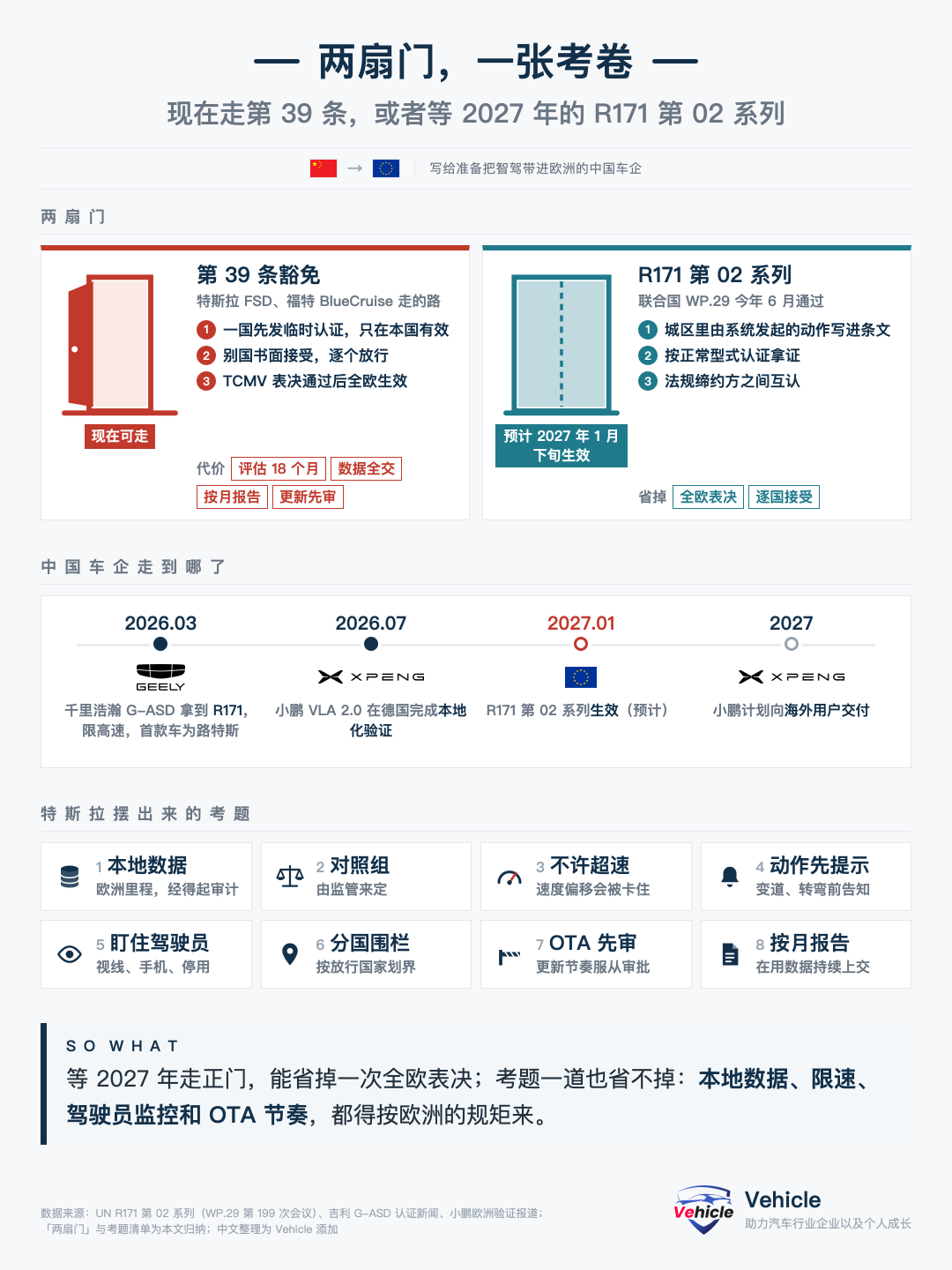
Geely and XPENG progress from company announcements and media reports; "two doorways" and exam question list summarized in this article
Europe has left the door open for new technologies beyond existing regulations, with the price of submitting evaluation, data, and update rhythms to the approval authority. When automakers take the main door in 2027, they can skip a Europe-wide vote, but none of the exam questions will be spared.
Final Thoughts
The vote on October 6 will set the tone for the months before R171 Series 02 takes effect. If passed, Article 39 will become the standard route for early movers, with later entrants needing to find an approval authority willing to accompany them for 18 months; if rejected, the Netherlands' temporary approval enters a six-month countdown, and everyone returns to the same starting line in 2027, watching Chinese intelligent driving systems compete in Europe.
*Unauthorized reproduction or excerpting strictly prohibited-
-
![]()
Why Do AI Glasses No Longer Need Cameras?
-
![]()
The Battle Among Tech Giants for AI Dominance: ByteDance Earns $20 Billion but Takes Out a $29.6 Billion Loan?", "ByteDance, Syndicated Loan, AI, Computing Power, Infrastructure
-
![]()
Is the XPENG GX, a 'Greater Bay Area Range Rover' Priced at 300,000 Yuan, Worth Buying? | Test Drive Report
-
![]()
The AI Price War is Undergoing Changes
-
![]()
Dropout Gen Zer, Valued at $67 Billion: Sold 100,000 AI Assistants
-
Re-evaluating AI Penetration Rates Among Three Internet Veterans
-
![]()
Decoding Tesla FSD's EU Certification: Two Pathways for China's L2++ Intelligent Driving to Go Global
-
![]()
Unistrong Sheds Overseas Assets After 7.5 Years of Losses Totaling Nearly RMB 3.7 Billion, Operating Cash Flow Plunges by 4532%