BYD and Geely Stand Firm! Li Auto 'Underperforms' | Top 500 Private Auto Enterprises in 2026
 09/23 2026
 372
372
Authored by | Guanchejun
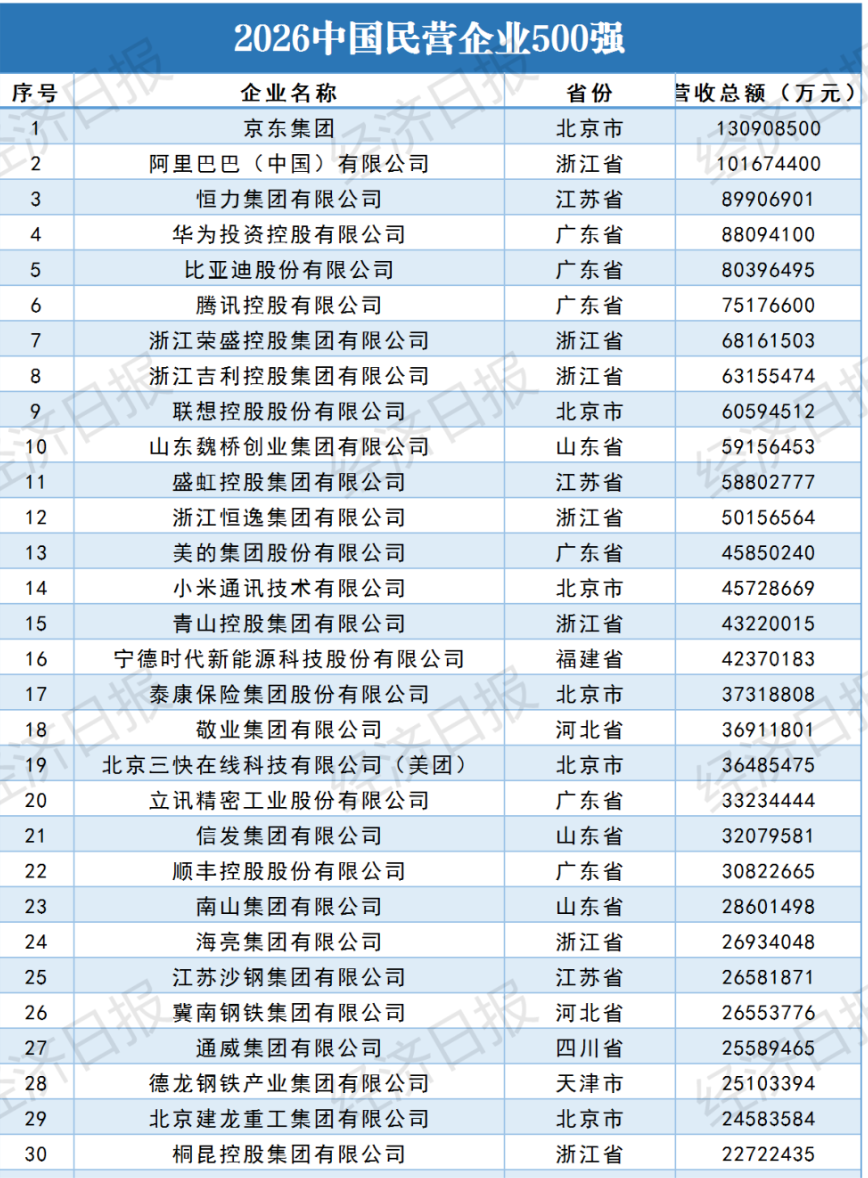
On September 22, the All-China Federation of Industry and Commerce unveiled the '2026 Top 500 Private Enterprises in China' list in Tianjin, highlighting the remarkable prowess of automotive companies.
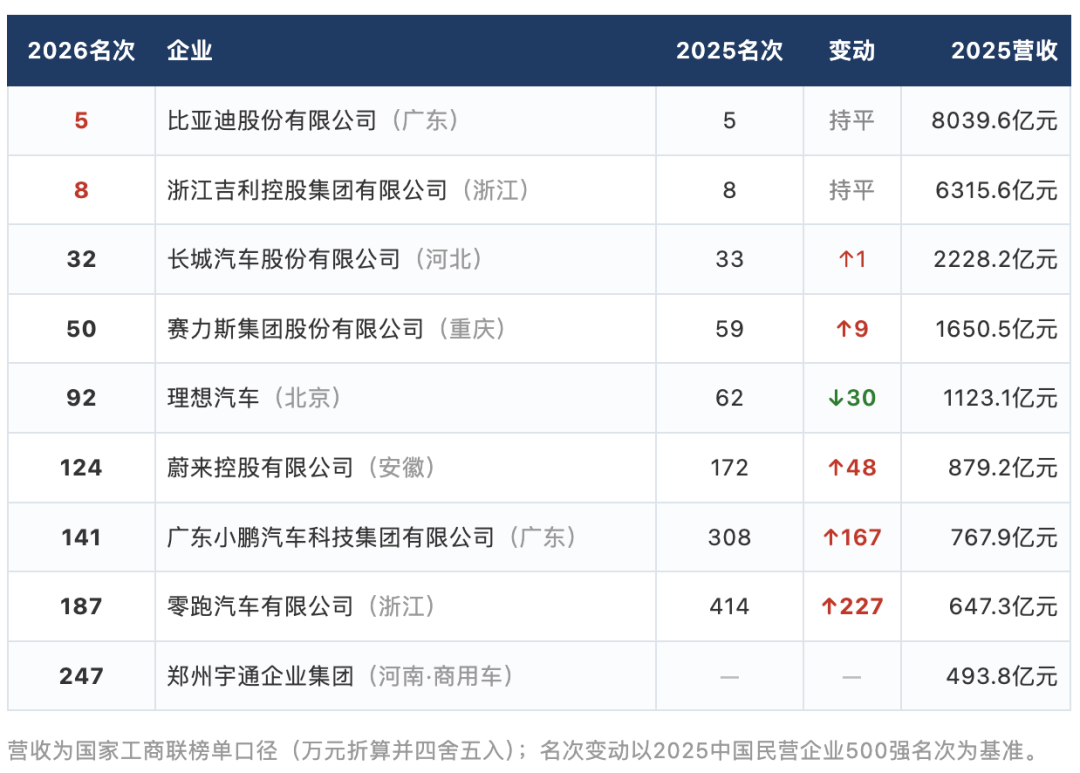
As depicted in the figure below, Guanchejun observed that a total of nine complete vehicle manufacturers made it onto the list this year: BYD, Geely, Great Wall, Seres, Li Auto, NIO, XPeng, Leapmotor, and Zhengzhou Yutong, which specializes in commercial vehicles. The list encompasses a wide array of companies, each excelling in distinct domains.
Let's begin with the frontrunners.
BYD secured the 5th position with revenue amounting to RMB 803.96 billion; Geely followed closely at 8th place with RMB 631.56 billion in revenue. These two are the sole automotive companies in the top ten, a testament to their significant market presence.
Their rankings remained consistent with the previous year. BYD's revenue in 2025 witnessed a 3.46% increase compared to the year before, with its prior listing reflecting revenue of RMB 777.102 billion.
At the RMB 800 billion revenue mark, each incremental step forward becomes increasingly challenging.
Geely fared somewhat better, with revenue growing by 9.87%, adding RMB 56.7 billion in a single year—equivalent to the size of another mid-tier automaker.
In the traditional automotive sector, Great Wall Motor ranked 32nd with revenue of RMB 222.82 billion, moving up one spot from 2025 with a 10.20% increase.
Among traditional independent automakers, this growth rate is commendable.
Seres ascended from 59th to 50th place with revenue of RMB 165.05 billion, marking a 13.69% increase and making its debut in the top 50. For a brand that was on the verge of survival just a few years ago, this achievement is no small feat.
However, Guanchejun also pointed out that their growth rates—10% and 14%—pale in comparison to their explosive growth in previous years. After new energy penetration surpassed 50%, growth has become more challenging for all players.
The new force (emerging automakers) camp exhibits signs of divergence, which is the most intriguing aspect of this year's list.
On one hand, Leapmotor soared from 414th to 187th, leaping 227 spots in a single year—the largest rise among all listed automakers. Its revenue reached RMB 64.73 billion, up 101.3% year-on-year; it delivered 596,600 vehicles, up 103.1% year-on-year, doubling its sales for two consecutive years.
XPeng also made significant strides: from 308th to 141st, up 167 spots. Its revenue reached RMB 76.79 billion, up 87.7% year-on-year; it delivered 429,400 vehicles, up 125.9% year-on-year.
NIO performed more steadily, rising from 172nd to 124th, up 48 spots, with revenue of RMB 87.92 billion and deliveries of 326,000 vehicles, up 46.9% year-on-year.
Then there's Li Auto, the only one to experience a decline: from 62nd to 92nd, down 30 spots. Its revenue reached RMB 112.31 billion, down 22.3% year-on-year.
When analyzing per-vehicle revenue, the picture becomes clearer.
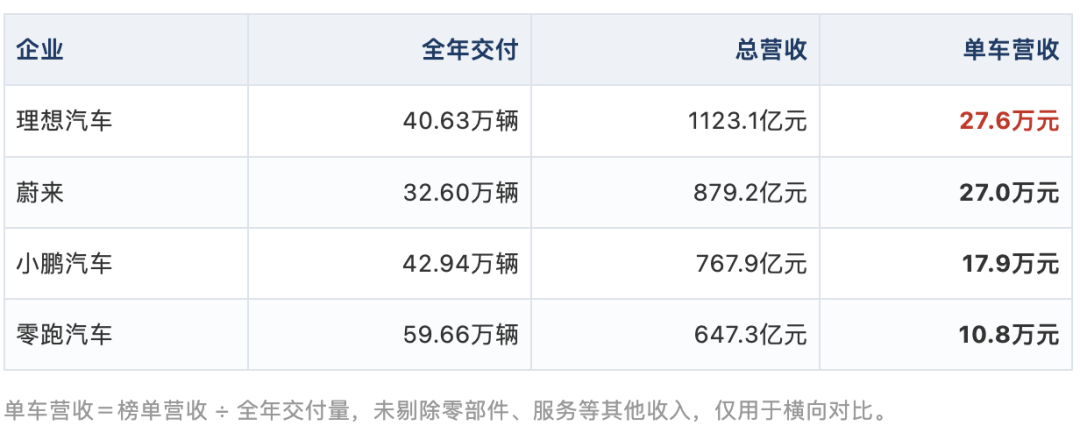
As shown in the figure above, Leapmotor sold 596,600 vehicles—the most among the four—but its per-vehicle revenue was only RMB 108,000, less than 40% of Li Auto's (RMB 276,000). Li Auto sold the fewest vehicles but had the highest per-vehicle revenue.
This explains why Leapmotor rose 227 spots and Li Auto dropped 30, yet Li Auto's revenue scale is still 1.7 times that of Leapmotor.
In Guanchejun's opinion, the new forces are no longer solely competing on volume—it's about who can generate profits within their respective price segments.
Leapmotor achieved RMB 540 million in net profit for 2025 through scale, marking its first full-year profit; XPeng reported RMB 380 million in net profit for Q4 alone; NIO reported RMB 283 million in net profit for Q4, reaching the breakeven point for the first time.
Thus, only two companies truly turned a profit for the year: Li Auto with RMB 1.1 billion and Leapmotor with RMB 540 million.
Li Auto may have slipped in rankings, but it still boasts RMB 101.2 billion in cash reserves—the largest among the four. So, each company has its own set of joys and worries.
From this list, Guanchejun can distill several current characteristics of the private complete vehicle industry:
First: New energy reshapes rankings, and the speed of transformation determines list positions.
Compared to previous years' lists, complete vehicle manufacturers with rapid revenue growth and significant ranking improvements have all bet on the new energy sector. Whether traditional private enterprises or new forces, those with a comprehensive new energy product lineup have witnessed revenue expansion rates significantly higher than the industry average.
Second: Scale does not equate to profitability, and profit challenges persist despite large revenues.
Although multiple companies have achieved RMB 100 billion in revenue, the overall profitability of the auto industry remains low. Heavy R&D investment, price war competition, and fluctuations in upstream costs such as batteries continue to squeeze profit margins for complete vehicle manufacturers. BYD, leveraging its massive scale, has achieved better profitability, while most companies, especially the new forces, are still in the stage of 'trading scale for profit.'
Third: Overseas expansion is the common second growth curve. All eight complete vehicle manufacturers on the list have identified overseas markets as a future focus. However, overseas operations also face challenges such as trade barriers, localization, and brand building.
Fourth: Industry reshuffling continues, and list positions are not permanent. The Top 500 Private Enterprises list uses annual revenue as a hard threshold. For complete vehicle manufacturers, if sales slow or product iterations lag, they risk dropping off the list in the next edition.
In the rapidly evolving new energy sector, no company can afford to rest on its laurels.
The charts in this article, unless otherwise noted, are sourced from public disclosures through various channels. We hereby acknowledge and express our gratitude! The views expressed herein are for reference only and do not constitute investment advice.
This article is original content from Guanchejun and is prohibited from reproduction without authorization. For reproduction, please obtain authorization. Additionally, when authorized for reproduction, please indicate (note) the source and author at the beginning of the article. Thank you!
-
![]()
JAC Motors Hits Price Ceiling, Leverages Huawei to Step into the 'Post-Seres' Era
-
AI Sparks a New Era of Efficiency Revolution
-
![]()
'Token Loans' See Intensive Rollout, Banks' Credit Anchors Quietly Shift
-
![]()
Is Seres Parting Ways with Huawei? Seres Chairman Rarely Responds! Yet, Other Sectors Are Also Forging Their Own Paths
-
![]()
Misconceptions and Misjudgments Surrounding Huawei
-
![]()
Zuckerberg of ALL IN AI Can Finally Breathe a Sigh of Relief
-
![]()
China’s Automotive Aftermarket Embraces New Policies to Unlock Growth Potential
-
![]()
"Xiaomi in the Auto Circle" Declares War on Xiaomi Auto: Are Double-Decker Vehicles the Next Battleground?