Tuopu Group Sees 10% Revenue Growth, But Profits Decline by 21%: Robot Business Contributes Just 14.0477 Million Yuan
 09/23 2026
 403
403
Revenue Up 9.8%, Profits Down 21.0%: Tuopu Faces Challenges from Annual Price Cuts and Rising Costs, Betting Big on Robots
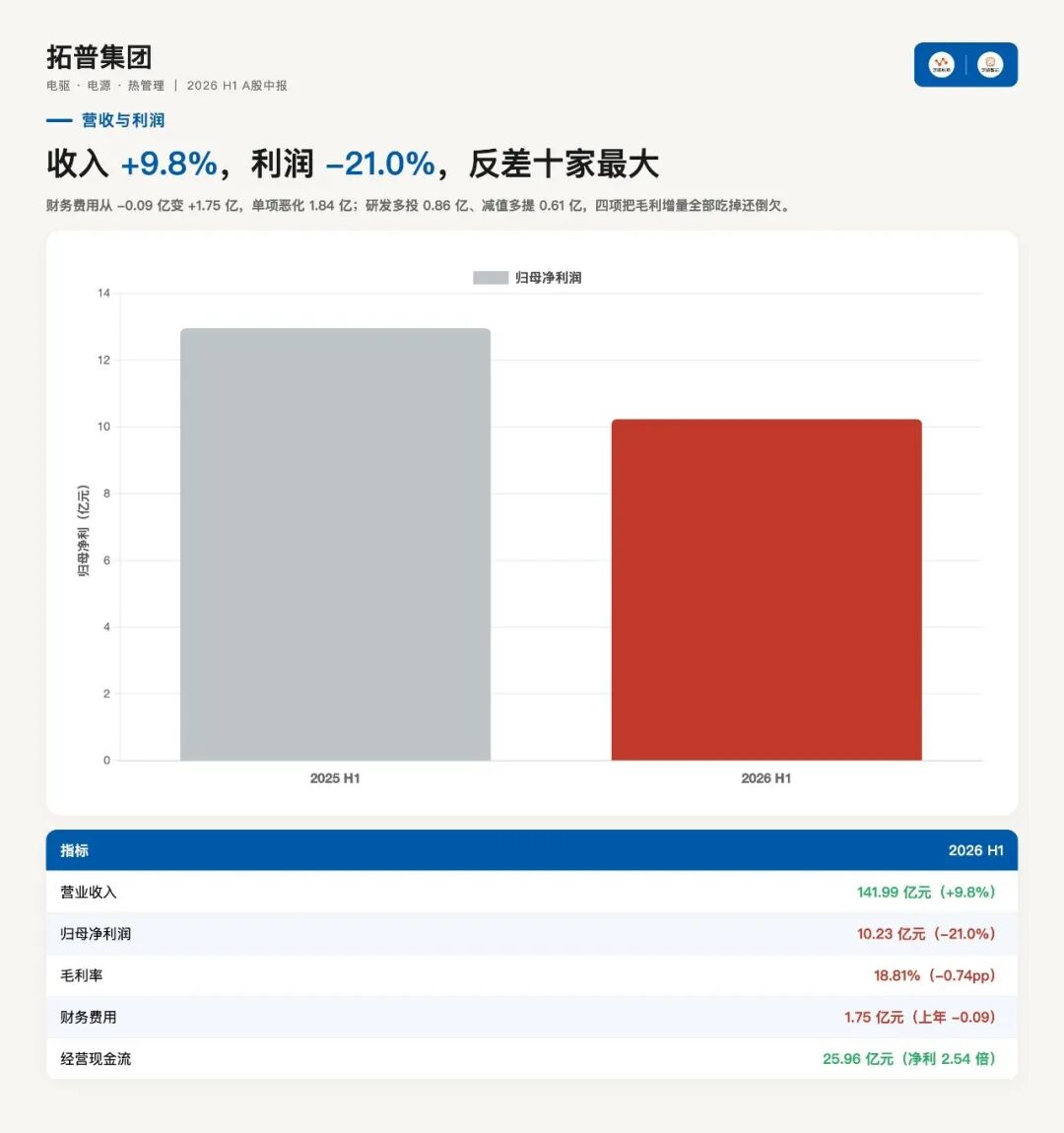
Tuopu Group reported a revenue of 14.199 billion yuan for the first half of the year, marking a 9.8% increase year-on-year. However, its net profit attributable to shareholders fell by 21.0% to 1.023 billion yuan during the same period.
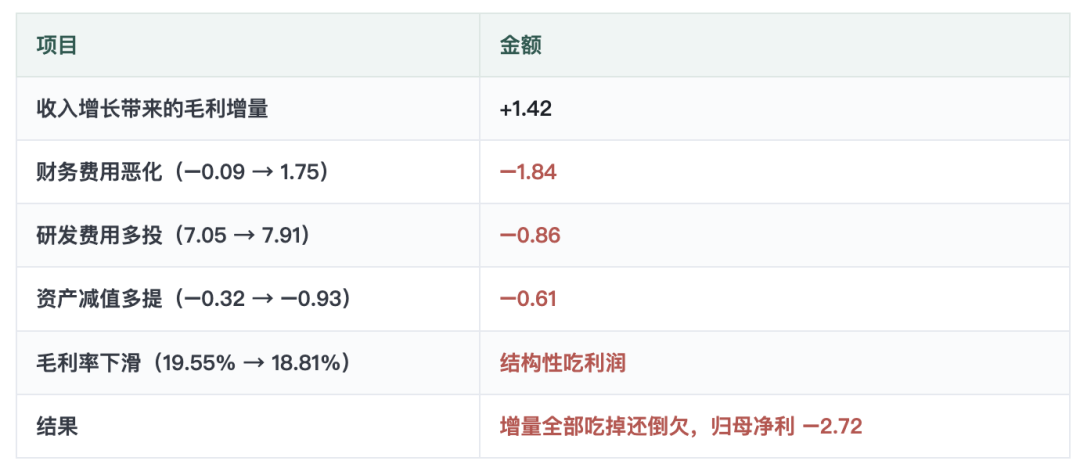
Financial expenses shifted from a net gain of 90 million yuan in the previous year to a net loss of 175 million yuan, representing a deterioration of 184 million yuan in a single item. R&D investment surged by 86 million yuan, asset impairment provisions increased by 61 million yuan, and the gross profit margin dipped from 19.55% to 18.81%. The 142 million yuan rise in gross profit due to revenue growth was entirely offset by these factors, leaving a deficit.
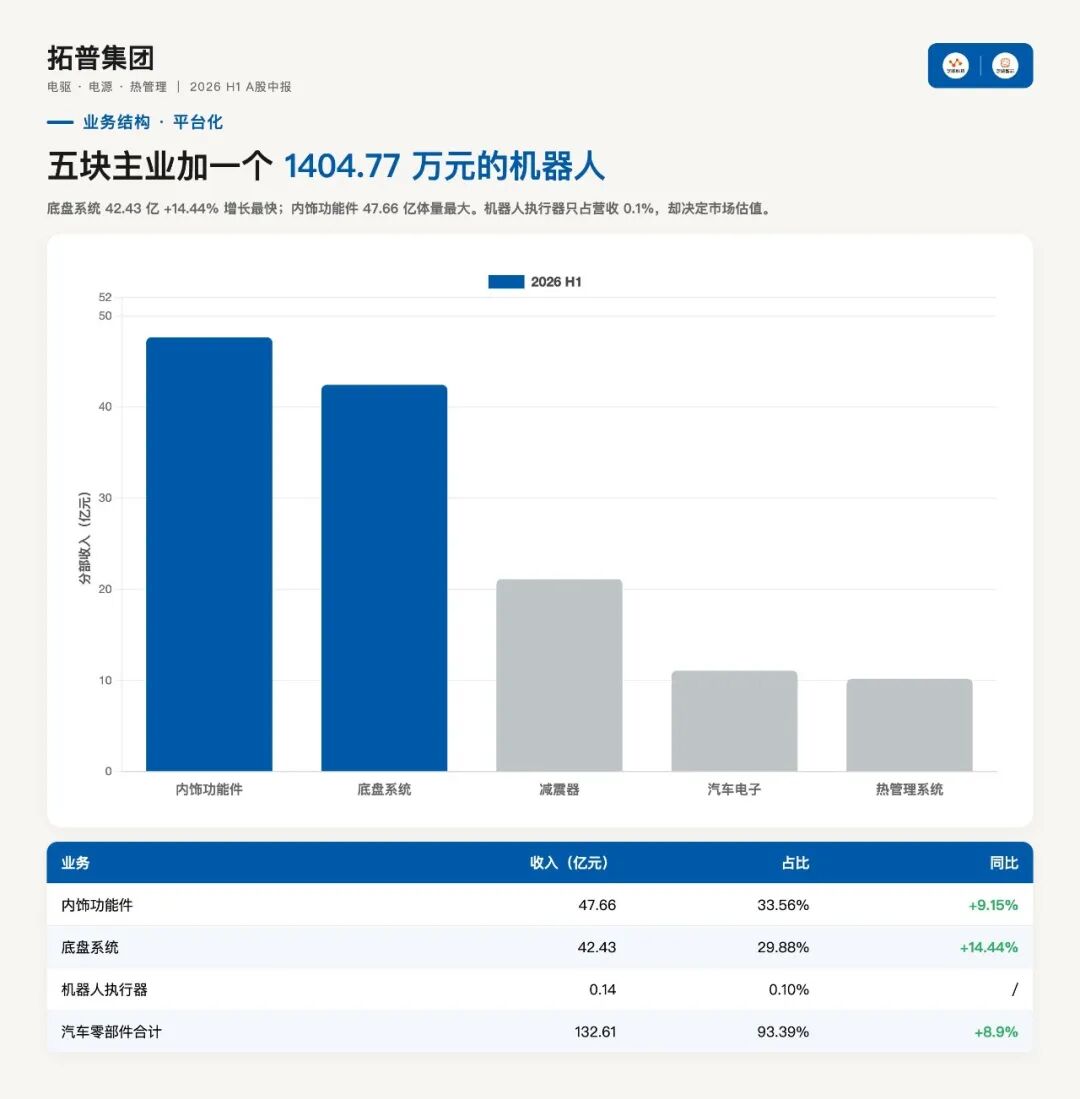
The robot actuator business, a frequent topic of market discussion, generated revenue of 14.0477 million yuan in the first half, accounting for a mere 0.1% of the total revenue.
Part 1: Interim Report Highlights
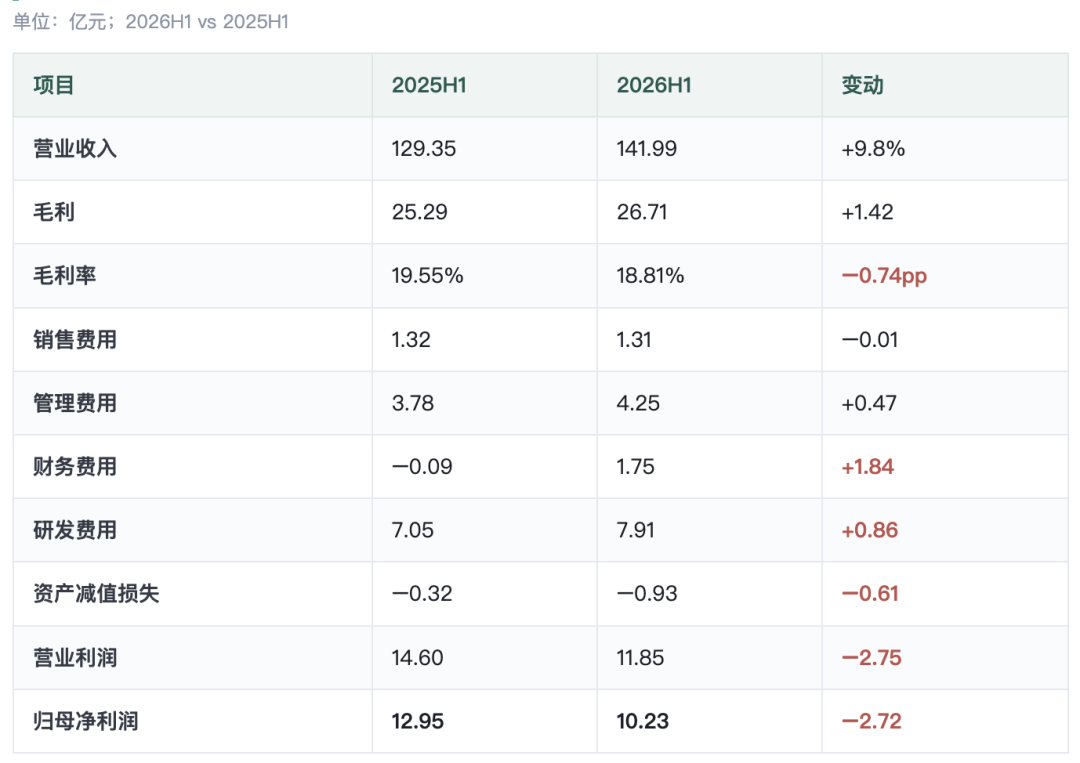
Here's a breakdown of the profit situation for the first half of 2026:
◎ Revenue: 14.199 billion yuan; Operating costs: 11.528 billion yuan; Gross profit: 2.671 billion yuan; Gross profit margin: 18.81%.
◎ Selling expenses: 131 million yuan; Administrative expenses: 425 million yuan; R&D expenses: 791 million yuan; Financial expenses: 175 million yuan. Total expenses amounted to 1.522 billion yuan, with an expense ratio of 10.72%.
◎ After deducting the four major expenses from the gross profit, 1.149 billion yuan remained, accounting for 8.09% of the revenue, ranking second among ten companies.
◎ Adding net investment income of 19 million yuan, reversing credit impairment losses of 27 million yuan, and subtracting asset impairment losses of 93 million yuan, the operating profit stood at 1.185 billion yuan. After deducting income tax of 151 million yuan, the net profit attributable to shareholders was 1.023 billion yuan, with a net profit margin of 7.20%.
◎ R&D expenses of 791 million yuan accounted for 5.57% of the revenue, the second-highest absolute amount among ten companies, following Sanhua's 763 million yuan. However, Sanhua has a larger scale and a lower proportion.
The 0.74 percentage point decline in the gross profit margin suggests that the product mix, pricing, or cost conditions of the new revenue were less favorable than the average level of the previous year.
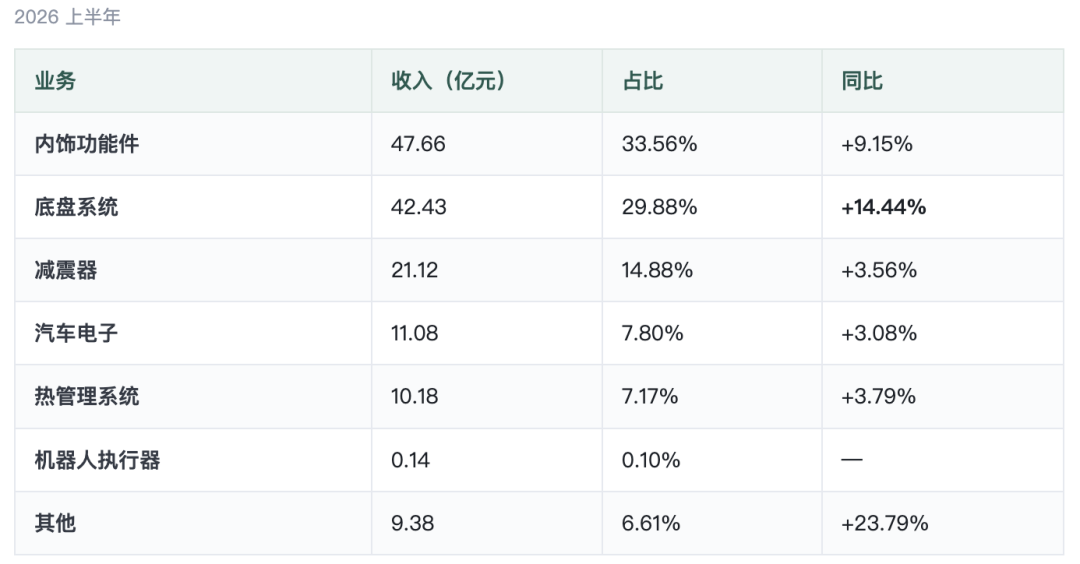
◎ Automotive components revenue totaled 13.261 billion yuan, accounting for 93.39% of the total and growing by 8.9% year-on-year. The chassis systems segment experienced the fastest growth, while interior functional parts had the largest volume. Shock absorbers, automotive electronics, and thermal management grew between 3% and 4%.
◎ Operating cash flow was 2.596 billion yuan, 2.54 times the net profit attributable to shareholders of 1.023 billion yuan, with free cash flow of +1.242 billion yuan. The cash flow performance was significantly better than the profit statement.
◎ Short-term borrowings were 3.911 billion yuan, easily covered by monetary funds of 5.326 billion yuan, with interest expenses already reflected in the profit statement.
Part 2: Key Takeaways
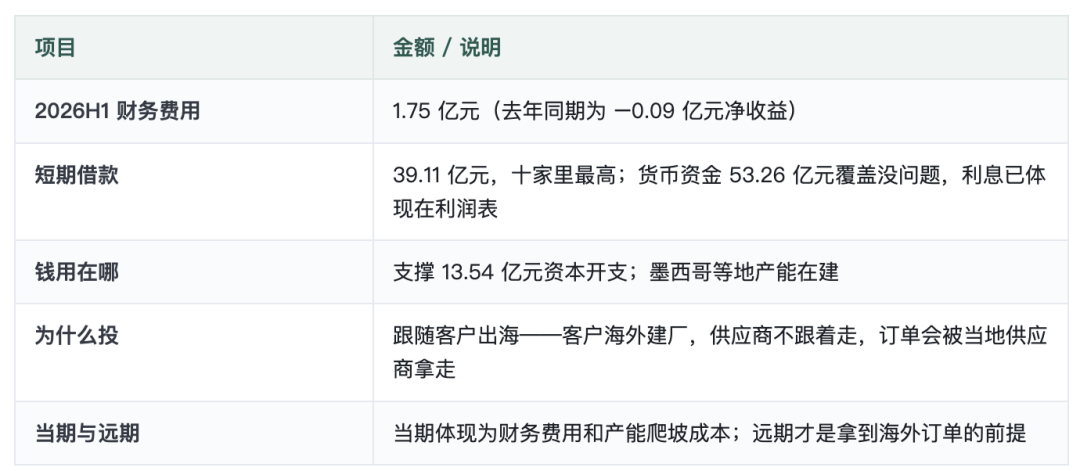
The 184 million yuan deterioration in financial expenses was the primary driver of the profit decline.
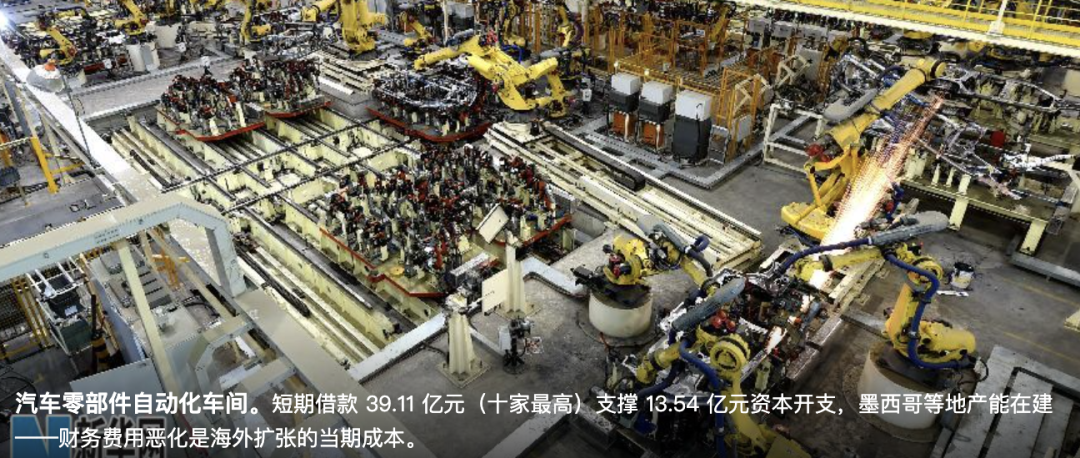
The composition of this deterioration awaits confirmation from the financial expense notes, but relevant actions are evident: short-term borrowings of 3.911 billion yuan supported 1.354 billion yuan in capital expenditures, with capacity under construction in Mexico and other locations.
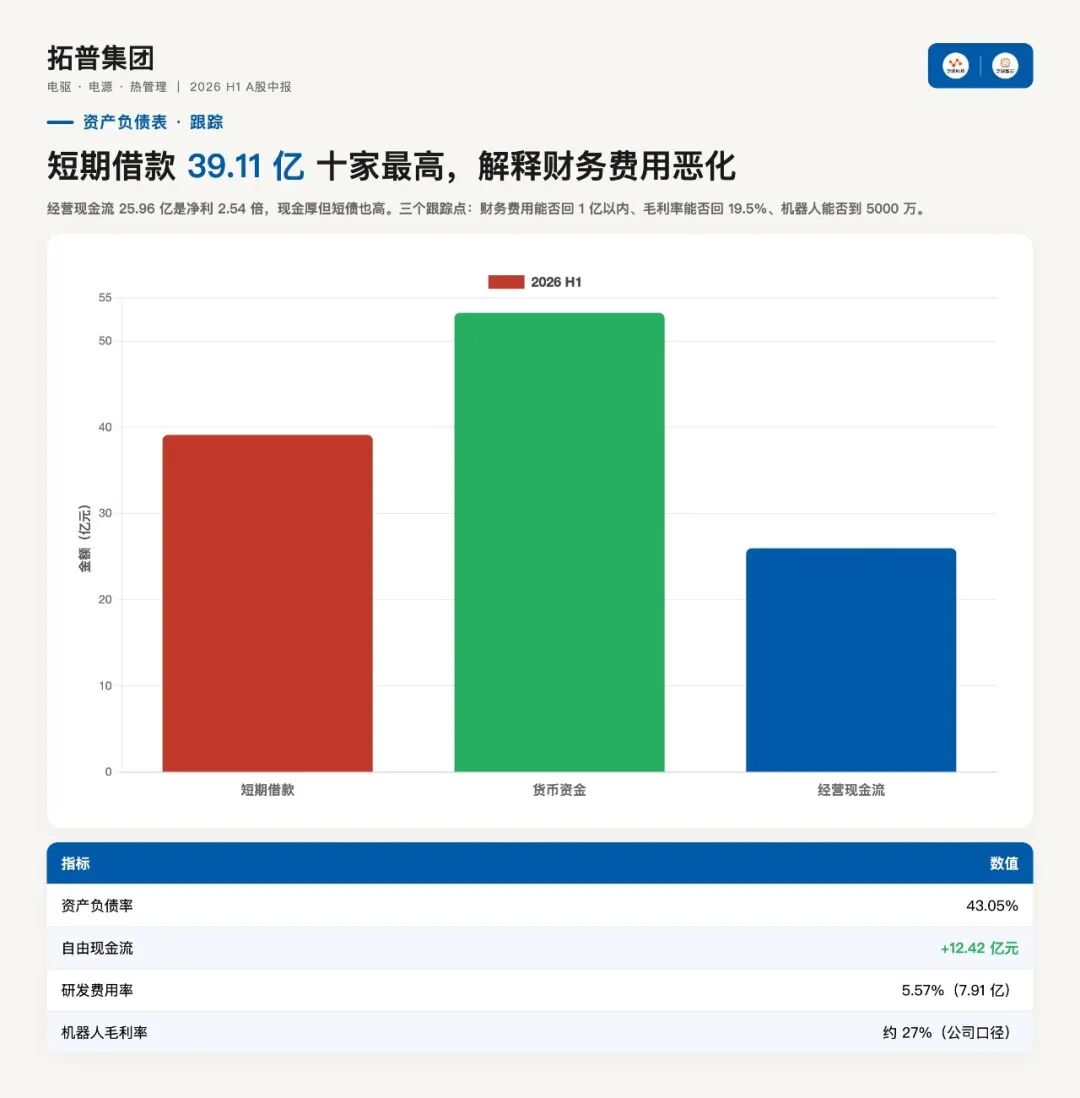
The company's capacity expansion in Mexico is aimed at following customers overseas. If customers establish factories overseas and suppliers do not follow suit, orders will be captured by local suppliers. This investment is reflected in current financial expenses and capacity ramp-up costs, with securing overseas orders being the long-term benefit.
The 14.0477 million yuan in robot actuators represents the standalone robot revenue reported in the financials.
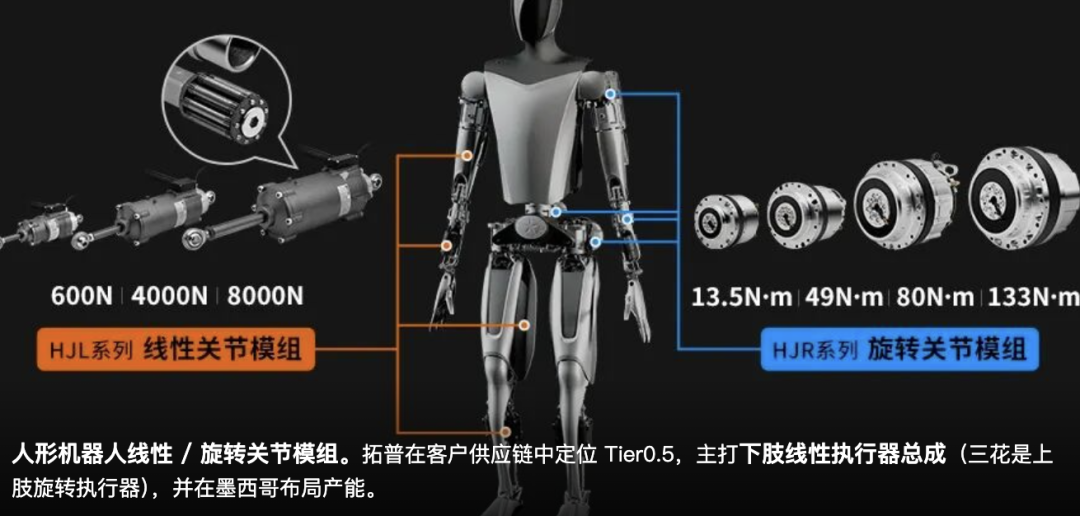
According to the company's interim report and public industry research, robot revenue grew approximately 83% year-on-year, surpassing the total for last year, with a gross profit margin of about 27%. Linear actuators, rotary actuators, and dexterous hand motors entered small-batch delivery, while body structural components, foot shock absorbers, and electronic flexible skins simultaneously advanced mass production capacity building. The first phase of the robot components industrial base was nearly complete.
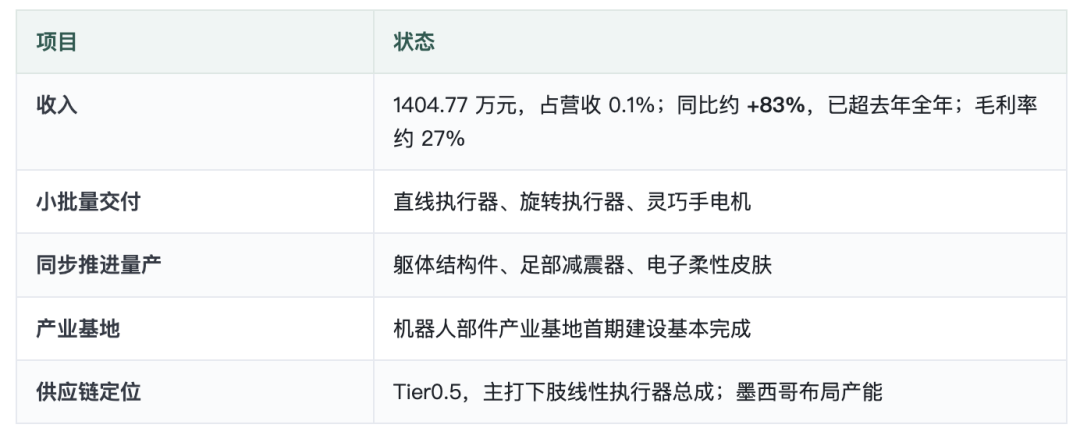
The company positions itself as a Tier 0.5 supplier in the customer supply chain, focusing on lower limb linear actuator assemblies, with capacity expansion in Mexico. The final word rests with the company's official announcements.
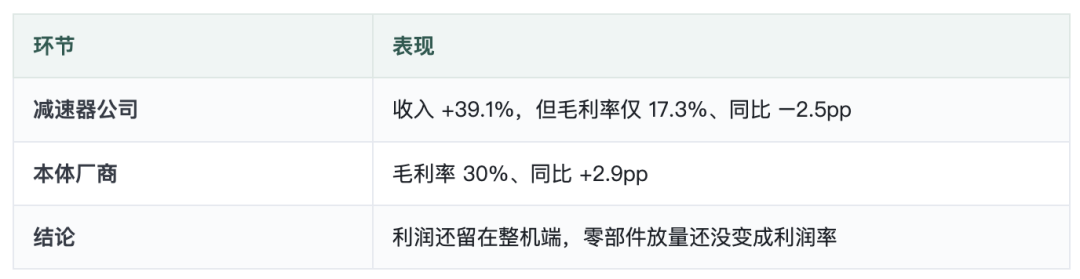
Industry background shows that humanoid robot shipments grew nearly 300% in the first half, with component segments moving from sample verification to small-batch delivery. Reducer companies saw revenue grow 39.1% in the first half.
However, the gross profit margin was only 17.3%, down 2.5 percentage points year-on-year, while integrated manufacturers had a 30% gross profit margin, up 2.9 percentage points year-on-year, indicating that profits remain at the integrated end.
The platform-based model determines the profit margin structure.
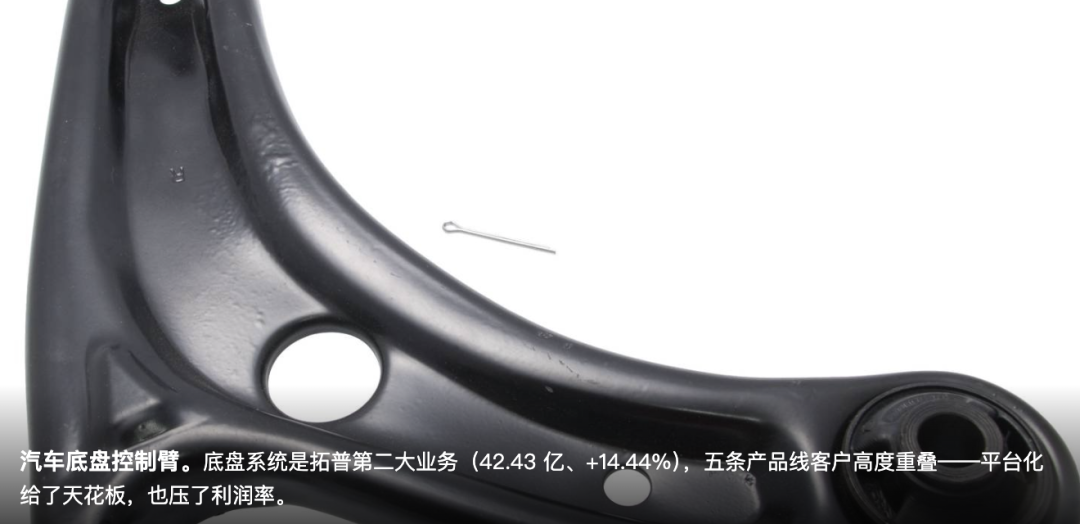
The five product lines—interiors, chassis, shock absorption, automotive electronics, and thermal management—share highly overlapping customers. Each new vehicle model launched by customers creates opportunities for multiple product categories, raising the revenue ceiling. However, each line requires maintaining capacity, R&D, and certifications, with non-current assets at 20.830 billion yuan and 791 million yuan in R&D covering five categories.
With a gross profit margin of 18.81% and a net profit margin of 7.20%, lower than focused players like Sanhua and Vmax, platform-based suppliers with larger scales have less bargaining power than high-value-added single-product manufacturers when facing annual price reduction pressures.
Summary
The main business is significantly larger than the robot segment, with the main business determining current profits and robots determining long-term valuation. The intersection depends on when actuators move from small-batch to mass delivery.
-
![]()
Why Has CATL Reached This Point?
-
![]()
Tuopu Group Sees 10% Revenue Growth, But Profits Decline by 21%: Robot Business Contributes Just 14.0477 Million Yuan
-
![]()
Shenzhen Announces Procurement Results for 2,036 Buses: BYD, Nanjing Golden Dragon, and ZTE Secure Contracts
-
![]()
Behind 'Audi Sues Audi': Profiteers Flock to Germany, Rumors Stay in China
-
![]()
Seres' Stock Price Soars for Five Straight Days: Is Investor Confidence Rising Over AITO Brand Control?
-
![]()
Porsche’s Winter Deepens: Another 4,100 Jobs to Be Cut Amid Worsening Conditions
-
![]()
26 New Models Launch in 'Golden September', Automotive Market Hits Late-Month High
-
![]()
JAC Motors Hits Price Ceiling, Leverages Huawei to Step into the 'Post-Seres' Era