Why Has CATL Reached This Point?
 09/23 2026
 557
557

Peers Overshadowed by the 'Battery King'
Image Source | Internet (Please contact for deletion if infringing) Partially AI-generated
With a net profit of RMB 72.2 billion and a market value evaporating by RMB 800 billion, the 'Battery King' finds itself under collective siege by its own clients.
In four and a half months, nearly RMB 800 billion wiped out.
No black swan events, no earnings surprises—net profit in the interim report even grew 41.98% year-on-year. Yet the stock price continued to fall.
This is the surreal reality CATL faces: On one hand, impressive 2025 results with RMB 423.7 billion in revenue and RMB 72.2 billion in net profit, averaging nearly RMB 200 million in daily profits. On the other, its stock price plummeted from RMB 467 in May to RMB 297, a cumulative decline exceeding 36%.
Profits rise, market value falls. What is the market afraid of?
In 2025, CATL's net profit reached RMB 72.2 billion. Meanwhile, the combined net profit of five leading automakers—BYD, Geely, SAIC, Great Wall, and Changan—totaled RMB 73.5 billion.
A single battery supplier outearned five automakers combined.
Even more striking is the profit margin: CATL's 2025 gross margin reached 26.27%, 6.4 times that of the automotive industry.
Cui Dongshu, Secretary-General of the China Passenger Car Association, bluntly stated at an industry event that Chinese automakers collectively achieved USD 14.7 billion in profits, with CATL alone accounting for USD 7.1 billion. 'Non-battery automakers shared just over 10% of the profits,' he said, using four words to describe the situation—'utterly dismal.'
This explains why the notion of 'automakers working for battery makers' resonates so widely.
Zeng Qinghong, former Chairman of GAC Group, publicly complained as early as 2022: 'Batteries account for 60% of vehicle costs. Am I not working for CATL then?'
Three years on, the issue has only worsened.
In Q1 2026, CATL's net profit of RMB 20.7 billion exceeded the combined profits of seven leading automakers. The average profit margin of the vehicle industry has fallen to around 4%.
While battery giants reap huge profits, automakers struggle in price wars.
This extreme profit distribution imbalance is the fundamental driver behind the 'de-CATLization' trend.

The Rallying Cry of 'De-CATLization'
Starting in H2 2025, automakers intensified their moves.
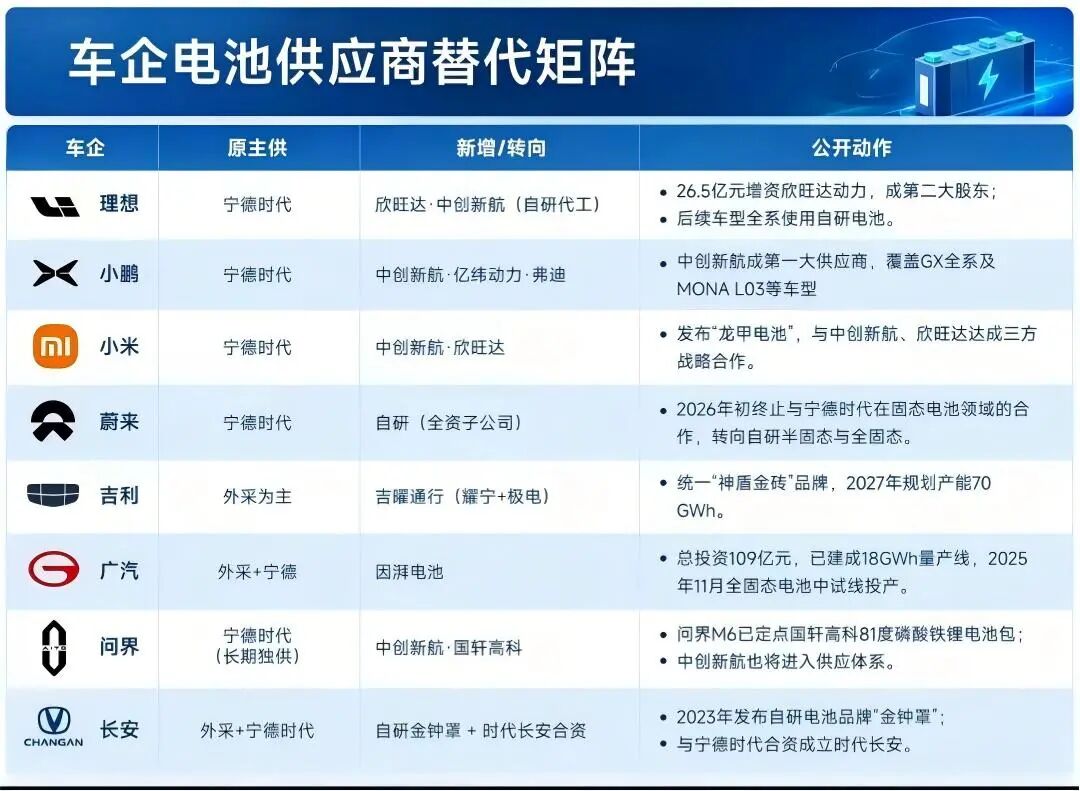
Leapmotor held a Technology Day in Huzhou, announcing 100% self-developed and manufactured battery cells, launching three standardized cell models, with its first cell production line already operational.
Xpeng's founder revealed after the G9L launch that the company would now self-produce all batteries. Li Auto announced its self-developed batteries would gradually equip all models, having previously invested RMB 2.65 billion in Sunwoda Power, acquiring a nearly 9% stake.
GAC's Inpower Batteries invested RMB 10.9 billion with a planned total capacity exceeding 60GWh.
Geely consolidated its battery assets to establish Jiyao Mobility. Great Wall and Chery accelerated their solid-state battery development.
The scene resembles a 'rebellion.'
However, closer inspection reveals vast differences in the 'self-developed batteries' claimed by automakers, which fall into at least three tiers:
The first tier involves true self-development and manufacturing, handling everything from cell material formulation to battery packs and BMS in-house. Great Wall's SVOLT Energy and GAC's Inpower follow this path.
The second tier involves 'self-development with contract manufacturing.' Automakers handle product definition and battery pack design, while cell production is outsourced to suppliers. Li Auto's 5C batteries, led by Li Auto but manufactured by Sunwoda, and Xiaomi's Dragon Scale batteries, defined by Xiaomi with custom cells from CALB and Sunwoda, fall into this category.
The third tier essentially involves switching suppliers. NIO, Leapmotor, and Xpeng bring battery pack integration in-house while still purchasing cells externally, merely introducing secondary suppliers like CALB, Gotion High-Tech, and Sunwoda to reduce reliance on CATL.
According to McKinsey estimates: Automakers only achieve cost advantages in self-producing cells when vehicle production exceeds 500,000 units or battery production surpasses 15GWh. For most automakers, this threshold remains far out of reach.
Cell manufacturing epitomizes 'process alchemy + capital black hole,' requiring tens of GWh scale and high yields to operate effectively. As a capital-intensive industry, only sufficient scale can amortize costs. Sales volatility can drag down automakers' balance sheets with heavy asset production capacity (capacity).
Thus, many automakers' 'de-CATLization' efforts resemble negotiation tactics: diverting procurement shares to pressure CATL on pricing rather than seeking complete separation.
Who Is Replacing CATL?
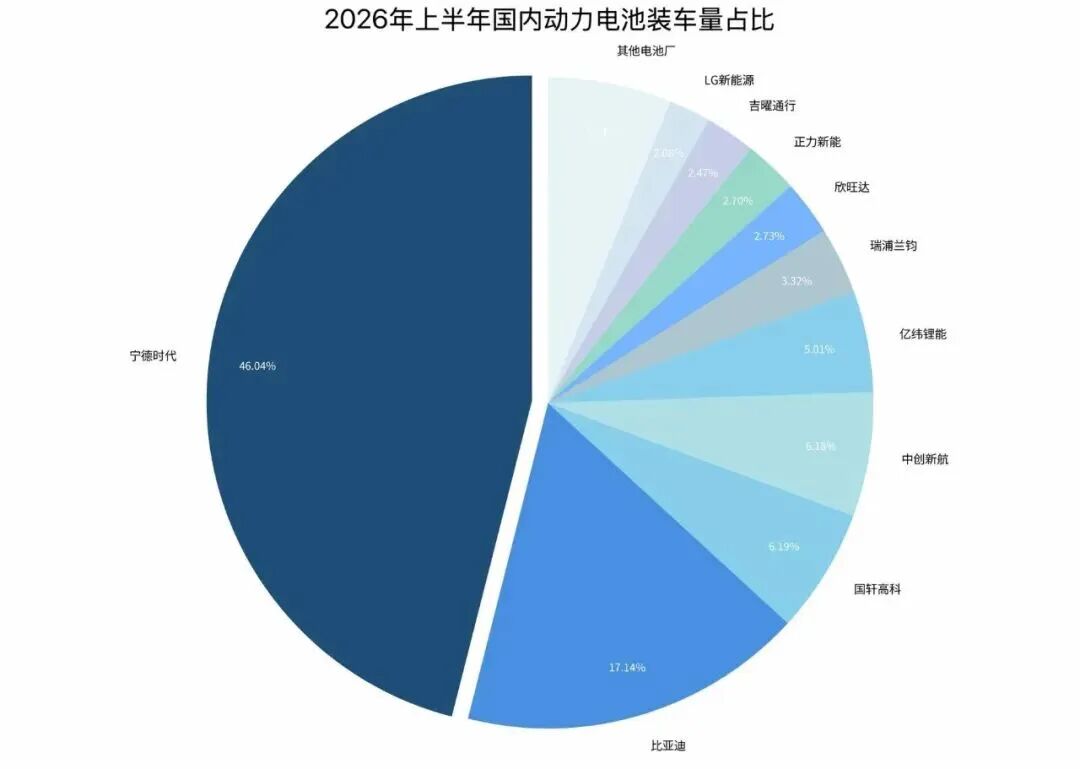
Data shows CATL not only survived 'de-CATLization' but rebounded strongly in Q1 2026.
CPCA data indicates CATL regained a 50.1% market share in Q1 2026, reclaiming 'half the market' for the first time in five years.
Meanwhile, BYD's share slipped to 17.5%, with second-tier players like Gotion High-Tech at 6.1% (third), CALB at 5.3%, and EVE Energy at 5%.
Interestingly, while automakers cry 'de-CATLization,' CATL's share rebounded. This suggests 'de-CATLization' hasn't weakened CATL's competitiveness but rather provided automakers with supply chain alternatives, enhancing their bargaining power.
The real threat comes from BYD. FinDreams Battery accelerated external supply, with external sales exceeding 20% in H1 2025, doubling from end-2024.
Clients include Xiaomi, FAW, NIO, Xpeng, Mercedes-Benz, and Audi. Xiaomi Auto, with 17.9% procurement share, surpassed Xpeng as FinDreams' largest external client.
Second-generation Blade Batteries will power FAW Hongqi's next-gen BEV platform, while Mega Flash Charging technology will debut in external brand models.
BYD's threat lies not in battery technology but its vertically integrated cost advantage. As both automaker and battery maker, BYD inherently controls battery costs better than CATL.
Second-tier players pose less threat. CALB's 2025 net profit reached ~RMB 2 billion, Gotion High-Tech ~RMB 2.5-3 billion—orders of magnitude smaller than CATL's RMB 72.2 billion.
The critical gap lies in capacity utilization: ~85-97% for leaders vs. ~40-65% for second-tier players.
Low utilization means slower yield improvement, higher unit costs, and poorer delivery stability. Some automaker engineers privately note CATL's battery consistency and stability significantly outperform second-tier brands.
This explains why many automakers, despite introducing secondary/tertiary suppliers, still choose CATL for core models' primary batteries—not out of sentiment but to avoid product and reputation risks.

How Deep Is CATL's Moat?
Judging solely by profit distribution, one might conclude CATL is a 'profiteering middleman.' The reality is far more complex.
In 2025, CATL invested RMB 22.1 billion in R&D, with cumulative investments over RMB 90 billion in the past decade, holding/applying for over 54,000 domestic/foreign patents and employing ~23,000 R&D personnel. This R&D scale exceeds most automakers' annual budgets.
Technologically, CATL covers all mainstream and cutting-edge battery routes—Qilin Batteries, Shenxing Ultra-Fast Charging Batteries, Sodium-Ion Batteries, and Condensed Matter Batteries.
It also launched third-gen Shenxing Ultra-Fast Charging, third-gen Qilin, and second-gen Xiaoyao Extended-Range Hybrid Batteries, deepening its technological moat at every node.
Beyond products, CATL pursues two longer-term strategies:
First, expanding from 'selling batteries' to 'selling chassis.' Its Panstone Chassis Technology integrates batteries deeply with chassis. CATL signed a 10-year strategic partnership with GAC focusing on intelligent chassis and battery-swapping ecosystems, advancing Panstone Chassis adoption.
This positions CATL beyond component supplier into defining vehicle technology foundations.
Second, transitioning from 'B2B' to 'B2C' branding—CATL's most underestimated strategy. It introduced the 'CATL Inside' logo, promoting 'Choose EVs with CATL Batteries' and becoming broadcast partner for the UEFA European Championship and Olympics, even advertising in airports and high-speed rail stations.
These efforts yielded immediate results. NielsenIQ reports global brand trust in CATL reached 78%, with China at 81%. 37.1% of Chinese consumers admit they'd abandon a model if it lacked CATL batteries.
Models with CATL batteries command 3-5% higher residual values in the used market.
When consumers 'recognize batteries over vehicles,' CATL's brand premium becomes a product strength rather than an automaker burden. News of EV owners demanding CATL battery replacements confirms this.
This duality—loved and hated by automakers—defines CATL: You can diversify procurement but not 'de-CATLize' consumer mindshare.

Where Are CATL's Real Risks?
Despite its strengths, CATL's 35% stock plunge suggests market rationality.
First, cost benefits won't last. Lithium carbonate prices fell from ~RMB 200,000/ton in May to RMB 124,000/ton in September. CATL purchases ~450,000 tons annually, theoretically reaping billion-dollar cost savings.
But markets expect these savings to evaporate. Battery supply contracts typically include lithium price linkage clauses, requiring price adjustments as lithium falls, thus redistributing gains to automakers.
Coupled with RMB 100+ billion inventory digestion pressure, cost benefits are being 'queued and shared' downstream.
Second, founder team share reductions. In November 2025, the co-founder offloaded >45 million shares via block trade, valued at >RMB 18.4 billion at the time, erasing >RMB 100 billion in market value on the first trading day post-announcement.
While citing 'personal financial needs,' the impact on market confidence was real. This co-founder had already stepped down in 2022 to venture into energy storage.
Third, industry overcapacity looms. Power and storage battery inventories exceeded 400GWh in 2025, with H1 2026 additions surpassing full-year 2025 levels.
Installation rates plummeted from 70% in 2023 to 38% in May 2026. As the industry shifts from 'battery shortage' to 'overcapacity,' valuation logic for leaders must Refactoring (restructure).
Finally, overseas uncertainties persist. Though CATL's overseas revenue share rose to 30.6% in 2025 with 30% global market share, trade barriers like the EU's Industrial Accelerator Act are rising.
While its Hungarian plant's 100GWh capacity (€7.34 billion) is pre-booked by Mercedes, BMW, and Volkswagen, capital expenditures and geopolitical risks for overseas factories remain overhead.

For five years, CATL was the absolute technology definer and price setter in power batteries. Automakers had no choice, nor did consumers recognize other battery brands. In such a position, excess profits were almost inevitable.
But today, the tide is turning. Automakers are learning to make batteries, though most remain at the 'switch suppliers' stage—the direction is clear.
BYD's Blade Batteries are accelerating external supply, transforming from 'self-use' to 'global super-supplier.'
Consumers now factor battery brands into purchase decisions, making CATL both a beneficiary and a target of heightened scrutiny.
'De-CATLization' won't shake CATL's fundamentals short-term—its 50.1% market share proves that.
But in the medium term, it is transforming CATL from the 'only choice' to 'one of the best choices.'
The shift from 'only' to 'one'—a difference of just four characters—is the reason behind the evaporation of RMB 800 billion in market value.
The key question going forward is this: When automakers nurture their 'backup plans' and consumer brand perception expands from 'batteries = CATL' to include more options, can CATL leverage its technological and ecological advantages to continue defending its 50% market share?
-
![]()
Why Has CATL Reached This Point?
-
![]()
Tuopu Group Sees 10% Revenue Growth, But Profits Decline by 21%: Robot Business Contributes Just 14.0477 Million Yuan
-
![]()
Shenzhen Announces Procurement Results for 2,036 Buses: BYD, Nanjing Golden Dragon, and ZTE Secure Contracts
-
![]()
Behind 'Audi Sues Audi': Profiteers Flock to Germany, Rumors Stay in China
-
![]()
Seres' Stock Price Soars for Five Straight Days: Is Investor Confidence Rising Over AITO Brand Control?
-
![]()
Porsche’s Winter Deepens: Another 4,100 Jobs to Be Cut Amid Worsening Conditions
-
![]()
26 New Models Launch in 'Golden September', Automotive Market Hits Late-Month High
-
![]()
JAC Motors Hits Price Ceiling, Leverages Huawei to Step into the 'Post-Seres' Era