Diversifying Production Capacity Amid Pressure and Hedging Against Price Wars: Chinese Automakers Seize Overseas Growth Opportunities
 10/08 2026
 461
461
In 2026, the domestic automotive market continues to undergo profound adjustments. Sales of traditional fuel-powered vehicles keep declining, and while the market penetration of new energy vehicles (NEVs) is steadily increasing, internal industry differentiation and price competition show no signs of easing. Amid this pressure on domestic demand, automobile exports have taken a sharply contrasting trajectory. In the first eight months of the year, Chinese automobile exports maintained robust growth, with exports accounting for nearly 40% of total vehicle production. Overseas markets are no longer just a "supplementary channel" for automakers; they have become a key factor in absorbing production capacity, boosting profits, and widening the competitive gap between companies.
▍Exports: The Primary Growth Driver for Automakers Amid Domestic Demand Challenges
First, let's examine the domestic market. Monthly data from the China Association of Automobile Manufacturers (CAAM) reveals that in August, domestic automobile production and sales reached 2.684 million and 2.712 million units, respectively, both experiencing year-on-year declines of approximately 5%. The cumulative production and sales volume from January to August was also lower than the same period last year. Weak demand has led to mounting inventory pressures. Data from the China Passenger Car Association (CPCA) indicates that at the end of August, the national passenger car industry inventory reached 3.14 million units, with inventory turnover days at 56 and the inventory index exceeding the warning threshold.
The internal market structure is also experiencing significant differentiation. In August, the retail penetration rate of new energy passenger vehicles hit a record high of 65.2%. Retail sales of fuel-powered vehicles declined by over 40% year-on-year, with their market share continuing to shrink. These shifts are compelling automakers to reallocate their production capacities. Cui Dongshu, Secretary-General of the CPCA, noted in a public analysis that exports have become the primary growth source for domestic automakers, with some leading companies deriving more than 40% of their sales from exports.
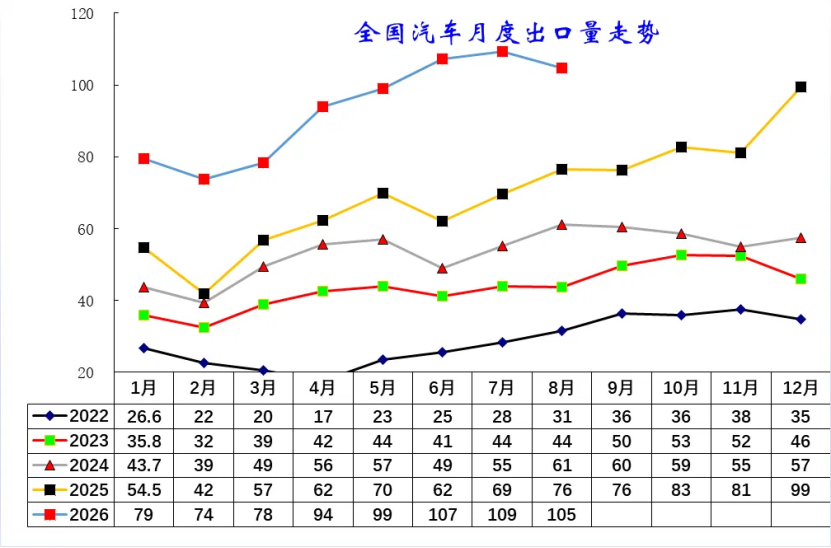
With slowing domestic demand growth, the increase in exports becomes even more critical. According to CAAM's customs-based statistics on whole vehicle exports, 7.153 million units were exported in the first eight months, marking a year-on-year increase of 66.7%, with monthly exports exceeding one million units in August. The CPCA's statistics, which cover a slightly broader scope, show 7.45 million units exported from January to August, a year-on-year increase of 51%, with full-year exports expected to approach 12 million units. While the absolute values differ between the two datasets, the growth trend is consistent. According to CAAM's first-half data, exports already accounted for 39.34% of total domestic vehicle production, nearing 40%.
These figures are first reflected in production capacity utilization. Data from the China Association of Automobile Manufacturers indicates that China's automobile production reached 34.53 million units in 2025, with an annual production capacity utilization rate of 73.20%. Research by East Money Securities points out that the prosperity of overseas markets can offset weak domestic sales and prevent a decline in production capacity utilization. For automakers, keeping production lines running helps spread fixed costs, which is the most direct benefit of exports.
In terms of profitability, domestic profit margins for automakers have been significantly compressed amid a market environment characterized by price wars. However, the situation is different for exports. Terminal selling prices in overseas markets are generally higher than in China. For example, BYD's ATTO 3 (the overseas version of the Yuan PLUS) is priced at over RMB 300,000 in the European market, offering greater profit margins. Research reports also indicate that export profits can partially offset the decline in domestic profits.
At the same time, the differentiation between companies is intensifying. Those that established export layouts early and have high export proportions are showing greater resilience in this round of adjustments. Reports show that in the first half of 2026, Chery Group sold a total of 1.3575 million vehicles, of which 943,800 were exported, accounting for about 69.5%. BYD's overseas sales from January to June 2026 were about 790,000 units, accounting for nearly 44% of its total sales of 1.81 million units. Industry analysis also points out that companies with higher export proportions have experienced significantly smaller declines in overall production and sales compared to those deeply rooted in the domestic market. In other words, export capabilities are becoming a key factor in widening the competitive gap between automakers.
However, there are limits to how much exports can support the domestic market. Cui Dongshu stated that going overseas is a "must" for automakers but not the "only solution." While exports can address incremental sales and profit issues, they cannot compensate for shortcomings in product strength and self-research capabilities. An automaker's core competitiveness still relies on technological iteration in the domestic market. Treating overseas expansion as a "refuge" from domestic competition may only delay necessary adjustments.
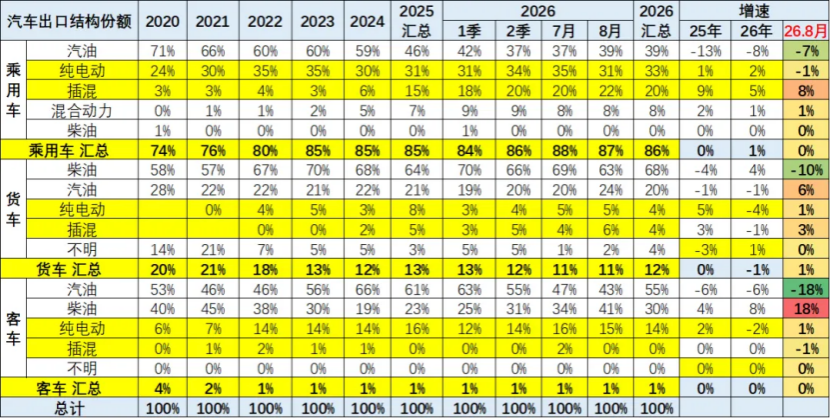
In terms of product structure, new energy vehicles are the core support for export growth. In the first eight months, 3.435 million new energy vehicles were exported, more than doubling year-on-year and accounting for nearly half of total exports. Technological differentiation is evident: Plug-in hybrid models saw the highest growth, with a 121% year-on-year increase in the first eight months, driven mainly by demand in the European market; battery electric models remained steady, with a 50% year-on-year increase. Exports of fuel-powered vehicles continued to grow, with a 27% year-on-year increase in the first eight months, but their structure is upgrading, with mid-to-high-end models featuring 1.5 to 2-liter displacements recovering more quickly. Among commercial vehicles, truck exports grew by 42%, while bus exports grew more slowly at 26%.
▍From Russia to Europe: Market Shifts and Practical Challenges
While Chinese automobile exports are on the rise, the structure of export destinations has been evolving in recent years. Early exports relied heavily on Central and South America and Russia-Central Asia, but the focus is now shifting toward the European market. Since the beginning of this year, independent Chinese automakers have exported 777,000 vehicles to the EU, a year-on-year increase of 106%, making the EU the top region for exports of independent brands, surpassing Central and South America and Russia-Central Asia.
From a country-specific perspective, Russia has regained the top spot. In the first eight months, China exported over 630,000 vehicles to Russia, with an increase of more than 350,000 units year-on-year. The background to this change is straightforward: Foreign automakers withdrew from Russia in previous years, leaving a market gap that Chinese automakers quickly filled. After Russia's market experienced destocking in 2025 and exports temporarily declined, demand stabilized in 2026, and combined with a low base effect, growth resumed. Brazil is another bright spot, with cumulative exports approaching 480,000 units in the first eight months. The effects of Chinese automakers establishing local factories in Brazil are gradually becoming apparent, with export volumes expanding as localized production capacity is released.
Within the European market, the UK, Belgium, Germany, and Italy all achieved rapid growth. Data from the European Automobile Manufacturers Association shows that in August, Chinese brands such as BYD and Chery accounted for a combined 11.3% of the market share in the EU plus the UK, up from just 7.1% in the same period last year. European consumers choose Chinese automobiles for three main reasons: cost-effectiveness, product innovation capabilities, and the widespread availability of intelligent driving features.
Performance in emerging markets is mixed. Southeast Asia maintains steady growth, with export volumes to the Philippines and Thailand continuing to expand. The African market is growing rapidly, becoming an important destination for fuel-powered vehicle exports. The Middle Eastern market has seen a noticeable decline in exports in August due to geopolitical conflicts, with exports to the UAE falling by more than 30% in a single month.
At the same time, the methods of Chinese automobile exports are evolving. Early exports focused on direct product exports, but now more automakers are establishing factories overseas and promoting localized operations. In Brazil, both BYD and Chery have built vehicle assembly plants, gradually localizing their supply chains to bypass trade barriers and improve market responsiveness. In Europe, Chinese automakers are building brand recognition by setting up R&D centers, expanding dealer networks, and improving after-sales systems.
Despite the strong growth momentum of Chinese automobile exports, significant challenges remain. First, trade barriers continue to escalate. The EU has imposed additional tariffs on Chinese electric vehicles under the pretext of overcapacity and anti-subsidy measures, and with the expansion of the Carbon Border Adjustment Mechanism, compliance costs for exporting companies will rise further. The Canadian market has complex certification processes, stringent safety and emissions requirements, and high entry barriers.
Second, geopolitical and policy risks pose uncertainties. Industrial policies and attitudes toward China in overseas markets are unpredictable. As more automakers invest in overseas factory construction, the scale of capital investment is substantial. Any political changes or policy shifts in the host countries could result in losses for early investments, making heavy asset investments overseas the most significant risk for automakers going global. In terms of brand and service systems, inadequate after-sales networks and insufficient supply chain coordination in some regions could harm the overall reputation of Chinese automobiles if not addressed promptly.
In summary, the high growth of Chinese automobile exports in 2026 is the result of multiple factors. Domestic demand is under pressure, prompting companies to actively explore overseas markets; global market demand exists; and the competitiveness of Chinese automobile products continues to improve. The impact of exports on companies goes beyond mere "incremental growth," playing a practical role in improving production capacity utilization and corporate profits. However, the boundaries of exports are clear: they cannot replace technological iteration and product upgrades in the domestic market. Issues such as escalating trade barriers, geopolitical fluctuations, risks associated with heavy asset investments, and shortcomings in brand services remain practical constraints on export growth.
Layout 丨 Yang Shuo
Image sources: Cui Dongshu's WeChat official account, Qianku Network
-
![]()
Diversifying Production Capacity Amid Pressure and Hedging Against Price Wars: Chinese Automakers Seize Overseas Growth Opportunities
-
Brake with Words, Accelerate with Actions: Why Are the Pledges of Overseas AI Titans to Slow Down Always En Route?
-
From Selling Server Racks to Selling Tokens: Where Has AIDC's Valuation Anchor Shifted?
-
![]()
Porsche’s 2035 Vision: Amid Layoffs and Model Streamlining, a Steadfast Commitment to Fuel-Powered Vehicle R&D
-
![]()
Global Market: Fuel Vehicle Sales Share Dips Below 50%. Is BYD Poised to Overtake Toyota Soon?
-
![]()
During Long Holidays, EV Charging Stations at Highway Service Areas Are in High Demand. Should Range-Extended and Plug-In Hybrid Vehicles Give Way?
-
![]()
September Auto Sales: Traditional Powerhouses BYD, Chery, Geely Maintain Lead; Leapmotor Holds onto New Energy Crown
-
![]()
Should Chinese Automakers Establish Factories in the U.S.: A Boon or a Bane?