Over 70,000 Orders Confirmed in the First Month! How Did Xiaomi Pengcheng Achieve Instant Success Amid a Sluggish Extended-Range Vehicle Market?
 10/09 2026
 327
327
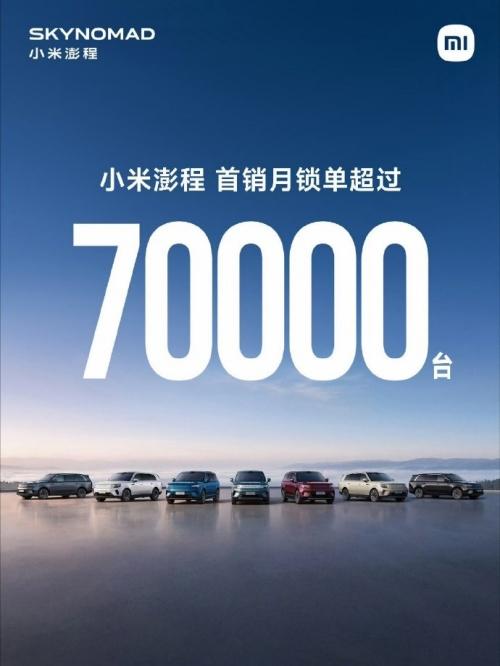
Yesterday, Xiaomi Auto released the order confirmation figures for the Xiaomi Pengcheng during its first sales month. From September 7 to October 7, the model garnered over 70,000 confirmed orders within just 30 days of its launch. It's important to note that these confirmed orders are non-refundable production commitments, not mere expressions of interest or casual bookings made by simply providing a phone number.
Against the backdrop of a cooling extended-range vehicle market—where domestic retail sales of such vehicles fell nearly 20% year-on-year from January to August this year—the Xiaomi Pengcheng secured over 70,000 confirmed orders in its debut month. This figure nearly matches the combined sales of the top two extended-range SUVs in the first half of this year (AITO M7 sold 43,114 units, while Li Auto L6 sold 29,513 units). The significance of this achievement cannot be overstated.
It demonstrates one key point: extended-range vehicles are far from obsolete; they simply require a more competitive player to redefine the segment. This raises the question: Why was it the Xiaomi Pengcheng that succeeded? In my opinion, the Xiaomi Pengcheng's explosive sales are no mystery, as it effectively leveraged three critical factors.
① Precise product definition that addresses consumer pain points. For SUVs priced between 200,000 and 300,000 yuan, consumers previously faced a trade-off between limited pure-electric range and inflexible interior space. The Xiaomi Pengcheng resolves this dilemma by combining a large-battery extended-range system (offering a CLTC pure-electric range of up to 505 km) with an intelligent, adaptable interior space (featuring a seven-seat layout and an electrically adjustable roof compartment). This dual appeal explains the particularly high conversion rate among family-oriented buyers who bring their children to view the vehicle.
② Uncompromising and equitable configuration. Features like LiDAR, NVIDIA Thor-U chips, and dual-chamber air suspension—previously reserved for models priced above 300,000 yuan—are now available in models starting at just 200,000 yuan. While competitors like the Li Auto L6 and AITO M6 are formidable, Xiaomi has gained a temporary edge in terms of feature density.
③ Ecosystem synergy as an invisible competitive moat. The seamless integration between Xiaomi smartphones, tablets, smart home devices, and automobiles creates a consistent user experience that traditional automakers cannot replicate through financial investment alone. Many users naturally transition from the Xiaomi smartphone ecosystem to purchasing cars, resulting in significantly lower customer acquisition costs compared to new energy vehicle startups.
In my view, the greatest significance of this achievement lies in proving that Xiaomi Auto is not solely reliant on the SU7 and YU7 to make breakthroughs in the pure-electric segment; it also possesses strong appeal in the fiercely competitive home-use extended-range SUV segment. With both segments taking shape, Xiaomi Auto is no longer a single-model company. It can now cater to a broader consumer base and support a larger annual delivery target.
This aligns with the long-term goal pursued by Xiaomi's leader, Lei Jun: to build a comprehensive family of automotive products. It's crucial to clarify a key distinction: confirmed orders ≠ deliveries. Confirmed orders represent users finalizing their purchase decisions and entering the production queue, not vehicles already handed over to owners. The 70,000 confirmed orders for the Xiaomi Pengcheng are a first-month result; the subsequent challenge lies in scaling up production and maintaining delivery momentum. The model achieved over 10,000 deliveries in its initial month, a promising start.
Meanwhile, the market competition leaves little room for Xiaomi to rest on its laurels. The 200,000-300,000 yuan extended-range SUV segment is already a fiercely contested "red ocean," with competitors like Li Auto, AITO, and Seres continuously iterating their products. Price wars and feature battles have become the norm. While the Xiaomi Pengcheng secured orders based on its initial launch hype, its ability to sustain sales will depend on ongoing product strength and after-sales systems, rather than short-term attention.
Overall, the 70,000 confirmed orders mark a strong start but represent only a phased victory. For the Xiaomi Pengcheng, the core challenge ahead is to smoothly convert confirmed orders into actual deliveries and maintain product reputation after large-scale rollouts. While short-term hype is easy to generate, the true test lies in establishing a lasting foothold in the shrinking extended-range market over the long term. What are your thoughts?
-
![]()
Zunjie V800 Rolls Out Free Upgrades Following Three Brake Pedal Malfunctions
-
![]()
FAW Toyota to Maintain Operations; FAW, GAC, and Toyota Forge New Partnership
-
![]()
Automotive Consumption Policy: Transitioning from Short-Term Boosts to Long-Term Ecosystem Development
-
![]()
QianWen N1 Pro and Wigain Flow Enhance Eye Perception, AI Glasses Complete Personal Context Entry
-
![]()
The Integration of North and South Toyota: A New Model for Chinese and Foreign Automakers
-
![]()
Why Does Mass Production Spell Doom? The Price Dilemma of Micro-Optical Engines from a Supply Chain Perspective
-
![]()
A Leap in Dimensionality Reduction: Why Both Meta and EssilorLuxottica Are Venturing into Hearing Aid Glasses
-
Reevaluating the Value of a Hundred-Billion-Dollar Track Through the Lens of Utopai Studios, the World's Largest Independent AI Film and Television Company