"FAW Toyota and GAC Toyota: A Merger of Strengths"
 10/10 2026
 411
411
"A Landmark Joint Venture Transformation Awaits"
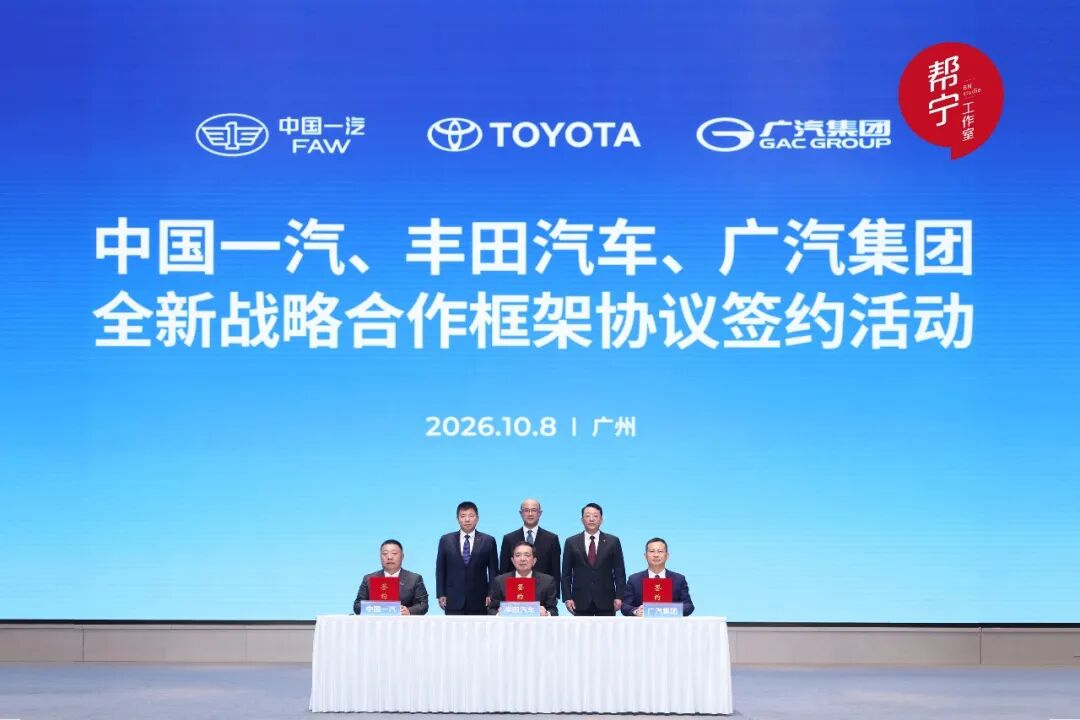
Three entities have finally united their strengths. On October 8, 2026, China FAW Group, Toyota Motor Corporation, and Guangzhou Automobile Group (GAC) inked a new strategic cooperation framework agreement in Guangzhou.
The crux of this agreement lies in GAC's plan to acquire a 50% stake in FAW Toyota, currently held by China FAW Group, through the issuance of shares. Post-transaction, GAC will emerge as the Chinese shareholder for both FAW Toyota and GAC Toyota joint ventures. Notably, FAW Toyota will maintain its operational independence, while China FAW Group will assume the role of a significant strategic shareholder in GAC.
Moving forward, FAW Toyota and GAC Toyota will collaborate on R&D, procurement, production, and sales functions for the joint ventures.
This development signifies a substantial leap forward in the much-discussed "integration of FAW Toyota and GAC Toyota." Relevant details have been progressively unveiled since September 14, when GAC issued a "suspension announcement concerning the planning of a major asset restructuring" on the Shanghai Stock Exchange.
Observers have offered varied perspectives.
From the vantage point of state-owned enterprise reform, some view it as a "novel paradigm of deep collaboration among central SOEs, local SOEs, and multinational corporations."
In terms of equity governance, others believe that China FAW Group and GAC are utilizing equity as a connector, adopting a lightweight cooperation model characterized by share swaps, independent entities, and unaltered actual control.
From the joint venture cooperation standpoint, some see it as a model for joint ventures transitioning to new energy.
From Bangning Studio's viewpoint, this agreement serves three key purposes. Firstly, it is a definitive response to prior interpretations and even skepticism regarding the relationship between China FAW Group and Toyota, clarifying that they are not severing ties.
Secondly, it underscores Toyota's adeptness in transitioning to new energy in the Chinese market by capitalizing on its brand recognition and inherent strengths, achieving notable results despite gaps compared to local Chinese brands.
Notably, GAC Toyota has expedited the implementation of its "Chief Chinese Engineer System," launching localized new energy models like the bZ3X and bZ7. FAW Toyota, on the other hand, reported net profits of approximately RMB 4.717 billion and RMB 4.234 billion in 2024 and 2025, respectively (based on unaudited financial data), indicating relatively stable operations.
In 2025, the combined sales of FAW Toyota and GAC Toyota accounted for 17.03% of joint venture passenger vehicle sales, ranking among the top in market share for joint venture brands.
Thirdly, Toyota Motor Corporation is the primary catalyst behind this strategic cooperation.
History has a knack for repeating itself, albeit unintentionally. In 2002, Toyota forged a joint venture with China FAW Group. When it partnered with GAC in 2004, its passenger vehicle joint venture quota was secured through two high-profile restructurings involving China FAW—the "Tianjin-FAW" restructuring and the Sichuan Toyota restructuring—where Toyota also played a pivotal role.
Behind this cooperation agreement lies a reality that all joint venture automakers must confront. Previously, joint ventures heavily relied on foreign technology, supply chains, and management expertise, merely localizing global models from foreign partners. However, in the new automotive era, the industry demands innovation, adaptability, and speed. Joint ventures have lagged behind Chinese brands and new energy vehicle startups in this transition, necessitating an urgent catch-up—even for a behemoth like Toyota.
So, what lies ahead post the "integration of FAW Toyota and GAC Toyota"?
GAC has amassed certain strengths in electrification, intelligent product technology, and industrial chain construction, while Toyota leads in HEV, solid-state batteries, and fuel cell technologies. This equity restructuring is poised to facilitate Toyota in integrating high-quality resources, enhancing resource allocation efficiency, and ushering in a new era for joint ventures (2.0).
This should be a much-anticipated development for Toyota and a pivotal strategic choice. Barring significant shifts in Sino-Japanese relations, Toyota can gradually introduce its fifth-generation HEV, solid-state batteries, and hydrogen fuel cell vehicles, making it only a matter of time before it enhances its performance in the Chinese market.
By then, GAC—its sole Chinese partner—and China FAW Group, as a "significant strategic shareholder" of GAC, will both reap the benefits.
Toyota's forte lies in HEVs, which, alongside pure electric vehicles, represent the most viable powertrain routes. If the joint ventures' HEV series achieve new breakthroughs in the domestic market, not only will Toyota's Chinese joint ventures flourish, but they may also empower China FAW Group and GAC, potentially reshaping the HEV landscape in China.
As for China FAW Group's equity stake in GAC, the focus will be on subsequent mechanisms and whether decision-making and execution efficiency can keep pace with the rapid evolution of intelligent electric vehicle technologies.
Currently, both the macroeconomic long cycle and the automotive industry's short cycle are experiencing downturns, and the established competitive landscape of the automotive industry is unlikely to undergo significant changes in the near term. China FAW Group and GAC still confront formidable challenges.
"Open the window and behold the vastness of the world outside," remarked Kenta Kon, Toyota's president who assumed office half a year ago, quoting Sakichi Toyoda, the inventor of the Toyota Automatic Loom, during the signing ceremony. He hoped the three partners would "open their hearts and minds to each other and gaze beyond the window."
This is a lofty aspiration that necessitates collective efforts from China FAW Group, Toyota Motor Corporation, and Guangzhou Automobile Group to realize. The journey ahead is arduous and lengthy.
-
Xiaomi Pengcheng Charges Market Confidence, Chinese Automakers Gear Up for the Second Battle
-
Is Apple Struggling to Sell iPhones Too? Order Cuts for iPhone 18 Pro
-
![]()
Out of the Spotlight: Traditional Industries Embrace AI Faster Than Imagined
-
"Formidable" BYD: Adversity as the Ultimate Test of a Company's Strength
-
Lei Jun’s 50 Consecutive Extreme Braking Tests: A Visionary Move Now Validated
-
![]()
【Electrical Equipment】Weichai Power and Lingong Heavy Machinery Forge Strategic Partnership
-
![]()
FAW, Toyota, and GAC Group Forge Tripartite Cooperation Pact
-
![]()
Ray Dalio Issues Latest Alert: The AI Bubble Is on the Verge of Popping!