FAW, Toyota, and GAC Group Forge Tripartite Cooperation Pact
 10/10 2026
 447
447
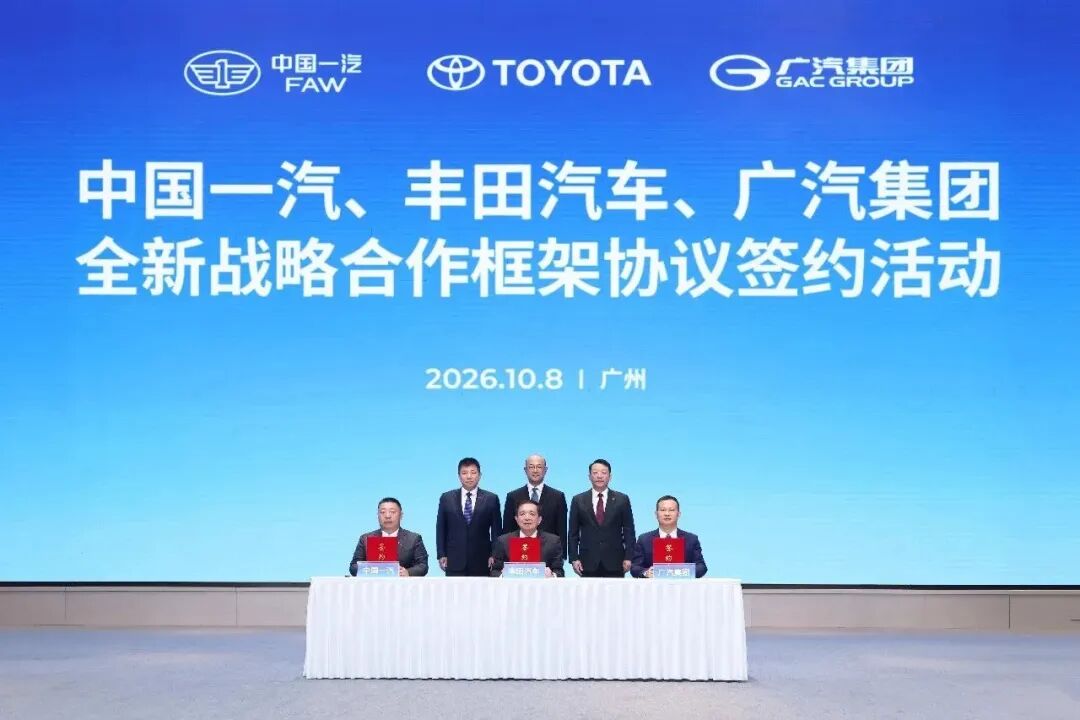
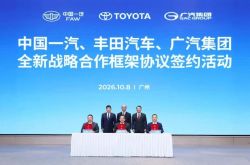
On October 8, a momentous strategic cooperation framework agreement was inked in Guangzhou among China FAW Group, Toyota Motor Corporation, and GAC Group. The crux of the agreement lies in GAC Group's plan to acquire a 50% stake in FAW Toyota from China FAW Group via share issuance. Post-transaction, FAW Toyota will persist as an autonomous entity, while China FAW Group will emerge as a significant strategic shareholder of GAC Group. Looking ahead, FAW Toyota and GAC Toyota are set to collaborate across various functions, including research and development, procurement, production, and sales.
This move marks a unique equity linkage within China's automotive joint venture landscape, bridging cross-central enterprises, local state-owned enterprises, and foreign automotive giants. Earlier, on September 28, GAC Group had unveiled a restructuring plan, tentatively pricing shares at 5.75 yuan each. The auditing, valuation, and final transaction price of the target assets remain pending. Upon completion, FAW Toyota's shareholders will shift to GAC Group and Toyota, each holding a 50% stake, with Toyota Motor Corporation becoming FAW Toyota's largest shareholder. FAW Co., Ltd. will ascend to the second-largest shareholder of GAC Group through share swapping, while the Guangzhou State-owned Assets Supervision and Administration Commission will retain its position as the actual controller of GAC.
The longstanding divide between Northern and Southern Toyota has led to a scenario where models sharing the same platform, such as the Corolla and Levin, RAV4 Rongfang and Wildlander, Avalon and Camry, Sienna and Granvia, are marketed through separate channels. In 2025, the combined sales of these two entities reached approximately 1.578 million units, accounting for 17.03% of joint venture passenger vehicle sales. However, in the first half of 2026, FAW Toyota's sales plummeted by 27.4% year-on-year to 273,700 units, while GAC Toyota's sales dipped by 6.3% to 341,100 units. Toyota's overall sales in China witnessed a 17.1% year-on-year decline. In the realm of pure electric vehicles, FAW Toyota's bZ series sold around 11,500 units in the first half of the year, while GAC Toyota's bZ4X series sold about 51,900 units, underscoring the significant pressure faced in the transition to new energy vehicles.
For the three parties involved, this adjustment serves distinct purposes. Toyota aims to terminate internal competition between its northern and southern entities and concentrate resources to tackle electrification and intelligent transformation, with an anticipated cost reduction of 5% to 8% post-integration. GAC Group, which reported a net profit attributable to shareholders of a loss of 8.784 billion yuan in 2025 and a loss of 4.467 billion yuan in the first half of 2026, stands to benefit from FAW Toyota's inclusion, which is expected to bolster its investment income and stabilize the foundation of joint venture profits. China FAW Group, through equity swapping, will transform its joint venture assets into shares of a listed company, achieving asset securitization, while redirecting its focus towards investments in its proprietary brands and new energy business.
The integration process, however, is not without challenges. Issues such as merging two management systems and corporate cultures, averting internal competition among nearly a thousand dealer outlets, and coordinating the allocation of production capacity across three major production bases must be addressed subsequently. On the day of the signing, October 8, GAC Group's A-shares plummeted by 8.22%, and H-shares fell by 6.01%. The market chose to cash in after the positive news was realized, reflecting concerns about the uncertainties surrounding the integration.
The transaction still necessitates the completion of auditing and valuation, another board of directors meeting for review, submission to the shareholders' meeting for voting, and regulatory approvals. Equity integration is merely the starting point. Whether collaboration in procurement, research and development, product planning, and channels can be truly realized will be the litmus test for determining whether Northern and Southern Toyota can achieve a "1+1>2" outcome.
-
![]()
Out of the Spotlight: Traditional Industries Embrace AI Faster Than Imagined
-
Lei Jun’s 50 Consecutive Extreme Braking Tests: A Visionary Move Now Validated
-
![]()
【Electrical Equipment】Weichai Power and Lingong Heavy Machinery Forge Strategic Partnership
-
![]()
FAW, Toyota, and GAC Group Forge Tripartite Cooperation Pact
-
![]()
Ray Dalio Issues Latest Alert: The AI Bubble Is on the Verge of Popping!
-
![]()
Zunjie Automobile's Latest Move: Far-Reaching Consequences
-
![]()
Did Dongchedi Trigger a Stock Plunge for JAC Motors?
-
![]()
Unattainable Annual Sales Targets: Automakers Brace for the Most Challenging 'Silver October' and a Daunting Final Quarter