Global Relocation of Computing Power: Who’s Copying Ulanqab?
 10/15 2026
 515
515
Author|Vinco
Editor|Li Xiaotian
The wind in Ulanqab blows twice a year, each time for half a year.
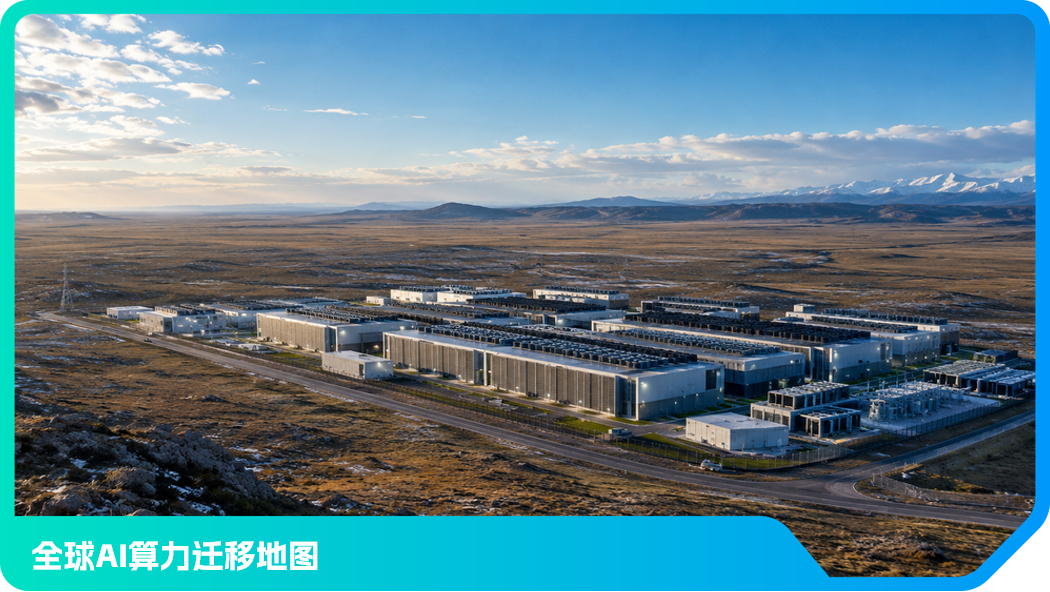
Locals have joked about this for years. The wind comes from Siberia, sweeping across the Inner Mongolian Plateau, carrying sand and grass, piercing in winter and blinding in spring. In the past, it meant difficult travel and the need for clothespins to keep laundry from flying away. No one imagined that one day, this wind would be captured by turbines, turned into electricity, and flow along transmission lines into rows of servers, becoming tokens that power model training in Beijing, inference calls in Shanghai, and intelligent agent backends in Shenzhen.
Even more unexpectedly, this wind is now blowing globally.
In August this year, a report by Goldman Sachs put Ulanqab in the global spotlight for computing power, calling it “one of the largest and fastest-growing AI computing clusters in the Asia-Pacific region.” Subsequently, Morgan Stanley, WIRED (a U.S. tech media outlet), and others turned their lenses toward this fifth-tier city. As of June this year, local data centers had secured capacity commitments of about 12.5 GW, surpassing OpenAI’s initial U.S. AI infrastructure commitment of 10 GW for its Stargate project set to launch in 2025.
A place known for growing potatoes, producing yogurt, and hosting volcanic grassland tourism festivals is now suddenly tied to GPUs, GW, and tokens. This vast grassland, covered with wind and solar farms, has overnight become the hottest spot on the global computing power map.
But Ulanqab’s rise is not an isolated case. It reflects a broader trend: AI computing power is migrating from tech hubs to energy-producing regions. The key to success in this migration lies not just in who has stronger winds or cheaper land, but in finding a unique combination of electricity prices, climate, network latency, government execution, and long-term stability that others cannot replicate.
The question then arises: Where are the overseas versions of Ulanqab emerging?

Why Ulanqab?
Let’s first examine what Ulanqab has in its hand.
The first card is electricity prices.
Data centers in Ulanqab pay about 0.32–0.36 yuan per kWh, following the standards of the Western Inner Mongolia Power Grid. In contrast, data centers in Beijing face actual electricity costs of around 0.80 yuan. At first glance, the difference may not seem extreme, but the real savings become clear when calculated per card.
Take a 700W AI acceleration card as an example. Running nonstop for a year, it consumes about 6,100 kWh, saving roughly 2,700 yuan annually per card. For a cluster of 10,000 cards, the annual savings reach 27 million yuan. And this is just for electricity costs.
So, how is this cheap electricity possible?
Western Inner Mongolia is managed by the Western Inner Mongolia Power Grid, the only provincial-level independent power grid in China besides State Grid and China Southern Power Grid. Local policies allow some data center projects to build dedicated power generation facilities directly connected to their computing clusters, bypassing the transmission restrictions that developers in other regions commonly face.
In simple terms, it’s not the electricity itself that’s cheap, but the institutional exemption of “grid transmission fees.”
The second advantage is cold. Ulanqab, located at 42 degrees north latitude, has an average annual temperature of 4.3°C, with a summer average of 18.8°C. It requires heating for six months a year, placing it in the internationally recognized “golden latitude” for data centers. As a result, data centers here can leverage natural cooling for nearly 10 months a year, achieving a Power Usage Effectiveness (PUE) as low as 1.1. Under the same technical conditions, this represents energy savings of 20% to 30%. Cooling is the second-largest cost for AI data centers after electricity, making these savings significant.
The third advantage is proximity. Ulanqab is about 240 kilometers from Beijing in a straight line, reachable by high-speed rail in about 100 minutes, enabling same-day round trips. It’s truly “one step west from Beijing, and you’re in Ulanqab.” Additionally, the region has laid a 144-core point-to-point dual-route fiber optic cable directly to Beijing, with end-to-end latency controlled below 4.2 milliseconds and a one-way minimum of 2.1 milliseconds. The model of “R&D in Beijing, computing in Ulanqab” is already operational. As of June this year, Ulanqab has handled over 75,000 P of computing demand from Beijing, exceeding the total intelligent computing capacity of many provinces.
Electricity, cold, and proximity—these three cards together form Ulanqab’s complete advantage. Missing even one would make the story incomplete.
But what truly accelerated Ulanqab’s growth is another factor: Inner Mongolia may be the administrative region with the most significant “local electricity surplus” globally. By the end of 2025, Inner Mongolia’s installed wind power capacity will exceed 100 GW, ranking first in China, along with about 130 GW of fossil fuel generation capacity. Such massive power production cannot be fully consumed by local industrial loads.
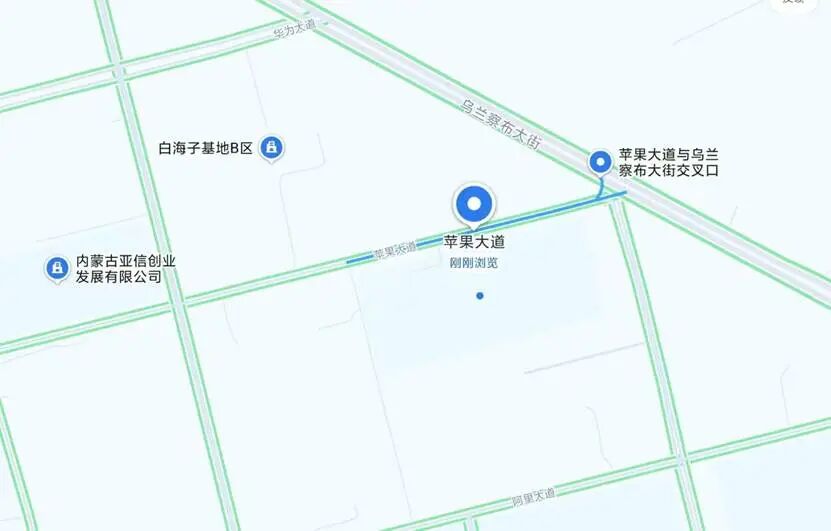
Inner Mongolia is not short of electricity, and data centers are essentially “power consumption tools.” Understanding this is key to grasping why Ulanqab’s expansion has far exceeded market expectations. From internet giants like Huawei, Alibaba, ByteDance, and Kuaishou to rising AI stars like DeepSeek and Z.ai, all are establishing facilities on this grassland.
Source: Gaode Maps
However, the hunger for computing power is global. With exponential growth in demand for large-scale model training and inference, cloud giants, tech newcomers, and sovereign funds worldwide are desperately seeking the next “Ulanqab.”
So, where else globally offers similar conditions?
Aragon, Spain: One of Europe’s Strongest Candidates, but Missing One Card
In Europe, a region known for high electricity prices, strict environmental regulations, and lengthy administrative approvals, the vast and sparsely populated Aragon region in northeastern Spain is attempting a European-style “computing power comeback,” much like Ulanqab’s rise.

For years, Europe has lagged far behind China and the U.S. in AI infrastructure development. To break this stalemate, the Aragon regional government chose to “fast-track” tech giants. They introduced the “PIGA” (Aragon Public Interest Project) special approval mechanism. While traditional environmental and construction permits in Europe can take years, Aragon’s “one-stop” investor services and PIGA green channel reduce the process to under 12 months.
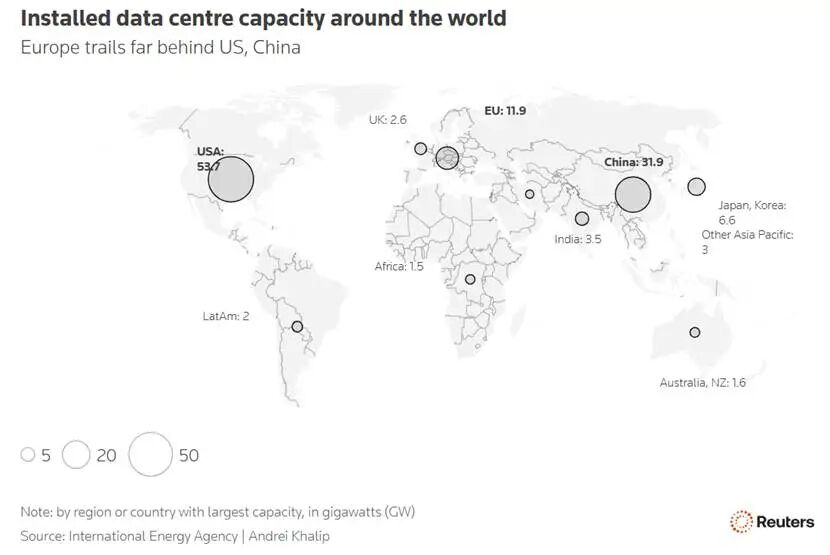
Global Installed Data Center Capacity (Europe Lags Far Behind China and the U.S.)
The results of agile administration and rapid deployment have been astonishing. Amazon has announced a cumulative investment of 33.7 billion euros (about $38.4 billion) in Aragon for cloud services and AI infrastructure, its largest cloud and AI infrastructure investment outside the U.S. The new facilities completed most of their permitting procedures in about a year, lightning-fast by European standards. Additionally, Aragon has accelerated more than a dozen large-scale data center projects for Microsoft and other companies.
Of course, what makes Aragon Europe’s “Ulanqab” is not just administrative efficiency but also its exceptional resource endowments:
Abundant green power: Aragon is a leader in renewable energy in Spain, with extremely rich wind (the largest share) and solar resources, providing ample and reasonably priced green electricity. Data centers have massive power demands, and Aragon’s green power advantage perfectly aligns with the “low-carbon, green power” site selection requirements for data centers.
Vast, inexpensive land: The region is sparsely populated, with low land prices, offering excellent expansion space for hyperscale data centers.
Network backbone intersection: Aragon lies between Spain’s two major economic centers (Madrid and Barcelona), close to Europe’s primary markets, and near submarine cables connecting Europe to Africa, South America, and the U.S., ensuring fast data transmission and low latency. The region also has a robust, redundant, and reliable power grid infrastructure with good interconnection capabilities, ensuring energy supply for critical users like data centers.
Favorable climate: Data centers require significant energy for cooling. Aragon’s relatively mild climate, without the extreme summer heat seen in some southern Spanish regions, allows for natural cooling with outdoor cold air in winter, helping reduce cooling energy consumption and operational costs (PUE) for data centers.
Currently, Aragon is one of Europe’s fastest-growing digital infrastructure hubs, expected to attract over 60 billion euros in data center and digital infrastructure investments in the next decade. However, Aragon’s rapid expansion has also raised concerns from the Spanish central government. Madrid is attempting to impose stricter water and power resource restrictions, adding a layer of uncertainty to this “computing power frenzy.” 
Johor, Malaysia: Leveraging Singapore, Serving China and the U.S.
A landmark event occurred in September 2026: Australian AI infrastructure company Firmus announced a multi-year strategic partnership with OpenAI, under which OpenAI will directly procure dedicated AI computing capacity from Firmus’s two AI Factory sites in Malaysia. This marks a move by a global leading AI company to lock in Malaysia as a core hub for its overseas computing resources.
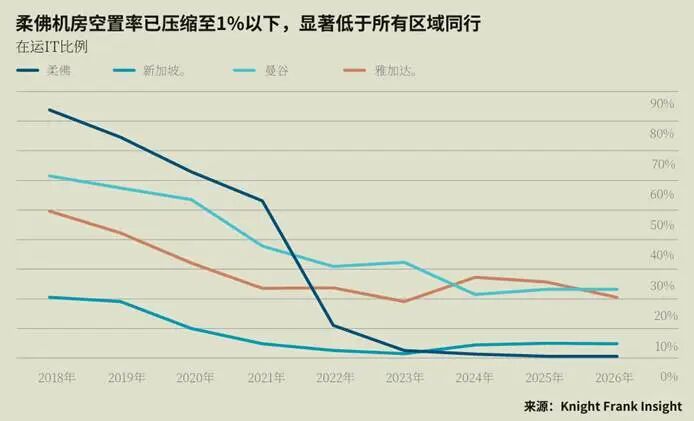
Source: Knight Frank Insight Report, Data Center Atlas 2026
Five years ago, Johor in southern Malaysia had a data center capacity of just 10 megawatts (MW); today, that figure has surged 110-fold in a few short years. Construction sites are adorned with “I Love Johor” banners, reflecting the fervent global capital pursuit of this region. According to HSBC, data center investments in Malaysia now account for 18% of its national GDP, the highest proportion globally.

Johor’s rapid growth owes much to Singapore. As Southeast Asia’s financial and networking hub, Singapore faces land and power shortages and imposed strict data center restrictions years ago. Johor, just across the water, has seized all the overflowing computing demand. Much like Ulanqab leveraging Beijing, Johor leverages Singapore—the logic of a “computing power backyard” is nearly identical.
Cost is another layer of attraction. Cheap land, stable power, and foreign investment-friendly policies are a winning combination. But what makes Johor truly unique is its timing amid geopolitical shifts. As global tech supply chains reconfigure and the “China+1” strategy advances, Johor has become a rare computing hub capable of absorbing massive tech investments from both China and the U.S. This position cannot be bought with policy subsidies alone.
As Malaysia’s AI infrastructure continues to improve, “enter Malaysia first, then extend to the ASEAN market” may become a regional layout strategy worth considering.
Faced with a planned capacity of 7.7 gigawatts (GW) by 2030, the Malaysian government is not content to remain merely a “data center landlord.” It has launched the National AI Action Plan (2026–2030) and established a dedicated agency to drive the transition from an infrastructure host to an AI ecosystem node. However, the soaring electricity consumption (expected to consume 31% of the peninsula’s power by 2035) and the resulting new electricity pricing structure are hurdles Johor must overcome. 
Chiba, Japan: Refusing to Be an “AI Colony,” Japan Builds Computing Power Next to Thermal Power Plants
Land is being cleared next to a thermal power plant in Chiba City. JERA, Japan’s largest power generator, announced a memorandum of cooperation with Dell Technologies and British AI infrastructure developer RHAELM to establish a standardized, replicable AI infrastructure development framework, with the first project located in Chiba—adjacent to JERA’s Chiba thermal power plant—involving an investment exceeding $15 billion.
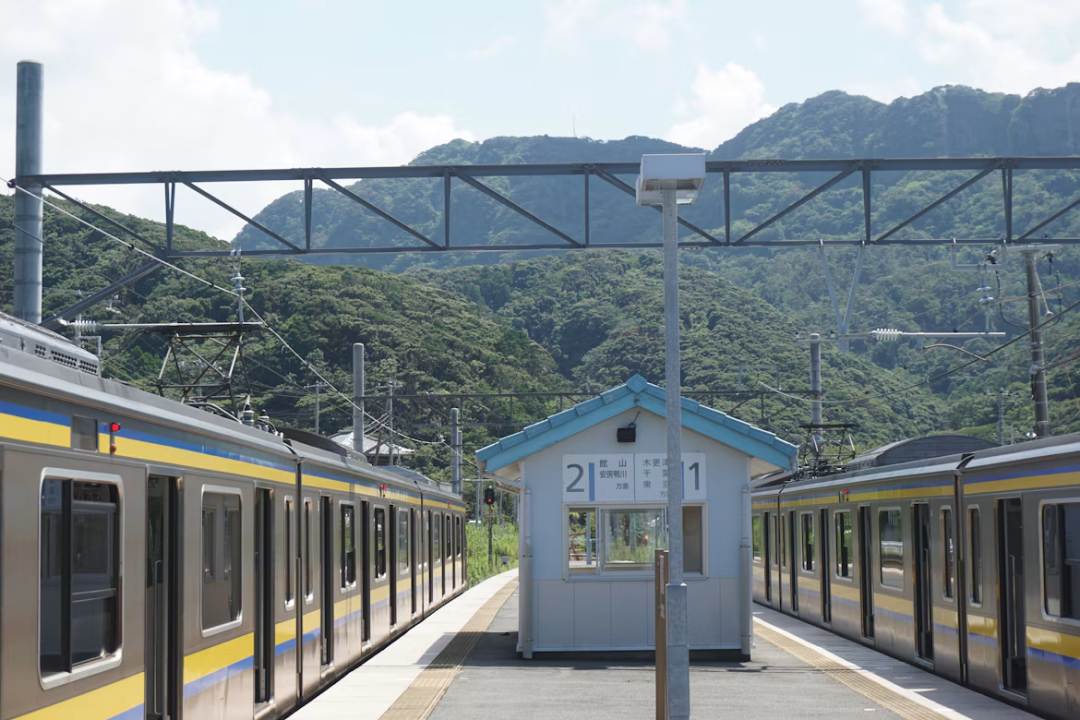
In this way, the power supply bypasses the public grid and is directly connected from thermal power plants, a practice known in the industry as "behind-the-meter power supply." The primary advantage is speed. There is no need to wait in line for grid capacity expansion, significantly advancing the delivery timeline.
Over the next five years, JERA also plans to establish 3-4 gigawatts (GW) of AI data centers and supporting gas-fired power generation infrastructure, aiming to position Japan as the largest global AI infrastructure hub outside of China and the United States. In official discourse, a more jarring term is used: avoiding becoming an "AI colony."
Japan has electricity, land, and a solid manufacturing foundation, yet it remains absent from the core decision-making table. In this context, the stronger AI becomes, the more Japan resembles a user rather than a player.
The clever aspect of the Chiba project lies in its location, adjacent to a thermal power plant. Behind-the-meter power supply bypasses the public grid's queuing mechanism, showcasing rare flexibility in Japan's infrastructure efficiency. However, this flexibility addresses only this specific project.
Thermal power plants are not ubiquitous, and grid access conditions vary. From an overall planning perspective, the $140 billion investment faces multiple bottlenecks. Energy is the first challenge: Japan's limited land and resources, chip supply, and the talent pool for engineering, operations, and scheduling required to run ultra-large-scale data centers are all hurdles that must be overcome individually.
The Chiba project in Japan utilizes behind-the-meter power supply to expedite timelines, indicating an awareness that the window of opportunity is fleeting. However, flexibility in handling a single project does not guarantee that the entire plan can proceed at the same pace. 
Kazakhstan and Uzbekistan: Eurasia's Computational Power Transit Hubs
In Central Asia, these two countries are quietly making strategic moves. Their approaches overlap in some areas and diverge in others: both leverage cheap electricity and their geographic hub positions, but Kazakhstan relies on coal-fired power and the Kazakhstan-Azerbaijan trans-Caspian fiber optic link, while Uzbekistan focuses on green energy and special economic zone policies.
Historically, Kazakhstan has been associated with oil and uranium. However, in 2026, Kazakhstan incorporated the "Year of Digitalization and AI" into its national agenda. The government is planning a "Data Center Valley" in Ekibastuz, spanning hundreds of hectares with a total capacity of up to 1 gigawatt (GW).
The rationale for selecting Ekibastuz closely mirrors Ulanqab's reliance on the West Inner Mongolia Power Grid and the source-grid-load-storage model:
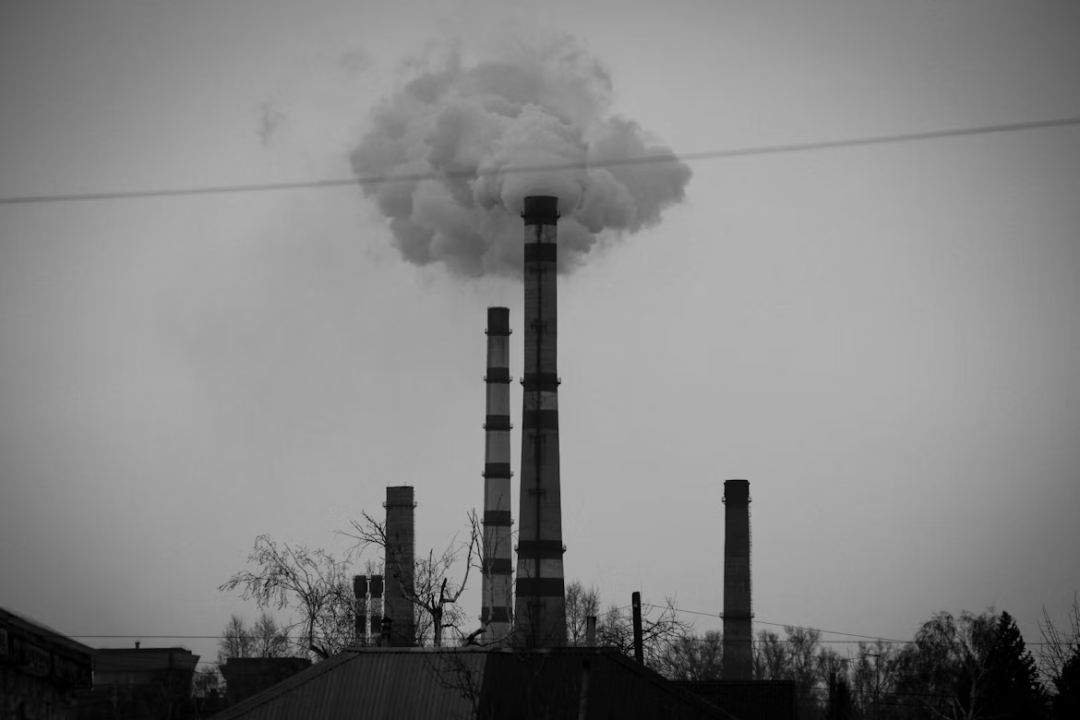
Proximity to Power Sources and Low Electricity Costs: Data Center Valley directly relies on a local energy hub, providing ample and cost-effective electricity that perfectly aligns with data centers' high power consumption needs, with room for expansion.
Natural Cooling and Vast Land: Central Asia's arid and cold climate offers natural cooling for large-scale data centers, and the expansive Gobi Desert land allows for extremely low construction costs.
Eurasian Network Corridor: Ekibastuz has the geographic potential to become a computational power hub for Eurasia, enabling low-latency connections to European and Middle Eastern markets, facilitating the export of computational services to these regions.
Additionally, the Kazakh government is preparing to introduce an innovative "cloud-first" policy (also known as the "data embassy" policy), allowing foreign governments and institutions to store their core data in Kazakhstan while retaining full legal sovereignty over it. This policy flexibility is making Ekibastuz the most notable new "computational power base" at the crossroads of Eurasia.
Uzbekistan, on the other hand, has chosen the Republic of Karakalpakstan as the site for its data center layout (Chinese term retained for specificity: "layout"), attracted by the region's abundant green energy resources, with over 30% of the country's electricity coming from green sources. After all, stable power supply is the "top priority" when engaging in dialogue with data center investors.
Last year, authorities announced tax incentives and special electricity rates for data center investments in Karakalpakstan. Overall, both countries are preparing "cloud-first" policies or "Enterprise Uzbekistan" special zones to vigorously attract foreign capital for building large-scale, high-energy-consuming green data centers and cryptographic computational power centers. 
United Arab Emirates: After Missiles Fall, the Middle East Buries Computational Power Underground
If Ulanqab, Aragon, Johor, and Central Asia represent the "low-cost and high-value" Civilian route (Chinese term retained for specificity: "commoner's approach") to winning the competition, then the United Arab Emirates' strategy in the Middle East involves using extreme national will and vast capital to stack the world's highest-security "super computational power fortress."
To reduce reliance on the oil economy, the UAE has partnered with the United States to launch the 5-gigawatt (GW) "UAE-US Artificial Intelligence Park," which will also become the largest AI facility outside the United States. The first phase, the "Stargate UAE" project, alone involves a $30 billion investment and was launched last year.

However, the sudden geopolitical shifts in 2026 poured cold water on the Middle East's computational power enthusiasm. During regional conflicts, several cloud data centers along the Persian Gulf were attacked by drones and missiles, causing some computing services to halt. This crisis prompted UAE officials to swiftly restructure their computational infrastructure planning logic:
Distributed and Underground Construction: Abandoning the original plan of concentrating in a single large park, the UAE now opts for decentralized construction. Simultaneously, it has started building AI data centers storing sensitive data directly underground or within mountains to withstand airstrikes.
Top-Tier Air Defense and Blast-Resistant Design: The new "underground AI data centers" employ blast-resistant concrete and deploy anti-drone interception systems and electronic jamming devices around the premises.
Sovereign-Level Chip Exemptions: Leveraging strong political negotiation skills, UAE tech giant G42 and its partners (Microsoft, OpenAI, Oracle, etc.) have secured special U.S. permits for high-end AI chips and servers, enabling the Large scale introduction (Chinese term retained for specificity: "large-scale introduction") of top-tier computational power.
The UAE's case highlights another point: when security costs are sufficiently high, energy cost advantages can be offset. It demonstrates not that "energy is unimportant," but that "energy advantages have prerequisites." The UAE has ample electricity, abundant funds, and rapid approval processes, but geopolitical risks can instantly alter investment logic. 
Which Way the Wind Blows: The Next Destination for China's Computational Power Export
Returning to the original question: Where is global AI computational power migrating? Which regions have the potential to transform from energy producers to computational power producers?
Spain's Aragon offers rapid approval processes but lacks flexibility in its electricity system. The UAE has capital and energy, but geopolitical risks can instantly change everything. Japan has a manufacturing foundation, but its energy structure, chip supply chain, and talent pool are bottlenecks. Malaysia has land and energy, but its ceiling remains unclear. Kazakhstan and Uzbekistan have cheap electricity and geographic hub positions, but their supporting infrastructure and connectivity are still in early stages.
As the industry shifts from "scaling up" to "optimizing efficiency," the survivors will not be those in the windiest or cheapest locations but those that find a unique combination of electricity prices, climate, network latency, government execution (Chinese term retained for specificity: "execution capability"), and long-term stability.
However, for China's computational power industry chain, there is another dimension to consider: not which place most resembles Ulanqab, but which places have already or could potentially partner with Chinese enterprises. Johor, Malaysia, is the densest landing spot, with ByteDance, Alibaba Cloud, and Tencent Cloud already establishing data centers or cloud regions there. Central Asia is the most policy-driven direction, with companies like Wetown Electric and Shanghai Linke Zhihua signing agreements or participating in modular smart computing center projects in Uzbekistan, while Huawei and ZTE have cooperation foundations in Kazakhstan. The common logic behind these landing spots is that Chinese enterprises are not there to "seize resources" but to "complement capabilities"—specifically, to provide the local markets with the delivery speed, supply chain integration, and operational experience they lack.
The wind in Ulanqab has blown for centuries. The same wind holds different values in different eras. The same resources carry different weights under different layouts.
So, where will the overseas version of Ulanqab ultimately emerge? This question may require a long time to answer.
-
![]()
How Much Gap Can HelloRobotaxi's World Model Bridge?
-
![]()
Total Investment Reaching Around 557 Million Yuan! Construction Commences for the Su Da Weige SVG Micro-Nano Optical Manufacturing Excellence and Innovation Center
-
![]()
Why Did a Low-Profile Optical Acquisition Ripple Through the Semiconductor and Defense Sectors?
-
![]()
Global Relocation of Computing Power: Who’s Copying Ulanqab?
-
![]()
Agent Safety: A New Benchmark for Financial AI
-
![]()
Tencent AI Leader Yao Shunyu Seated Beside Pony Ma
-
![]()
Intent Economy Fails to Displace China’s Attention Economy
-
![]()
Two PhDs Teach AI, Earn 670 Million Yuan Annually, Valued at 20.7 Billion Yuan