German Luxury Car Brands Encounter Group Pressure in Q3, with Porsche Seeing the Sharpest Drop
 10/20 2026
 526
Recently, leading car manufacturers have been releasing their delivery statistics for the third quarter of this year, highlighting a notable overall sales decline for the four German luxury brands—Mercedes-Benz, BMW, Audi, and Porsche—with drops surpassing 20%.
Official delivery data made public shows that Porsche experienced the most significant decline, selling only 6,992 vehicles in the Chinese market during the third quarter of this year, marking a 35.8% year-on-year decrease. This further deepens the 32% drop seen in the first half of the year. Mercedes-Benz was close behind, with an alarming 31% year-on-year decrease in third-quarter deliveries in the Chinese market, totaling 86,800 units.
BMW fared somewhat better, though not significantly, with only 114,355 vehicles delivered in China during the third quarter, representing a 24.8% year-on-year decline. Audi, at the back of the pack, also witnessed a considerable drop, with a 24.5% year-on-year decrease in third-quarter deliveries in China.
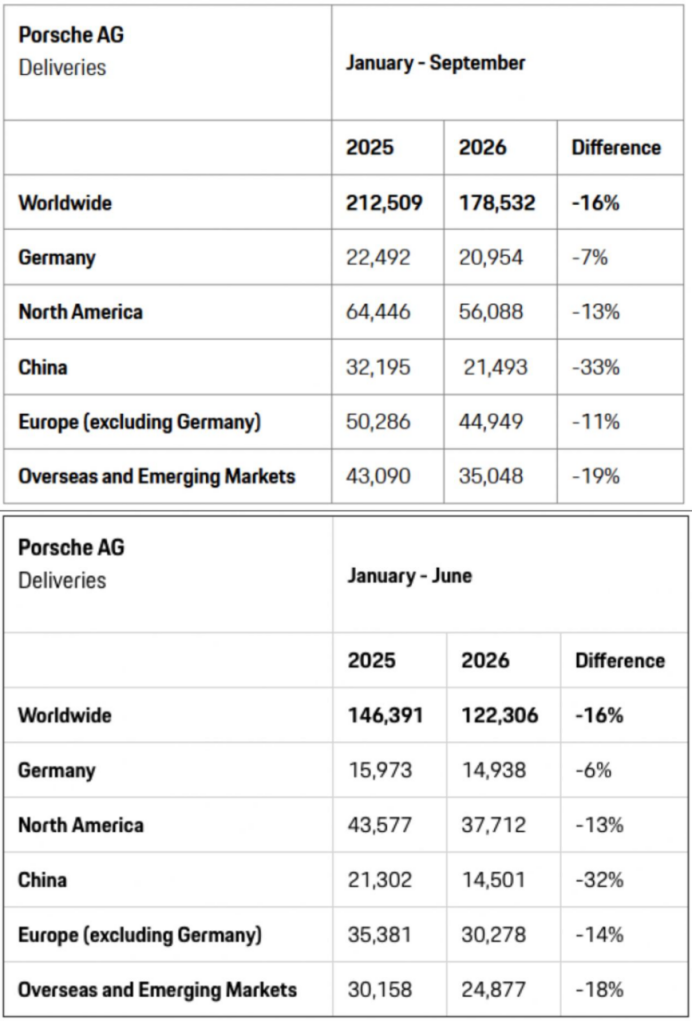
In reaction to their respective sales challenges, Porsche officials attributed the brand's market performance to a range of factors, including shifts in the domestic consumption landscape, the discontinuation of the Fuel 718 (Fuel-Powered 718) model, and a high delivery base for the all-electric Macan during the same period last year. On the other hand, Mercedes-Benz, BMW, and Audi more commonly pointed to external factors such as heightened market competition and the shrinking fuel vehicle market.
While the four German luxury brands cited various reasons for their sales declines, fundamentally, beyond the objective factors they mentioned, the more crucial issue lies in the sluggish pace of their transition to electrification and the intense competitive pressure from the robust rise of domestic independent brands, ultimately resulting in sustained pressure on their market share.
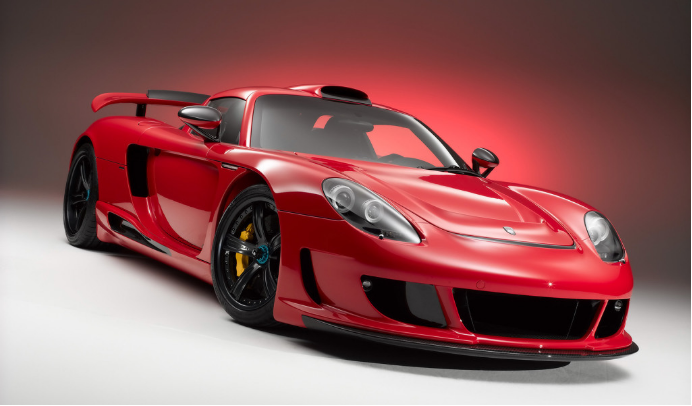
Of course, confronted with the persistent pressure of declining sales, the four German luxury brands are also taking measures to stabilize the situation. Porsche's strategy involves 'taking a step back.' In its plan released this October, Porsche clarified that it would refocus on fuel-powered vehicles while reducing its model derivatives by 20% to concentrate resources on higher-margin D/E-segment models. Its distribution network in China is also being streamlined, with plans to reduce dealer outlets from the current 114 to around 80 by the end of 2026. In this regard, Porsche China CEO Michael Kirsch was quite candid, stating that the brand is not chasing sales volume or market share, but rather emphasizing 'quality over quantity.'
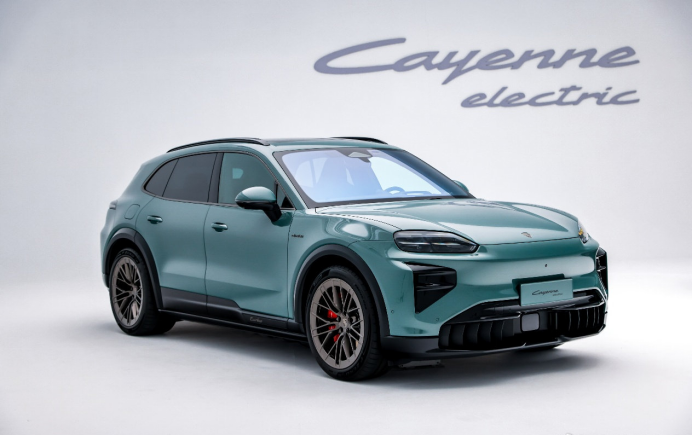
However, scaling back operations does not equate to stagnation in product development. In March of this year, Porsche launched the Panamera Exclusive Edition for the domestic market. At the Beijing Auto Show in April, the brand continued to introduce new models, with the global debut of the all-electric Cayenne Turbo Coupé and the China debut of the all-electric Cayenne Turbo. Additionally, it rolled out the Panamera Exclusive Edition and the 911 GT3 Sonderwunsch Collector's Edition, both customized specifically for the Chinese market.
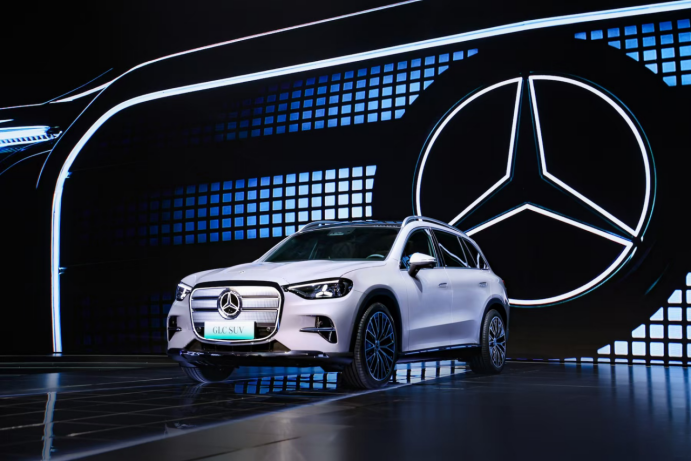
Meanwhile, Mercedes-Benz is continuously accelerating the localization of electrification and intelligent cockpits. The new all-electric GLC Long Wheelbase Edition is a concrete manifestation of this strategy. Built on the MB.EA native all-electric architecture, the vehicle's wheelbase has been extended to 3,027 millimeters, offering a six-seat option for the first time. The urban navigation assist system for the domestic market was jointly developed by Mercedes-Benz and Momenta.
Furthermore, from the second half of 2026 to 2027, Mercedes-Benz plans to introduce more than 20 new and facelifted models in China, encompassing both electric and fuel-powered products. The all-electric GLC L, next-generation S-Class, Maybach S-Class, and domestically produced long-wheelbase GLE will gradually enter the market, while AI-powered intelligent cockpits and navigation assist driving will be extended to more products.
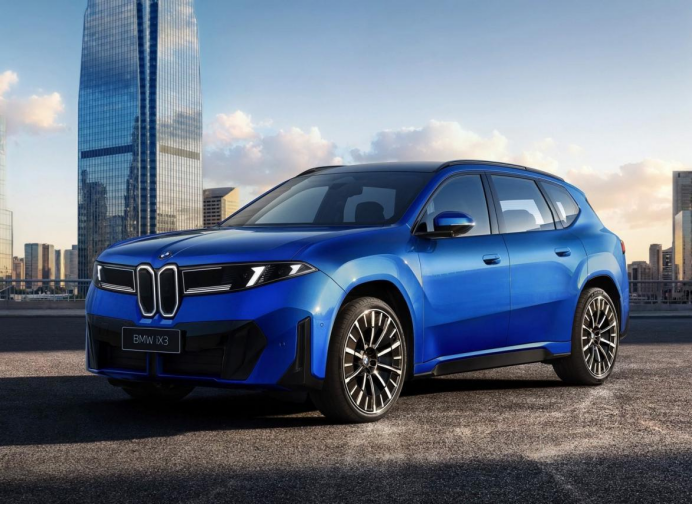
BMW's electrification transition revolves around its 'Neue Klasse' (New Class) strategy, with the primary focus on the Neue Klasse iX3 Long Wheelbase Edition and the Neue Klasse i3 Long Wheelbase Edition.
Among them, the BMW iX3 Long Wheelbase Edition has become BMW's first 'New Class' model to be 100% locally developed and manufactured. The new vehicle is based on an 800V high-voltage platform and equipped with CATL's large cylindrical batteries, achieving an approximately 20% increase in energy density, a range exceeding 900 kilometers, and efficient charging capabilities.
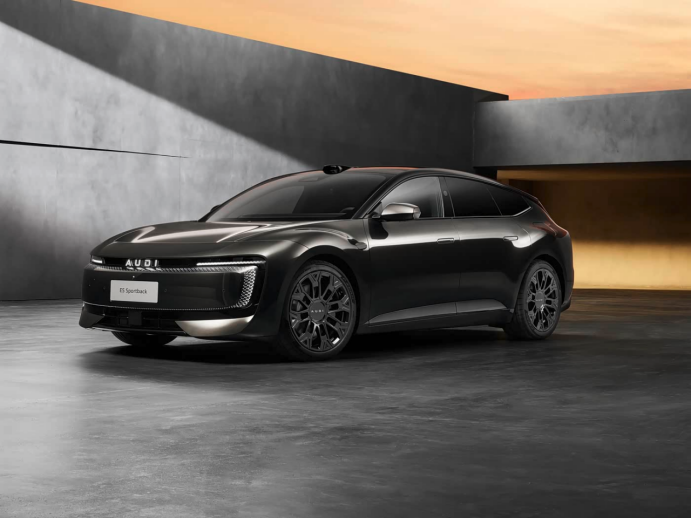
Audi is taking even bolder steps. The brand has created the 'AUDI' intelligent electric sub-brand specifically for the Chinese market, aiming to establish itself in the high-end electric vehicle segment. As the first production model under the AUDI sub-brand, the Audi E5 Sportback is equipped with CATL's CTP batteries, offering a CLTC range of up to 773 kilometers. In terms of intelligent driving, Audi has collaborated with Momenta to develop intelligent assist driving systems and has introduced Huawei's Qian Kun (Qiankun) intelligent driving technology on some models.
In product development, FAW-Audi and SAIC Audi are advancing localization projects simultaneously. Leveraging the intelligent digital platform ADP, simultaneous development by Chinese and German teams has been achieved, reducing the new vehicle development cycle by approximately 30%. Audi is attempting to deeply integrate into the domestic technology ecosystem and accelerate the launch of new products.
In Conclusion:
It is clear that each brand is forging its own path to breakthrough at its own pace. Porsche is scaling back its distribution network to safeguard profits, Mercedes-Benz is deepening its roots in China for research and production, BMW is entrusting intelligence to local partners, and Audi is testing the waters with dual brands. While their directions and paces vary, they all share a common premise: the era when selling cars based solely on brand logos is truly over.
As for who will be the first to successfully navigate this transition, it is too soon to draw conclusions. The only certainty is that in the luxury car market in the coming years, there will be no more players who can win by simply coasting along.
(Image sources: Internet. Images will be removed if infringement is found.)
-
![]()
Can Leapmotor Truly ‘Lead the Charge’? The Cost-Quality Trade-off Behind Export Profits
-
AI-Driven Short Dramas: A Formidable Competitor to the Gaming Industry?
-
Automotive Industry Undergoes Profound Transformation
-
![]()
Observation | XGIMI and OBE Enter the AI Glasses Track, Extending the Battlefield of Projector Manufacturers from Living Rooms to Faces
-
![]()
September Compact Car Sales Review: Traditional Fuel-Powered Models Remain Dominant
-
![]()
In the First Three Quarters, 8.2 Million Vehicles Sold: Overseas Markets Emerge as a Competitive Frontier for Chinese Automakers
-
![]()
China and the EU Both Achieve Success! Will the Export Volume of New Energy Vehicles to Europe Rise or Fall?
-
![]()
After a Year of Restructuring, WM Motor Encounters Fresh Hurdles in Production Restart