GM China Reports $210 Million Net Profit in Q3: Two Consecutive Years of Profitability, Though CEO Warns of Tougher Market Conditions
 10/22 2026
 391
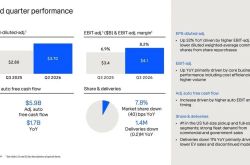
On October 21, General Motors (GM) released its financial results for the third quarter. The Q3 financial report reveals that, owing to the restrictions on Chinese cars in the U.S. market, American automakers are outperforming their European counterparts. During the third quarter, GM achieved net revenue of $50 billion, a year-on-year increase of $1.4 billion; net profit stood at $3.3 billion, with adjusted EBIT reaching $4.1 billion, up by $700 million from the previous year. The profit margin was 8.2%, and the adjusted automotive business cash flow amounted to $5.9 billion, marking a year-on-year rise of $1.7 billion. GM attributed these improvements to enhanced profitability and the timing impact of tariff-related cash receipts and payments.
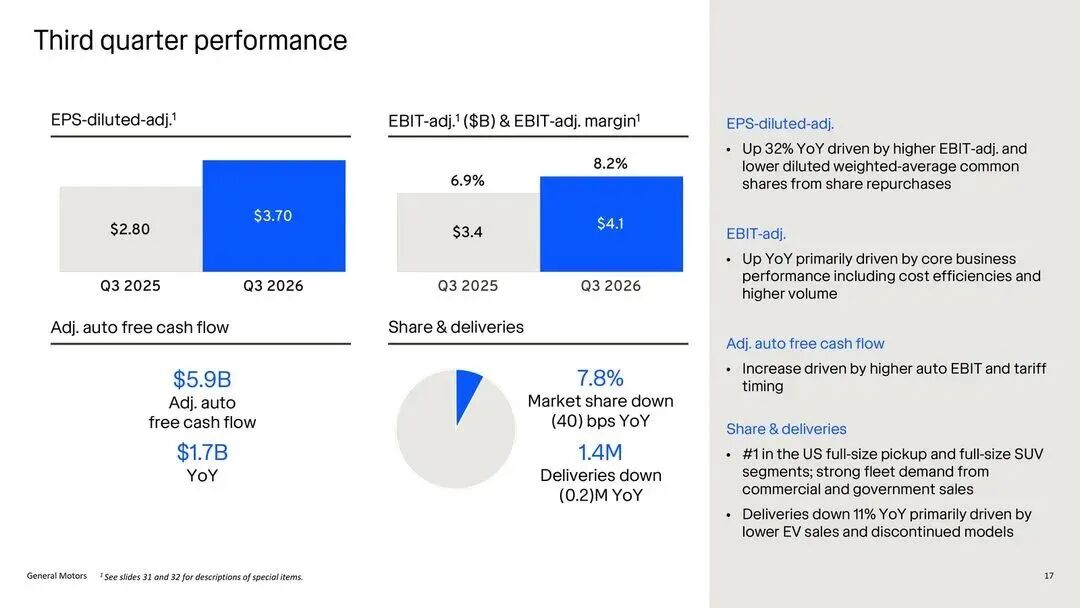
As a result, GM has revised its full-year adjusted EBIT forecast to a range of $14.5 billion to $15.5 billion, narrowing from the previous range of $14 billion to $16 billion. The company also announced that its board had approved a new multi-year stock buyback program worth $20 billion and declared a quarterly dividend of $0.18 per share. "This year, we have raised our full-year guidance twice while mitigating the impact of rising commodity, logistics, and other uncontrollable costs," said Mary Barra, Chairman and CEO of General Motors, during a conference call on the evening of October 20.
Mary Barra stated that 2027 will be another strong year for General Motors, surpassing the performance of 2026. GM anticipates incremental benefits from improved warranty expenses, reduced losses in electric vehicles (EVs), growth in software and service revenue, and the launch of the next-generation Chevrolet Silverado and GMC Sierra light-duty pickups. However, the EV segment remains challenging for GM.
Mary Barra noted that, driven by adjustments to EV production capacity and a significant decline in sales, GM still expects to achieve its full-year goal of reducing losses by $1 billion to $1.5 billion. As GM enters the year-over-year comparison period following the expiration of consumer purchase incentives last year, losses are expected to decrease slightly further in the fourth quarter. This year, EV profitability has improved significantly, primarily due to lower sales following business adjustments and fixed cost reductions during the restructuring process, creating a substantial positive impact for 2026.
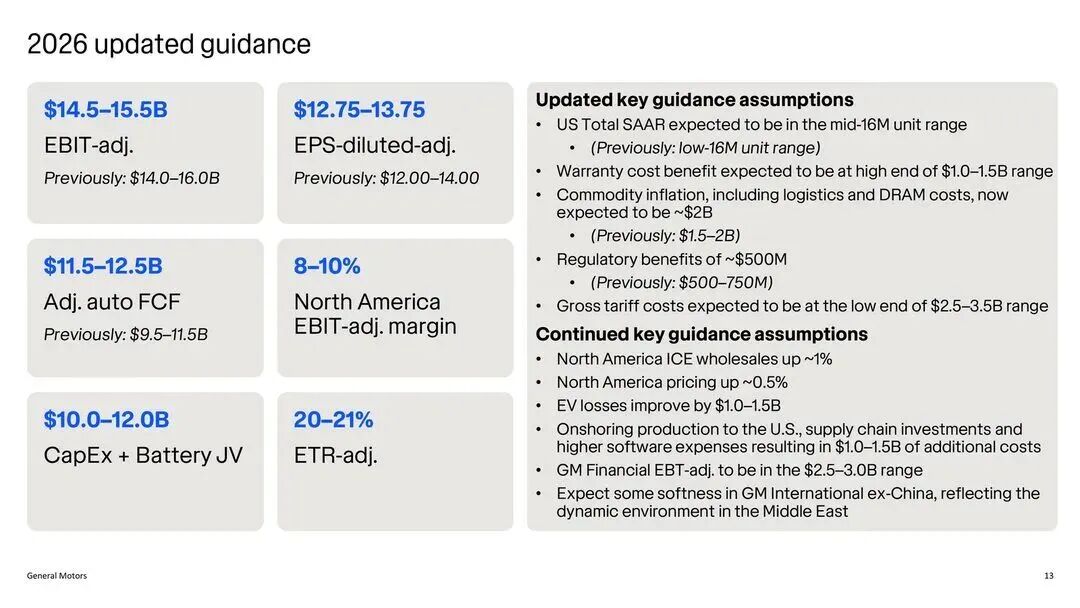
GM forecasts that improvements in its EV business in 2027 may be smaller compared to 2026 but are still likely to continue. Subsequently, in 2028 and 2029, with the application of lithium-rich manganese-based batteries and next-generation cells and battery packs, a significant step-change improvement in profitability is expected. GM emphasized that it will continue to monitor sales, noting that at current oil and fuel price levels, EV penetration may continue to rise, making it crucial to ensure readiness for this trend.
"We are the second-largest EV producer in the U.S., with a robust vehicle portfolio, and are committed to improving the profitability of these products," Mary Barra said.
In the Chinese market, GM China's equity income from business operations was $32 million (RMB 210 million), marking the eighth consecutive quarter of profitability. The company expects this positive trend to continue in the fourth quarter. New energy vehicles (NEVs) accounted for more than 60% of GM China's Q3 sales. GM stated that its Chinese team continues to focus on execution, cost efficiency, and product mix optimization to achieve sustained profitability. Based on current trends, SAIC-GM's profitability in Q3 was approximately RMB 420 million, with Q4 profitability expected to surpass that of Q3. This indicates that SAIC-GM's profitability last year likely exceeded RMB 1.5 billion, reflecting overall strong performance.
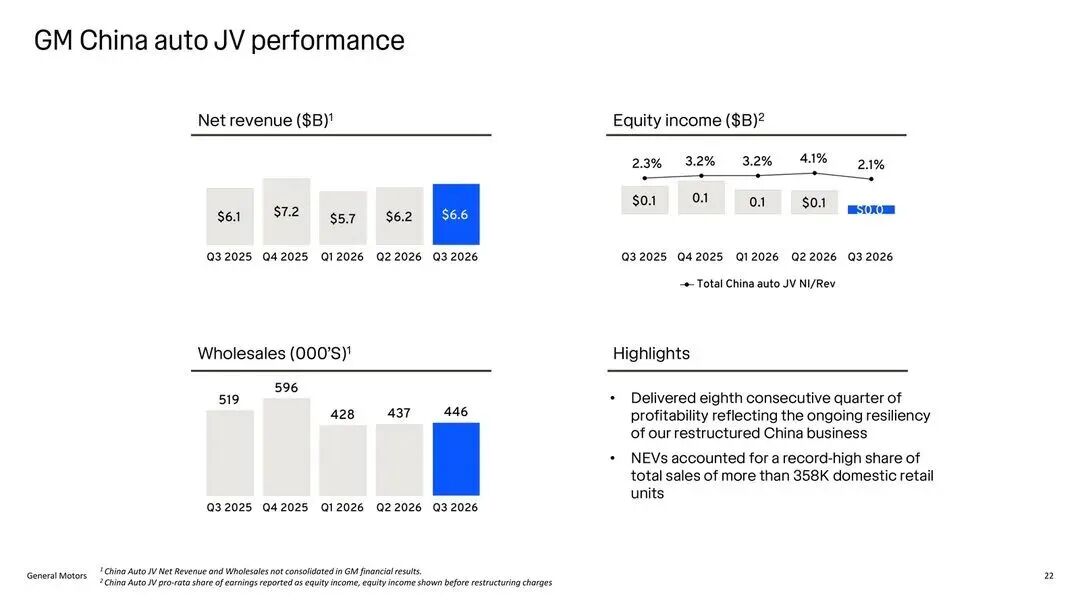
However, regarding the Chinese market, Mary Barra acknowledged that GM currently faces intense competitive pressure. She noted that within China, GM has not yet reaped significant benefits from the current market dynamics. Nevertheless, due to GM's early restructuring efforts, its Chinese business has remained profitable despite the sluggish economic environment of the overall local automotive industry. Export opportunities may provide some minor benefits, but overall, GM anticipates that the Chinese market will present tougher challenges.
Nevertheless, GM remains committed to investing in the Chinese market. In August this year, General Motors and SAIC Motor officially signed a joint venture renewal agreement, extending their cooperation period by 20 years to 2047. Meanwhile, SAIC-GM is actively transforming, with the full transfer of product definition rights to the Pan Asia Technical Automotive Center, making the joint venture the core force driving underlying R&D. According to the plan, SAIC-GM will launch no fewer than 30 NEV models by 2030. This means that GM's NEV products in China will no longer need to passively wait for the global platform's rollout schedule; their development pace has begun to synchronize with the iteration speed of the Chinese market.
In addition, significant changes are occurring at the supply chain level. Joint venture brands traditionally relied on global procurement systems, but now, the cost and response speed advantages built by the Chinese supply chain in the fields of power batteries and intelligent driving are reshaping this logic. It has become a trend for local suppliers such as CATL and Momenta to enter the procurement lists of joint venture brands. GM is more forward-looking and decisive in this regard compared to most joint venture brands.
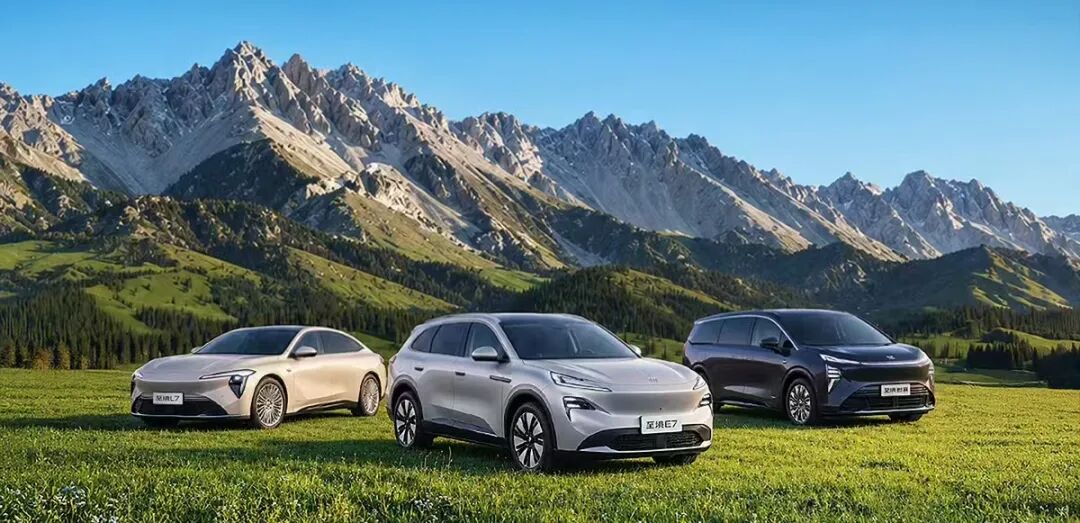
From a market perspective, since the third quarter of this year, the Buick Envision L7 pure electric version and the Envision E7 plug-in hybrid mid-size SUV have been refreshed and launched; the all-new Cadillac XT5 PHEV, exclusively designed for the Chinese market, is the first luxury hybrid SUV to be delivered with Momenta's R7 world model; the Wuling Xingguang L plug-in hybrid SUV has been well-received in the three-row, six-seat flagship SUV market.
Among them, the all-new Cadillac XT5 PHEV Intelligent Hybrid Four-Wheel Drive Air Edition was launched on October 16, with a limited-time price starting at RMB 239,900. The Air Edition shares the exact same hardware as the Pro and Pro Max versions, featuring standard front and rear dual-motor four-wheel drive, 6kW external power discharge, 5C ultra-fast charging, and an electric Hummingbird chassis. It is equipped with the Doubao large model, Level 2 assisted driving, and parking assistance capabilities.
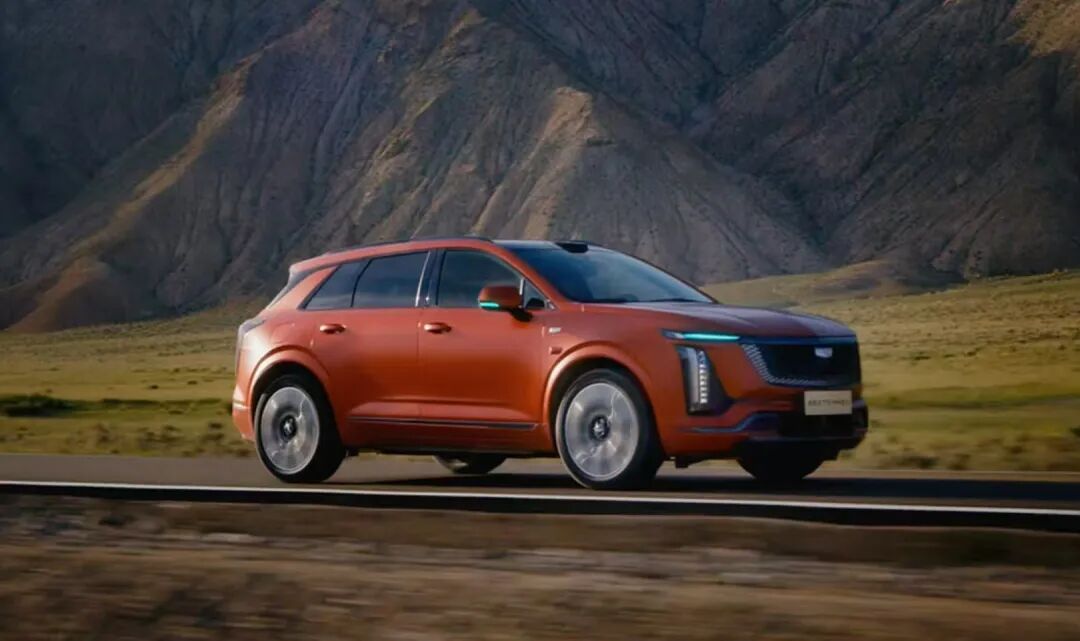
At the market end, among the more than 358,000 vehicles delivered in Q3, NEV models accounted for over 60% and achieved sequential double-digit growth for two consecutive quarters. Meanwhile, the company sold 94,000 NEVs from January to September, up 67.4% year-on-year. On a monthly basis, SAIC-GM's overall terminal sales in September were 47,695 vehicles, up 6.1% month-on-month, including 9,520 NEVs, up 31% month-on-month.
Currently, the collective criticism of hastily developed vehicles in the NEV market has brought new opportunities for joint venture brands. In the long run, competition in the NEV market is shifting from simple parameter comparisons to systemic capability competition. For joint venture brands, as long as they streamline their mechanisms and find the right path, they are fully capable of creating NEV products with scale, reputation, and premium pricing, rewriting the market's established perceptions of joint venture NEVs.
In addition, Mary Barra also discussed the global competition brought about by the current export of Chinese automobiles. Mary Barra said that looking at some markets where Chinese automakers are operating, especially South America, GM is still maintaining its market share. Furthermore, she said that GM also exports some products from China. As long as a market allows Chinese competitors to enter, GM is in a favorable position to compete with products that align with the Chevrolet brand positioning while offering corresponding price competitiveness.
-
![]()
Post-85s AI Meteorology Entrepreneur from Changzhou, Jiangsu: Secures Multi-Million Funding
-
![]()
Why Is Light Able to Pass Through Holes Smaller Than Its Wavelength?—Exploring the Extraordinary Optical Transmission of Metasurface Infrared Filters
-
![]()
Film and Television Hurricane Delivers a Rigorous Review of the iPhone Duo! Withstands 10,000 Folds, Yet Falls Short in Software
-
![]()
Is the XPENG MONA L05’s Pre-sale Price 40,000 Yuan Steeper Than Its Rivals’?
-
![]()
Historic Windfall in Layoffs: BMW's Up to €650,000 Compensation Sparks Employee Exodus, Overwhelms System
-
![]()
Has Geely’s Debut Boxy SUV Shaken Up Off-Road Pricing?
-
![]()
GM China Reports $210 Million Net Profit in Q3: Two Consecutive Years of Profitability, Though CEO Warns of Tougher Market Conditions
-
![]()
BMW Layoffs: Employees Compete to Leave!