Why Is Light Able to Pass Through Holes Smaller Than Its Wavelength?—Exploring the Extraordinary Optical Transmission of Metasurface Infrared Filters
 10/22 2026
 450
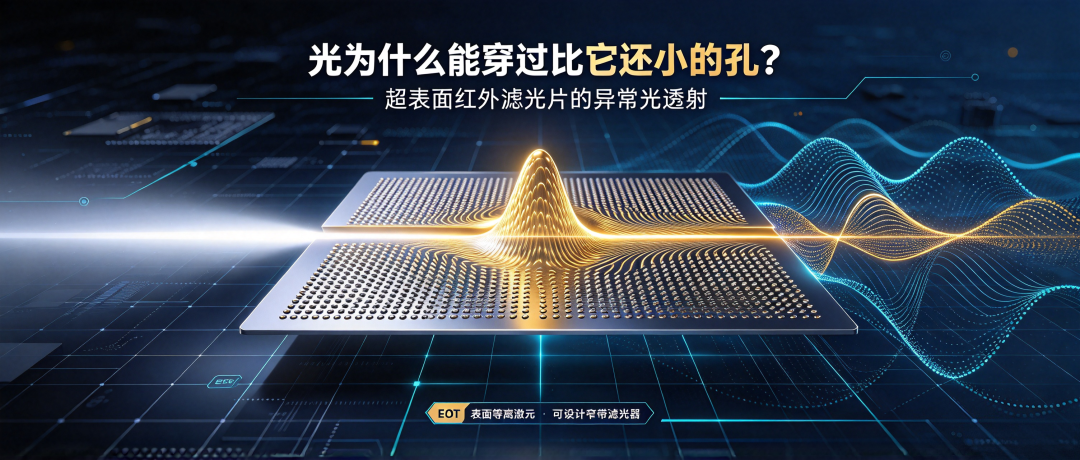
Abstract: Traditional theory posits that light encounters difficulty traversing holes smaller than its wavelength. However, the phenomenon of extraordinary optical transmission (EOT) challenges this long-held belief.
By harnessing the surface plasmon polariton effect, metasurfaces employ nanohole array configurations to manipulate this physical phenomenon, resulting in the creation of tunable infrared narrowband filter devices.
Having established that metasurfaces fall under the category of DOE (Diffractive Optical Elements)—are DOE and metasurfaces synonymous?
This article delves deeper into the subject: Using infrared filters as a case study, we examine how metasurfaces transform the EOT physical phenomenon into designable devices. Conventionally, light faces significant challenges in passing through holes smaller than its wavelength.
In 1944, Bethe's theory suggested that the transmission capability diminishes rapidly, decaying with the fourth power of the ratio between aperture size and wavelength—the smaller the hole, the greater the difficulty for light to pass through.
However, in 1998, Ebbesen's team observed unexpected results in nanohole arrays on metallic thin films: the transmittance of specific wavelengths significantly surpassed predictions made by classical diffraction theory.
The first time I encountered the EOT test curve, my initial reaction was, 'This must be a measurement error.'
Later, I came to realize that it wasn't a case of light defying physical laws. Rather, we had unconsciously treated the notion that 'small holes equate to no light transmission' as a universal physical principle, when in fact, it was merely an approximate conclusion applicable to isolated single-hole scenarios.
Why does Bethe's conclusion seem to 'fail'?

Bethe's (d/λ) attenuation law, formulated in 1944, holds true under stringent assumptions: a single isolated hole, an infinitely thin ideal conductor, and no consideration of electromagnetic responses at the metal surface.
Within these constraints, the formula remains impeccable. Ebbesen's experiment, however, utilized periodic nanohole arrays, where the periodic structure introduced new momentum-matching conditions, rendering Bethe's model assumptions invalid.
When the underlying premises shift, the conclusions naturally cease to apply. Light doesn't 'drill' through the holes; instead, it 'hitches a ride' along the metal surface.
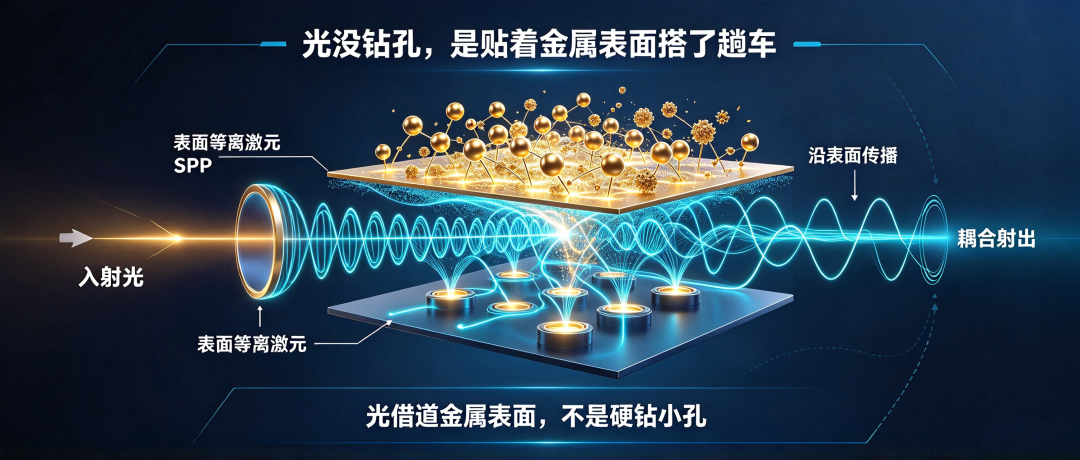
The core principle originates from surface plasmon polaritons. Incident light excites collective oscillations of free electrons on the metal surface, forming surface plasmon polaritons that propagate along the metal-dielectric interface.
Light doesn't pass directly through the center of the holes; rather, it propagates along the metal surface, transferring energy between adjacent holes before coupling out from the opposite side of the film. This mechanism forms the basis of EOT's anomalous transmission.
Single Holes Can Resonate Too: It's Not Just for Arrays

Beyond the surface plasmon polariton effects introduced by arrays, individual nanoholes can also generate localized electromagnetic resonances.
These localized resonances effectively transform each hole into a micro-antenna, achieving localized energy enhancement at specific wavelengths. The combined effects of array coupling and single-hole localized resonances collectively contribute to the formation of the anomalous transmission peaks.
Hole Spacing, Diameter, and Dielectric: Three Factors Determine One Wavelength
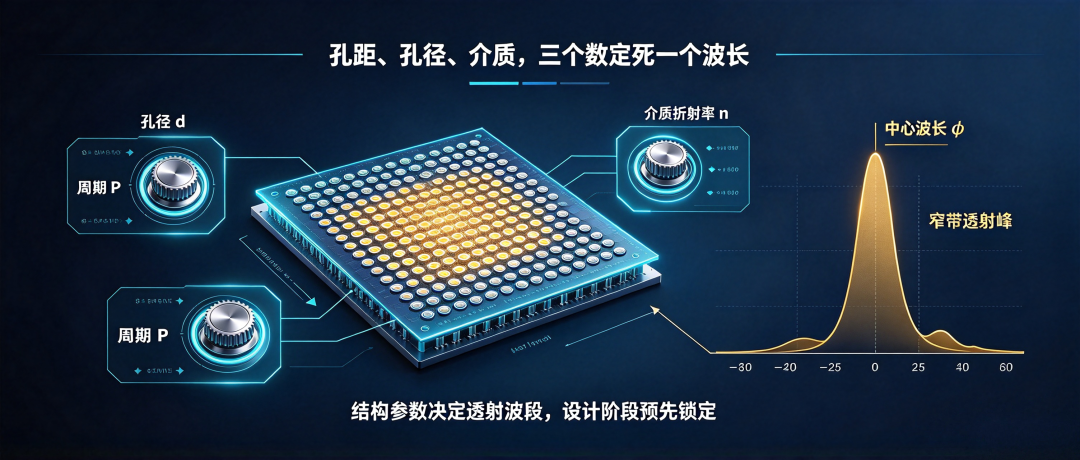
To be candid, EOT was initially merely an anomalous physical phenomenon accidentally discovered in the laboratory. When integrated into metasurface systems, precise control over the nanohole diameter, array period, and refractive indices of the upper and lower dielectrics allows for the accurate determination of the transmission peak's central wavelength by satisfying momentum-matching conditions.
Based on this principle, engineers can leverage the EOT effect to fabricate infrared narrowband filters.
However, it's crucial to establish clear boundaries: These filters are incapable of switching wavelengths in real-time. They are static optical devices locked to predefined transmission bands during the design and lithography stages, rather than truly dynamically programmable devices.

To be honest, EOT filters currently face inevitable engineering limitations: high sensitivity to incident angles, limited achievable bandwidth, and inherent absorption losses from the metallic thin film.
They do not serve as a universal replacement but rather as an alternative solution with unique advantages in specific scenarios, such as infrared sensing and miniature spectral detection.
Interactive Topic: In your AR sensing or display work, is the performance of infrared filters a critical aspect that requires focused attention?
—AR Andy | Specializing in waveguide and AR microdisplay technologies, dissecting the fundamental logic of the optics industry.
【Risk Disclaimer】This article serves as an industrial science popularization (popular science); physical models are simplified for clarity. Actual device simulation necessitates FDTD full-vector electromagnetic calculations to optimize structural parameters before lithography. Mass production performance is influenced by factors such as thin-film processes, surface roughness, and etching profiles.
-
![]()
Post-85s AI Meteorology Entrepreneur from Changzhou, Jiangsu: Secures Multi-Million Funding
-
![]()
Why Is Light Able to Pass Through Holes Smaller Than Its Wavelength?—Exploring the Extraordinary Optical Transmission of Metasurface Infrared Filters
-
![]()
Film and Television Hurricane Delivers a Rigorous Review of the iPhone Duo! Withstands 10,000 Folds, Yet Falls Short in Software
-
![]()
Is the XPENG MONA L05’s Pre-sale Price 40,000 Yuan Steeper Than Its Rivals’?
-
![]()
Historic Windfall in Layoffs: BMW's Up to €650,000 Compensation Sparks Employee Exodus, Overwhelms System
-
![]()
Has Geely’s Debut Boxy SUV Shaken Up Off-Road Pricing?
-
![]()
GM China Reports $210 Million Net Profit in Q3: Two Consecutive Years of Profitability, Though CEO Warns of Tougher Market Conditions
-
![]()
BMW Layoffs: Employees Compete to Leave!