Laying Cards on the Table! Tesla Q3 2026: Vehicle Sales Peak, All Funds Poured into AI
 10/26 2026
 523
Recently, Tesla released its Q3 2026 earnings report.
In this quarter, it delivered 487,000 vehicles, a 2% year-over-year decrease; revenue reached $28.05 billion, nearly unchanged from the previous year;
operating profit stood at $720 million, more than halved year-over-year, with an operating profit margin of only 2.6%.
At first glance, these figures resemble a dismal report card.
However, when examining the past 11 quarters, the narrative becomes more complex: the gross profit margin on vehicle sales climbed from 12.5% in Q1 2025 to 18.1%, with gross profit per vehicle returning to $7,350, nearing a two-year high;
the thinner profits resulted from a 69% year-over-year increase in R&D expenses, with funds actively spent on chips, computing power, and robotics.
Thus, Jack's initial curiosity arises: Can Tesla still sell its vehicles? Where is the money earned from vehicle sales being spent?
What progress has been made on the Cybercab, Optimus, AI5 chip, Terafab wafer fab, and self-built mapping, which were repeatedly mentioned during the earnings call?
How do these developments differ from what Chinese automotive companies are doing?
This article will synthesize Tesla's Q3 earnings report, the full transcript of the earnings call, and related reports, combining the expertise of Vehicle analysts to share and discuss these questions.
01 Sales Volume
Sufficient Orders, Insufficient Batteries · Deliveries
Let's start with the most fundamental metric: delivery volume.
In Q3, Tesla delivered 486,532 vehicles and produced 464,391, with deliveries exceeding production by over 20,000 units, reducing inventory days to 11.
Model 3 and Model Y deliveries reached 478,000, a 1% year-over-year decrease;
other models (Model S, Model X, and Cybertruck) delivered only 8,295, a 48% year-over-year decline.
Over a longer timeline, Tesla's quarterly deliveries bottomed at 337,000 in Q1 2025, then rebounded consistently, surpassing 480,000 for two consecutive quarters in Q2 and Q3 2026.
Year-to-date for the first three quarters of 2026, deliveries reached 1.325 million, an 8.8% year-over-year increase, with revenue growing by 12.5%.
Jack believes the single-quarter decline is mainly due to a higher base from panic buying before the expiration of U.S. tax credits in Q3 last year, with overall annual growth remaining modest.
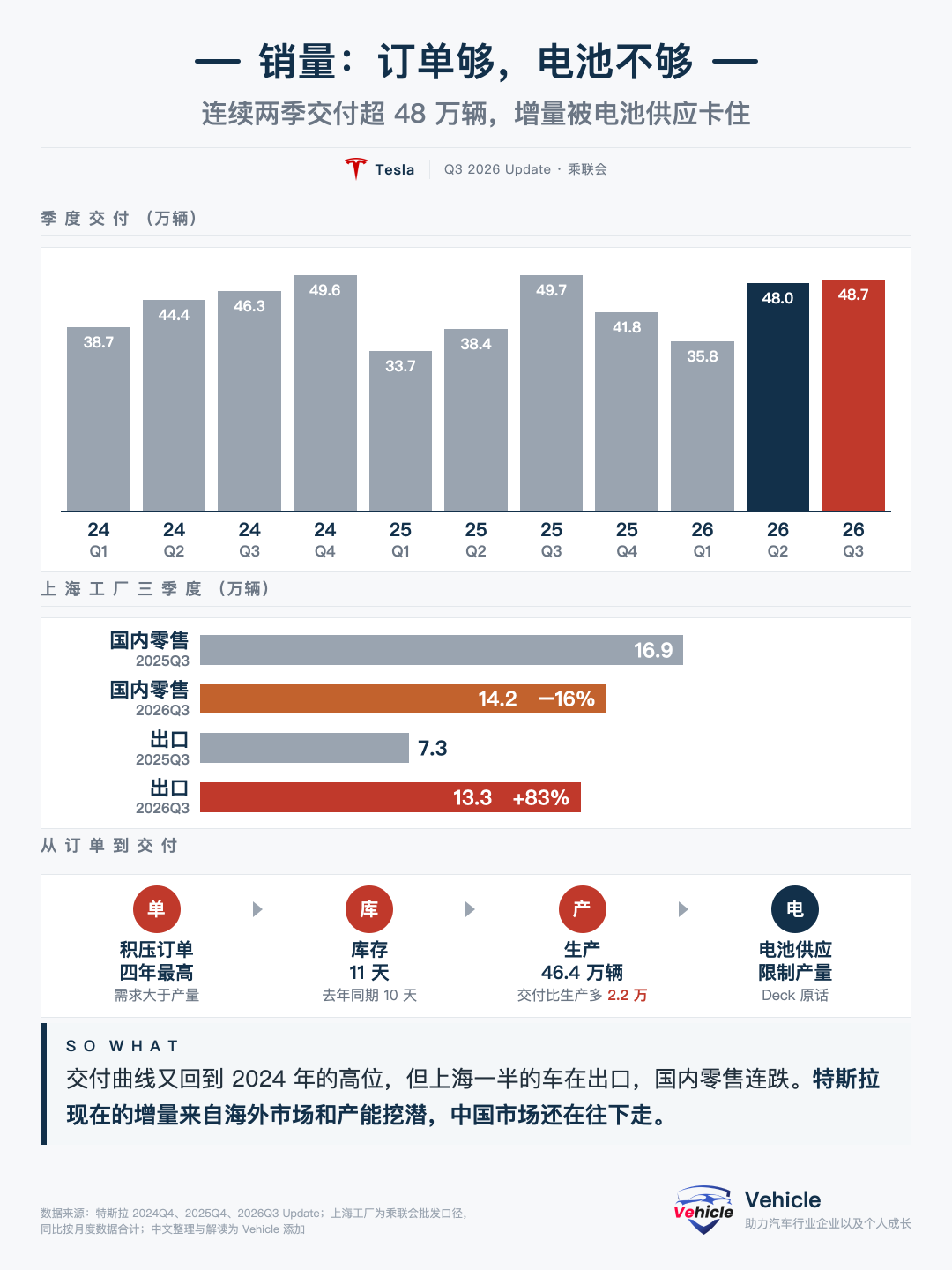
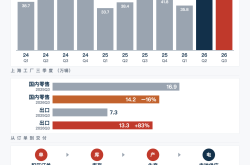
Tesla's quarterly deliveries and Shanghai factory outflows; Shanghai data follows CPCA wholesale figures, differing from global delivery metrics.
Quick Insights
Deliveries: 487,000 (+2% YoY), +8.8% YTD; growth constrained by battery supply.
Revenue: $28.05 billion, flat YoY; services and others +33%, regulatory credits +73%.
Gross profit per vehicle: $7,350; R&D +69%; operating profit margin: 2.6%.
FSD paying users: 1.74 million; North American new car subscription rate: 75%+.
Cybercab: 300+ in Austin; customer Model Y to join fleet in Q2 2027.
Optimus: External deliveries by late 2027; Terafab chip production in Q3 2028.
So why can't more vehicles be sold? Management's answers during the earnings call were consistent:
Elon Musk stated that demand significantly exceeds production, with FSD being the primary driver;
CFO Vaibhav Taneja noted that deliveries are mainly constrained by production capacity, with backlog orders at their highest in four years by quarter-end;
the earnings report directly cited battery supply as the limiting factor for increasing automotive production this quarter.
A closer look at Tesla's production capacity reveals that the combined annual capacity for Model 3 and Model Y exceeds 2.25 million units, with Q3's annualized production around 1.83 million, implying a capacity utilization rate below 81%.
Musk explained that factory downtime stems from battery pack shortages.
This also explains why Tesla, despite reporting high order volumes this quarter, is aggressively building in-house cell and lithium refining capacity.
The Chinese market provides another clue.
According to CPCA data, Tesla's Shanghai factory wholesale volumes reached 275,000 in Q3, a single-quarter record, but the composition shifted: domestic retail sales were 142,000, a 16% year-over-year decrease;
exports hit 133,000, an 83% year-over-year increase. Exports now account for 48% of Shanghai's wholesale volume. As discussed in our article "Data Interpretation | Detailed Analysis of China's Automotive Performance in September 2026: Domestic Sales Shortfall of 670,000 Units, Exports Compensate for Only 60%," export surges are widespread, and Tesla is no exception.
China's retail share of Tesla's global deliveries dropped from 34.1% last year to 29.2%.
To stabilize domestic demand, Tesla offered ¥5,000 off Model 3 final payments and ¥7,000 off select Model Y variants before late October.
Meanwhile, the Model Y reclaimed the top spot in pure electric vehicle sales in Europe, led passenger vehicle sales in South Korea, and set records in Canada, Australia, Japan, and Taiwan.
Increased Asia-Pacific representation lifted gross margins.
Tesla's vehicles remain in demand, with growth constrained by battery supply; the Shanghai factory increasingly serves as an export hub, while the domestic Chinese market continues to decline.
02 Revenue
Automotive Stagnation, Services Flourish · Revenue Mix
In Q3, Tesla's total revenue reached $28.05 billion, nearly flat year-over-year. Breaking it down, the four business segments performed starkly differently:
Automotive Sales and Leasing: $20.56 billion, a 3% year-over-year decrease;
Energy Generation and Storage: $2.88 billion, a 16% year-over-year decrease, with 13.7 GWh of storage deployed, partly due to customer refunds related to tariffs;
Services and Others: $4.61 billion, a 33% year-over-year increase;
Regulatory Credits: Only $113 million, a 73% year-over-year decrease.
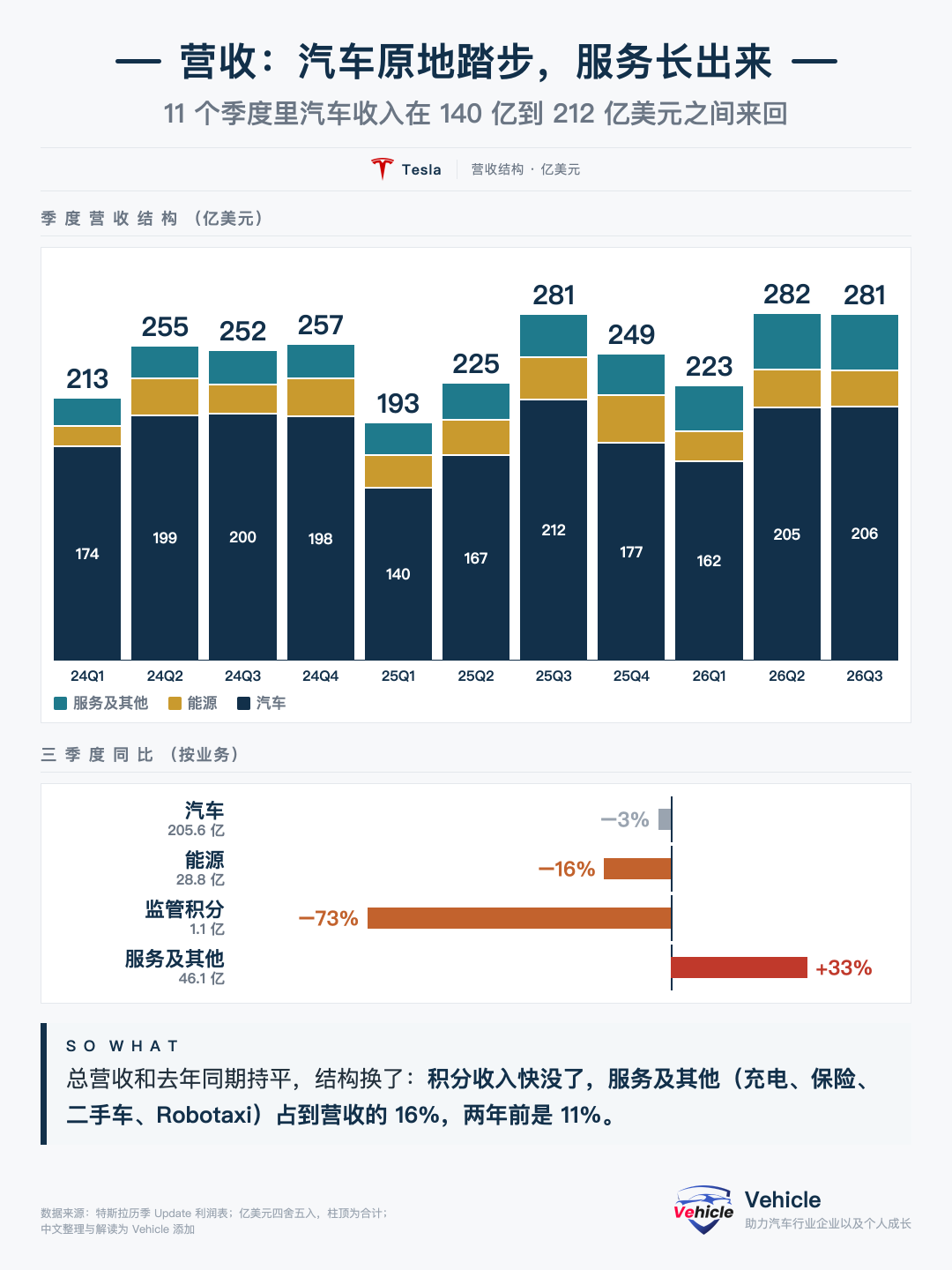
Tesla's quarterly revenue composition (Q1 2024—Q3 2026) and YoY changes in Q3.
Over the past 11 quarters, Tesla's automotive revenue has fluctuated between $14 billion and $21.2 billion without showing trending growth.
The most stable growth segment is services and others, whose share of total revenue rose from 10.7% in Q1 2024 to 16.4%.
This segment includes used car sales, parts, insurance, Supercharging, and increasingly, revenue from FSD subscriptions.
Regulatory credits represent another noteworthy shift for domestic peers.
After the U.S. abolished fuel economy penalties, other automakers' incentive to purchase credits virtually disappeared.
In Q3 last year, credit revenue accounted for 26% of Tesla's operating profit; this quarter, it totaled just $113 million.
Tesla's path of subsidizing profits through credit sales has largely ended.
Tesla's revenue structure is shifting from "one-time payments per vehicle sale" to "recurring revenue post-sale," with services and software driving growth.
03 Profitability
Vehicle Margins Rise, Profits Spent on R&D · Margins & OpEx
Tesla's automotive gross margin (excluding regulatory credits) was 18.1% in Q3, a 2.7 percentage point year-over-year increase. Gross profit per vehicle stood at approximately $7,350, roughly ¥52,000 at an exchange rate of $1 = ¥7.1.
At its lowest in Q1 2025, gross profit per vehicle was just $4,530.
The margin recovery stems from several factors: a higher share of sales in high-margin regions like Asia-Pacific, improved product and regional mix, the absence of last year's restructuring costs, and additional revenue from FSD subscriptions.
Rising commodity prices and interest rates posed headwinds, which Tesla partially offset through adjusted financing schemes.
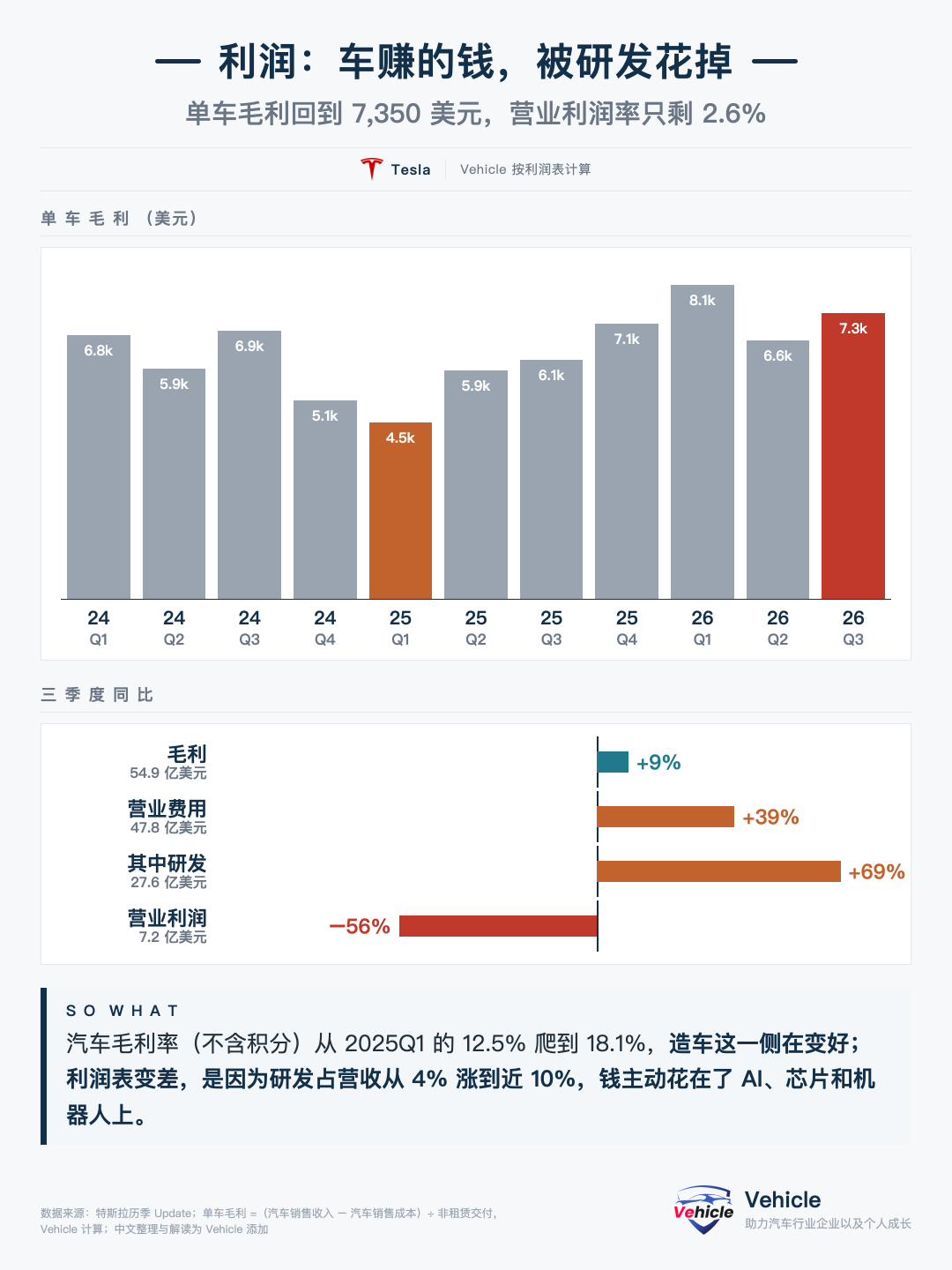
Tesla's quarterly gross profit per vehicle (calculated per financial report) and key YoY changes in Q3's profit and loss statement.
Now, examining expenses: operating expenses reached $4.78 billion in Q3, a 39% year-over-year increase;
R&D accounted for $2.76 billion, a 69% year-over-year increase.
R&D's share of revenue rose from 4.1% in Q3 2024 to 9.8%.
Operating expenses consumed 87% of gross profit, up from 68% last year.
Where is R&D spending concentrated?
According to the earnings report, investments focus on autonomous driving and AI, including training computing power, FSD, and Optimus.
Stock-based compensation expenses were also significant, totaling $1.165 billion in Q3, or 24% of operating expenses, including Musk's new 2025 incentive package.
Ultimately, operating profit reached $720 million, a 56% year-over-year decrease, with an operating profit margin of 2.6%.
Jack finds this highly instructive.
Many domestic automakers also operate within 2%-5% profit margins, but mostly due to price wars eroding per-vehicle gross profit.
Tesla's situation is the opposite: per-vehicle gross profit is recovering, but profits are actively spent by the company.
Management stated during the earnings call that operating expenses will continue to rise until new products are commercialized.
Tesla's low Q3 profitability stems from investment intensity; its automotive profitability has improved compared to a year ago.
04 FSD
From Optional Feature to Subscription Business · FSD (Supervised)
In the product technology section, Jack begins with FSD, as it directly impacts vehicle sales.
Globally, FSD had 1.74 million paying users in Q3, a 67% year-over-year increase, with subscribers accounting for half for the first time.
Over 75% of new vehicles delivered in North America activated paid subscriptions, up roughly 20 percentage points sequentially.
Tesla now offers a one-month free FSD trial with every new vehicle, yet three-quarters of buyers still sign up for paid subscriptions at delivery.
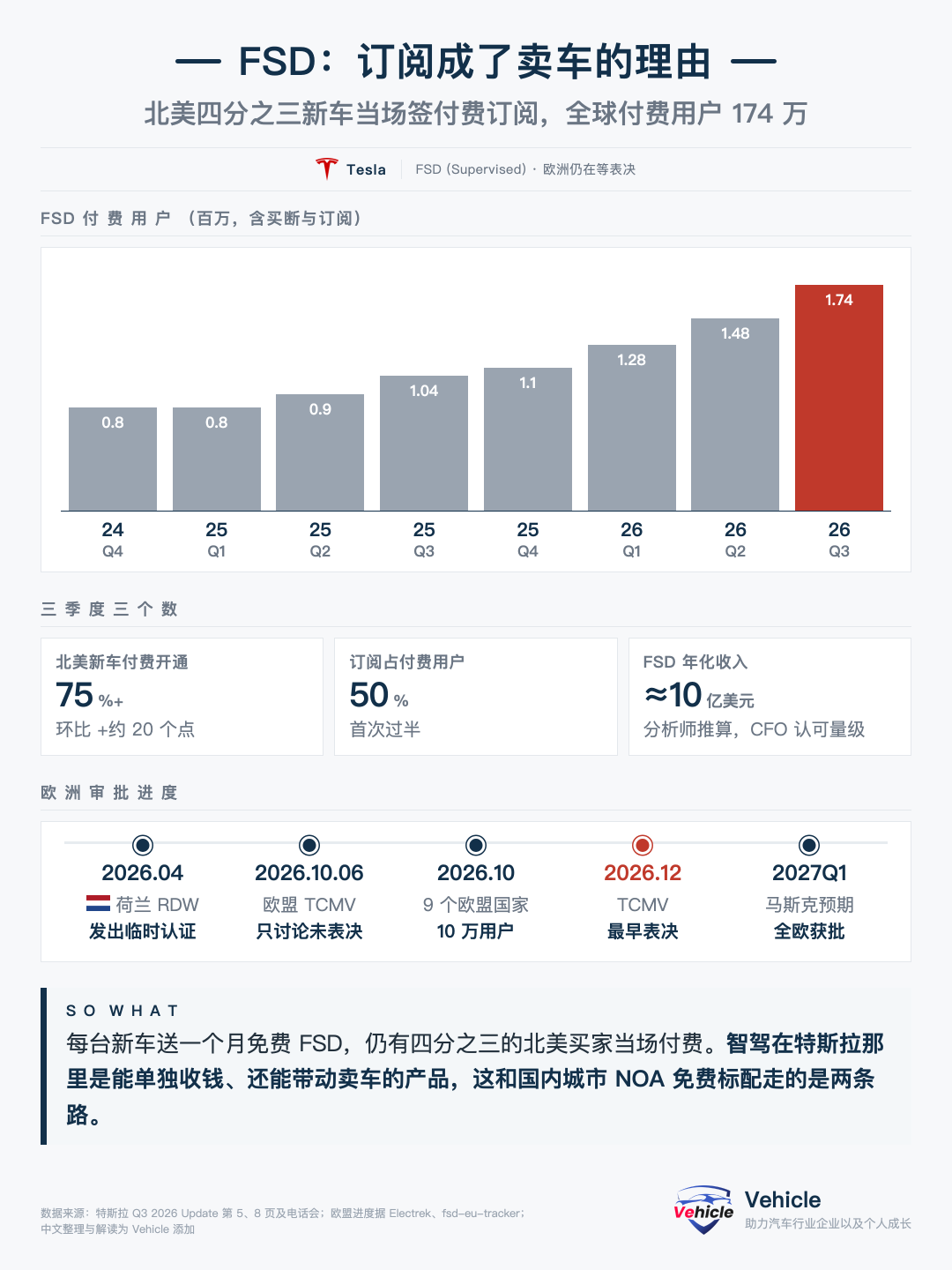
FSD paying users, Q3 key metrics, and European approval progress.
A notable exchange occurred during the earnings call.
New Street Research analyst Pierre Ferragu estimated Tesla's annualized FSD revenue at nearly $1 billion, with per-vehicle factory gross profit around $7,000, and FSD adding over $1,000 annually.
Taneja responded, "The numbers are correct," and mentioned future disclosures on annualized revenue and churn rates.
Europe is FSD's next frontier.
Our previous article, "Decoding Tesla FSD's European Certification: Two Pathways for China's L2++ Intelligent Driving to Go Global," noted that the Netherlands' vehicle authority (RDW) issued provisional certification in April 2026.
Musk expects full European approval within months, expressing surprise if it delays beyond Q1 2027, though he acknowledged that timing is beyond Tesla's control.
China's situation warrants separate discussion. Currently, domestic FSD remains a ¥64,000 one-time purchase, with no subscription option or new timeline announced.
Some domestic media reported, "Musk admits FSD has no leading edge in China." After reviewing the earnings call, Jack found that CFO Taneja actually said Chinese automakers currently lack Tesla's technological leap, and Tesla is collaborating with regulators.
The report reversed the meaning.
Jack believes the most inspiring aspect for domestic peers is the business model.
Domestic urban NOA features are mostly offered as free standards to boost vehicle sales;
Tesla's FSD generates standalone revenue while driving vehicle sales, and its subscription model ensures sustainable income.
Both approaches have merit, but Tesla has demonstrated user willingness to pay.
In North America, FSD has transformed from an expensive optional feature into a service subscribed to by most buyers, altering how Tesla accounts for vehicle sales.
05 Cybercab
Manufacturing Feasible, Challenges Lie in Operations and Licensing · Robotaxi
Cybercab was the most frequently questioned product during the earnings call. Key facts:
On September 3, Cybercab began passenger operations in Austin, expanding its fleet tenfold within a month to over 300 vehicles, per Tesla's official statement;
by quarter-end, cumulative unsupervised miles neared 2 million, an eightfold quarterly increase, with weekly growth in the double digits;
operating hours extended from 6 AM-9 PM to 11 PM, midnight, soon to 2 AM, aiming for 24/7 operations by year-end, including highway access and expanded weather coverage;
Robotaxi services now operate in six cities, with Dallas adding Cybercab next month.
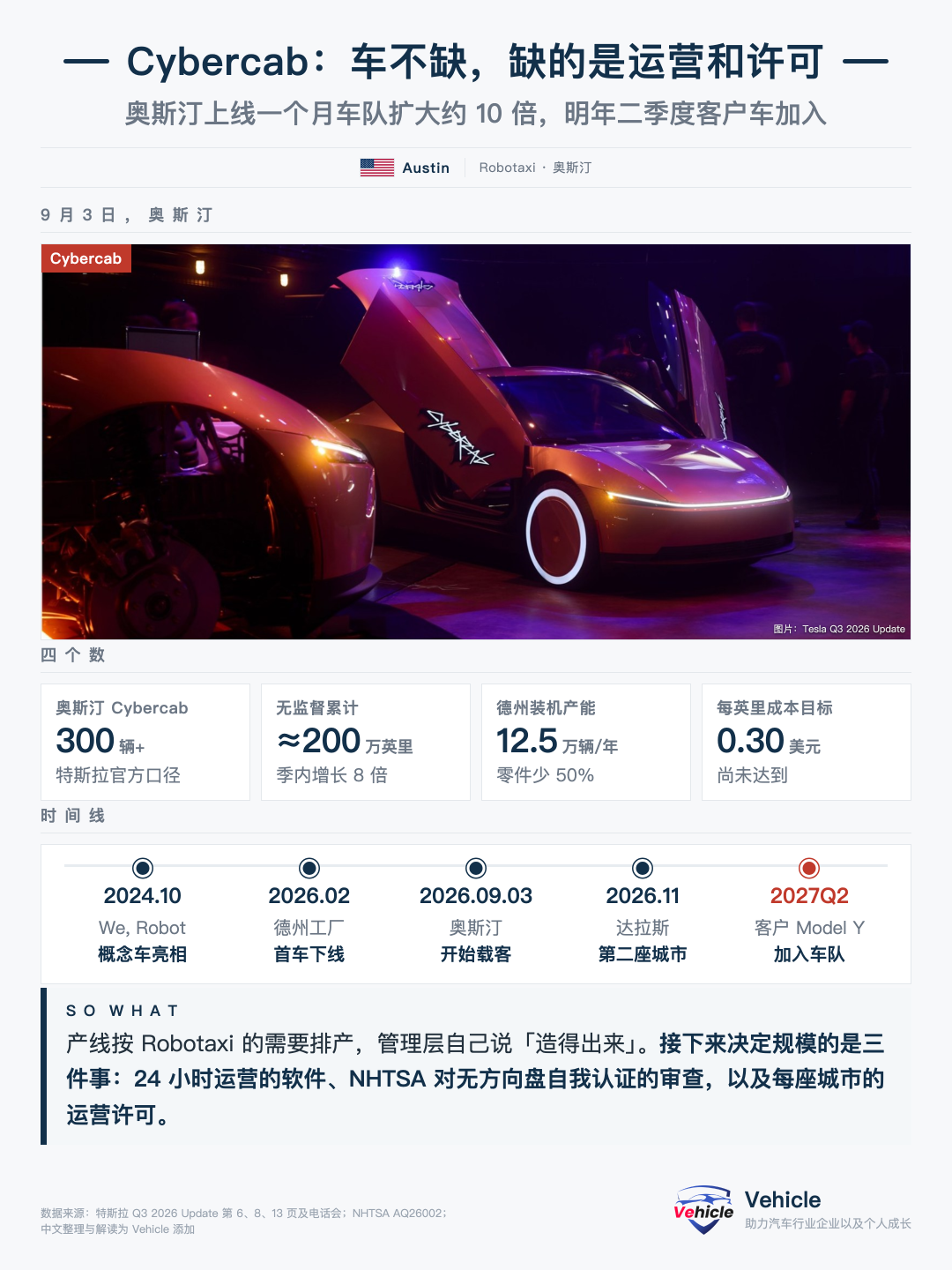
Cybercab's Austin operations, key metrics, and timeline; image from Tesla's Q3 2026 Update.
Manufacturing insights hold greater industry relevance.
Management stated that Cybercab has 50% fewer parts than any previous Tesla model, with the Texas factory currently capable of producing over 125,000 units annually—approximately 340 daily—though line capacity is higher, with production scheduled based on Robotaxi operational needs.
The cost target is $0.30 per mile, though management admitted this hasn't been achieved yet.
Cybercab deliveries to customers will begin by year-end, but most vehicles will be retained by Tesla for ride-hailing services.
Regarding customer vehicles:
Cybercab and Model Y run on the same software suite; v15 will roll out to customer vehicles, allowing the first batch of Model Y owners to join the Robotaxi fleet around Q2 2027.
Taneja provided a revenue timeline: Robotaxi income will become visible in Q2 2027, scaling in Q3 and Q4.
Where are the bottlenecks? Musk suggested that after Q1-Q2 2027, constraints may shift from technology to regulation.
A case in point: On September 3, the U.S. NHTSA opened an investigation into Cybercab (Case No. AQ26002), covering approximately 1,000 vehicles, requiring Tesla to submit a sworn response by October 30 regarding self-certification of steering wheel-less vehicles.
The production line for Cybercab has already been scheduled according to the demands of Robotaxi. The scale of production will be determined by the software for 24-hour operation, the review of NHTSA, and the operational permits from each city.
06 Optimus
Production line is ready, but hands are not yet perfect · Humanoid robot
The information revealed about Optimus this time is more specific than ever:
The original production lines for Model S and Model X at the Fremont factory have been converted into a high-volume production line for Optimus, with early production already underway. Most of the production line capable of producing one million units annually is already in place.
It will take at least a year to ramp up production to 20,000 units per week, and the design is still being refined.
External delivery is expected around the end of 2027, initially targeting industrial scenarios that are dangerous, repetitive, and require 24-hour operation.
A larger Optimus factory is under construction in Austin.
A non-pre-programmed demo video will be released within 1 to 2 months (meaning previous demo videos were all pre-programmed).
Musk mentioned three challenges: the hands are the most complex electromechanical part of the entire robot; the lifespan of custom gears still needs to be addressed;
The AI architecture is also undergoing iteration.
He also proposed an idea: first build 10,000 to 20,000 Optimus robots, place them in an 'Optimus Academy' for self-training in simulated and real environments, and then proceed with external delivery.
The pace of Optimus will also be influenced by chips.
AI5 is expected to be integrated into Optimus around April 2027, offering an order of magnitude increase in computing power compared to the current AI4.
In terms of cost, Musk stated that the cost of Optimus will approach that of Cybercab.
Jack believes this section holds significant reference value for domestic automakers' robotics teams.
Tesla adopts an automotive factory approach: first prepare the production lines and capacity, repurpose existing model lines, and then let design iterations catch up with production lines;
At the same time, it acknowledges that core components like hands and gears are not yet ready, deferring external delivery by a year.
Many domestic humanoid robot projects start with demonstrations and then build production lines, reversing the rhythm (Note: ' rhythm ' is kept as-is since it's a common term in both Chinese and English contexts related to timing or pace, but for strict translation, it could be 'pace').
The production line for Optimus is already in place, but the pace is constrained by the hands, gear lifespan, and AI5 chips, with mass production and external delivery expected around the end of 2027.
07 Chips and Computing Power
From buying chips to building a wafer fab · AI5 / Terafab / Cortex
Let's first look at training computing power.
Tesla's Cortex 1 in Texas exceeds 105 megawatts, Cortex 2 exceeds 120 megawatts, with an additional 40 megawatts of other computing power, aiming for a total of 400 megawatts by the end of the year.
In the second quarter, Cortex 1 and Cortex 2 were at 90 megawatts and 115 megawatts, respectively.
Now, let's consider vehicle chips.
AI5 is manufactured by Samsung and TSMC. According to South Korean media, Samsung's Taylor factory has already conducted trial production using a 2-nanometer process, planning to complete mass production verification by the end of the year and supply in 2027.
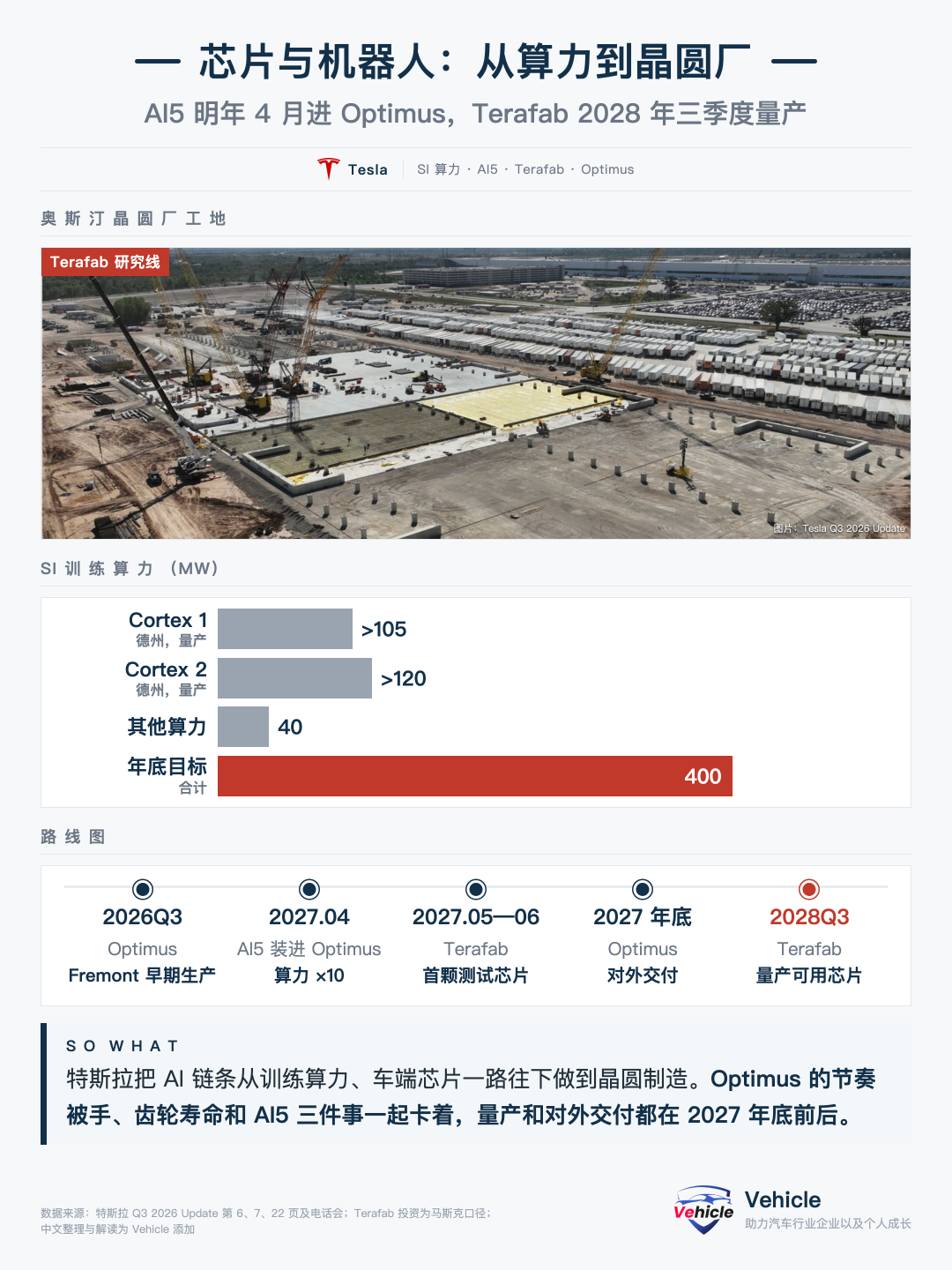
Tesla's training computing power, Austin Terafab construction site, and chip and robotics roadmap; image from Tesla Q3 2026 Update
The most aggressive move is Terafab.
This is Tesla's self-built wafer fab in Austin. Most of the equipment for the research line has already been ordered, with installation and debugging scheduled for the first half of 2027. The first test chip is expected in May-June, and mass production of 'useful chips' will begin in the third quarter of 2028.
In terms of investment scale, equipment investment will reach tens of billions of dollars by early 2028, potentially exceeding $100 billion in the long term. How this will be shared between Tesla and SpaceX has not been determined yet.
Jack believes it's important to distinguish two things.
Training computing power and AI5 chip design are being pursued by domestic leading automakers and intelligent driving companies, with the gap primarily in scale;
Building a self-owned wafer fab is another level of bet, requiring tens of billions of dollars and multiple years. Currently, Tesla is the only global automaker taking this route.
For most automakers, a more realistic reference is to tie chip design, software, and vehicle requirements together to gain definition rights.
Tesla has extended its AI chain from training computing power and vehicle chips all the way to wafer manufacturing, representing the heaviest investment route among global automakers.
08 Maps
No more relying on others' maps · AI-based navigation
During the conference call, maps were a topic that was easily overlooked but, in my opinion, worth pondering for the automotive and humanoid robotics industries.
Ashok Elluswamy, Tesla's AI lead, stated that Tesla should not rely on others' maps.
They are building their own AI-based map and navigation architecture, capable of voice interaction, learning individual preferences, and the preferences of the entire fleet.
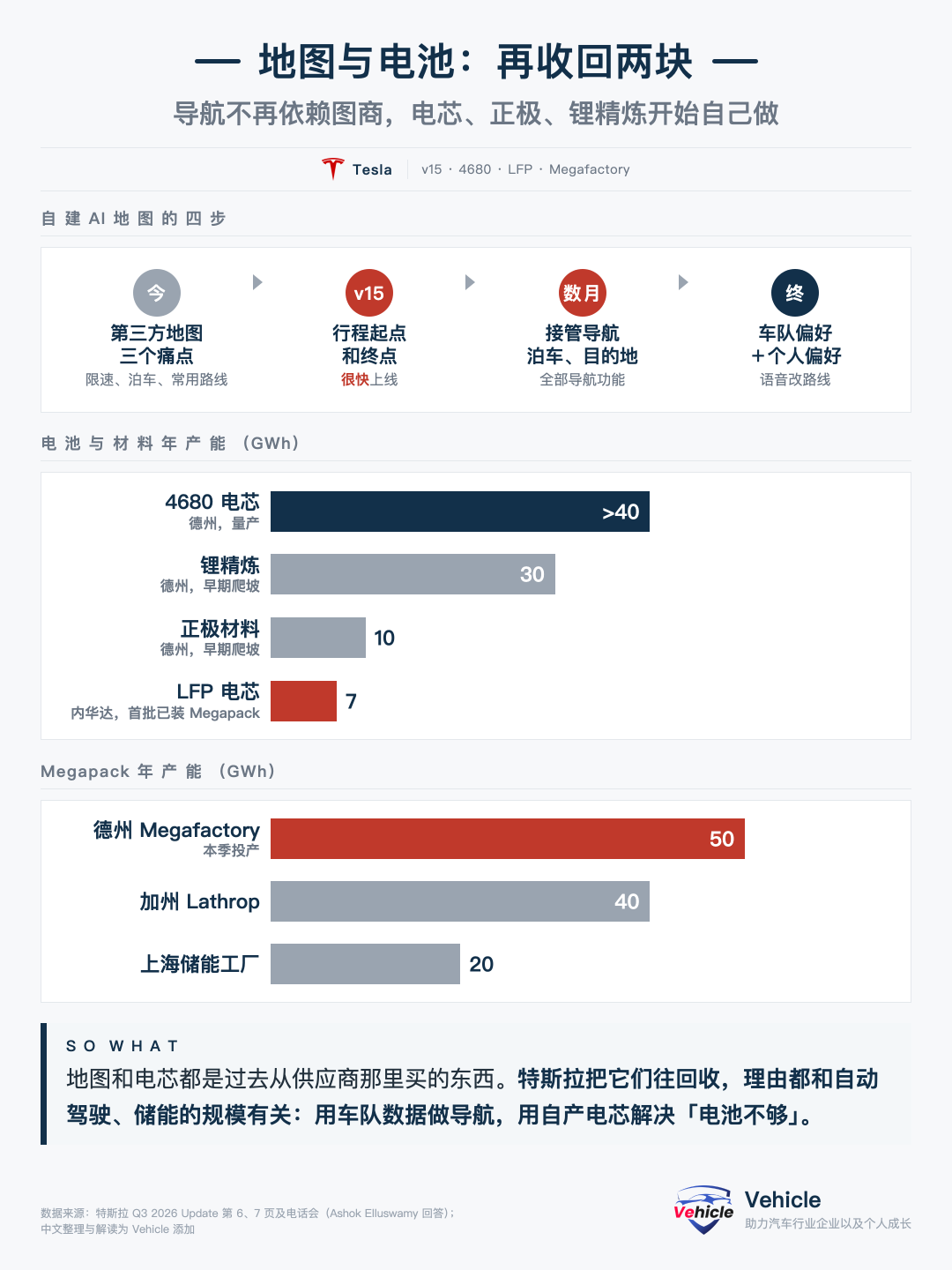
Tesla's self-built AI map progression steps alongside battery and energy storage capacity
The rollout will proceed in two steps:
v15 will first take over the start and end points of trips, such as driving out of a parking spot and finding a parking spot at the destination;
Within the following months, it will take over all navigation, parking, and destination handling.
Why build their own?
First, to correct a common misconception: both autonomous driving and humans need map information. Machines need it even more. Navigation maps are for humans, but autonomous driving robots also require information on speed limits, lanes, entrances, and parking lots. Current 'mapless' approaches simply mean no high-definition (HD) maps; navigation maps still need to be compiled and fed to autonomous driving software.
Tesla now has millions of vehicles on the road every day, using fleet data to draw maps themselves. The update speed and granularity are things they can do conveniently on their own, and it's more conducive to customization.
09 Batteries and New Products
Batteries, energy storage, Semi, and Roadster · Battery & Energy
Finally, let's quickly go over the other product lines.
Batteries: Texas's 4680 cell annual capacity exceeds 40 GWh, already in mass production;
Lithium refining at 30 GWh and cathode materials at 10 GWh are in early ramp-up;
Nevada's LFP cell production line at 7 GWh, with the first batch of Megapacks using fully self-produced LFP cells already shipped;
Berlin's 4680 production line is under construction.
Given that batteries are a bottleneck for vehicle production, Tesla's response is to move upstream and produce them in-house.
Energy storage: Texas's Megafactory with an annual capacity of 50 GWh commenced operations this quarter;
California's Lathrop at 40 GWh and Shanghai at 20 GWh.
Management stated that Megapack's production capacity for 2027 is almost fully sold out.
Semi: Mass production has begun at the new factory in Nevada, with a planned annual production of 25,000 units.
The top-spec model can carry a full load of 82,000 pounds and travel 500 miles, with an energy consumption of 1.7 kWh per mile, roughly one-third that of a diesel truck.
Roadster: Launched on October 15 at SpaceX's McGregor test site, available in Performance, Thrust, and Rocket versions, with production starting in 2028. Highlights of this model can be seen in our previous article 'Tesla Can Fly, but Among the Three Versions of Roadster, I Only See Potential in the One That Can't.'
The Performance version requires a $50,000 deposit, the Thrust version $250,000, with prices for the Rocket version yet to be announced.
Additionally, Musk reiterated the goal of producing 5 million vehicles annually by around 2030, with the path being to first maximize capacity at existing factories and then build new ones.
From cells, cathodes to lithium refining, Tesla is bringing the battery supply chain in-house to meet the demands of its automotive, energy storage, and Semi lines simultaneously.
10 Conclusion
Several Insights for the Automotive Industry
After reading this earnings report and conference call, Jack has four insights to share with you.
Analyze the income statement separately: A 2% operating profit margin achieved through price wars is fundamentally different from one resulting from high investment intensity; these represent two entirely different operating states.
Tesla's gross profit per vehicle is 52,000 yuan, with R&D accounting for nearly 10% of revenue. Its low profitability is a deliberate choice.
Software revenue is becoming significant: Three-quarters of new car buyers in North America are willing to pay a subscription fee for FSD, with service revenue increasing by 30% year-on-year.
Domestic automakers offer intelligent driving as a standard free feature, which can boost sales in the short term. However, how to recover R&D investments in the long term is worth serious consideration.
Core components are being brought in-house: Tesla is shifting from 'buying' to 'self-producing' batteries, maps, and chips.
Each of these moves is expensive, but Tesla is choosing to directly control the links that are crucial for autonomous driving and production volume.
Manufacturing first: Cybercab is scheduled for production at a rate of 340 units per day, and Optimus's million-unit production line is ready first, with design catching up later. This approach to building robots is interesting. Could Unitree have learned the essence? Hence, its recent surge.
Do you believe in Tesla's path of investing its car sales revenue into AI? Which will generate revenue first, Cybercab or Optimus? Feel free to leave a comment and discuss.
References and Images
Tesla Q3 2026 Earnings Report pdf
Tesla Q3 2026 Conference Call
*Unauthorized reproduction and excerpting are strictly prohibited.-
-
![]()
He Gang, Yu Chengdong's 'Trusted Partner,' Promoted to Huawei Director: A Pivotal Phone Call 13 Years Ago Altered His Career Path
-
![]()
Breaking News: Huawei Inks Landmark Deal with Century-Old Audi
-
![]()
Laying Cards on the Table! Tesla Q3 2026: Vehicle Sales Peak, All Funds Poured into AI
-
![]()
What We Can Learn from the 2026 WICV Speeches: Where Are Weride, DeepRoute, and ZhiJia Xincheng Betting on the Next Wave of Intelligent Driving?
-
![]()
Why Does Water Still Penetrate Despite IP68 Waterproofing?
-
![]()
Bridging the Gap: From Understanding to Safely Executing Intelligent Driving Commands
-
![]()
Why I’m Skeptical About the Near-Term Commercial Viability of L3 Autonomous Driving
-
![]()
Why Do Similar Problems Persist in Intelligent Driving Systems Despite Growing Training Data?