What We Can Learn from the 2026 WICV Speeches: Where Are Weride, DeepRoute, and ZhiJia Xincheng Betting on the Next Wave of Intelligent Driving?
 10/26 2026
 550
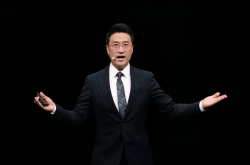
During the recent WICV 2026 World Intelligent Connected Vehicle Conference, there was a 'Key Technologies Forum' for intelligent vehicles. Among the day's speakers, three were from intelligent assisted driving companies.
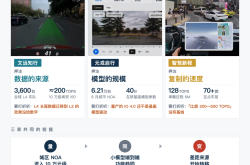
Han Xu, CEO of Weride, used the 100,000-yuan-class GAC Aion i60 as an example, stating that the vehicle's assisted driving system uses only about 200 TOPS of computing power.
Zhou Guang, CEO of DeepRoute, presented a bar chart showing 62,100 urban NOA installations in August, ranking second in the industry for the month. He also showcased an experiment where the general-purpose large model GPT-6 Astra directly controlled a real vehicle to complete a route.
Jiang Jingfang, President of ZhiJia Xincheng, discussed a 128 TOPS Journey 6M running a one-stage end-to-end system and plans to expand products to over 30 countries by 2026-2027.
All three companies started with 'Physical AI,' but they meant very different things. Weride referred to the long-term operation of L4 autonomous vehicles in over a dozen countries. DeepRoute spoke about a 40B driving foundation model trained using large model methods. ZhiJia Xincheng discussed a lightweight one-stage solution that could be sold to dozens of automakers. Stripping away the promotional language, our analysis is that with urban NOA reaching the 100,000-yuan-class and August penetration nearing 28%, all three companies are essentially answering the same question: where will the next round of differentiation come from? Weride is betting on data sources, DeepRoute on model scale, and ZhiJia Xincheng on replication speed.
Based on these three speeches, this article analyzes and summarizes trends in the assisted driving industry, examining what each company said and why. We hope to provide the industry with some information and insights.
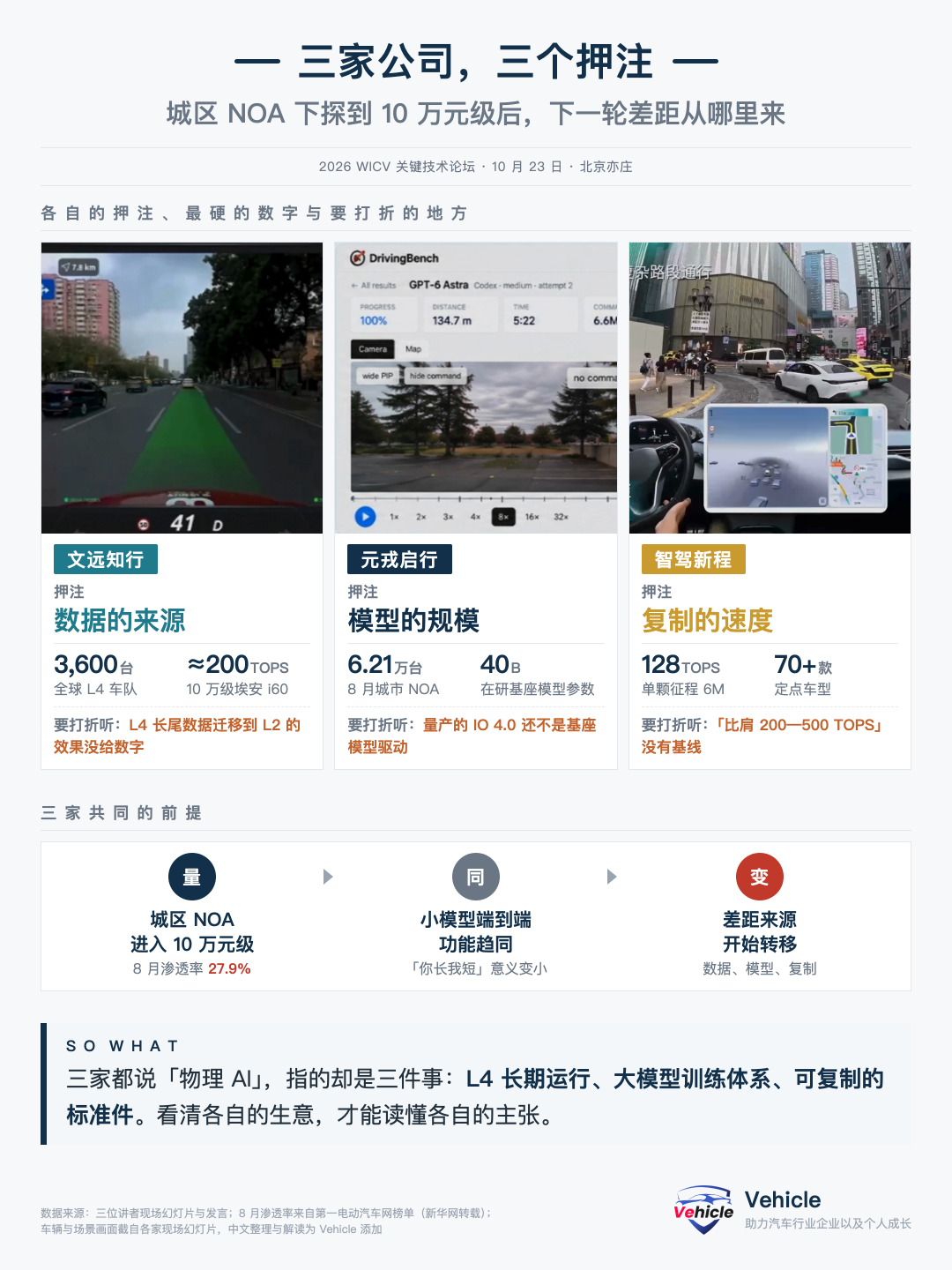
Source: On-site slides and speeches from three speakers at the 2026 WICV Key Technologies Forum, summarized for this article.
Five Industry Signals Revealed by the Three Speeches
The Yardstick for Evaluating Intelligent Driving Is Changing
Over the past two years, chip computing power has been nearly synonymous with the tier of intelligent driving systems. This time, all three companies sidestepped that yardstick.
Han Xu proposed 'intelligence generated per unit of computing power,' calling it 'intelligence density' by analogy with battery energy density.
Zhou Guang used MPCI (Key Handover Interval Mileage - how many kilometers can be driven before a driver needs to take over critically) and 'generalization time' (how many days it takes to perform well in a new country).
Jiang Jingfang discussed achieving 200-500 TOPS-level performance with 128 TOPS and latency below 200 milliseconds.
There are two reasons for this change in yardsticks.
First, as urban NOA moves toward the 100,000-yuan-class, vehicles cannot afford 500 TOPS, so suppliers must prove they can perform better with limited computing power.
Second, as shared in our previous article 'How Far Has China's Assisted Driving (Intelligent Driving) Come Now?', consumers are also evaluating experiences based on handover frequency, reducing the persuasiveness of computing power parameters.
However, due to time and level constraints at this conference, all three new yardsticks remained conceptual: Weride did not provide a calculation method for 'intelligence density,' DeepRoute's MPCI curve was illustrative without actual measured values, and ZhiJia Xincheng's claim of 'comparable to 200-500 TOPS' did not specify what it was compared against or in which scenarios.
Overall, it is revealed that the industry is seeking alternatives to TOPS. Whoever first makes handover mileage and generalization time auditable metrics will hold the next round of discourse power.
The Main Battleground for Urban NOA Falls in the 100-200 TOPS Range
The primary solutions from these three companies actually fall within this range:
Weride's solution on the Aion i60 uses about 200 TOPS, with Han Xu verbally mentioning 20,000 orders.
ZhiJia Xincheng's Astra was simplified from dual Journey 6M to a single 128 TOPS chip. Its product hierarchy is straightforward: the entry-level Luna uses Journey 6B for integrated driving and parking, the affordable Astra for urban NOA, the 500+ TOPS Astra Max for parking-to-parking functionality, and the 600+ TOPS Astra Ultra for cabin-driving integration and L3 experience. In August, there were approximately 427,000 urban NOA installations nationwide, with a penetration rate of 27.9%.
As volumes rise, automakers' requirements for solutions have shifted from 'function availability' to 'how much extra per vehicle.' Higher computing power tiers primarily support flagship models and L3 reserves.
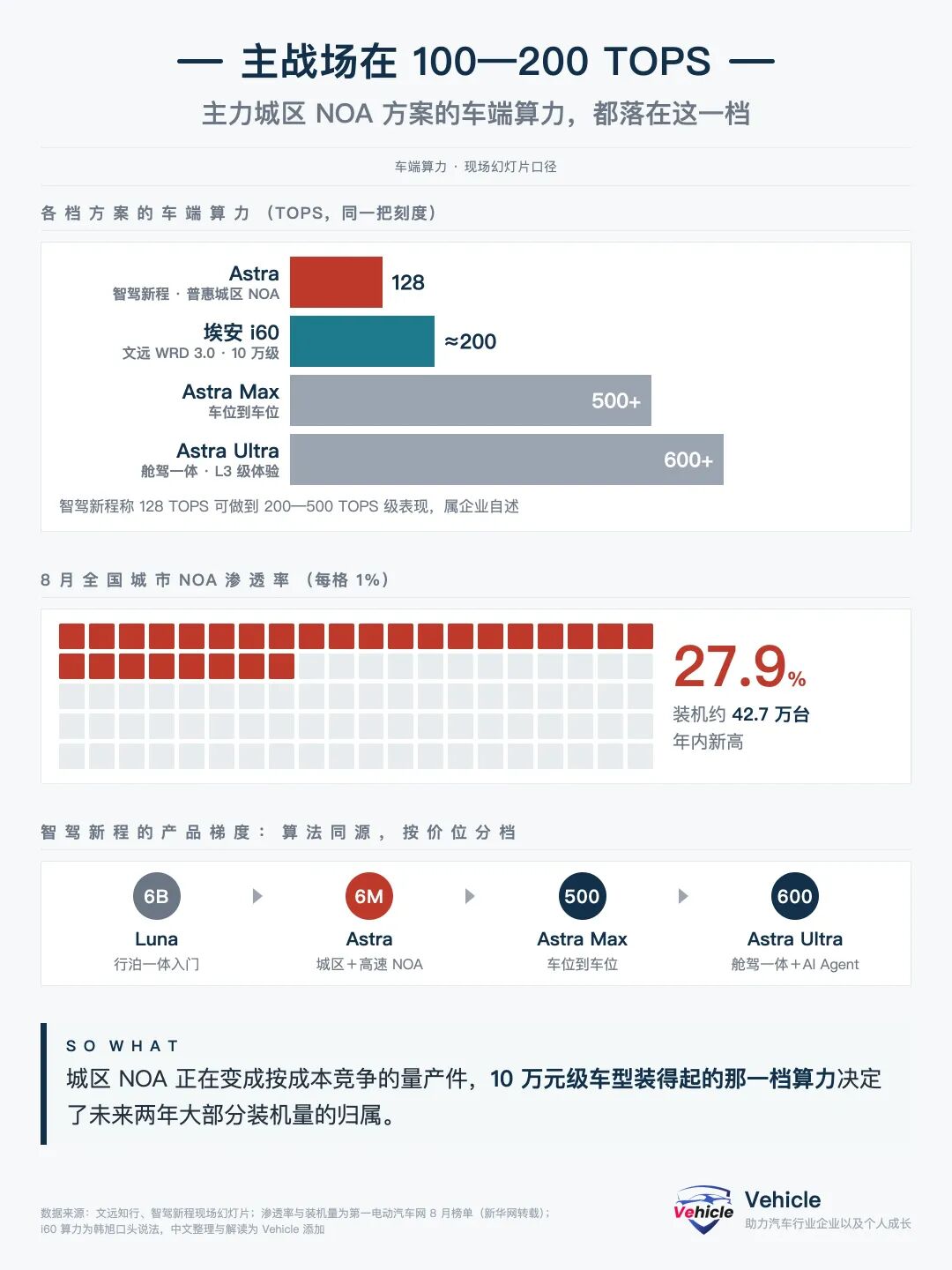 Source: On-site slides from Weride and ZhiJia Xincheng
Urban NOA has become a mass-produced component competing on cost. The computing power tier affordable for 100,000-yuan-class models will determine who captures most installations in the next two years.
The Data Competition Has Shifted from 'How Much' to 'What's Missing'
Han Xu explained this most clearly: In L2 systems, drivers usually take over in dangerous situations, so the system's own handling of these scenarios is missing from the data. In L4 autonomous vehicles, with no one to take over, scenarios like 'ghost pedestrians' and accident avoidance leave complete records of perception, decision-making, and execution. Thus, Weride uses its L4 fleet to supplement L2 long-tail data.
DeepRoute starts with handover data, treating handovers as signals to locate weaknesses, and uses RSI (Recursive Self-Improvement) to involve AI in post-training data allocation.
ZhiJia Xincheng discusses localized closed loops for data collection, compliance processing, and iteration in each region.
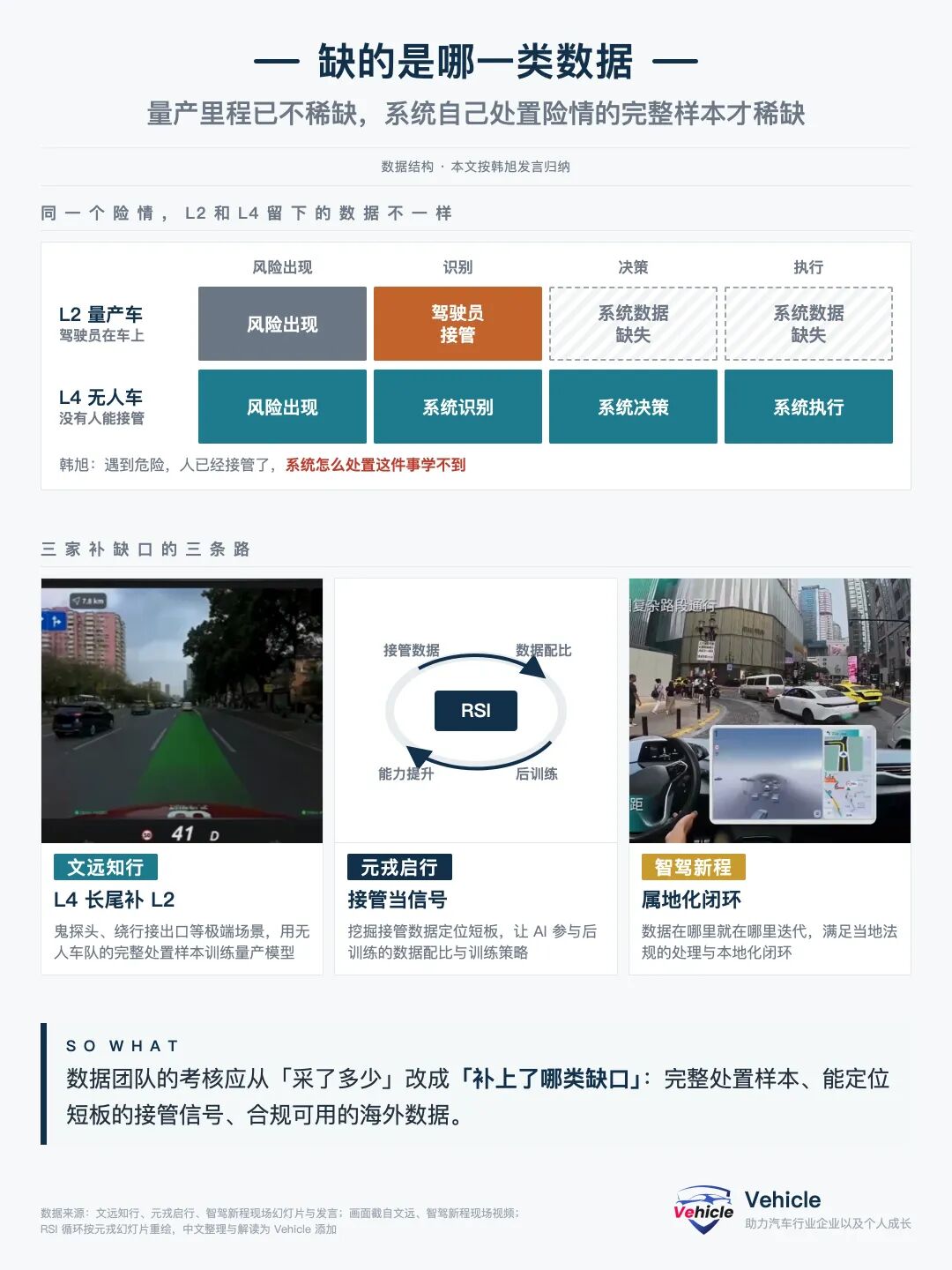 Source: On-site slides and speeches from three speakers, summarized for this article.
The cost structures of these three approaches differ.
Maintaining an L4 fleet requires significant investment in vehicles and operations, yielding expensive but complete long-tail samples.
Handover data comes from mass-produced vehicles already sold, being cheap but requiring strong mining capabilities.
Overseas localized data is constrained by regulations, often necessitating local teams and data centers. The choice depends on what a company already has.
Mass-produced mileage is no longer scarce; what's scarce are complete handling samples, handover signals that locate weaknesses, and compliant overseas data. Data team evaluations should shift from 'how much was collected' to 'what types of gaps were filled.'
After End-to-End Models, Routes Begin to Diverge
One-stage end-to-end systems integrate perception, planning, and control into a single network, taking sensor data and navigation instructions as input and outputting trajectories. As shared in our previous article 'The Battle for Intelligent Driving's Future: A Comprehensive Look at the Underlying Logic and Architectural Evolution of Autonomous Driving's 'End-to-End' Approach,' end-to-end models have become the mainstream for mass production (at least in name).
Divergence emerged on how end-to-end models will evolve. Zhou Guang believes current end-to-end models are 'small models,' trained on about 10 million 10-second clips, totaling 20,000-30,000 hours—just one-thousandth of the data used for large models—and lacking large-scale pre-training. In his view, these models' MPCI ceiling is tens to a hundred kilometers, requiring foundation models trained using large model paradigms to go further.
ZhiJia Xincheng and Weride maintain vehicle-end model scale, stacking multimodality, reinforcement learning, and physical priors onto one-stage systems to fully utilize computing power.
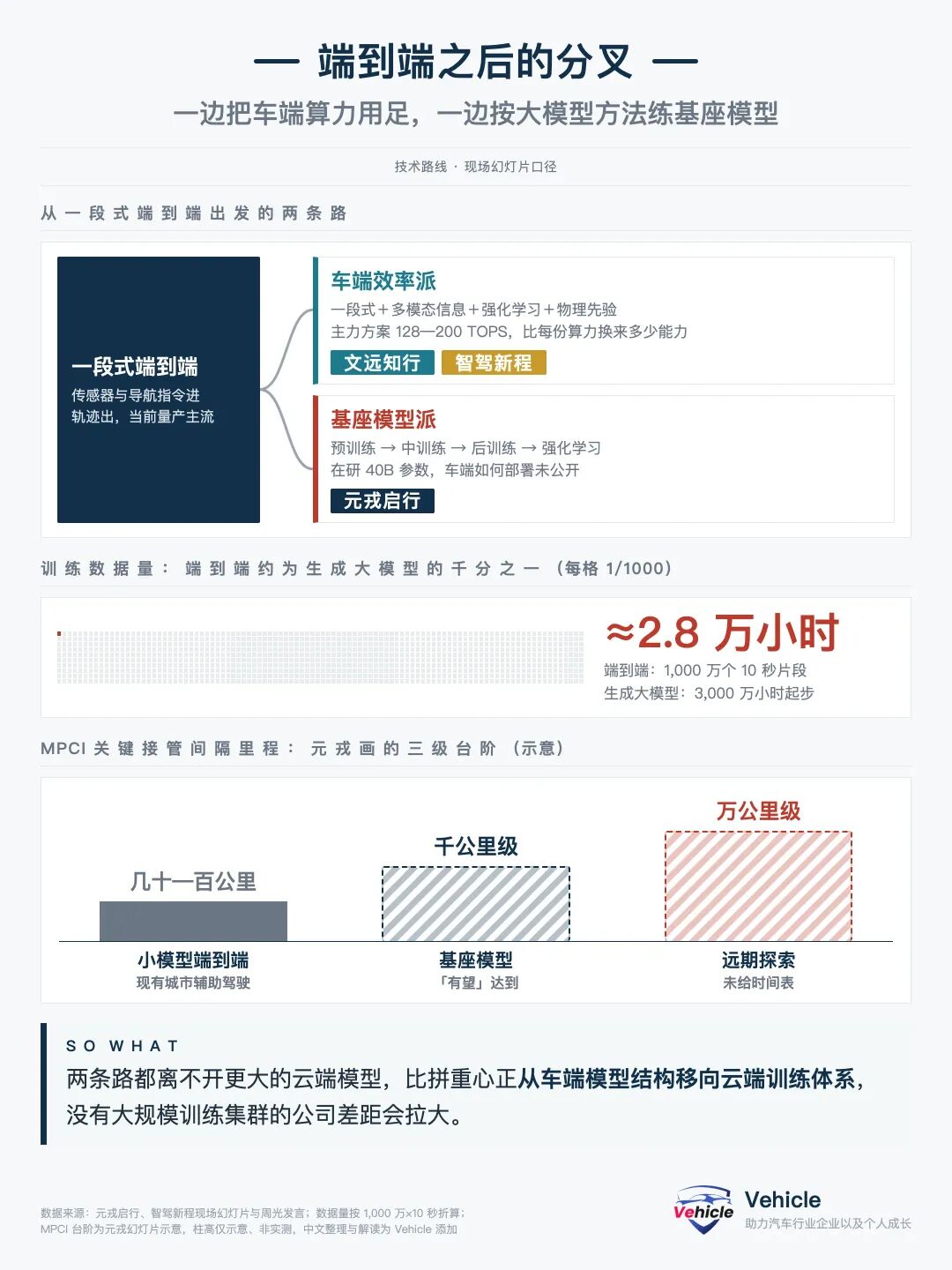 Source: On-site slides from DeepRoute and ZhiJia Xincheng; the MPCI ladder is illustrative from DeepRoute's slides, without actual measured values.
These two routes are not entirely opposed.
A 40B model cannot fit into a single 128 or 200 TOPS vehicle chip. As shared in our previous article '2026 China EV100 Forum: DeepRoute | The Era of Small Models Is Over; Zhou Guang Reconstructs Autonomous Driving with a 40B Foundation Model,' DeepRoute will pursue cloud training with distillation to the vehicle end.
Vehicle-end efficiency proponents also need stronger cloud models for data mining and evaluation.
The divergence lies in where money is spent: one side invests in cloud pre-training and talent, the other in vehicle-end engineering and mass production adaptation.
The focus of competition is shifting from vehicle-end model structure to cloud training systems. Companies without large-scale training clusters and large model background teams will struggle to maintain differentiation through minor structural improvements.
Overseas Expansion Costs Have Become Generalization Costs
All three companies have made overseas expansion a priority.
Zhou Guang provided the most specific figures: generalization in Berlin took four months in September 2025, but only about four days in Paris by October 2026.
Weride operates in over 60 cities across 13 countries, with over 100 vehicles in the UAE providing fully driverless commercial operations. It is filling in the operational layer: progressing from safety drivers to driverless with remote assistance and scalable operations, each step requiring local regulatory approval.
ZhiJia Xincheng has its global headquarters in Singapore and a research center in Germany. Jiang Jingfang listed four key tasks that essentially form an overseas expansion cost checklist: generalization training for global roads, compliance with EU GSR II, E-NCAP, and GDPR, adapting to driving habits like left-hand drive, European roundabouts, and Southeast Asian motorcycles, and establishing locally compliant data closed loops.
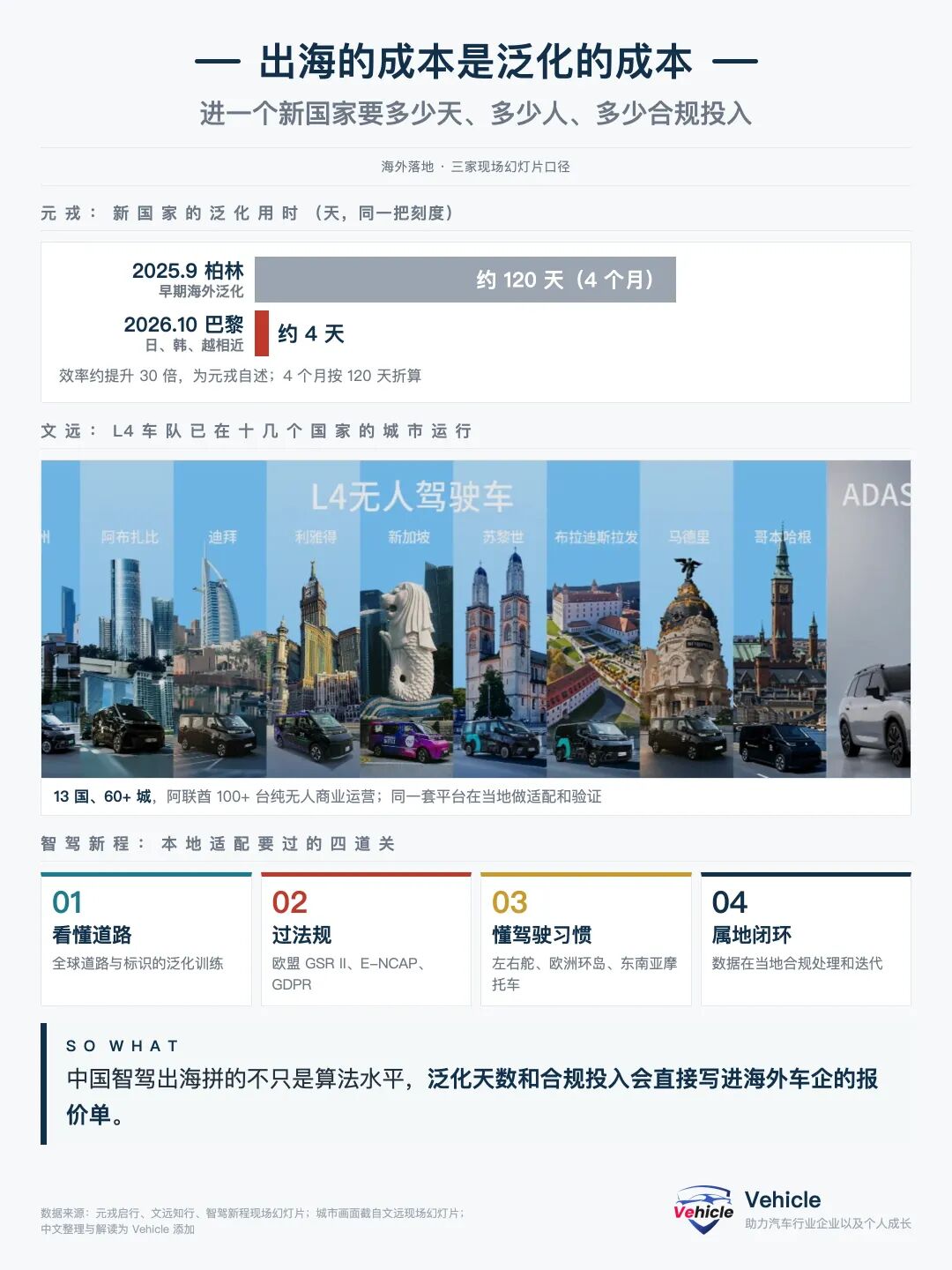 Source: On-site slides from ZhiJia Xincheng, DeepRoute, and Weride, summarized for this article.
How many days, people, and compliance investments are needed to enter a new country will directly factor into quotes for overseas automakers.
General-Purpose Large Models Are Starting to Take the Wheel
Zhou Guang admitted to 'growing anxiety.' He referenced DrivingBench, where general-purpose models control real vehicles through tool interfaces. GPT-6 Astra completed a course on its second attempt, while other models achieved 6%-45% completion. On the RoboDojo robot simulation leaderboard, GPT-6 Astra—without specialized robot training—ranked first. He worries that in a few years, companies like OpenAI, Anthropic, or DeepSeek might achieve autonomous driving, a view I share. If these large model companies launch a dimensional strike, the impact on current large model-based autonomous driving companies will be significant.
Based on the screenshot, this 134.7-meter drive took 5 minutes and 22 seconds, averaging about 1.5 km/h, costing $7.74 or approximately $57 per kilometer—far from practical. The significance of this image lies in how general-purpose models are starting to tackle the hardest part: 'scene understanding.'
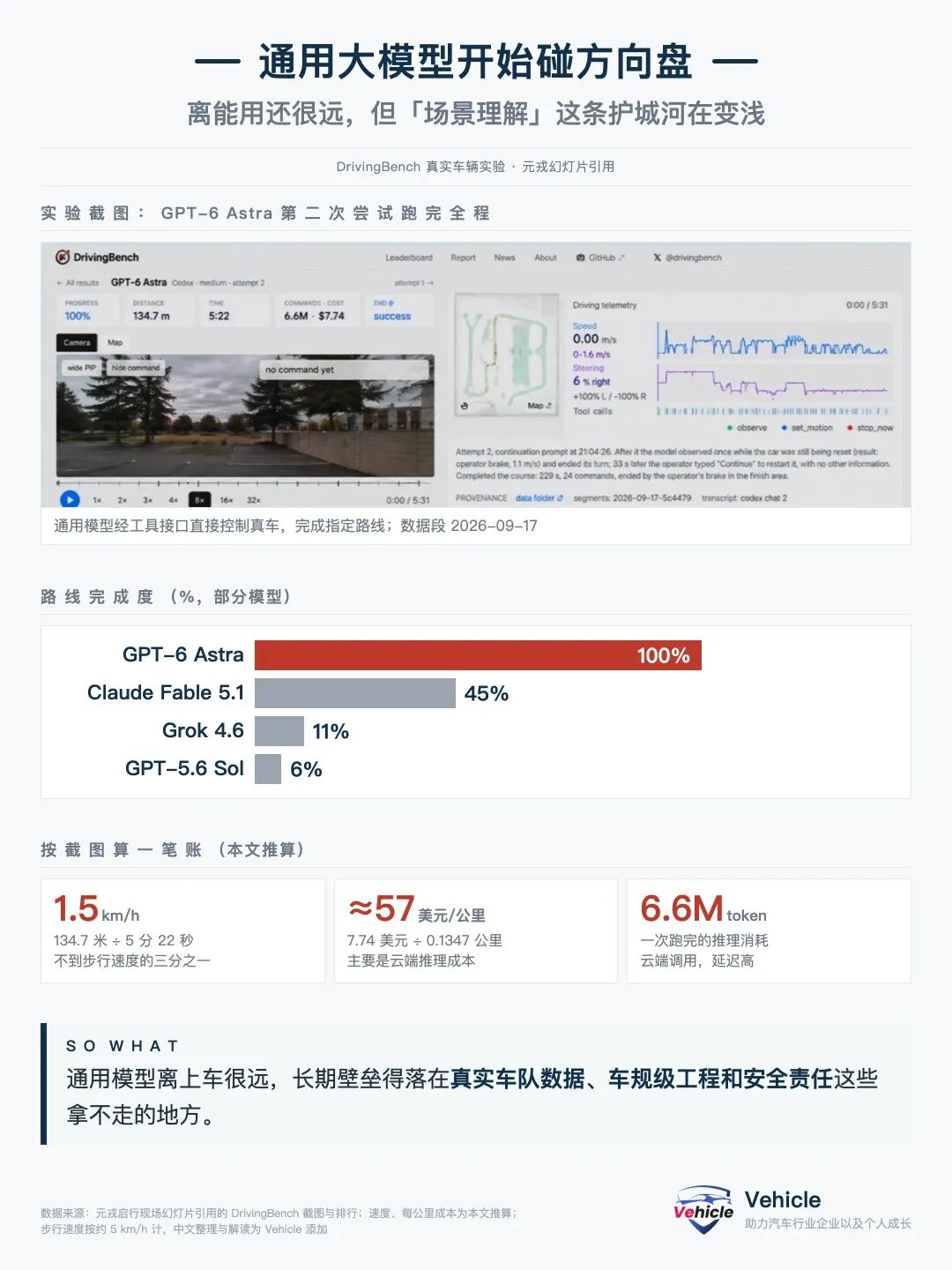 Source: DrivingBench screenshot cited in DeepRoute's on-site slides; speed and cost per kilometer calculated by the author based on screenshot data.
Intelligent driving companies' long-term moats must lie in areas general-purpose models cannot take: real-world fleet data, automotive-grade engineering, and safety responsibilities.
Weride: Feeding L2 with L4's Long-Tail Data
Han Xu's main theme was 'bringing L4 capabilities to L2 mass-produced vehicles.' He showed commuting and extreme avoidance videos of the Aion i60, introduced 'intelligence per unit of computing power,' and finally used 3,600 L4 vehicles, 100 million kilometers driven, and fully driverless operations in the UAE to explain where these capabilities come from.
He also made two points: data flows bidirectionally, with L2 mass production data and model improvements also feeding back into L4; AI hallucinations might be amusing in the digital world but are fatal in the physical world, so safety investments should be seen as highly cost-effective brand-building.
There are practical reasons for this approach. As shared in our previous article 'Weride's 2026 Q2: Earning L2 Revenue, Regularization in Sight,' despite its L4 origins, Weride's revenue remains small, with Q2 revenue at 230 million yuan. L2 mass production is its most realistic volume business, and this crowded track ( track means 'track' or 'competitive arena') needs 'L4 long-tail data' as a differentiator. Flagship models can only accommodate about 200 TOPS, so framing hardware constraints as efficiency advantages makes sense.
Data migration effectiveness remains unclear—the sensors and computing power of Robotaxi fleets differ greatly from a 100,000-yuan SUV, and no migration performance figures were provided.
Intelligence density remains a concept without an algorithm, preventing horizontal comparison (horizontal comparison).
Fleet figures were current as of July 31 at approximately 3,400 vehicles, with the forum citing 3,600; the 20,000 i60 orders were mentioned verbally.
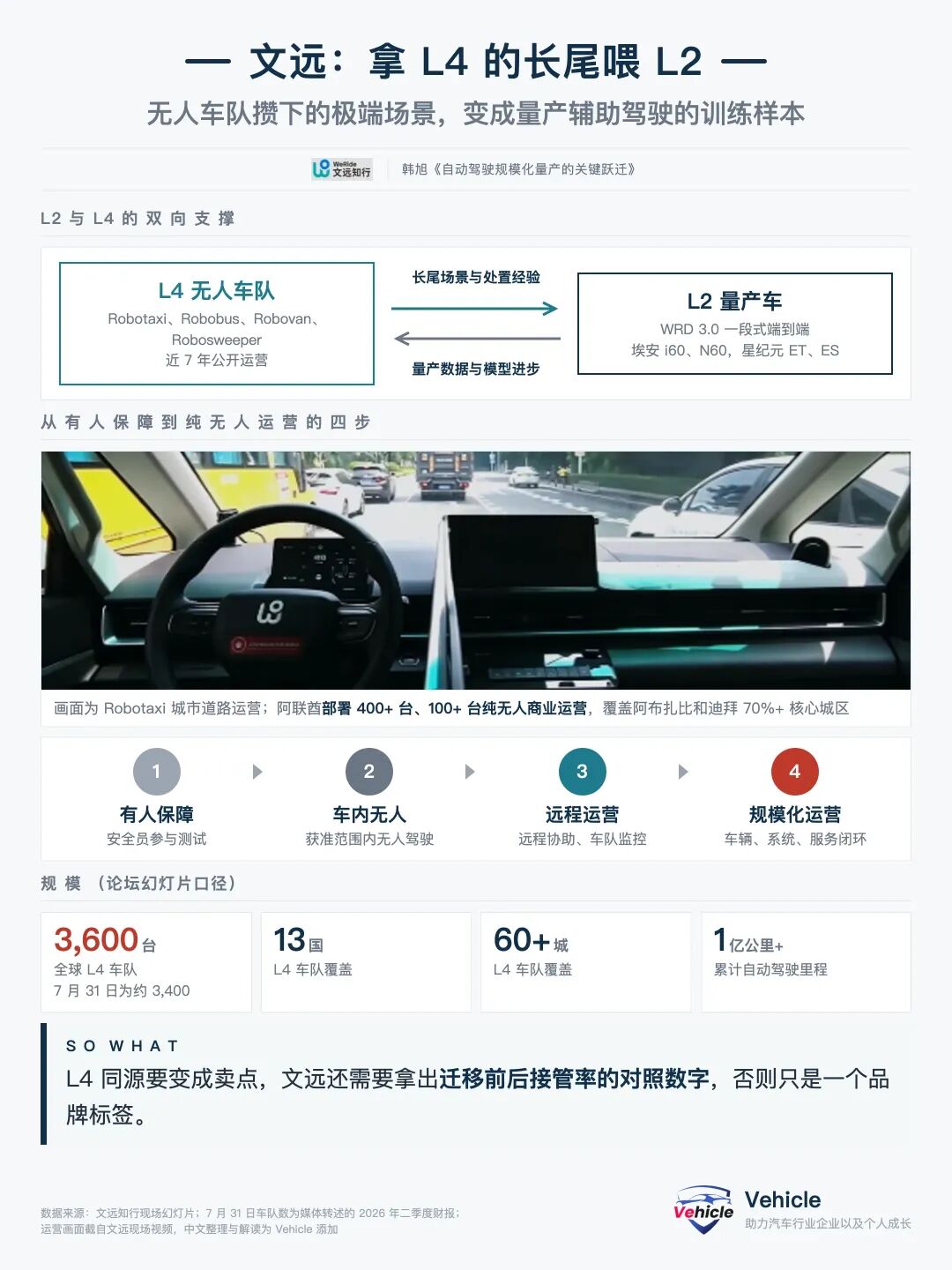 Source: On-site slides from Weride; fleet figures as of July 31 from media reports of Q2 2026 financial results.
Weride needs to provide before-and-after handover rate comparisons for L4 data migration; otherwise, 'L4-derived' remains just a branding label.
DeepRoute: Betting on Foundation Models as the Next Paradigm
Zhou Guang barely discussed product features, focusing instead on paradigms: from rules-based and modular to end-to-end, and since 2026, In depth research and development (in-depth R&D) of foundation models, with barriers being data, talent, computing power, and funding. DeepRoute reported a 90% improvement in decision-making ability for its 40B foundation model, a 10x improvement in data closed-loop efficiency, established the Superfluid Lab with a chief scientist from DeepSeek, and added spatial capabilities like reverse extraction and multi-U-turns to its mass-production IO 4.0.
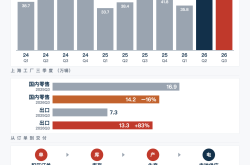
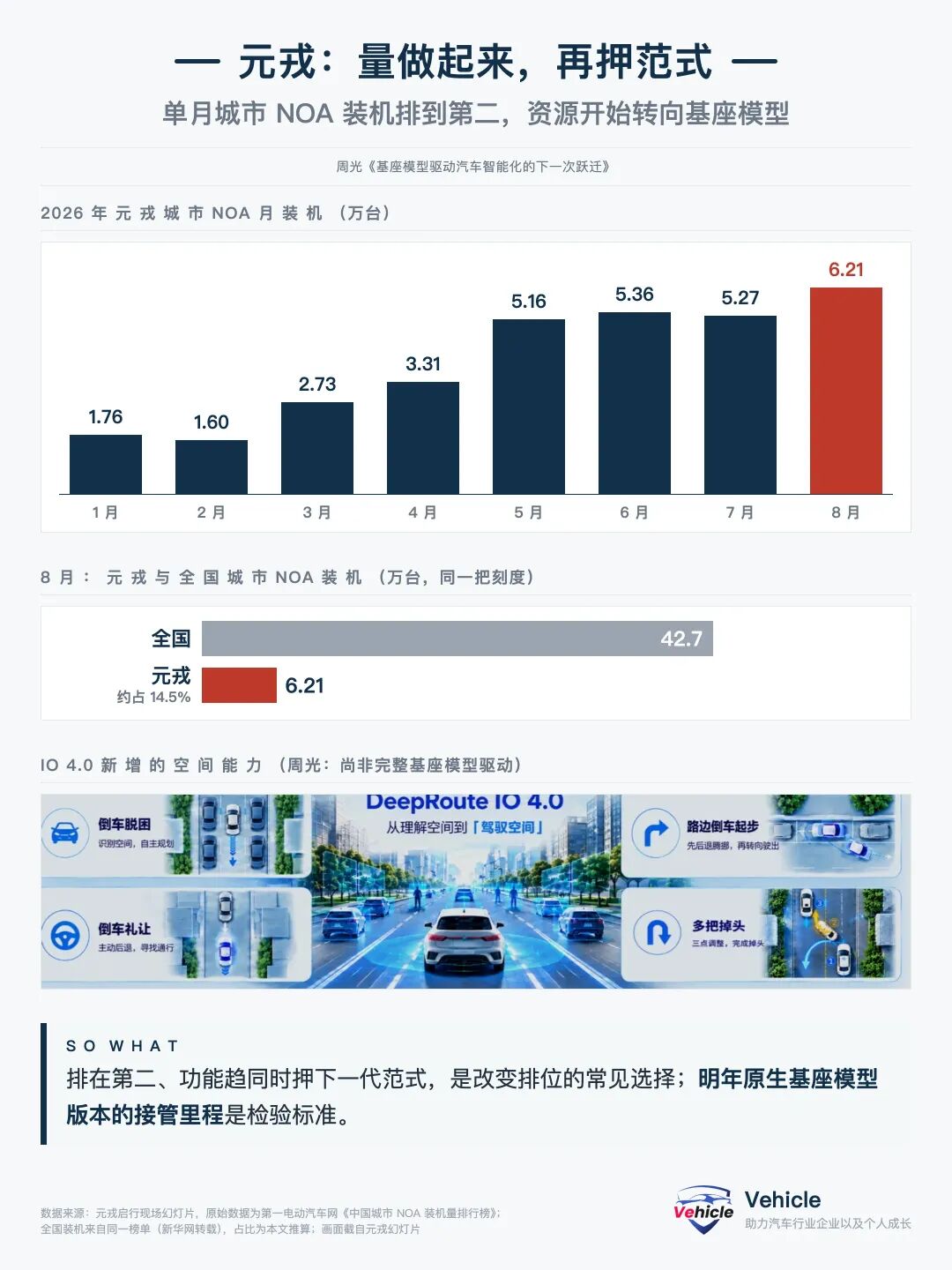 Source: On-site slides from DeepRoute; original data from the First Electric Vehicle Network's 'China Urban NOA Installation Rankings'; totals and percentages calculated by the author.
Why do I say so? Let's look at two sets of figures. From January to August, Yuanren had a total of approximately 314,000 installations, accounting for about 14.5% of the national market in August; ranking second in a single month, with Huawei ahead. The functions of small end-to-end models are converging. Zhou Guang himself said that further competition over minor differences is no longer significant.
Betting on the next-generation paradigm is a common choice for the second-ranked player to change positions, and three out of the four thresholds require money. This argument is also a call to the capital and talent markets. Zhou Guang shared two details: the first comment from the Chief Scientist after joining was that the "talent density is insufficient," noting that the field of autonomous driving is far below that of large model companies; the scale of 1,000 cards for end-to-end operations is insufficient to support breakthroughs in intelligence limits.
These two statements are not only industry judgments but also explain why Yuanren needs to continue financing and why it organizes its team in the manner of a large model company.
The mass-produced vehicles have not yet utilized it. Zhou Guang explicitly stated that IO 4.0 is not driven by a complete foundational model, and the native version will not be available until next year.
The claim of 90% lacks a baseline—no mention of which model it is relative to or what metrics are used.
MPCI indicates that the three-tiered steps of 100 km, 1,000 km, and 10,000 km are the direction, but Yuanren's own measured values are not shown on the graph.
There is no explanation of how it will run on the vehicle end—how the 40B model will be implemented on vehicle-end chips, which determines cost and mass production timing, was not addressed throughout the event.
Whether the takeover mileage of next year's native foundational model version can increase by an order of magnitude is the sole criterion for testing Yuanren's judgment.
Intelligent Driving Journey: Making Intelligent Driving Replicable
Intelligent Driving Journey is a joint venture between Horizon Robotics and OmniVision (formerly the automotive electronics business of Continental AG), renamed from "Intelligent Driving Continental" in April this year.
Jiang Jingfang presented a gradient of algorithm homology: Journey 6B for integrated driving and parking, a single Journey 6M for 128 TOPS affordable urban NOA, and above that, parking-to-parking and cockpit-driving integration. The same set of capabilities also extends to two-wheeled vehicle riding assistance and L4 logistics vehicles. Her judgment is that the watershed for next-generation competition lies in faster cross-scenario deployment capabilities.
This is related to its shareholders and customers. Horizon Robotics provides chips and teams, while OmniVision contributes a global supply chain, channels, and quality systems; its customers include Honda, Toyota, Nissan, and Hyundai, which require a solution that can simultaneously meet regulatory requirements and achieve mass production in both China and overseas markets.
The company positions itself as a "Software T2 or Software T1," listing Tier 1 suppliers like Desay SV and Hyundai Mobis as partners, selling standardized software and reference designs that can be integrated by others. For such a company, replication speed equals scale, and scale equals gross margin, so it values the number of designated vehicle models and the number of countries covered the most.
The relationship with OmniVision also brings hardware resources. The slides explicitly state that it has secured the first release (first launch) cooperation for OmniVision's 6th-generation millimeter-wave radar. In the eyes of overseas customers, a Chinese software company with a German supply chain and quality system is easier to include in procurement lists than purely local suppliers.
Performance claims lack baselines—"comparable to 200 to 500 TOPS," "100% behavioral consistency," and "over 90% reduction in partial braking and swaying"—all lack comparison objects and testing conditions.
Designation does not equal mass production—the figures of over 16 automakers and 70 models refer to designations. Jiang Jingfang said that this year and next year will be the period for concentrated mass production and delivery, and the actual number of implementations will depend on subsequent insurance registration data.
Alignment of terminology—the oral mention of "16 countries" should refer to 16 automakers; for overseas model coverage, over 50 countries were mentioned orally, but the slides state an expected 30+ by 2026-2027 and 50+ in the long term.
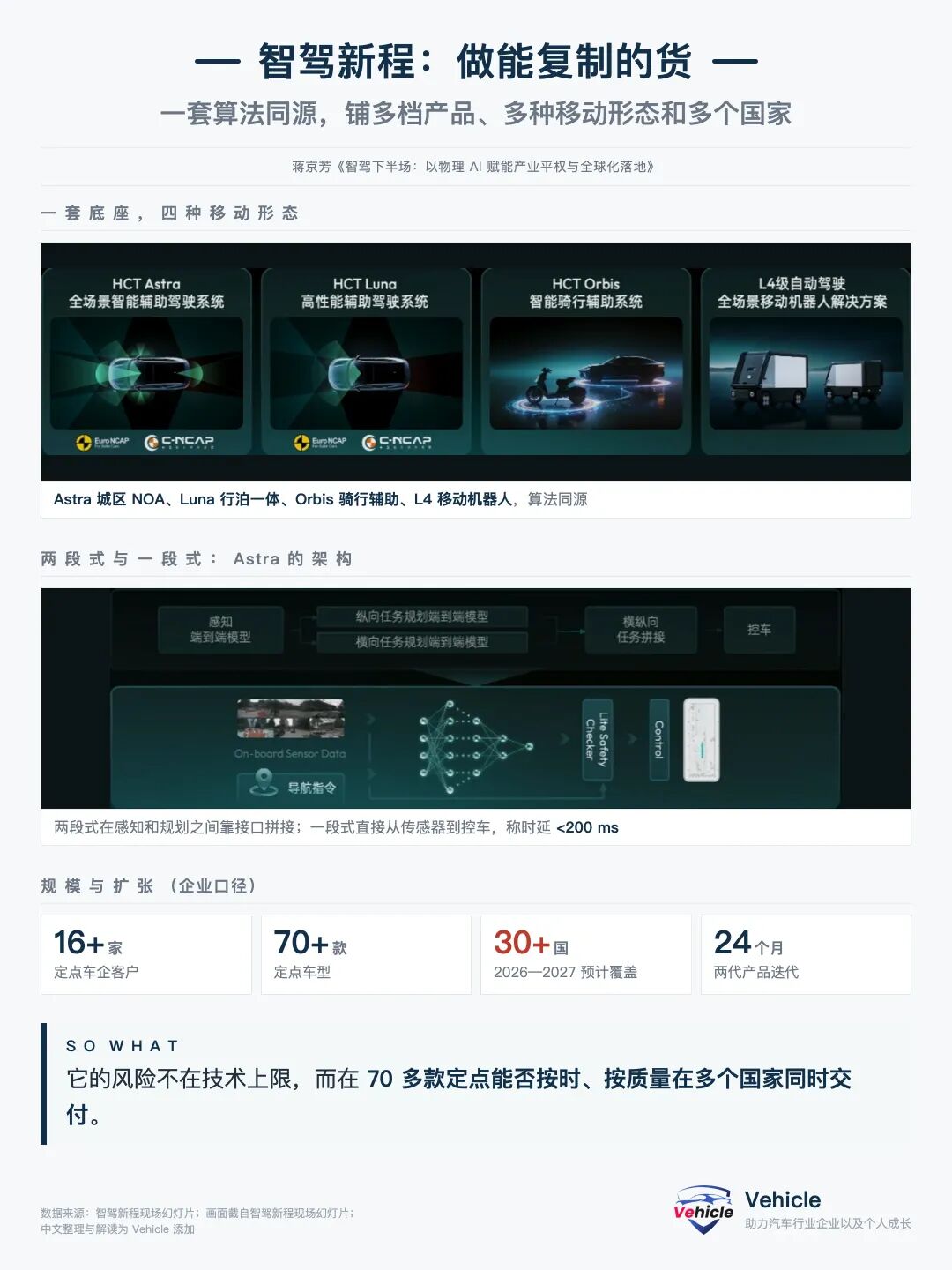 Source: On-site slides from Intelligent Driving Journey; renaming and financing information from public reports
The risk for Intelligent Driving Journey lies not in technological limits but in whether the 70+ designated models can be delivered on time and with quality across multiple countries simultaneously.
In Conclusion
Viewing the three speeches together, intelligent assisted driving has crossed the chasm and entered a phase of rapid mass production and popularization. Urban NOA has shifted from a technical issue to one of cost and replication. Assisted driving is no longer a halo feature but has become a Chassis safety and stability (chassis safety and stability) element like AEB/ESP. At this juncture, its product, positioning, and market approach are all changing.
Practitioners may need to adopt new ways of thinking and operating in terms of strategy, product, and market.
References and Images
WICV 2026 Yuanren AI Speech and PPT
WICV 2026 WeRide Speech and PPT
WICV 2026 Intelligent Driving Journey Speech and PPT
*Reproduction and excerpting are strictly prohibited without permission-
-
![]()
From Lucent to NVIDIA: When History Echoes
-
![]()
Thermal Effects on Femtosecond Filamentation and Supercontinuum Generation in YAG Crystals: Insights from Ultrafast Nonlinear Optics Study No. 105
-
![]()
The Next Bottleneck for AI May Not Be Chips
-
![]()
What's Next? The HarmonyOS Ecosystem Accelerates Its Expansion, While Luxeed and Aito Move Away from Huawei ADS Overseas
-
![]()
He Gang, Yu Chengdong's 'Trusted Partner,' Promoted to Huawei Director: A Pivotal Phone Call 13 Years Ago Altered His Career Path
-
![]()
Breaking News: Huawei Inks Landmark Deal with Century-Old Audi
-
![]()
Laying Cards on the Table! Tesla Q3 2026: Vehicle Sales Peak, All Funds Poured into AI
-
![]()
What We Can Learn from the 2026 WICV Speeches: Where Are Weride, DeepRoute, and ZhiJia Xincheng Betting on the Next Wave of Intelligent Driving?