Can South Korean Automobiles Rebound with Monthly Sales in China Under 10,000 Units?
 10/28 2026
 415
South Korean automobiles, which once dominated China's domestic auto market, have now reached a new nadir in terms of market performance.
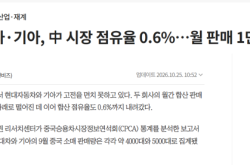
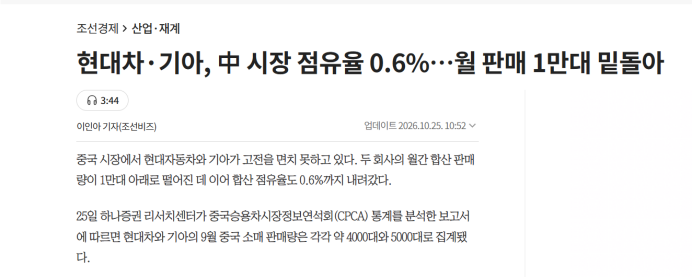
According to a recent report by the Chosun Ilbo, Hyundai Motor and Kia Motor collectively sold only around 9,000 units in September, with their market share plummeting to 0.6%. This marks a significant downturn from their heyday.
Specifically, Hyundai sold approximately 4,000 units in China in September, reflecting a year-on-year decline of 47%. Meanwhile, Kia managed to sell only 5,000 units in the same period, down 31% year-on-year. The decline rates for both brands surpassed the overall trend in China's passenger car market.
Over a decade ago, South Korean cars were a major player in China's domestic joint venture auto market. In 2016, Hyundai and Kia together sold nearly 1.8 million units throughout the year, with their market share once exceeding 10%. However, their performance in the Chinese market has been on a downward trajectory ever since. Public data reveals that by 2025, Beijing Hyundai had sold only 210,000 units cumulatively, while Yueda Kia fared slightly better, selling 254,000 units for the entire year.
In 2026, Hyundai and Kia's sales in China have continued their downward spiral. From February to September this year, sales of these two major brands have declined year-on-year for eight consecutive months. Cumulative sales have dropped from 18,000 units in January to 9,000 units in September, halving since the beginning of the year.
In fact, the challenges faced by Hyundai Motor and Kia Motor in the Chinese market mirror the broader transformation occurring within the automotive industry. Data from the China Association of Automobile Manufacturers indicates that in the first half of this year, the combined market share of joint venture and foreign brands was merely 28.2%, while Chinese brand passenger cars sold 9.138 million units, accounting for 71.8% of the market share.
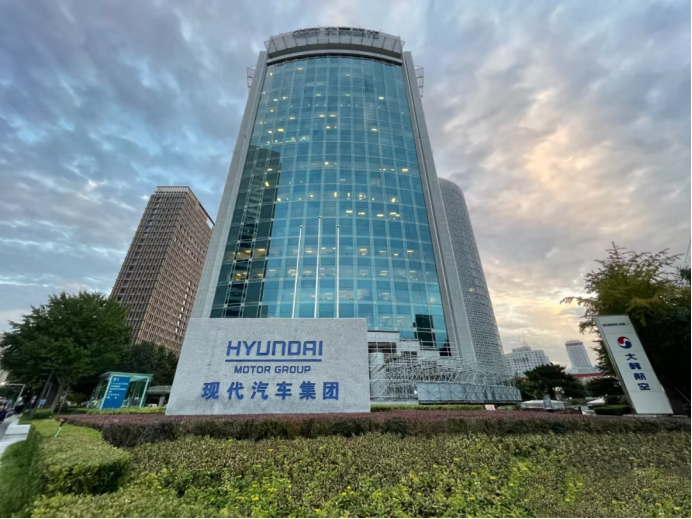
Specifically, among the major joint venture automakers, sales of the four main groups—German, Japanese, American, and South Korean—have all decreased in the first half of this year.
Volkswagen China, representing the German contingent, delivered a cumulative 971,000 units in China in the first half of this year, a year-on-year decrease of nearly 26%. The Japanese brands are also under pressure, with Toyota, Honda, and Nissan all experiencing varying degrees of year-on-year declines. SAIC-GM, representing the American camp, sold a cumulative 231,200 units in the first half of the year, a year-on-year decrease of 5.7%.
Among the South Korean contingent, Hyundai China sold 47,800 units in retail in the first half of the year, a year-on-year decrease of 20%, roughly in line with Kia's sales. Beijing Hyundai sold 94,700 units in wholesale, a year-on-year decrease of 5.3%. The market share of South Korean brands in China has dwindled to 1.6%.
Faced with this persistently weakening situation, Hyundai Motor has not shied away from attempting self-rescue measures.
To keep pace with China's new energy trend, Hyundai Motor has forged partnerships with leading domestic technology companies such as CATL and HaoMo Zhixing, making China a crucial hub for electric technology research and development. It has successively launched pure electric models tailored specifically for the domestic market.
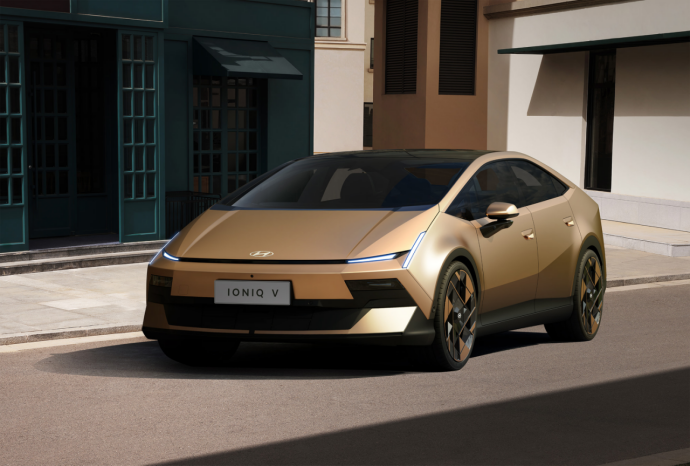
However, despite a series of localization efforts, positive market feedback has yet to materialize, with two key pure electric models receiving a tepid response. The pure electric SUV "EO YIOU" sold a cumulative 558 units from October to December last year and 645 units in the first nine months of this year. The IONIQ brand's first model exclusive to the Chinese market, the "IONIQ V," sold only 558 units in September.
Nevertheless, Hyundai Motor remains undeterred.
At this year's Beijing Auto Show, the brand unveiled an ambitious plan to launch twenty new models in China over the next five years, aiming to boost annual sales to 500,000 units. According to the latest plan, they will introduce a new electric SUV model in the first half of next year and expand their electric vehicle product lineup to include mid-size and large vehicle segments.
Kia's electrification journey commenced earlier, but its pace is also undergoing adjustments.
In 2023, Kia unveiled its China New Energy Strategy, planning to launch six pure electric models by 2027 and achieve annual sales of 180,000 pure electric vehicles by 2030. Its pure electric models, the EV6 and EV5, have been successively launched, but the market response has been lackluster. The EV5 sold a cumulative 3,192 units in 2025 and only 354 units in the first nine months of this year.
Following the 2025 CEO Investor Day, Kia slowed down its pure electric vehicle rollout and re-emphasized HEV hybrid vehicles, adopting a "parallel path" strategy that includes both gasoline and electric vehicles. Meanwhile, the brand has been relatively cautious in its investment in the Chinese market, focusing more on transforming its Yancheng plant into an export base and leveraging global orders to absorb production capacity.
Both major brands have implemented a series of measures, but significant hurdles remain in swiftly reversing the current market downturn. Moreover, competition in the domestic auto market continues to intensify, with faster product iterations, price adjustments, and updates in intelligent driving technologies, leaving little room for South Korean brands to experiment and adjust. They must not only address shortcomings in electrification and intelligence but also realign with consumer preferences. With domestic brands continuing to gain market share and other joint venture brands also under pressure, the effectiveness of Hyundai and Kia's subsequent transformations remains to be seen and requires ongoing observation.
(Images sourced from the internet, removed if infringing)
-
![]()
Has the Era of Abundant AI Computing Power Reached Its Twilight?
-
![]()
Rushing to Market and Compromising on Quality: Is Apple’s Foldable Phone Repeating Samsung’s Blunder?
-
![]()
The Sexiness and Leverage of Token Factories
-
![]()
Why is the efficiency of your optical waveguide only 6%? -- The Physical Limit of the Coupling-in Process
-
![]()
Can South Korean Automobiles Rebound with Monthly Sales in China Under 10,000 Units?
-
![]()
Anthropic Also Eyes Cloud Provider Partnerships
-
![]()
Can the ZON 09, Priced from 169,900 Yuan, Strike a Balance Among Model 3, Xiaomi SU7, and Itself?
-
![]()
What's Ailing XPENG?