Why is the efficiency of your optical waveguide only 6%? -- The Physical Limit of the Coupling-in Process
 10/28 2026
 571
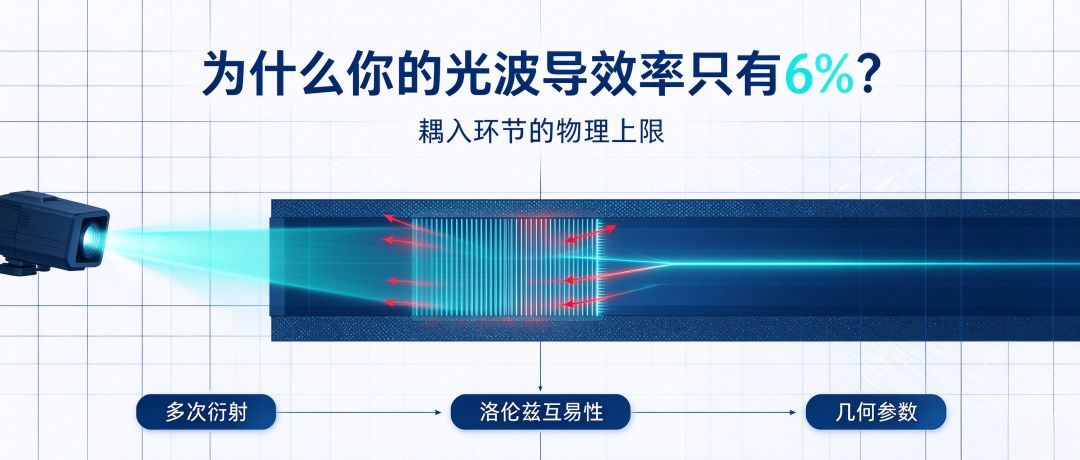
Abstract: The low coupling-in efficiency of optical waveguides is mainly caused by multiple diffraction: gratings allow light to enter but also let it leak out. Lorentz reciprocity ensures that the coupling-out and coupling-in efficiencies are synchronized, with the theoretical upper limit determined by waveguide thickness, pupil size, and pupil distance.
Polarization management is currently the only proven method to alter this upper limit. Nearly everyone working on AR optical waveguides encounters the same frustrating issue: even when the light engine's brightness is maximized, the final image entering the eye remains dim.
The root of the problem often lies in the coupling-in step. Most of the energy is directly lost in the moment light couples from free space into the waveguide.
Relevant research from the University of Rochester indicates that the primary source of efficiency bottlenecks in optical waveguides is the multiple diffraction effects in the coupling-in region.
In extreme field-of-view scenarios, over 70% of the incident light is lost due to repeated interactions with the coupling-in grating. This is not because engineers have designed the gratings poorly, but because physical laws impose inherent boundaries.
The coupling-in grating is not just an entrance—it’s also an exit.
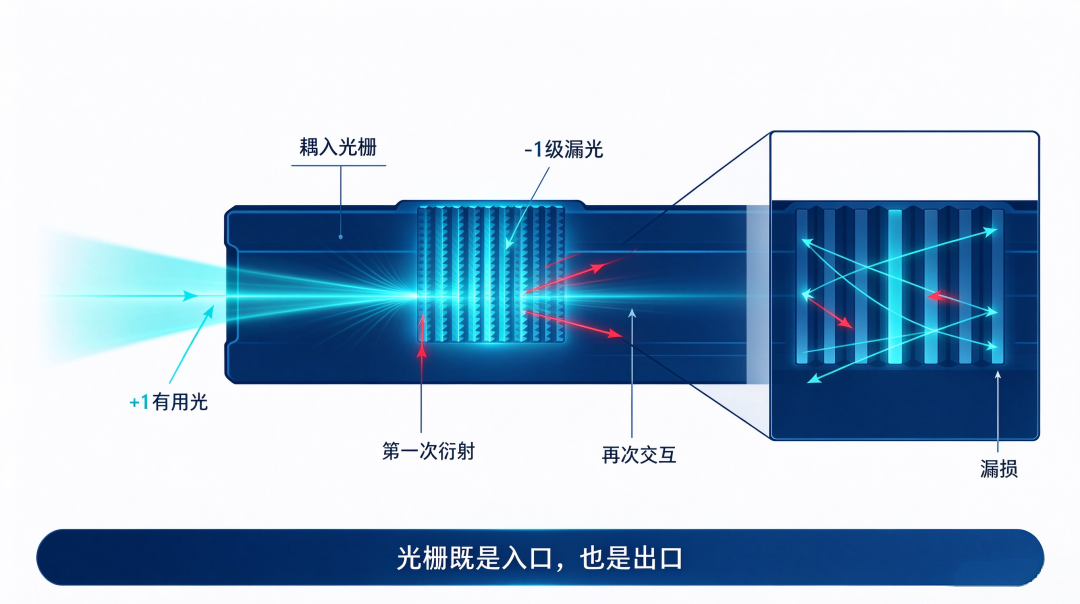
To understand low coupling-in efficiency, one must first accept a counterintuitive conclusion: the coupling-in grating is both an entrance and an exit for light.
Light emitted from the projector hits the coupling-in grating, undergoes first-order diffraction, and the +1 diffraction light meets the total internal reflection condition to enter the waveguide—this is the useful light we need.
However, the coupling-in grating is not an infinitely small point; it is a region with actual area. As light propagates back and forth inside the waveguide via total internal reflection, it passes through the coupling-in grating region again.
When the light inside the waveguide collides with the coupling-in grating a second time, it triggers a new round of diffraction. Some light continues to propagate inside the waveguide as 0-order transmission, while another portion becomes -1 diffraction light, directly escaping the waveguide back into the air—this is the energy leakage.
The larger the coupling-in grating area, the more times light repeatedly passes through it inside the waveguide, increasing the leakage loss. This is the underlying reason why multiple diffraction locks in the coupling-in efficiency.
Lorentz Reciprocity: High diffraction efficiency is actually a trap.
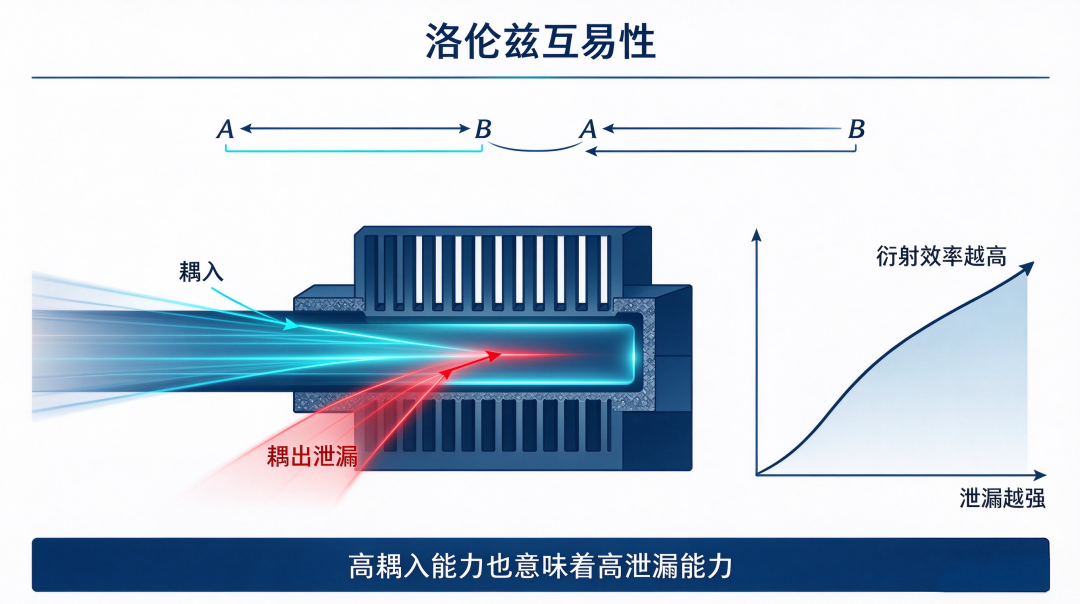
There is an even deeper constraint from Lorentz reciprocity. Simply put, reciprocity means that light propagating from point A to point B follows the same physical rules as light traveling backward from B to A.
Applied to the coupling-in grating, the conclusion is straightforward: the higher the grating's coupling-in diffraction efficiency, the stronger its ability to couple out and leak light from inside the waveguide.
This creates an unavoidable engineering trade-off: to allow more external light to enter the waveguide, you increase the grating's diffraction efficiency, but the cost is that light propagating inside the waveguide is more likely to leak out when it passes through the grating again.
A paper published in the Optica journal uses energy conservation and Lorentz reciprocity to derive the theoretical upper limit of coupling-in efficiency. This ceiling is not determined by grating design but by the overall waveguide geometry: waveguide thickness, projection pupil size, and pupil distance.
No matter how much the grating design is refined, it can only approach this upper limit, not surpass it.
What 'eats' coupling-in efficiency: Three geometric parameters.
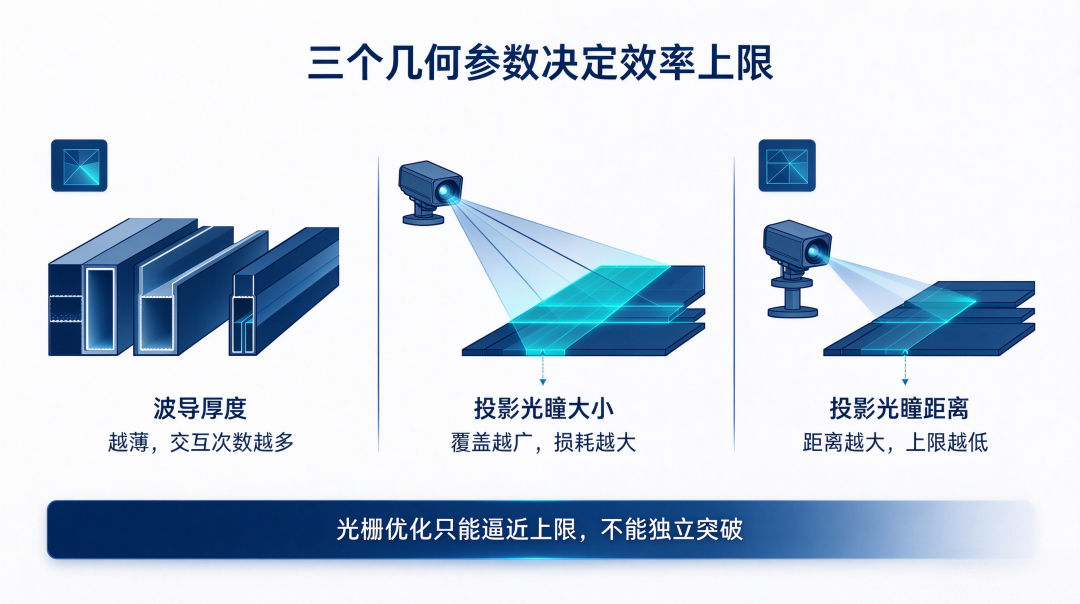
The upper limit of coupling-in efficiency is jointly determined by three geometric parameters, each with inherent physical trade-offs.
Waveguide thickness: A thinner waveguide results in shorter total internal reflection paths, causing light to pass through the coupling-in grating more frequently per unit distance, increasing losses from multiple diffraction.
Conversely, a thicker waveguide reduces light leakage but directly increases the weight and volume of AR glasses, compromising wearability—a classic dilemma.
Projection pupil size: The light beam output by the projector has a fixed pupil size. A larger pupil covers a broader area of the coupling-in grating, causing some light to trigger multiple diffraction immediately upon entering the waveguide, resulting in energy loss.
Projection pupil distance: The greater the pupil distance, the more pronounced the beam divergence from the projector to the waveguide, reducing the effective coupling-in area and image uniformity.
When the pupil distance is zero, the efficiency upper limit is highest; as the distance increases, the upper limit continuously declines.
Polarization management: A 'legal cheat code' to break the upper limit.
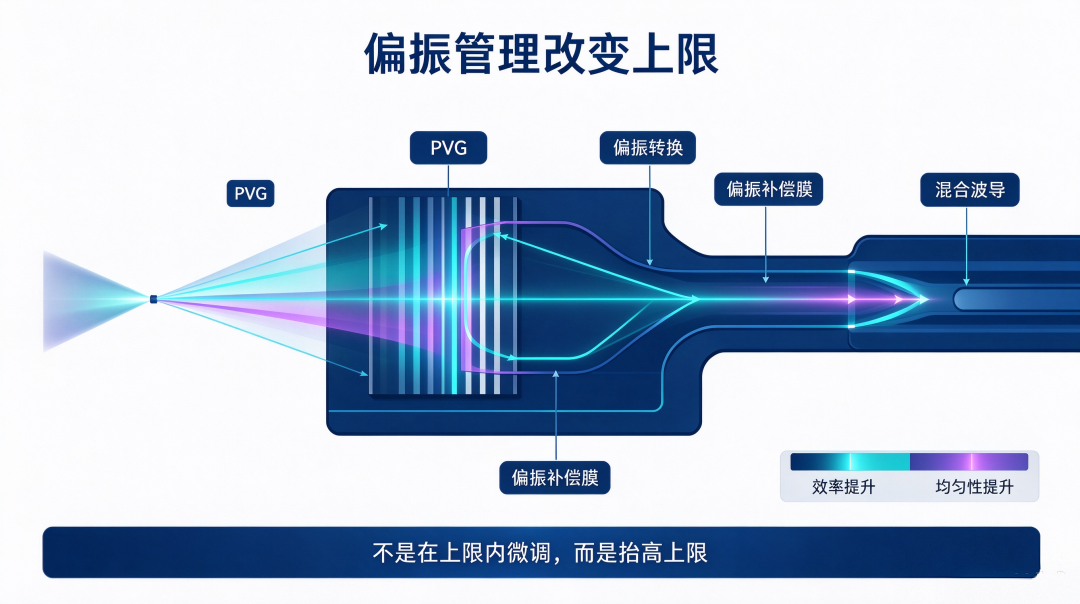
Since geometric constraints lock in the efficiency ceiling, is there no way to break through? Polarization management offers a viable path.
Research by the Fuzhou University team found that polarization volume holographic gratings (PVGs), when the incident angle approaches the Bragg plane, cease to function as diffraction gratings and instead act like waveplates to alter the light's polarization state.
A PVG-based hybrid waveguide architecture built on this principle achieved a 2x improvement in coupling-in efficiency and a 2.3x improvement in FOV uniformity at a 50° field of view. When paired with a polarization compensation film, most light successfully couples into the waveguide.
Relevant Optica papers also incorporate polarization management into theoretical models, confirming that this approach can raise the theoretical upper limit of coupling-in efficiency. In other words, polarization management does not just fine-tune within the existing upper limit—it directly changes the limit itself.
What does this mean for AR optical waveguides?
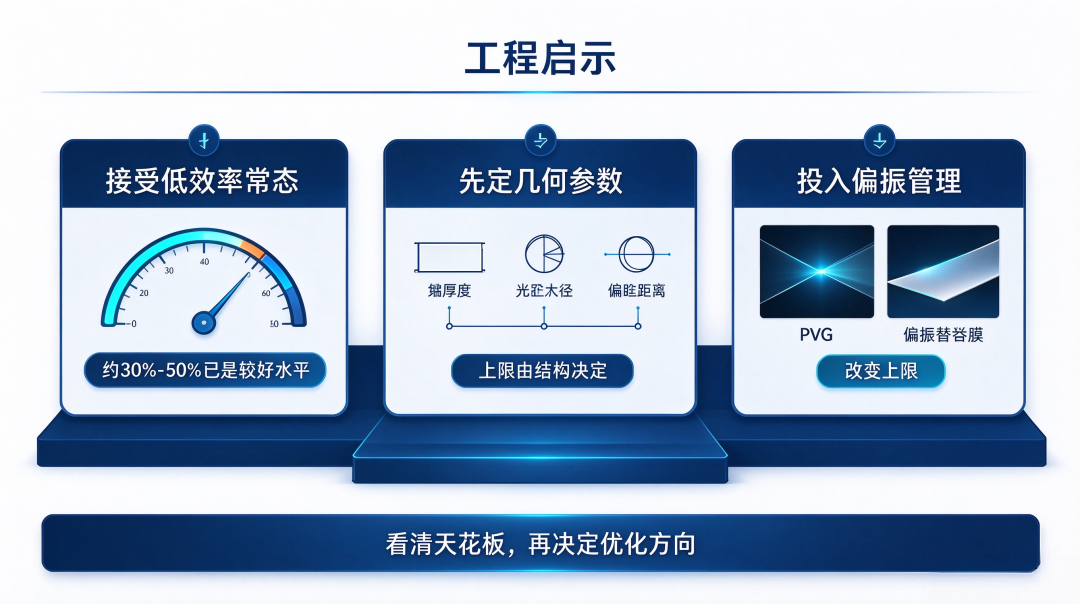
Understanding the physical upper limit of coupling-in efficiency has three key implications for frontline engineering and R&D.
First, accept that low efficiency is the norm. A coupling-in efficiency of 30%–50% is already considered good in the industry; a system total efficiency of 6% is a reasonable result under physical constraints. Do not expect to achieve over 90% coupling-in efficiency by simply optimizing the grating structure.
Second, choosing the right optimization direction is far more important than minor parameter adjustments. Geometric parameters like waveguide thickness, pupil size, and pupil distance determine the efficiency ceiling. Optimizing these geometric trade-offs yields far greater benefits than repeatedly fine-tuning grating parameters. The theoretical framework from the University of Rochester allows for quick assessment of the current structure's efficiency upper limit, avoiding wasted R&D resources on unachievable directions.
Third, polarization management is a direction worth prioritizing. It is not a zero-sum optimization within the existing upper limit but has been proven to raise the limit itself. In conclusion, the inability to increase coupling-in efficiency is not due to poor grating design but rather the physical boundaries set by multiple diffraction effects and Lorentz reciprocity.
Waveguide thickness, pupil size, and pupil distance—these three geometric parameters lock in the efficiency upper limit. Grating optimization can only approach this ceiling, not surpass it. Polarization management is currently the only proven technical path to rewrite this upper limit. Only by first understanding where the ceiling lies can R&D efforts be focused on the most impactful areas.
Interactive Topic: In your optical waveguide design, is the coupling-in efficiency bottleneck more constrained by geometric parameters or grating design? Is polarization management an optional or essential feature in your solution? Welcome to share your experiences in the comments.
[Risk Disclaimer] This article is for industry education purposes. The efficiency values, FOV improvement multiples, and other data cited are from papers and public research under specific experimental conditions and do not represent mass-production specifications. Coupling-in efficiency is influenced by multiple factors, including materials, wavelength, incident angle, coating systems, and system integration. The actual benefits of polarization management solutions must be validated through specific device and system testing.
-- AR Andy | Focused on optical waveguides and AR microdisplay technology, deeply dissecting the underlying logic of the optics industry.
-
![]()
Has the Era of Abundant AI Computing Power Reached Its Twilight?
-
![]()
Rushing to Market and Compromising on Quality: Is Apple’s Foldable Phone Repeating Samsung’s Blunder?
-
![]()
The Sexiness and Leverage of Token Factories
-
![]()
Why is the efficiency of your optical waveguide only 6%? -- The Physical Limit of the Coupling-in Process
-
![]()
Can South Korean Automobiles Rebound with Monthly Sales in China Under 10,000 Units?
-
![]()
Anthropic Also Eyes Cloud Provider Partnerships
-
![]()
Can the ZON 09, Priced from 169,900 Yuan, Strike a Balance Among Model 3, Xiaomi SU7, and Itself?
-
![]()
What's Ailing XPENG?