What's Ailing XPENG?
 10/28 2026
 414
Let's delve into the current situation surrounding XPENG.
With the official launch of the XPENG MONA L05 just around the corner, XPENG finds itself embroiled in a public controversy over the term "Lao Deng."
Frankly, being entangled in such a debate at this crucial juncture is likely not what XPENG had envisioned.
Especially on the eve of a new car launch, a critical article can easily be perceived as an attempt to undermine the product or even suspected of having ulterior commercial motives, potentially impacting the promotion and sales of the new vehicle.
Nonetheless, I believe this incident warrants serious consideration and discussion, and XPENG should seize this opportunity for introspection and improvement.
01 One Word, "Lao Deng," Alters the Launch Event's Tone
Let's first recap the events.
On October 15, the XPENG MONA L05 opened for pre-sale. As the inaugural large five-seater SUV in the MONA series, the new car offers two powertrain options: pure electric and extended-range hybrid, with a starting pre-sale price of 169,800 yuan.
This launch event had a distinctive twist.
At the time, He Xiaopeng was in Paris and participated via video link, while a group of young product managers took the stage to explain the product.
According to XPENG, the event had no fixed script, granting the young team significant freedom to express themselves, even incorporating debates and clashes they had with management during product development.
This setup is quite intriguing.
Having the young individuals who genuinely contributed to shaping the product tell their own story, rather than having executives recite parameters verbatim, is at least a commendable attempt in terms of presentation.
The issue lies in the specific language used.
During the event, Enta, a product manager born after 2000, repeatedly used the term "Lao Deng" to tease management, mock traditional design elements like wood grain and chrome, and called for "rejecting the Lao Deng aesthetic."
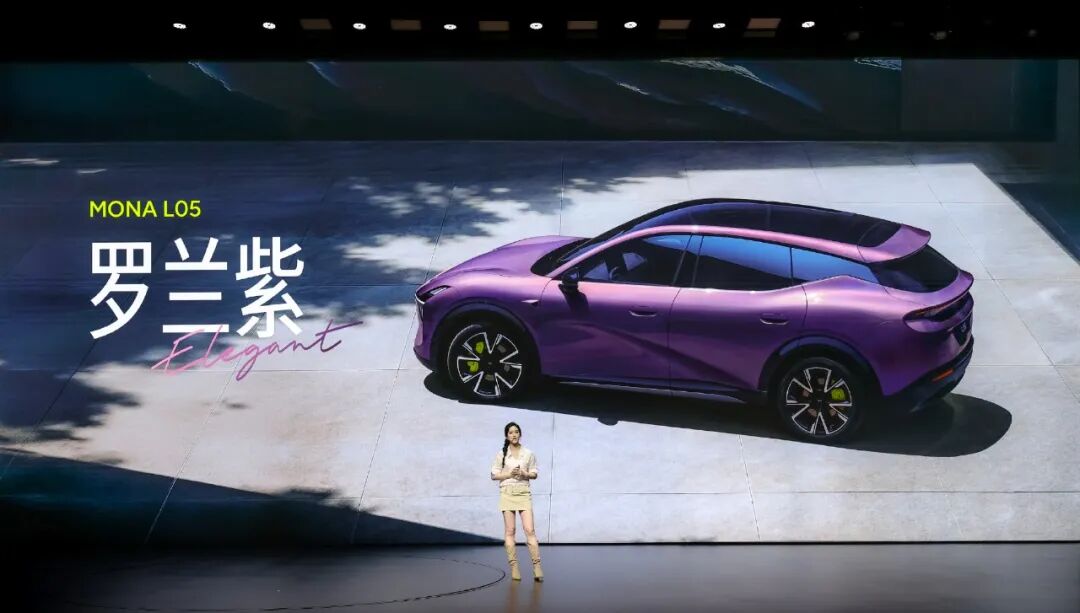
From their perspective, this might have been emphasizing the aesthetic preferences of the younger generation and showcasing the team's culture of innovation and challenging authority, while also demonstrating a harmonious atmosphere.
However, for many consumers, the tone shifted.
Especially when "Lao Deng" was directly linked to certain traditional aesthetics, the original discussion about car design took on an additional layer of labeling individuals.
Does liking wood grain imply a lack of youthfulness? Does preferring chrome trim suggest outdated taste?
Obviously not.
Aesthetics are highly subjective. Some prefer simplicity and sportiness, while others favor understated luxury. Even the same person may have vastly different aesthetic preferences at different life stages.
XPENG can certainly adhere to its own design philosophy and communicate to consumers that this is a car specifically designed for young people.
However, emphasizing one aesthetic does not necessitate mocking another.
More importantly, "Lao Deng" is not a completely neutral term.
It can be a teasing remark among acquaintances but may also carry a clear derogatory connotation. When used in a public commercial launch event, it's unrealistic to expect everyone to interpret it as intended by the company.
Just because you think you're joking doesn't mean everyone else has to find it amusing.
Especially for an automotive company, its consumers vary in age, aesthetic preferences, and needs. While a company can choose its target users, it shouldn't make other groups feel like they're being used as negative examples.
This, I believe, is the crux of the issue in this entire incident.
02 Just Because the Internal Team Thinks It's Okay, Should Consumers Accept It?
On October 22, Enta issued a public apology via video.
She explained that "Lao Deng" was a term commonly used within the team as a joke, intended to mock rigid design thinking, not targeting age or external consumers.
At the same time, she admitted that her wording was thoughtless and apologized to those who felt uncomfortable.
In my view, this is an acceptable way to handle the situation.
Young people making mistakes in their speech is not unforgivable. Being able to recognize that their expression was inappropriate and willing to explain and apologize publicly at least shows a willingness to face their mistakes.
If things had ended here, the controversy might have gradually faded away.
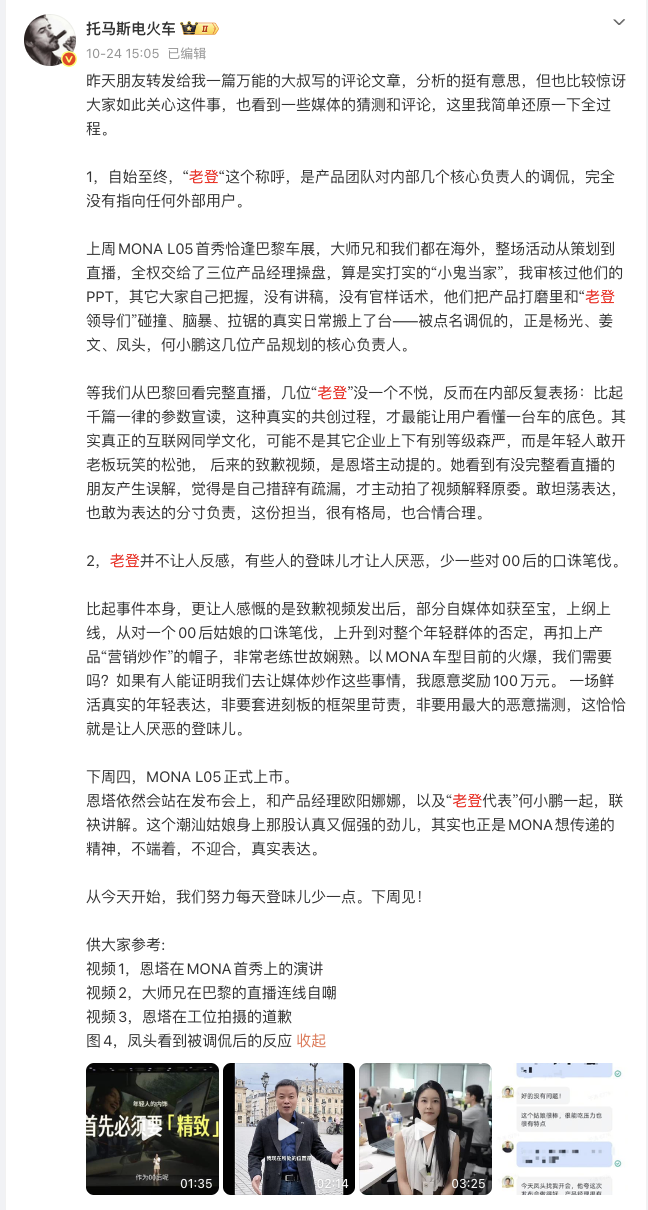
But two days later, a lengthy post by Yu Tao, Vice President of XPENG Group, reignited the issue.
Yu explained that the so-called "Lao Deng" at the event always referred to internal managers like He Xiaopeng and Wang Fengying and did not target external users.
He also stated that the management team being teased was not upset but rather praised the young team's performance.
Does this explanation make sense?
Certainly.
If we respect the facts, we should acknowledge that XPENG was originally trying to showcase a relatively equal and relaxed communication style between the young team and management.
Allowing employees to joke about their bosses within a company is not necessarily a bad thing.
But the problem is that this explanation doesn't really address the public's doubts.
Because whether the management minds is entirely separate from whether consumers feel uncomfortable.
He Xiaopeng might find the joke funny, and Wang Fengying can certainly appreciate the courage of young employees to express themselves.
But their acceptance doesn't directly represent the feelings of external consumers.
The key here is the change in roles and context.
If, in the office, a young employee calls their supervisor "Lao Deng" and the supervisor accepts it, that's entirely an internal matter.
But when a product manager stands on stage at a public launch event, she no longer represents just herself but an automotive company.
At that moment, her expressions are no longer directed at a few familiar colleagues but at thousands of potential consumers.
Some will understand your internal jokes, while others won't. Moreover, when the term is repeatedly used to negate certain traditional designs, it's not surprising that consumers make associations.

I want to emphasize: Consumers can use internet slang to evaluate a company, but that doesn't mean it's appropriate for a company to evaluate consumer groups in the same way.
The roles are different, and so are the responsibilities.
Consumers are expressing their feelings, while companies are providing goods and services to the market.
Companies can certainly have personality, but they can't expect all consumers to unconditionally accept that personality.
So, the real issue that needs reflection is not whether anyone within XPENG was offended, but why an expression that could cause external discomfort was used in such an important public setting.
03 Why Continue to Argue After Apologizing?
I can actually understand why Yu Tao stepped forward.
A young product manager was criticized for using inappropriate language, with attacks even targeting her age, appearance, and personal abilities.
As a corporate leader, stepping in to protect an employee and prevent her from bearing excessive public pressure alone is understandable.
From a corporate culture perspective, such responsibility is even commendable.
The problem is that there are many ways to protect an employee.
You could internally reassure her that the company recognizes her professional abilities and won't negate her previous work because of one remark.
You could also publicly state that you oppose personal attacks against the employee while acknowledging that the event's expression was indeed inappropriate.
These two things are not mutually exclusive.
However, Yu Tao's response conveyed a different message.
He emphasized that this was authentic youth culture, argued that some external criticisms were overblown, and claimed that what was truly offensive was not "Lao Deng" but the "Lao Deng-ness" of certain people.
This is precisely where I find the entire incident most puzzling.
After Enta had already admitted her expression was inappropriate and apologized, the management's strong insistence that there was no problem only confused the public.
First, you say you did something wrong, then someone else steps in to explain that actually, nothing was wrong.
So, what does the apology mean?
Was it a genuine recognition of a problem in expression, or just a concession to quell the controversy?
I don't believe XPENG necessarily had the latter mindset, but its response did lend itself to such an interpretation.
To put it bluntly, if you've realized that your expression made some consumers uncomfortable, just admit it openly.
There's really no need to keep explaining that you weren't really wrong after apologizing.
Even more dramatically, during this controversy, Yu Tao offered a 1 million yuan reward to anyone who could prove that XPENG had arranged for media to hype up the "Lao Deng" incident.
Let's clarify this point.
XPENG was not offering a bounty to find critics but was refuting accusations from some self-media outlets that the company had deliberately created the controversy for marketing purposes.
Accusing a company of orchestrating hype without evidence is, of course, irresponsible. It's entirely reasonable for a company to defend its reputation and demand evidence from accusers.
However, the issue is that such a strong response didn't address the core of the original controversy.
Whether there was deliberate hype and whether the event's wording was appropriate are two entirely different questions.
Even if it's proven that XPENG never arranged for any media hype, that doesn't mean the event's expression was entirely appropriate.

Conversely, even if some self-media did exploit the situation, that doesn't mean all consumers who felt offended were being unreasonable.
Moreover, when the highly shareable content of a 1 million yuan reward emerged, public attention shifted further away from the product, fostering even greater aversion and resistance to the brand.
This runs counter to XPENG's original intentions and even its apology.
From the initial design philosophy and youthful expression, to whether the product manager should apologize, to whether management was "protecting their own," and whether the company was hyping up the controversy, the entire discussion increasingly resembled an unnecessary verbal battle.
What good does this do for XPENG?
Perhaps it demonstrates the executives' strong stance in protecting employees and countering false accusations, but such aggressiveness may not win consumer understanding.
A company can be tough against malicious attacks but should remain humble when faced with reasonable criticism.
Otherwise, even if you win a particular argument, it doesn't mean you've truly earned consumer recognition.
04 XPENG Needs to Reflect on More Than Just PR
Of course, I don't believe all the blame should be placed on the young product manager on stage or simply attributed to XPENG's PR department.
According to Yu Tao, he reviewed the event's PPT, but the young team didn't have a fixed script, leaving significant room for on-the-spot expression.
This means we can't assume that every controversial remark was vetted word-for-word by the PR department.
But that doesn't mean the company shouldn't reflect on how the event was prepared.
A new car launch is not an internal meeting, nor is it a casual chat in the pantry.
It's directed at the media, potential consumers, current owners, and a large audience unfamiliar with the company's internal culture.

Especially in today's communication environment, a remark can easily be taken out of context, circulated, and repeatedly shared. Isn't this "Lao Deng" controversy a perfect example?
There's nothing wrong with a company wanting to make its launch events more authentic and youthful.
But the more freedom given to on-the-spot expression, the more essential it is to establish basic communication boundaries beforehand.
What content is suitable for joking about, what expressions might cause misunderstanding, how to maintain individuality while avoiding labeling consumers—these should have been fundamental questions in the preparation process.
Good corporate communication doesn't mean silencing everyone but allowing the company to express its personality while still respecting the public.
If XPENG retreats to a traditional launch model devoid of emotion, personality, or genuine opinions because of this controversy, I would consider it a step backward.
What truly needs improvement is placing freedom of expression and responsibility on equal footing.
Objectively speaking, XPENG is not a company lacking in product competitiveness.
The MONA series has proven its appeal in the market, and the upcoming L05, with its large five-seater space, dual power options (pure electric and extended-range hybrid), intelligent configurations, and youthful design, has plenty of features worth highlighting.
XPENG is fully capable of garnering attention solely through its products, without allowing a debate over internet jargon to overshadow the conversation.
After all, a car with a starting price of 169,800 yuan is not a impulse - buy consumer good.
Regardless of whether consumers are in their 20s or 40s, and whether they lean towards sporty aesthetics or traditional luxury, what ultimately matters to them is whether the car fits their needs and offers good bang for their buck.
According to the current timeline, when the MONA L05 officially hits the market on October 29, Enta will still share the stage with He Xiaopeng and others to provide an in - depth explanation of the new car.

I don't think this is a negative development.
A company shouldn't thrust a young employee into the limelight after a slip - up and then promptly sideline them as a result.
However, if XPENG truly aims to move past this incident, the most crucial aspect may not be to re - explain at the launch event who the real "Lao Deng" is.
Rather, it's about giving everyone another look at the product, demonstrating the company's respect for consumers, and showcasing its maturity in handling divergent views.
Ultimately, this issue was never overly complex from the outset.
If an inappropriate comment was made, simply acknowledging it, offering a sincere apology, and making tangible improvements should be sufficient.
I've always held the belief that a company's true youthfulness doesn't hinge on whether employees dare to call their boss an "old geezer" or on the number of internet slang terms used during a press conference.
Instead, it lies in whether the company has a sufficiently open - minded approach to understand differing perspectives and whether it possesses a mature enough judgment to admit its own shortcomings.
If the so - called "old geezer mentality" implies stubbornness, arrogance, and a refusal to accept differing opinions, then it's not just car designers who should be on guard against this mindset.
The same applies to companies.
What XPENG truly needs to prove this time has never been whether it embodies this "old geezer mentality."
Instead, it's about whether, when consumers voice their dissatisfaction, the company has the ability to set aside arguments and listen intently.
After all, apologizing isn't an admission of defeat, and respecting consumers isn't a sign of weakness.
For an automotive company aspiring to go the extra mile, this point may be even more critical than winning an online public opinion war.
The end.
-
![]()
The Sexiness and Leverage of Token Factories
-
![]()
Why is the efficiency of your optical waveguide only 6%? -- The Physical Limit of the Coupling-in Process
-
![]()
Can South Korean Automobiles Rebound with Monthly Sales in China Under 10,000 Units?
-
![]()
Anthropic Also Eyes Cloud Provider Partnerships
-
![]()
Can the ZON 09, Priced from 169,900 Yuan, Strike a Balance Among Model 3, Xiaomi SU7, and Itself?
-
![]()
What's Ailing XPENG?
-
![]()
From Recommendation to Mandatory: The Countdown Begins for C-V2X's 'Birth Certificate'
-
![]()
The Auto Market Price War: A Call for an Immediate Halt