Are Consumers Abandoning Imported Luxury Cars? Can Domestic High-End Brands Seize the Windfall?
 10/30 2026
 377
Lead-in
Introduction
This is not a monthly fluctuation—it marks the end of an era.
As expected, imported car sales collapsed once again in September.
Data from the China Passenger Car Association shows that in September 2026, China's automobile imports stood at 21,000 units, down 49% year-on-year, with the single-month import scale nearly halved. In the first nine months, cumulative imported car sales reached 290,000 units, down 20% year-on-year. Terminal retail data paints an even grimmer picture: in September, 29,000 imported cars were delivered, down 39%, and retail sales in the first nine months totaled 280,000 units—a drop of 32%.
For car enthusiasts who are slightly older, these numbers may feel somewhat surreal.
After all, ten years ago, the imported car market presented a completely different picture. Back then, a Mercedes-Benz S-Class that had just arrived at port often commanded a markup of hundreds of thousands of yuan; orders for the Land Rover Range Rover were scheduled half a year out; and the Lexus ES could only be secured through connections. The word "imported" itself represented prestige, status, and a sense of scarcity unavailable domestically.
But what about now? In September, nationwide sales of imported cars totaled just 21,000 units—not even a fraction of a mainstream brand's monthly sales.
Clearly, the decline of the imported car market is not a monthly fluctuation, but the end of an era.
01 From 1.43 Million to 350,000 Units
The further we extend this timeline, the more keenly we feel the magnitude of the shock in the imported car market.
In 2014, China's imported cars reached a historical peak of 1.43 million units. That was an era when parallel imports had just taken off and German luxury brands were at their zenith. Imported cars at the time could be called "hard currency"; models from imported BBA, Land Rover, Porsche, Lexus, and other brands served as business calling cards and labels displaying strength.
At that time, the pricing system for imported cars was quite exaggerated, with overseas prices and domestic guide prices often differing by a factor of two to three. That year, the zero-to-whole ratio for the Beijing Benz C-Class was reported at 1273%, meaning the total price of all parts could buy 12 complete vehicles. The premium problem of imported luxury cars was even more severe, and "huge profits on luxury cars" was a hot topic across society.
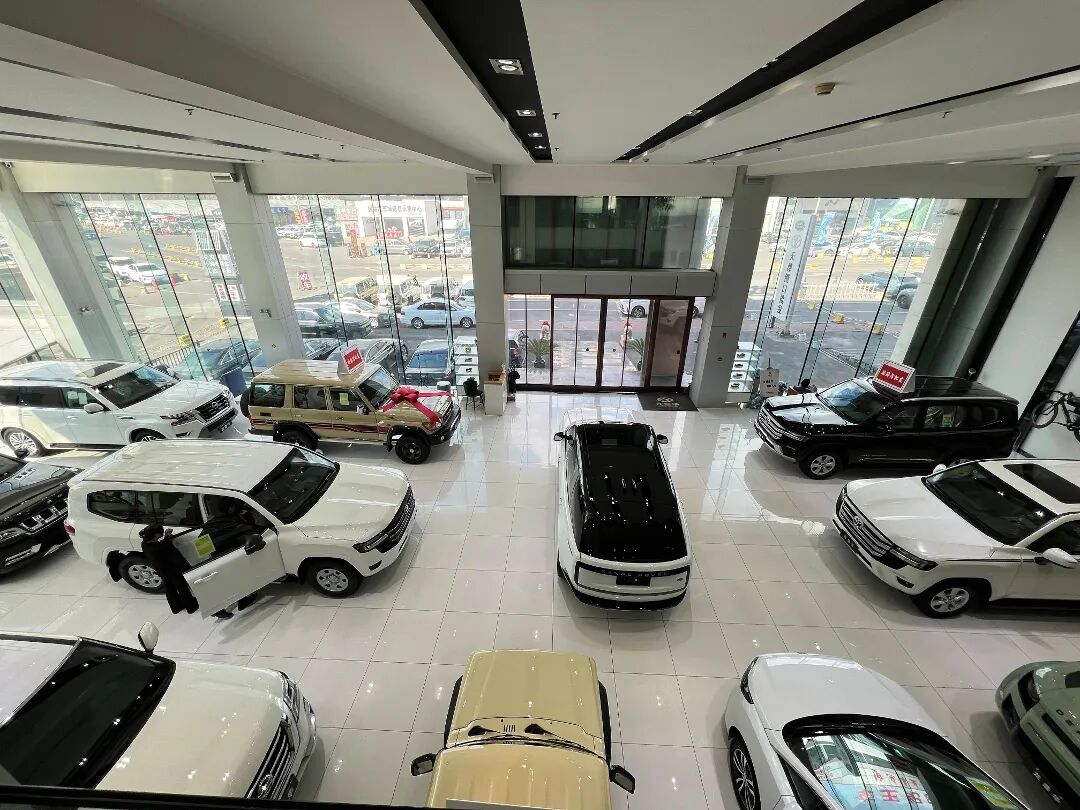
Based on the market's boom, it was even widely circulated in the industry that 1.43 million units was not the peak of demand, but merely a supply peak created by manufacturers desperately pushing inventory into the country.
But the good times did not last. Afterwards, apart from a brief breather in 2016–2017, import volumes moved downward all the way, until 700,000 units were sold in all of 2024, down 12% year-on-year; 480,000 units in 2025, down another 32% year-on-year. If short-term disturbances such as China-US trade friction and Red Sea shipping disruptions are smoothed out, imported cars have actually posted negative growth for eight consecutive years.
By this year, the imported car market has not recovered but declined further. In the first nine months, only 290,000 units were sold, with average monthly sales of just over 30,000 units, and only 21,000 units in September. And if you look at retail sales, the last time they fell below 20,000 units was February 2020.
Looking at sales by brand, most imported car brands have seen considerable declines.
Among mainstream BBA, Audi sold 24,000 fewer units, Mercedes-Benz sold 24,000 fewer units, and BMW sold 16,000 fewer units. The three BBA brands alone sold 63,000 fewer units in total, accounting for 77% of the decline in the entire imported car market. Their declines were 41.7%, 44.4%, and 28.9%, respectively.
Second-tier imported luxury brands did not escape either. Land Rover sold 3,082 fewer units in September, a drop of 58%; Volvo sold 5,013 fewer units, down 43.4%; Cadillac sold 2,784 fewer units, down 30.8%. The worst was Jaguar: it sold 1,937 units in September last year, but only 6 units this year—a decline of 99.7%, which can almost be regarded as the brand's substantial exit from China's import channels.
Lexus, however, is something of an "exception" in the imported luxury camp. In 2025, it held its base with 184,000 insurance retail units, actually edging up 2% year-on-year, accounting for 37.6% of the imported luxury car share. In September this year, Lexus sold 4,258 fewer units, a decline of 27.3%.
Compared with peers, Lexus's decline is already very resilient, because in September its share of the luxury car market was 8.3%, 0.4 percentage points higher than last year—purely because others fell harder.
In the ultra-luxury camp, in September, seven ultra-luxury brands including Bentley, Rolls-Royce, Ferrari, Lamborghini, and Maserati sold a combined total of only 221 vehicles in China, 216 fewer than last year—a drop of 49.4%.
Among them, Maserati sold 17, Lamborghini 21, Ferrari 22, and Bentley 99; none broke 100 units in a single month. Porsche was slightly more respectable, but in the first nine months it delivered only 21,000 vehicles in China, down 33% year-on-year.
It is worth noting that today's imported car market is almost entirely propped up by luxury cars. Imported cars from non-luxury brands such as Volkswagen, Renault, and SEAT have shrunk to a negligible level.
Why imported cars have fallen to this extent is something anyone can say a few words about.
Some say it is because consumers no longer worship badges, and young buyers look at intelligent experience rather than imported sentiment.
Some say it is because imported cars have stood still on electrification: in the first nine months, imported pure electric passenger cars fell 27%, plug-in hybrids fell 54%, and the only gainer was non-plug-in hybrids, up 15% year-on-year.
Others say it is because foreign brands' volume models have successively been localized, directly undermining the cost-effectiveness of pure import versions.
But from a global perspective, the decline in imported car performance is not only occurring in China.
GTAIC data shows that over the past 12 months, US passenger car import value fell 21.88% and import volume fell 21.7%; in the first half of the year, US pure electric vehicle import value was halved. ACEA statistics show that in the first half of 2026, global new car registrations fell 4.9% to 35.7 million units, with China's market decline of 23.2% as the main drag.
02 Demand Has Not Disappeared—It Has Simply Found Another Outlet
However, it should be made clear that the imported car tide has receded, but the people who want to buy a good car—a good car with face—or rather this demand, have not disappeared. And this demand is the windfall placed before domestic high-end brands.
Judging from data released by manufacturers, NIO delivered 37,400 vehicles in September this year, of which the NIO brand itself had 21,300 insurance registrations, up 55.3% year-on-year; Li Auto delivered 31,800 vehicles in September, with cumulative deliveries of about 290,000 in the first nine months; Xiaomi Auto had about 40,000 insurance registrations in September, with SU7 steady at 15,700 and YU7 exceeding 11,000.
In terms of price, NIO's average transaction price in the second quarter was 406,000 yuan, and in July it further rose above 430,000 yuan. At this price level, it is already in direct competition with the Mercedes-Benz E-Class and BMW 5 Series, and this upward movement in price bands is also appearing in other domestic car brands.
Looking further up, the ultra-luxury price band above 800,000 yuan used to be the private domain of Bentley, Rolls-Royce, and Maybach. Now many independent brand models have also appeared there.
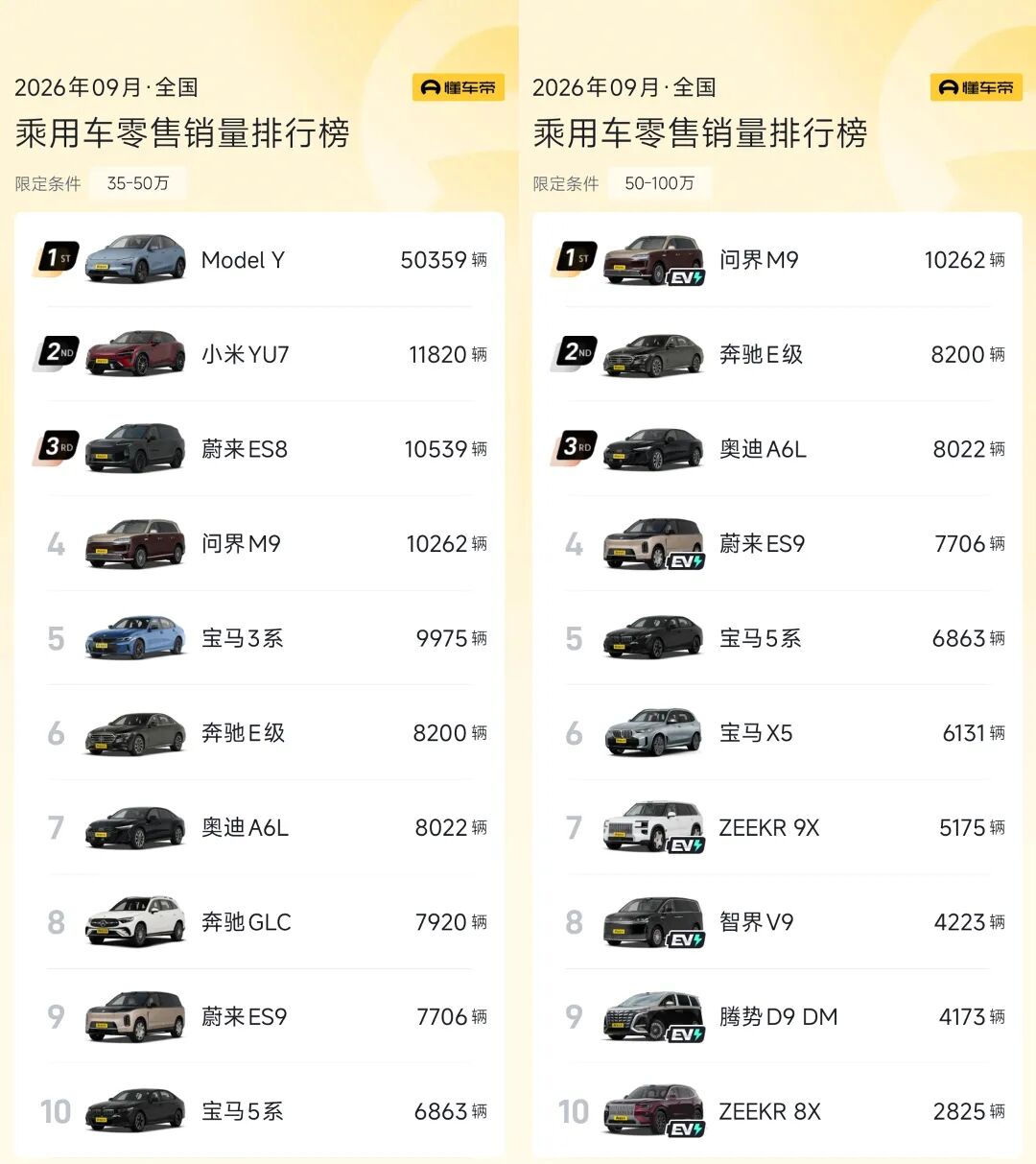
Specifically, in September, the Yangwang U8L sold 169 units in a single month, the U8 sold 71 units, and the Yangwang brand had cumulative sales of more than 3,000 units in the first nine months; NIO ET9 had cumulative deliveries of 880 units in the first nine months; Denza N8 had cumulative sales of 25,000 units in the first nine months, firmly establishing itself in the 300,000-yuan-class SUV market.
Admittedly, these numbers still lag behind traditional luxury brands, but it is important to know that five years ago, it was unimaginable for independent brands to dare to touch the million-yuan market.
And with the collective efforts of major independent high-end models, the market share of independent brands has climbed to 71.8%. The 300,000–500,000 yuan price band has been redefined by NIO, Li Auto, Zeekr, Yangwang, and Denza with air suspension, lidar, high-end intelligent cockpits, and other "former million-yuan-class configurations."
But then again, catching the windfall and truly swallowing this wealth are two different things.
First, domestic high-end brands have stacked configurations aggressively in recent years, but in slow-building areas such as build consistency, long-term reliability, and chassis refinement, early models still have a perceptible gap compared with the decades of accumulated foundation of BBA. Many product details can be understood and forgiven at the 300,000-yuan price level because of cost-effectiveness, but at 600,000 or 800,000 yuan, consumers' tolerance will clearly drop significantly.
At the same time, the badge is something many imported luxury cars have accumulated over a hundred years. Mercedes-Benz's luxury, BMW's driving, and Lexus's reliability have been fed by the word-of-mouth of generation after generation of owners. In comparison, NIO's battery swapping, Li Auto's family label, and Xiaomi's tech persona are building their own brand narratives, and they still need more time to catch up in brand power.
In addition, channels and after-sales also pose stricter tests for luxury. Although imported luxury cars are declining, the infrastructure in core cities nationwide—authorized systems, body and paint centers, courtesy car services, door-to-door pickup and delivery—is already in place. Domestic high-end brands are expanding quickly, but service network density, technician training, spare parts response speed, and especially coverage in third- and fourth-tier cities still need time to be completed.
So rather than saying domestic high-end cars have ushered in an opportunity to replace imported luxury cars, it is better to say they have only obtained an admission ticket. The high-end market vacated by imported cars will not automatically become cake for independent brands.
The windfall is right before their eyes, and whether they can catch it ultimately still depends on product strength—and on time.
Responsible editor: Li Sijia Editor: He Zengrong

THE END
-
![]()
When Every Company Dons the AI "Hat"
-
![]()
Toy Giant ZURU Moves China HQ to Shenzhen's China Resources Tower with 30,000 sqm Lease
-
![]()
SDD Spec-Driven Development Tutorial — The More Features You Add, the More AI Starts "Making Things Up"
-
![]()
Xpeng MONA's Three Models Overlap in Price Range of 119,800 to 176,800 Yuan, Beginning to Compete with Themselves
-
![]()
Avatr Cancels Launch Event: Carmakers Spend 8.12 Million Yuan on a Grand Show, Yet 87% of New Cars Peak in Their First Month
-
![]()
XPeng Robotaxi Cleared for Full-Area Demonstration Operations in Guangzhou — the Real Test Has Only Just Begun
-
![]()
BYD Enters the Million-Employee Era: The World's Largest Automaker by Headcount
-
![]()
Tesla's Q3 Earnings: Profits Halved, Yet the Stock Rose—Here's Why