Annual Sales Target of 800,000? Xiaomi Auto Has Me Sweating
 10/30 2026
 409
To be honest, as a latecomer among new car-making forces, if I had to sum up Xiaomi Auto's current sales performance in two words, in Car Quick Review's view, "stunning" would be no exaggeration at all.
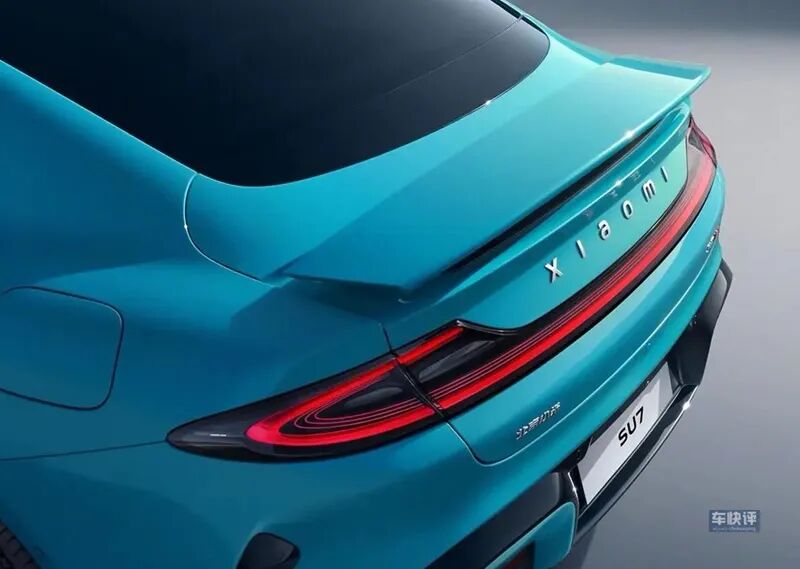
Take the Xiaomi SU7 and Xiaomi YU7, for example. These two models should be the only Chinese-brand all-electric sedan and all-electric SUV priced above 200,000 yuan whose sales can surpass the Tesla Model 3 and Tesla Model Y. At the same time, the Xiaomi SU7 and Xiaomi YU7 are, or once were, the sales champions among domestic mid-to-large sedans and mid-to-large SUVs—a testament to genuinely strong capabilities.
Not only that, but in September, Xiaomi Pengcheng's two newly launched models, the Pengcheng N70 and Pengcheng N90, both entered the top ten sales rankings for domestic mid-to-large and large SUVs. According to the official diagnosis, sales of these two extended-range hybrid SUVs from Xiaomi should grow steadily in the coming months.
However, just recently, a piece of news about Xiaomi Auto published online made Car Quick Review break into a sweat for Xiaomi Auto. What exactly is the situation?
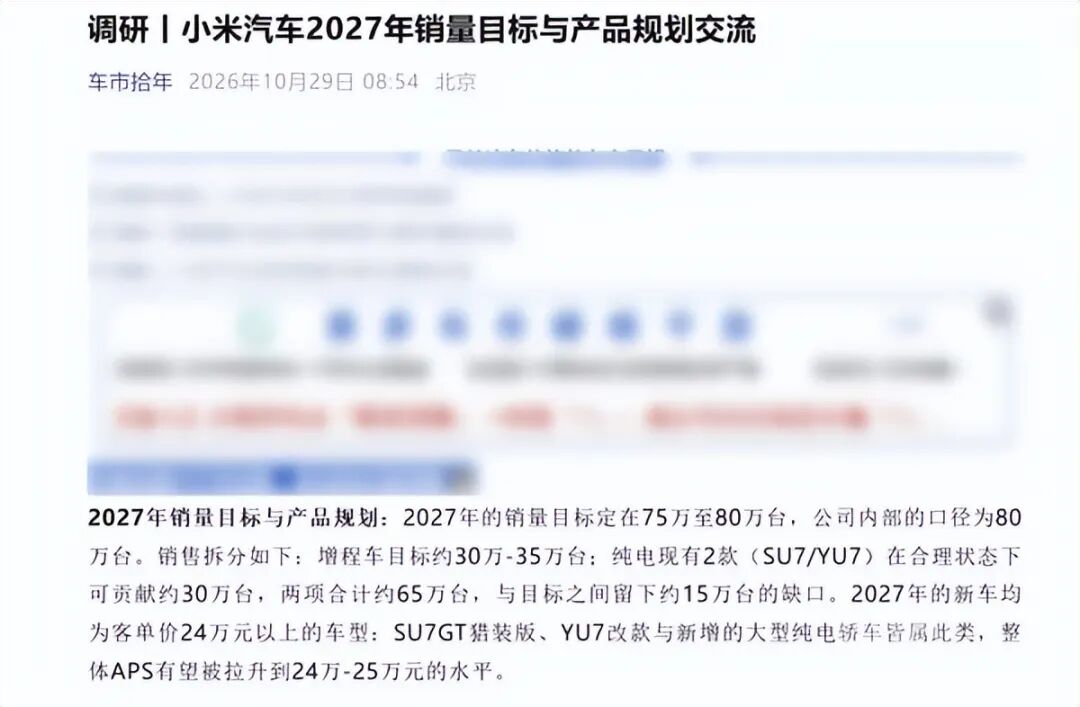
The matter began when a WeChat official account posted that Xiaomi Auto's 2027 sales target and capacity planning set the sales target at 750,000–800,000 vehicles. Of these, sales of the Xiaomi SU7 and Xiaomi YU7 are estimated at 300,000 vehicles, and sales of the Pengcheng N70 and Pengcheng N90 are estimated at 300,000–350,000 vehicles. The remaining sales task will be divided among new cars Xiaomi Auto launches afterward.
According to the plan, in 2027 Xiaomi will launch models including the SU7 GT shooting brake version, the new Xiaomi YU7, and a large all-electric sedan. This large all-electric sedan is said to have a length of more than 5.2 meters and a wheelbase of about 3.1 meters, feature L3-level autonomous driving redundancy, and will also be equipped with a digital steer-by-wire chassis, active steering, and active suspension. The Pengcheng extended-range hybrid series may also see new models launched.
According to previous reports, Xiaomi's all-electric series may also launch all-electric models such as the SU3 and YU5 priced under 200,000 yuan, but whether they will go on sale in 2027 is still uncertain. The YU9, priced above 500,000 yuan, will also go on sale by 2028 at the latest.
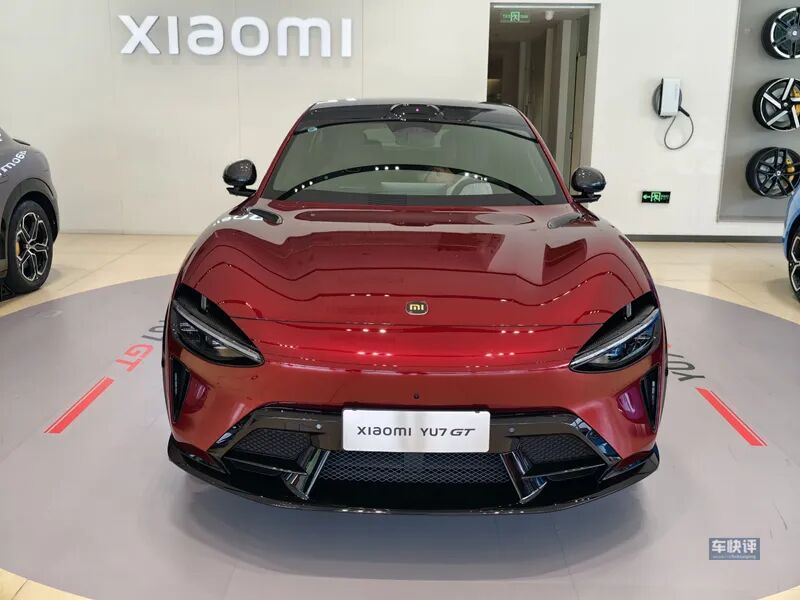
From the above, we can draw the conclusion that in 2027 and 2028, Xiaomi Auto's product matrix will be further improved. This can also be seen as a major product year for Xiaomi Auto, especially 2027.
But here comes the question: launching many new cars does not necessarily have a direct relationship with good sales. In other words, even if Xiaomi Auto launches multiple new cars in 2027, it cannot guarantee 100% completion of the 800,000 annual sales target. A brief analysis follows.
In 2024, Xiaomi Auto's full-year sales target was adjusted from 300,000 to 350,000 vehicles, and ultimately Xiaomi Auto's full-year sales in 2025 exceeded 410,000 vehicles, overfulfilling the annual sales task. In the new car-making force sales rankings, it ranked fourth, second only to XPeng.
Faced with such good sales results, Xiaomi Auto Chairman Lei Jun confidently set a 2026 annual sales target of 550,000 vehicles for Xiaomi Auto. If judged by the sales performance in the second half of 2024, Xiaomi Auto should be able to complete the 2026 sales target of 550,000 vehicles.

But the actual situation is that, judging from Xiaomi Auto's market performance in recent months, it is clearly lacking in staying power. Although the Xiaomi SU7 is still the sales champion among mid-to-large sedans, its sales have continued to decline. And after the Xiaomi YU7 set a historic monthly sales high of more than 39,000 vehicles last December, it has also seemed unable to keep up this year.
In the sales data for the past six months, the Xiaomi YU7's highest monthly sales was in June, with 14,300 vehicles sold. Sales in April and May both fell below 10,000 vehicles.
In the first nine months of this year, Xiaomi Auto's cumulative sales were only 286,500 vehicles, a target completion rate of 52%. Even with the support of the two new cars, the Pengcheng N70 and Pengcheng N90, for Xiaomi Auto to complete the remaining 263,500 vehicles in sales in the final three months, the possibility is almost zero.
Having read this, how likely do you think Xiaomi Auto is to complete next year's 800,000 sales target? Leave a comment in the comment section to interact.
Copyright statement: This article is original by Car Quick Review. Please contact us for authorization to repost. Reposting without permission is strictly prohibited, and any form of plagiarism or misappropriation of text and images is forbidden, otherwise legal liability will be pursued. Some images in the article are from the internet, and the copyright belongs to the original authors. If your work is used, please contact us to claim remuneration or request deletion.
-
![]()
When Every Company Dons the AI "Hat"
-
![]()
Toy Giant ZURU Moves China HQ to Shenzhen's China Resources Tower with 30,000 sqm Lease
-
![]()
SDD Spec-Driven Development Tutorial — The More Features You Add, the More AI Starts "Making Things Up"
-
![]()
Xpeng MONA's Three Models Overlap in Price Range of 119,800 to 176,800 Yuan, Beginning to Compete with Themselves
-
![]()
Avatr Cancels Launch Event: Carmakers Spend 8.12 Million Yuan on a Grand Show, Yet 87% of New Cars Peak in Their First Month
-
![]()
XPeng Robotaxi Cleared for Full-Area Demonstration Operations in Guangzhou — the Real Test Has Only Just Begun
-
![]()
BYD Enters the Million-Employee Era: The World's Largest Automaker by Headcount
-
![]()
Tesla's Q3 Earnings: Profits Halved, Yet the Stock Rose—Here's Why